
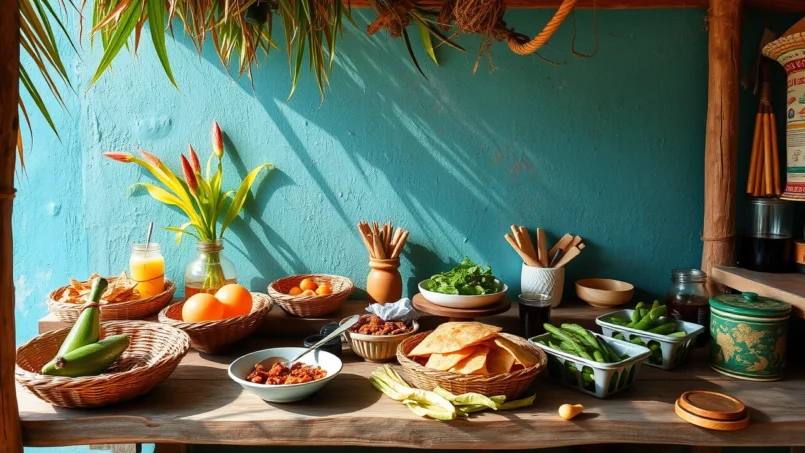
 Published on and written by Cyril Jarnias
Discovering the cuisine of Belize is about much more than learning a few local recipes. It is entering a genuine living laboratory where Mayans, Garifuna, Creoles, Mestizos, British, Chinese, Indians, and Mennonites have woven, generation after generation, a creolized cuisine deeply connected to the land, the sea, and the seasons. For an expat, knowing what to eat, where to buy, how to behave at the table, and which dishes to choose based on the region completely transforms the experience of living there.
Understanding Belize’s culinary melting pot
Belize is a small country of approximately 400,000 to 450,000 inhabitants, about the size of New Jersey or Wales, located on the northeastern coast of Central America. Although officially English-speaking, daily life functions in a ballet of languages: English, Kriol (Creole), Spanish, Garifuna, and several Mayan languages. This blend is reflected on the plate at every meal.
Belizean cuisine is a unique blend of Mayan, Mestizo, Creole, Garifuna, Chinese, and Mennonite influences. Each community has contributed its ingredients and techniques, such as corn and cacao from the Maya, cassava and plantain from the Garifuna, or Indian curries. This fusion creates a ‘trans-cultural tapestry’ where history, environment, and innovation meet in every dish.
For an expat, this means that an ordinary lunch can already be a history lesson: a plate of rice and beans cooked in coconut milk (Creole and Caribbean) accompanied by chicken marinated in red recado (Mayan and Spanish), served with a cabbage salad with mayonnaise (British), and spiced with a habanero sauce by local icon Marie Sharp’s.
Even though dishes now circulate among communities, it remains useful to recognize a few major culinary “families.” They structure restaurant menus, street stalls, and party buffets.
Mayan heritage: the realm of corn, recado, and cacao
The Maya, present in the region since at least 1500 BCE, shaped the country’s food foundation. Corn, considered sacred, is at the heart of their cuisine, along with the “Three Sisters”—corn, beans, and squash—complemented by chili peppers.
Their techniques—drying, smoking, cooking in banana leaves—are still omnipresent. Masa (corn dough), recado pastes (red, white, or black), and chaya leaves remain staple ingredients.
In Mayan-inspired households and some restaurants, you’ll find:
– Hot drinks based on masa, like atole
– Tamales cooked in banana leaves, sometimes enriched with chaya
– Complex soups like caldo, chilmole, or rellenos negro and blanco
– Meat dishes marinated in citrus and slow-cooked, like cochinita pibil or poc chuc
– Preparations based on ground squash seeds, like sikil pak
To experience Mayan culture practically, cooking workshops and “bean-to-bar” cacao experiences are offered in towns like San Ignacio, Punta Gorda, Hopkins, or Placencia. These activities allow participants to get hands-on with traditional techniques, such as grinding corn or cacao on a metate, cooking over a wood fire, or preparing recado paste.
Garifuna cuisine: cassava, plantain, and Caribbean Sea fish
The Garifuna, recognized by UNESCO for the richness of their intangible heritage, are descendants of African and Carib populations who settled on the Caribbean coast. Arriving in Belize in the 19th century, they developed a cuisine strongly marked by the coast, cassava, and coconut.
Their repertoire rests on a few pillars: grated and transformed cassava into dry, crisp bread (ereba), boiled and mashed green bananas and plantains, whole fish cooked in fragrant coconut milk. The iconic dishes every expat should know are:
– Hudut: Large pieces of fish stewed in a coconut milk sauce, served with a mashed plantain puree, sometimes a mix of green and ripe
– Sere: Fish soup with coconut milk and green plantain
– Bundiga: Green banana and coconut milk fritters
– Gari or gungude, plantain and coconut porridge for breakfast
– Cassava bread, an almost sacred staple of the Garifuna table
In Hopkins or Dangriga, participate in authentic experiences where you can pound plantain, grate cassava, and cook a *hudut* (fish stew). The culinary experience concludes with a shared meal, accompanied by the traditional rhythms of *punta* drums.
Creole (Kriol) cuisine: comfort food with coconut milk
Creole culture formed from the encounter between British colonists and enslaved Africans. Its cuisine, widespread throughout the country, is often what foreigners first identify as “the” Belizean cuisine.
The signature dish is rice and beans, so central it’s considered the national dish. Rice and red or black beans cook together in a broth flavored with coconut milk, almost always served with:
– Stewed chicken, colored with red recado
– Or baked chicken, marinated with the same spices
– Sometimes boil up: an assortment of tubers, eggs, fish, or pig’s tail, covered in a spicy tomato sauce
Creole breads—creole bread, johnny cakes, fry jacks—structure breakfast, often accompanied by fried beans and cheese. The small savory pies, meat pies, reflect the British influence in a Belizean version, much spicier than their European equivalents.
Mestizo and Hispanic-Central American cuisine: fried corn, black soups, and ceviche
The Mestizos, heirs to Spanish-Mayan mestizaje, are demographically dominant in the north of the country. Their eating habits are closer to those of the Yucatán and Central America, with a strong presence of corn in the form of fried or cooked masa.
In the markets of Corozal, Orange Walk, San Ignacio, or Belize City, expats encounter very quickly:
Discover a selection of traditional dishes and delicious street food, from different Central American cultures.
Puffed corn cakes, topped with chicken, avocado, and pickled red onion.
Fried turnovers stuffed with fish or beans.
Crispy tortillas, refried beans, grated Dutch cheese, and fresh vegetables.
Thick, Salvadorian-inspired griddle cakes, stuffed with cheese, beans, or meat.
Soups hold an important place: escabeche, a broth of onions and chicken in vinegar; chimole (or black dinner), a thick soup colored with black recado, with chicken and hard-boiled eggs. Ceviche, made from fish, conch, or shrimp marinated in lime juice, has become a staple throughout the country.
Indian, Chinese, and British influences
Indian immigration has primarily left its mark through the use of curries, often creolized with coconut milk. Chicken curry with coconut milk is common on family tables and in some small restaurants.
Chinese families, very present in retail, have popularized fried rice, “Chinese fry chicken,” and some stir-fried dishes, while also managing a large part of the supermarket offerings. Thus, one often eats “Chinese-style” fried chicken, served with fries or rice.
The British legacy, finally, is more visible in pastries and beverages: rum-soaked black fruit cake for holidays, bread pudding, hot cross buns at Easter, creamy potato salad as a side for grilled meats, and of course rum and Belikin beer at the adult table.
Meals, rhythms, and table codes: what an expat needs to know
In Belize, days are organized around three main meals, on a rhythm close to North America, but with certain cultural peculiarities that an expat benefits from adapting to.
In the morning, one “drinks tea,” an expression that actually refers to the entire breakfast. This meal can be very simple—bread, flour or corn tortillas, cereal—or hearty, with eggs, fried beans, local cheeses, fry jacks, johnny cakes, and sometimes meat. Coffee, tea, milk, cocoa, malted drinks like Milo or Ovaltine, and orange juices accompany the table.
At noon, life stops for a substantial family meal, considered a communion, with dishes like rice and beans with chicken, onion soup, chilmole, tamales, panades, or garnaches. Dinner is then lighter, often consisting of leftovers or a simple dish.
Socially, the table follows a few implicit rules. Arriving early at someone’s home is frowned upon; it’s better to be a few minutes late. One waits for the host’s invitation to sit and start eating. Dishes are willingly shared in the center, elbows remain off the table, hands visible. Leaving a small amount on one’s plate signifies being full. Eating with your hands for certain traditional dishes is common, and it’s generally appreciated to compliment the person who cooked.
When invited to a local’s home
Bringing a little something—flowers (except red), a beverage, pastries, or candy—is a welcome gesture. It’s expected that the foreigner at least tastes a little of what is offered, especially during parties or large family gatherings. Systematically refusing or criticizing a dish can be perceived as disrespectful, particularly in rural areas or within very close-knit communities.
Outside, in restaurants, service may seem slow to someone coming from countries with fast table turnover. People here often speak of ‘Belizean Time,’ a more relaxed relationship with time. Ordering a Belikin while waiting for your plate is part of the ritual.
Belizean Time
Tipping and the bill
Belizeans do not systematically leave a tip, but it is expected that an expat or foreign visitor will do so. In bars and restaurants, 10 to 15% is appreciated, preferably given directly to the person who served you. Similar amounts generally apply to guides, taxi drivers, and culinary tour operators.
The must-know classics (and to order often)
In a country where cuisine is an identity marker, a few dishes serve as a “common language” between communities. Mastering them—even just as a guest—helps one feel at home quickly.
Rice and beans and stew chicken: the inseparable duo
Rice and beans is the starting point for almost everything. Unlike the very similar “beans and rice” (where rice and beans are cooked separately), here the two simmer together with coconut milk, salt, sometimes herbs or garlic. Served with a stewed chicken generously flavored with red recado, you get what many describe as the Creole “Sunday dinna,” even though it’s eaten all week.
Belizean breakfast: tortillas, fry jacks, and meat pies
At breakfast, expats quickly discover an assortment of hearty options: puffy fry jacks like cushions, to break open and fill with beans, eggs, or cheese; somewhat dense johnny cakes, close to a dinner roll; flour or corn tortillas fresh off the comal. Meat pies, small turnovers filled with spiced meat, are enjoyed at any hour but serve as a highly prized morning snack in town.
Street food: garnaches, salbutes, panades, tacos
The best culinary entry point for a newcomer is often the street. Stalls and small bars offer, for a few Belize dollars, an array of small preparations based on fried corn or corn dough.
A simple table helps navigate the information presented.
| Specialty | Base | Typical Topping / Composition | Where it’s often found |
|---|---|---|---|
| Garnaches | Fried, crispy corn tortilla | Refried beans, cabbage or onion, grated Dutch cheese, sometimes ketchup and hot sauce | Markets, city stalls, festive evenings |
| Salbutes | Slightly puffed corn cake | Shredded chicken, cabbage, tomato, pickled red onion, sometimes avocado | North of the country, San Ignacio, Orange Walk markets |
| Panades | Fried corn dough turnover | Fish, chicken, or beans, served with a vinegared onion sauce | Everywhere, often in the evening |
| Tacos | Small soft or slightly grilled corn tortilla | Stewed chicken or pork, cabbage, onion, habanero sauce | Orange Walk (very renowned), morning markets |
To these classics add pupusas (of Salvadorian origin but very present), dukunu (sweet corn and coconut dough cooked in a leaf), and numerous burrito variants, often filled with stewed chicken, beans, and fresh vegetables.
Fish and seafood: living with the reef
No point in Belize is more than 60 km from the coast, and the coral reef—the second largest in the world—structures both the landscape and the diet. Conch, shrimp, reef fish, and lobster hold a central place in the economy and on restaurant menus.
Expat seafood enthusiasts will notably encounter:
– Conch fritters, fritters of chopped conch in a spiced batter, very popular as an appetizer
– Fish ceviche, conch or shrimp, marinated in lime juice with onion, tomato, cilantro, and chili
– Grilled lobster or lobster tacos during the open season
– Fish or conch soups in coconut milk, like the Garifuna fish sere
Here, the calendar of the sea dictates the menu. The seasons are strictly regulated to preserve resources:
| Seafood Product | Approximate Season Opening | Approximate Closing | Remarks |
|---|---|---|---|
| Conch | October 1st | End of June (often closes early around end of May) | Fishing sometimes closes earlier if quotas reached |
| Lobster | June 15 | Mid-February | Gives rise to the big Lobster Fests on the coast |
| Wild Shrimp | Mid-March | Mid-July | Outside this period, mostly farmed origin |
| Nassau Grouper | Early April | End of November | Protected breeding season (Dec.–March) |
For an expat, remembering these periods not only allows for choosing fresher and tastier dishes, but also participating in preservation efforts by avoiding consumption of species during breeding seasons or protected ones (sea turtles, nurse sharks, goliath grouper, parrotfish, and other reef fish).
Grocery shopping when you move: learning to “hunt” for your food
The biggest culture shock for many expats doesn’t come from what’s on the plate, but from the way of shopping. Forget the single supermarket where you find everything, all the time. In Belize, grocery shopping is more of a coordinated circuit: Chinese grocery stores, fruit stands, butchers, informal fishmongers, and sometimes farm deliveries.
Chinese supermarkets, Belizean grocery stores, and specialty shops
Most basic food stores are run by Chinese or Taiwanese families. These shops, often simply called “Chinese stores,” sell an assortment of imported products (cereals, cookies, canned goods, snacks, sodas, household products) and a small selection of fresh produce (milk, some vegetables, eggs, frozen meats).
Imported products there are significantly more expensive than local equivalents, as they include sales tax (12.5%) and customs duties that can reach 20% or more. Belizean supermarkets like Brodie’s in Belize City or Belmopan offer an experience closer to what North Americans or Europeans know, with more stocked aisles and a bit more signage, but the principle remains: stock fluctuates, and a product seen today can disappear for months.
On Ambergris Caye, San Pedro concentrates several major stores—Super Buy, Caye Mart, Walk-Mart, Publix, Island City, Marina’s—complemented by specialty shops like The Greenhouse, focused on more “health” products and gluten-free options, or The Farmhouse Market for farm products.
The logic for an expat is to identify the purpose of each address:
– One or two “general” supermarkets for staples and non-food items
– A market or fruit and vegetable stands for freshness
– A butcher or a poultry brand (Caribbean Chicken, Quality Poultry)
– Possibly a more specialized shop for organic products, targeted imports, or dietary items
Markets and stands: real freshness is outside
The most appetizing fruits and vegetables aren’t found in refrigerated aisles, but on stalls lining the streets, covered markets, and wooden shacks. In San Ignacio, the large Saturday market becomes a condensed version of the country: Mennonite farmers with dairy and cheese, Mayan families with corn and herbs, tropical fruit vendors from all districts.
In coastal villages like Hopkins, Dangriga, or Placencia, delivery days (often Tuesday and Friday) are not-to-be-missed events: vegetable trucks arriving, freshly stocked stalls, informal lines of regular customers. Going in the morning maximizes chances of finding nice avocados, intact mangoes, fragrant cilantro, and juicy limes.
An overview of what you pay, on average, for basic products helps with orientation (prices in Belize dollars, 2 BZD = 1 USD):
| Product | Indicative Price | Comment |
|---|---|---|
| Bananas | 7 for 1 BZD | Ultra-affordable snack everywhere |
| Tomato | ~2.5 BZD / lb | Slightly more expensive off-season |
| Avocado | 1.5–3 BZD each | Very seasonal (June–Sept.) |
| Mango | 1–2 BZD each | Abundance in season (May–Aug.) |
| Whole chicken | ~2.9 BZD / lb | From Caribbean Chicken or Quality Poultry |
| Medium shrimp | ~19 BZD / lb | Price varies by coast and season |
| Lobster (tail) | ~20 BZD / lb | During open season only |
Tropical fruits are particularly abundant: pineapples, papayas, watermelons, soursop, craboo, sapodillas, mamey, starfruit, local plums, golden plums (ambarella), guavas, etc. The peak fruit season generally runs from May to August, but the country produces fruit year-round thanks to its different microclimates.
Meat, dairy, and bread: how to adapt your habits
The meat aisles in supermarkets don’t necessarily resemble those in many expats’ home countries. Meat is mostly sold frozen or in refrigerated trays. Beef, from different breeds and farming methods, is often leaner and firmer, so it needs slow cooking or generous marinating. Pork, on the other hand, often surprises with its flavor.
Major local brands like Caribbean Chicken and Quality Poultry serve the entire country and sometimes have their own outlets. In some areas, expats prefer to order directly from small farms (buffalo, free-range chickens, etc.) or artisanal butchers.
Regarding dairy, Western Dairies dominates the market for milk, yogurt, and ice cream. Fresh milk exists, but ultra-pasteurized milk in cartons (like “La-la”) is more common and practical. Local cheeses, often called “Dutch cheese,” resemble some European semi-hard cheeses. Liquid cream or “half-and-half” remain rarer; many get around this by cooking with evaporated milk or cream cheese.
Bread, finally, is everywhere: large industrial slices, Creole bread, buns, johnny cakes. In several towns, bakeries—French, American, or local—offer croissants, bagels, pastries, and more sophisticated breads, but their production remains limited and they must be consumed quickly, as the heat shortens the shelf life of any bakery product.
Water, hygiene, and food safety: basic rules
Access to drinking water is improving but remains unequal by region. In large cities like Belize City or San Ignacio, tap water is treated and considered drinkable by national standards. However, in many villages and rural areas, the supply comes from wells, rainwater cisterns, or rudimentary systems, with highly variable chlorination and microbiological control rates.
Over one-third of water systems tested in rural areas show fecal coliforms.
The consequence for an expat is quite simple: in the city, many trust tap water for cooking but use filtered or bottled water for drinking or brushing their teeth as a precaution; in rural areas or on poorly serviced small islands, bottled water is the rule, even for brushing teeth. In all cases, it’s recommended to ask for advice from long-term residents (locals or expats) and your accommodation.
Regarding food, the famous rule “boil it, cook it, peel it, or leave it” remains entirely valid. Washing fruits and vegetables yourself with safe water, avoiding ice cubes of unknown origin in less touristy areas, and favoring street stalls frequented by Belizeans, where food turnover is rapid, significantly reduces the risk of stomach trouble. Cases of traveler’s diarrhea, hepatitis A, or typhoid exist, even if most expats avoid them with a few precautions.
Learning by cooking: workshops, tours, and experiences for expats
One of the best ways to get comfortable with local cuisine is to get your hands dirty. The country has seen a proliferation in recent years of cooking classes and culinary excursions designed for visitors, but perfectly suitable for newly arrived residents.
The following overview gives an idea of what is offered, providing a view of the different available options or services.
| Experience | Location | Main Content | Interest for an Expat |
|---|---|---|---|
| Garifuna Cultural & Culinary Experience | Hopkins | Preparation of Garifuna dishes (hudut, cassava), discovery of plants, drums and songs | Understand a key culture of the southern coast, learn to handle cassava and plantain |
| Maya Brunch Experience | Lina Point Overwater Resort | Basic Mayan cuisine, collective brunch, live music | Get familiar with corn, recado, and leaf-cooking techniques |
| Belizean Food Experience | San Pedro | Preparation of “classic” Belizean dishes in a family kitchen | Ideal for gaining confidence with rice and beans, stew chicken, fry jacks |
| Villa Massis Classes | Near San Ignacio | Classes focused on rice and beans, stew chicken, fry jacks with farm products | Very useful for anyone settling in the interior of the country |
| Taste Belize Tours | Placencia | Various classes (Creole, Garifuna, Maya and chocolate), farm and spice garden visits | Anthropological view of cuisine, perfect for those wanting to understand the “why” behind dishes |
| San Antonio Women’s Cooperative Cooking Class | San Antonio Village (Cayo) | Grinding corn on a metate, tortillas, tamales or caldo, traditional coffee | Authentic rural immersion, excellent for an expat settling in Cayo |
| Blancaneaux Lodge Farm-to-Fork | Cayo | Harvesting from organic garden, class with chef, sample menu including salbutes, chilmole, ceviche, cassava cake | “Farm-to-table” approach Belizean style, useful for those wanting to cook local and seasonal |
These experiences have several virtues: they provide recipes, of course, but above all, they teach where to procure certain ingredients, how to recognize good recado, how to adjust the heat of a wood fire, or how to use chaya or cassava safely. For an expat who wants to move beyond restaurants only, they are valuable shortcuts.
Festivals and gastronomic events: living to the rhythm of the seasons
Living in Belize also means tuning into the festive calendar, where several events highlight key products. These are opportunities to understand the intimate relationship between agriculture, fishing, culture, and cuisine.
Among the most significant: the events that changed the course of history.
Discover the cultural and culinary richness of Belize through its festivals dedicated to emblematic products, celebrating Mayan, Mestizo, and Caribbean traditions.
Celebrate cacao and Mayan tradition in Punta Gorda with demonstrations, tastings, and special menus around this ‘food of the gods’.
San Pedro, Placencia and Caye Caulker celebrate the opening of lobster season with grills, ceviches, tacos, and Caribbean music.
In Crooked Tree, taste wines, jams, and savory dishes dedicated to the cashew nut and its fruit.
Explore dozens of local mango varieties and their uses, from chutneys to ice creams.
Celebrate corn, the pillar of Mayan and Mestizo cuisine, with cultural presentations and culinary demonstrations.
In the Toledo district, discover Indian roots and curry dishes highlighting turmeric.
For an expat, these festivals are also idea labs: you discover how to transform products seen at the market, you taste unexpected combinations (cashew wine, craboo or soursop ice cream, turmeric bread, etc.), and you spot producers and artisans you can then find throughout the year.
Drinking in Belize: beers, rums, coffees, and tropical juices
No culinary exploration would be complete without a look at beverages. Here, the landscape is dominated by a few national players and a profusion of homemade products.
The emblematic beer is Belikin, brewed near Belize City, in several versions: lager, stout, seasonal variants like a chocolate stout. The bottle deposit system is very common: you return your empty crates to be able to buy new ones. Microbreweries like Hobbs also introduce some craft beers.
Rums are distilled from local cane, with brands like One Barrel or Caribbean Rum. They are often enjoyed in punches with pineapple or mango juice. A typical cocktail to try is the ‘Panty Ripper,’ a mix of coconut rum and pineapple juice, found on most menus.
Wines, on the other hand, are either imported (at high prices) or come from a tradition of homemade “fruit wines”, made from cashew, sorosi, starfruit, sea grape, rice, or other local fruits. You can find them at fairs, in some villages, or by word of mouth.
In daily life, fresh juices and smoothies are an integral part of the table: orange, watermelon, pineapple, papaya, banana, soursop, mango, lime. Coffee, grown notably in the highlands, is increasingly appealing, with brands like Gallon Jug or Mayan roasters offering quality shade-grown coffee.
Integrating through the table: some strategies for expats
Settling in Belize involves building new food routines. A few simple approaches facilitate adaptation.
First, accept the idea that the menu will follow the seasons and availability more than in a hyper-importing country. Planning meals based on what’s found at the market—mangoes and avocados in the rainy season, citrus in the dry season, fish based on fishing trips—rather than the other way around, allows for saving money and eating better.
For better quality and product availability, prioritize direct purchases from producers and vendors at markets. Take time to talk with them to learn their delivery days, the availability of seasonal products like fish or conch, and to build relationships of trust, for example with a Mennonite butcher or a dairy cooperative. This approach is often more advantageous than buying everything at the supermarket.
Learning a few words in Kriol or Spanish helps enormously, especially for asking for specific cuts of meat, red or black recado, or for getting an explanation on how to cook an unknown product. A simple “Weh di gowan?” (How’s it going?) can be enough to start a conversation.
Finally, it’s useful to think about your cooking based on the most accessible local ingredients: rice, beans, corn, plantain, chicken, eggs, coconut, tropical fruits. Rather than trying at all costs to recreate imported dishes that are very costly in ingredients, many expats end up developing a hybrid cuisine, mixing techniques from home and local products, much like Belizeans themselves have always done.
Conclusion: experiencing Belize through your stomach
Discovering the local gastronomy of Belize, for an expat, is not limited to making a list of “dishes to try.” It is accepting to enter a culture where the table is a place of connection, where at noon shops and schools close for a family meal, where a mango or cashew festival says as much about the country as its Mayan sites or seabeds.
Belize’s culinary diversity, ranging from Creole stews to Mayan tamales, Garifuna specialties, and local fruits, offers expats a unique opportunity to integrate and engage in dialogue with local communities through every meal.
Knowing where to buy, how to respect the seasons and table rules, which dishes to choose by region, and taking the time to cook alongside those who master these skills is what transforms a stay into a true local life. In Belize, gastronomy is not a tourist backdrop: it’s the beating heart of a society where people continue, day after day, to tell each other stories… over a plate of rice and beans or a steaming bowl of caldo.
Disclaimer: The information provided on this website is for informational purposes only and does not constitute financial, legal, or professional advice. We encourage you to consult qualified experts before making any investment, real estate, or expatriation decisions. Although we strive to maintain up-to-date and accurate information, we do not guarantee the completeness, accuracy, or timeliness of the proposed content. As investment and expatriation involve risks, we disclaim any liability for potential losses or damages arising from the use of this site. Your use of this site confirms your acceptance of these terms and your understanding of the associated risks.

Cyril Jarnias is an independent expert in international wealth management with over 20 years of experience. As an expatriate himself, he is dedicated to helping individuals and business leaders build, protect, and pass on their wealth with complete peace of mind.
On his website, cyriljarnias.com, he shares his expertise on international real estate, offshore company formation, and expatriation.
Thanks to his expertise, he offers sound advice to optimize his clients' wealth management. Cyril Jarnias is also recognized for his appearances in many prestigious media outlets such as BFM Business, les Français de l’étranger, Le Figaro, Les Echos, and Mieux vivre votre argent, where he shares his knowledge and know-how in wealth management.





