
 Published on and written by Cyril Jarnias
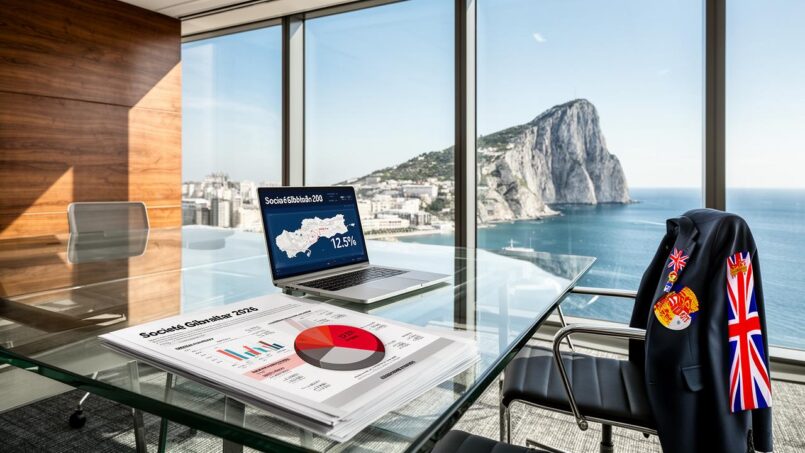
In the shadow of the Rock, a 2.6-square-mile micro-society is redefining its economic, fiscal, and social model. Gibraltar Society 2026: 12.5% CT UK territory is no longer just a marketing slogan for investors seeking an attractive corporate tax rate. It is the entry point to a much broader narrative: that of a British Overseas Territory adapting to the end of the “all-Europe” era, the new international fiscal environment, and the pressures of demographics and land scarcity.
In 2026, Gibraltar faces several major challenges: an increase in the corporate tax (CT) rate, the implementation of a treaty with the European Union, a digital boom, a tight real estate market, and the preservation of its strong cultural identity. This territory thus illustrates how a small entity can evolve among large-scale players.
A Services Micro-State Caught Between the Atlantic, Spain, and International Standards
Wedged at the southern tip of the Iberian Peninsula, facing the strait that connects the Atlantic and the Mediterranean, Gibraltar is a place of many peculiarities. Politically, it remains a British Overseas Territory, with a Constitution (2006) granting it broad internal autonomy, provided London retains control over defense, foreign policy, and certain aspects of security.
This is the territory’s area in square kilometers, a large portion of which is not suitable for construction.
Socially, the equation is simple: a core of approximately 34,000 residents, supplemented daily by nearly 15,000 cross-border workers coming from Spain. This mechanism is vital for running an almost entirely service-based economy which concentrates over 30,000 jobs, with unemployment considered among the lowest in the world.
From 12.5% CT to 15% CT: Gibraltar Caught by the Global Tax Revolution
For a long time, the brand “Gibraltar Society 2026: 12.5% CT UK territory” projected the image of a territory where corporate tax was significantly lower than European standards. That time is over, even though local taxation remains aggressively competitive.
A Gradual Shift Toward the OECD Floor
The move was planned in two stages. In August 2021, the government of Fabian Picardo raised the CT rate for the first time in years: from 10% to 12.5%. The argument was already twofold: to fill part of the post-Covid budget deficit, while preparing Gibraltar for the wave of reform driven by the OECD’s Inclusive Framework.
Then, starting July 1, 2024, another step: the standard rate rises to 15%. This pivot is not isolated: it aligns Gibraltar with the global minimum set by the BEPS project’s Pillar 2, the reform pushing for a global minimum tax of 15% to limit base erosion and profit shifting. By complying, Gibraltar secures a form of respectability in multilateral forums, while maintaining a tax environment more attractive than the European average.
A System That Remains Territorial and Selective
This CT increase does not change the system’s key principle: taxation is territorial. In other words, only profits arising in or effectively connected to Gibraltar are taxed. For services or online gaming groups, the flow structure and the concept of “substance” thus become central, especially as the financial regulator’s supervision tightens.
In certain sensitive segments, the government applies a 20% surcharge. This concerns companies supplying water, electricity, fuel, telecommunications, and those abusing a dominant position. For telecoms, only the portion of profits from non-telecoms activities remains taxed at the ordinary 15% rate, allowing for a modulation of the tax pressure.
The government justified these trade-offs as a compromise between fiscal responsibility and maintaining a comparative advantage. Before 2024, the sequence was also accompanied by targeted support measures: accelerated depreciation for equipment, super-deductions for job creation, tax bonuses for training or international marketing.
Direct Taxation, Transaction Tax, and Absence of VAT
The other red line drawn is the absence of VAT. Gibraltar will not join the EU VAT system; this is one of its legacies from when it was in the Union with numerous opt-outs (outside CAP, outside Common Fisheries Policy, outside customs union, no VAT). To articulate the future treaty with the EU and the free movement of goods, however, the government introduced a 15% “transaction tax” on goods, set to be rolled out gradually over two years.
Dubai’s tax system relies on a strategic combination: a “transaction tax” that functions like a consumption tax without adopting the European VAT model, a territorial corporate tax, and a key-exemptions ecosystem. These exemptions include no capital gains tax, wealth tax, inheritance tax, or annual property-type “council tax.” Ultimately, this structure makes the total cost of holding assets significantly lower than in major European capitals.
A simple table allows one to visualize the evolution of the CT and the logic of the phased increase:
| Effective Date | Standard CT Rate | Utilities / Fuel / Telecoms Rate | Main Context |
|---|---|---|---|
| Before August 1, 2021 | 10% | 20% | Pre-BEPS model, very low taxation |
| August 1, 2021 | 12.5% | 20% | Anticipation of OECD minimum, Covid backdrop |
| July 1, 2024 | 15% | 20% | Alignment with the 15% global floor |
A Services-Based Economic Model Under Land Constraint
Gibraltar has no agriculture, heavy industry, or natural resources. Its GDP – around £2.9 to 3.1 billion between 2023 and 2025, or over £75,000 per capita – is almost entirely driven by services. The authorities describe an economy “firing on all cylinders,” with a budget projected to be in surplus again by 2025/26, following the massive deficits linked to Covid (up to £158 million in one fiscal year).
Malta’s economy rests on four main sectors: financial services, online gaming, tourism, and shipping and maritime activities. These pillars are complemented by a particularly dynamic construction and real estate sector, which also contributes to the archipelago’s economic growth.
| Main Economic Pillar | Weight and Key Characteristics in 2026 |
|---|---|
| Financial Services | Growth, access to the UK market, strong presence in car insurance and asset management, UK-aligned regulation |
| Online Gaming / Remote Gaming | 25 to 30% of GDP, about one third of tax revenue, 3,400 to 3,800 jobs |
| Tourism and MICE | Approximately 20 to 25% of GDP, over 10 million visitors, £276 million in spending in 2024 |
| Shipping / Maritime / Bunkering | Major Mediterranean refueling port, Strait traffic ~60,000 ships/year |
This fabric relies heavily on cross-border labor: over half of the total workforce resides in Spain, mainly in the Campo de Gibraltar area. This is what makes the issue of the border and the agreement with the EU absolutely structuring for Gibraltarian society.
The Treaty with the EU: A Faded Border, Relocated Schengen, and Sought Stability
Since Brexit, Gibraltar has been in a unique situation: outside the Union and excluded from the EU-UK trade agreement, it had to negotiate a custom-tailored treaty with Brussels, but under the British flag. After years of talks, a major political agreement was announced in June 2025, then the full text – over 1,000 pages – was published in February 2026.
From Physical Barrier to Integrated Labor Market
One of the most visible changes for the population is the promise of the disappearance of the border as it is known. The treaty provides for the dismantling of the fence at the La Línea checkpoint and the end of systematic checks on people and goods at that crossing point. In practice, the border area becomes a buffer zone without checks or customs.
Schengen checks are “relocated” to the airport and port: Spanish officers will conduct entry checks into the Schengen area there, similar to the model of French police at London’s St Pancras station. Concurrently, Gibraltar – or the UK on its behalf – will conduct its own immigration checks, creating a sort of superimposed double border.
The main operational benefits of the new regulations for cross-border flows.
Over 15,000 cross-border workers (more than half of the active workforce) will no longer face delays caused by vehicle or pedestrian queues, especially during periods of intense heat.
End of variable inspections and formalities. Goods will benefit from a specific customs regime designed to avoid systematic checks.
Targeted Exemptions and Sovereignty Guarantees
The treaty goes further than simple cross-border facilitation. Gibraltarian residents are to be exempt from the ETIAS travel pre-authorization system, and the famous “90 days in 180” rule effectively no longer applies for regular travel. Bases also exist for direct flights between Gibraltar and EU cities, operated by both British and European airlines.
In return, the text includes a set of commitments on “level playing field” issues: state aid, taxation, labor, environment, anti-money laundering, police and judicial cooperation, and protection of cross-border workers’ social rights. The introduction of the 15% transaction tax fits precisely within this adjustment logic.
On the political front, London and Gibraltar insist that sovereignty is not on the table. A “double lock” is written into the treaty: none of its articles affect, directly or indirectly, the question of the territory’s status, and British military installations remain entirely under London’s control.
Governments of London and Gibraltar
Transition and Implementation: A Technical and Political Endeavor
The path is not fully paved: ratification by the European Parliament and the British Parliament, CRaG procedure in London, amendable motion in Gibraltar’s Parliament, finalization of an internal UK-Gibraltar “concordat” setting out how to manage the agreement. In the meantime, a transitional regime extends access for Gibraltarian financial service providers to the UK market via the future Gibraltar Authorisation Regime (GAR) until the end of 2026.
Technically, switching to this new border regime involves removing the EES infrastructure meant to collect biometric data at the EU’s traditional external borders and setting up temporary facilities to ensure fluidity until permanent sites are built. Here again, coordination with Madrid is continuous.
For the economy and local society, the stakes go far beyond the issue of queues at La Línea checkpoint: it’s the potential transformation of the area into a labor and services market integrated with the neighboring Spanish city and the entire Campo de Gibraltar.
Financial Services and Tech: A Regulated, Yet Highly Competitive Hub
Despite leaving the EU, Gibraltar has taken care to stay within the lines of UK and international standards. The financial sector has a dedicated regulator, the Gibraltar Financial Services Commission (GFSC), required by law to align its requirements with those of the UK in areas covered by ex-European law.
The GFSC’s 2023-2026 strategic plan focuses on three axes: deploying the GAR for UK market access, risk-based supervision, and digital transformation. Concurrently, the territory makes anti-money laundering a priority, with a new National Risk Assessment planned for 2025 and an objective to exit EU and FATF grey lists. The overall aim is to prepare a solid case for the 2027 MONEYVAL assessment.
Several recent regulatory waves contribute to this tightening: a Consumer Duty regime effective in 2024, inspired by outcomes-based approaches, 2025 rules on the restricted promotion of highly speculative products to retail customers, and a pre-approval mechanism for dividend distributions by e-money institutions and DLT companies, implemented in 2026.
Despite this strengthening, attractiveness remains real: the corporate tax, even at 15%, remains low relative to the region, the law is common law, procedures are relatively agile, and access to the UK market via the GAR is an asset that no other European micro-financial center offers.
DLT, Crypto-Assets, and Innovation: Gibraltar, a Regulatory Laboratory
One of the most notable aspects of Gibraltar’s positioning is its approach to managing the blockchain wave. As early as 2018, the territory adopted a specific regime for providers using Distributed Ledger Technology (DLT), now integrated into the Financial Services Act 2019. Rather than multiplying detailed rules, the regulation is based on ten high-level principles: adequate financial resources, good governance, protection of client assets, robust anti-money laundering measures, appropriate systems and controls.
DLT Providers and VASPs (Virtual Asset Service Providers) are subject to GFSC authorization, with a three-stage process including a pre-submission phase and sometimes a pilot on a restricted activity. Fundraising through token issuance must be pre-registered and comply with LCB-FT obligations, even though the territory has not chosen a formal regulatory sandbox.
Thanks to this framework and territorial taxation, several key players – crypto banks, exchange platforms, institutional intermediaries – have set up all or part of their operations in Gibraltar. Alone, DLT providers and VASPs manage over £3.75 billion in client assets.
The government anticipates an extension of the DLT regime to all digital asset providers in 2025–2026, in order to integrate the latest international requirements without breaking the attraction effect.
Online Gaming, a Key Sector Under Extraterritorial Tax Pressure
Remote gaming remains the other major engine of Gibraltar Society 2026: 12.5% CT UK territory, to the point of representing between a quarter and nearly a third of GDP and roughly one third of state revenue. Global groups like Entain (Ladbrokes, Coral), bet365, 888 Holdings, BetVictor, or William Hill steer a significant part of their operations from the Rock, benefiting from over twenty years of accumulated expertise, a specialized regulator, and a talent pool drawn from across Europe.
The overall effective tax burden for some online gaming houses, combining local Gibraltar tax and UK levies.
To remain competitive, Gibraltar is adapting its gambling legislation: a new Gambling Act introducing finer license categories, increased substance requirements, a more risk-based approach, creation of a specialized appeals tribunal. The accumulated credibility as a pioneering e-gaming jurisdiction, combined with the stability of local law and the prospect of the EU treaty, favors the maintenance of a powerful ecosystem, despite a less favorable global environment.
Hyper-Tight Real Estate Market: Between Post-Covid Correction and Supply Shock
In such a confined territory, housing quickly becomes the nerve of social life and the political climate. After a spectacular price surge between 2020 and 2022 – increases of 30 to 50% in one to two years for many segments, sometimes double pre-pandemic levels for some properties – an adjustment began in mid-2022.
Between mid-2022 and late 2024, average prices fell by about 15 to 25%, without returning to their pre-boom levels. Luxury seafront apartments, notably in Ocean Village or Queensway Quay, held up better; conversely, an oversupply emerged for micro-apartments (studios, small one-bedrooms) with the delivery of developments like E1.
In 2026, the median price of apartments in Gibraltar is about £750 per square foot, reflecting a balanced real estate market.
A simplified overview of residential values in 2026 allows one to gauge this “micro-Monaco” effect:
| Property Type / Location | Typical Price Range |
|---|---|
| Studio | £165,000 – £250,000 |
| 2-Bedroom Apartment | £300,000 – £680,000 |
| 3-Bedroom Semi-Detached House | Over £1,000,000 |
| Penthouses / Luxury Villas | £1,000,000 – Over £5,000,000 |
| Median Apartment Price (All Gibraltar) | ≈ £750/sqft |
| Median House Price (All Gibraltar) | ≈ £820/sqft |
The tension is also evident in transaction statistics: total sales value dropped from about £366.5 million to £202.2 million on the latest known period, while the number of transactions fell from 638 to 344. Less volume, prices stabilizing without crashing: the image of a market finding a floor, awaiting a new cycle.
Over 2,000 residential units were in the pipeline at the start of 2026 to meet needs, including via state-aided housing.
Faced with an influx of around 3,000 residence applications in one year, about three times the usual average, the government finally decreed in autumn 2025 a temporary freeze on new residence applications, officially to manage infrastructure and public services, and respond to fears of a relocation wave from the UK. This suspension, still in effect in early 2026, created a climate of uncertainty for private recruiters and some unease for candidates who had already arrived to settle.
A Rental Market Driven by Digital and Finance Salaries
In parallel, the rental market proves to be extremely tight and structurally strong, fueled by the thousands of international employees in online gaming, financial services, tech, and business services. In practice, only 70 to 100 properties for rent are available at any given time for the entire territory, ensuring very low vacancy periods, often limited to one or two weeks between tenants.
Maximum percentage increase in rents for large family apartments and in the most sought-after neighborhoods between 2025 and 2026.
Gross yields vary significantly by neighborhood: around 4.5 to 6% in Ocean Village, 5 to 6.5% in Queensway, 5 to 7% in the city center, 6 to 8% in Westside, 4 to 6% in the more residential South District. Projections continue to forecast a 5 to 10% increase in rents by 2027, a sign that land scarcity outweighs cyclical hiccups.
For low-income residents and workers, this rental inflation mechanically translates into moving further away across the border, where prices in La Línea can be 75 to 85% lower for equivalent size and comfort. This interplay of communicating vessels reinforces dependence on border fluidity and increases the role of cross-border workers in Gibraltarian society.
Massive Investment in Infrastructure and Digital
To absorb this growth while meeting sustainability imperatives, Gibraltar is heavily investing in its physical and digital infrastructure.
The Pelagos Data Centres project envisions a data center campus with a capacity of 250 MW, for an investment of £1.8 billion. Developed in five phases until 2033 on 20,000 m² near the port, it will create about 500 direct jobs. It aims to position Gibraltar as a key digital node in Europe, notably for AI, with an independent power supply and leisure facilities open to the public.
Concurrently, the authorities are rolling out a vast renovation and greening program: a green boulevard on Line Wall Road with a separated cycle lane, reconfiguration of Chatham Counterguard and Montagu Curtain into a leisure park, new cycle routes connecting Fish Market Lane, Market Place, and Europort Avenue, creation of additional green spaces at Queensway, modernization of the bus network – with new, high-frequency electric lines – and major sanitation works to secure the main collector under the old town’s ramparts.
These works are part of the Sustainable Traffic, Transport and Parking Plan, a strategy aimed at reducing car usage in a territory with limited space and high tourist pressure. Ultimately, they will improve public space with more pedestrian zones, walks on historic ramparts, playgrounds, and continuous cycle routes.
Healthcare and Education: A Welfare State at the Scale of a City
Despite its size, Gibraltar has developed a public service apparatus close to that of a small European state. In healthcare, the Gibraltar Health Authority (GHA) manages a universal system largely modeled on the British NHS, funded by a social contributions scheme (GPMS). Healthcare spending represents about 12% of GDP, a high level translating into a quality of care considered comparable to Western European standards.
St Bernard’s Hospital, opened in 2005 with 210 beds, offers medicine, surgery, trauma, pediatrics, and maternity services. It has two operating theaters, a day surgery unit, and rehabilitation services (hydrotherapy and cardiac rehab). However, some specialized care is provided by visiting consultants or delegated to facilities in Britain and Spain.
Access to the public system is reserved for residents under the local social security definition, with proof increasingly strictly requested. Visiting Britons can benefit from free emergency care for thirty days, provided they show a passport, while EU citizens use the European card (EHIC or GHIC) for temporary stays. Without recognized residence, private insurance remains essential, often provided by the employer. In this landscape, the private insurance sector – sometimes backed by major names like BUPA or AXA – naturally occupies a significant place.
Gibraltar follows the English model: free and compulsory schooling from age 4 to 16. The public system includes Lower/Upper Primary then Secondary, and leads to GCSE and A‑Level qualifications, facilitating access to higher education in the UK. A network of nurseries and childcare centers, partly private but overseen by the Education Department, complements the offering.
Students with special needs are supported by St Martin’s School and integrated support units (Learning Support Facilities) in several primary and secondary schools. Beyond secondary, Gibraltar College offers vocational and general courses, complemented by the University of Gibraltar, founded in 2015, accredited by the UK’s Quality Assurance Agency and a member of the Association of Commonwealth Universities. This institution plays a growing role in local training in business, education, history, natural sciences, and health, while leaving a significant part of higher education to take place at UK universities thanks to a public scholarship system.
Cultural Identity, Multilingualism, and Social Cohesion
Beyond tax and GDP figures, Gibraltarian society rests on a mixed identity, forged by centuries of Moorish presence (711‑1462), the Spanish period, coming under British sovereignty after Utrecht (1713), siege episodes, the evacuation of the civilian population during WWII, and the unilateral border closure by the Francoist dictatorship in 1969.
This history has produced a population where predominantly Gibraltarians of European origin – largely descendants of Italian, Portuguese, Maltese, British, or Genoese migrants – coexist with more recent communities from India, Morocco, or other EU countries. A 2012 census gave an emblematic snapshot: about 79% Gibraltarians, 13.2% other British, 2.1% Spanish, 1.6% Moroccan, 2.4% other EU nationals, and 1.6% “other.”
English is the official language and its growing dominance among the young favors English monolingualism. Older generations remain mostly bilingual English-Spanish. A unique local variety, Llanito, mixes English, Castilian, and sometimes Italian, Maltese, or Hebrew influences, reflecting the territory’s identity diversity.
Social norms value politeness, respect, friendliness, the importance of family, and a certain flexibility regarding time, close to Mediterranean culture. Mixed marriages – including with Spaniards, despite the hardening of anti-Francoist sentiments in the 20th century – have been and remain frequent, and marriage of foreign nationals in Gibraltar benefits from a relatively simple procedure, with few residency requirements.
Gibraltar’s cultural authorities promote a holistic approach to heritage, including monuments, language, traditions, folklore, and natural environment. International recognition of this rich heritage is symbolized by the inscription of the Gorham’s Cave Complex as a UNESCO World Heritage site in 2016, for its outstanding value attesting to Neanderthal presence.
The Gibraltar Heritage Trust, established in 1989, has made it its mission to involve citizens in built heritage preservation, heritage education, and the reuse of historical sites, with a 2025‑2028 strategic plan focused on education, community collaboration, and organizational resilience. Festivals punctuate the year – National Day, Jazz Festival, Dance Festival, Literature Week, International Film Festival, Calentita – and reflect a blend of British, Iberian, and Mediterranean culture.
Mass Tourism, MICE, and Social Sustainability
Gibraltar’s tourist appeal feeds on this density of stories and symbols. In 2023, over 10 million entries were recorded (excluding cross-border workers), including 5.6 million by road, hundreds of thousands by cruise, and about 200,000 by air. Tourist spending amounted to over £276 million in 2024, up 7.1% year-on-year, after a spectacular 63% rebound in 2022 post-Covid.
The majority of land-based excursionists are Spanish, followed by other Europeans and Britons. Visitors arriving by air are mainly British (nearly 90% in 2023), for short stays of about three days. Cruise passengers stop for duty-free shopping and a quick visit to the Rock, its nature reserve, and military tunnels.
While this windfall represents about a fifth of GDP, it also generates tensions: peak attendance concentrated in a few months, pressure on infrastructure, gentrification of some neighborhoods, coexistence between tourist flows and daily life. Aware of these challenges, the government seeks to better smooth attendance throughout the year via off-season events, attract more overnight stays – notably through the opening of new hotels in 2025‑2026 – and position Gibraltar in the MICE market, thanks to its air links with the UK, high security, and density of conference facilities.
The new terminal under construction aims to increase handling capacity beyond 300,000 annual passengers, combining investment in growth, flow optimization, and reduction of environmental footprint in collaboration with shipping companies.
A Society Under High Land Pressure, but with Political and Fiscal Levers
In 2026, therefore, Gibraltar Society 2026: 12.5% CT UK territory refers to a reality more complex than just the corporate tax rate question. The territory has agreed to progressively raise its CT to the global minimum of 15%, to create a transaction tax on goods, to strengthen its LCB‑FT arsenal, and to sign a treaty laden with commitments with the Union. In exchange, it consolidates its access to the UK market, secures a near-invisible border with Spain, strengthens the viability of an economic model based on services and high value-added, and improves its international standing.
With one of the highest population densities in the world, continuous demographic growth, the influx of cross-border workers, and an attractive economy, every decision regarding housing, infrastructure, or migration policy has immediate social repercussions.
The 2025 temporary freeze on residence applications is its silent equivalent: a strong signal sent to local voters concerned about the cost of living, but also notice to businesses and prospective settlers about the system’s saturation level. In the long term, Gibraltar’s ability to remain both an attractive business location, a high-performing digital hub, a sought-after tourist destination, and a livable community for its residents will depend on its capacity to orchestrate these tensions.
Gibraltar has so far prospered by combining the responsiveness of a small jurisdiction, the political protection of the United Kingdom, and attractive fiscal flexibility, all underpinned by strong cultural cohesion. Its model now faces new global challenges like the minimum tax, control of financial flows, and the ecological transition. This situation could make the territory an interesting laboratory for a small-sized society with disproportionate economic weight in the 21st century.
A heritage project or a question? Contact us now to speak with a wealth management expert.
Disclaimer: The information provided on this website is for informational purposes only and does not constitute financial, legal, or professional advice. We encourage you to consult qualified experts before making any investment, real estate, or expatriation decisions. Although we strive to maintain up-to-date and accurate information, we do not guarantee the completeness, accuracy, or timeliness of the proposed content. As investment and expatriation involve risks, we disclaim any liability for potential losses or damages arising from the use of this site. Your use of this site confirms your acceptance of these terms and your understanding of the associated risks.

Cyril Jarnias is an independent expert in international wealth management with over 20 years of experience. As an expatriate himself, he is dedicated to helping individuals and business leaders build, protect, and pass on their wealth with complete peace of mind.
On his website, cyriljarnias.com, he shares his expertise on international real estate, offshore company formation, and expatriation.
Thanks to his expertise, he offers sound advice to optimize his clients' wealth management. Cyril Jarnias is also recognized for his appearances in many prestigious media outlets such as BFM Business, les Français de l’étranger, Le Figaro, Les Echos, and Mieux vivre votre argent, where he shares his knowledge and know-how in wealth management.





