
 Published on and written by Cyril Jarnias
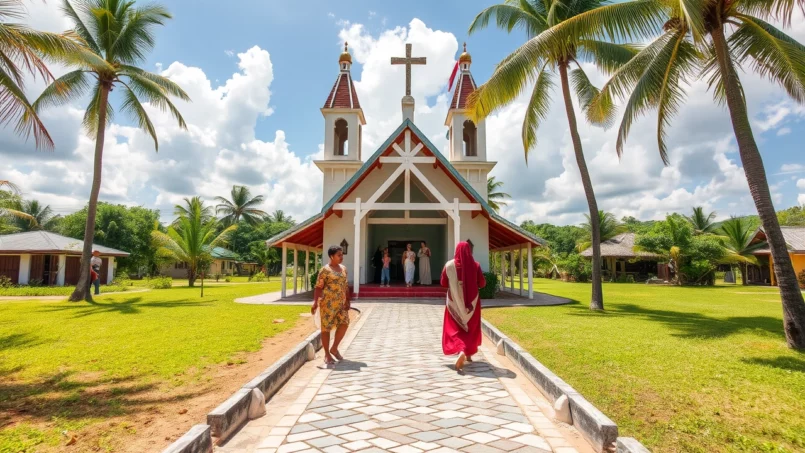
Moving to Belize means entering a country tiny in size but immense in religious and cultural diversity. For an expatriate, this mosaic can be fascinating… and disorienting. Between Catholic masses, evangelical services, Garifuna ceremonies with hypnotic drums, Maya spiritualities, and Mennonite rigor, religion profoundly structures social life, calendars, dress codes, and everyday relationships.
This guide aims to clarify Belize’s religious landscape and explain the expected attitudes from a foreigner to integrate without committing faux pas. The goal is not to adopt all religious practices, but to understand what is important and perceived as respectful by Belizeans, as well as what might shock them.
A Country Small in Size, Immense in Spiritual Diversity
Belize has just under 400,000 inhabitants, but hosts an impressive array of traditions: Catholics, Protestants of many denominations, German-speaking Mennonite communities, Garifuna and Maya spiritualities, Muslims, Hindus, Buddhists, Baha’is, Rastafarians… not to mention a growing proportion of people with no declared religion.
To grasp this balance, one only needs to look at recent figures. The table below summarizes the major religious families in 2022.
| Religious Category | Estimated Number | Share of Population |
|---|---|---|
| Christians (all denominations) | 244,855 | 61.6% |
| – of which Roman Catholics | 126,596 | 31.8% |
| – of which Protestants (total) | 113,782 | 29.8% |
| Other Religions | 25,116 | 6.3% |
| No declared religion | 123,372 | 31.0% |
| No response | 4,134 | 1.0% |
| Total Population | 397,483 | 100% |
The underlying trend is clear: Catholicism remains the largest denomination, but its share has been declining since the 1980s, even as the number of followers in absolute terms increases. In parallel, Protestant currents – often evangelical – have consolidated, and the “no religion” category has exploded, rising from 15.6% in 2010 to 31% in 2022.
A Dominant Yet Fragmented Christianity
For an expatriate, it is useful to know which Churches will structure their daily life the most, especially outside heavily tourist areas.
| Major Denominations (2022) | Estimated Adherents | Share of Population |
|---|---|---|
| Roman Catholic | 126,596 | 31.8% |
| Pentecostal | 36,459 | 9.2% |
| Seventh-day Adventist | 18,641 | 4.7% |
| Anglicans | 15,943 | 4.0% |
| Mennonites | 15,440 | 3.9% |
| Baptists | 14,108 | 5.6% (within total Protestant) |
| Methodists | 6,623 | 1.7% |
| Nazarenes | 6,568 | 1.6% |
| Jehovah’s Witnesses | 4,477 | 1.1% |
In practice, Christianity remains the backdrop of public life: most major public holidays are linked to the Christian calendar, a majority of public schools are managed by Churches, and many radio stations are owned by evangelical or Catholic groups.
In Ireland, where the Constitution guarantees freedom of religion and prohibits discrimination, interfaith tensions are rare. Mixed marriages, for example between Catholics and Anglicans, are common there, illustrating a sociability that extends far beyond established denominational boundaries.
Understanding Belize’s Religious Culture: Conservative but Tolerant
Belize is often described as broadly conservative. This translates into strong expectations regarding modesty, public behavior, and a certain reserve towards topics like homosexuality or public displays of affection.
For an expatriate, the implicit message is twofold: great freedom of belief, but a strong expectation of respect for local sensitivities.
Religious Freedom… and Social Responsibility
The Constitution guarantees individuals the right to practice the religion of their choice. Religious groups, if registered with the state, benefit from tax exemptions and can invite foreign religious workers with a specific status. The law even provides for respect for prisoners’ faith and a military chaplain.
In practice, this translates into: the implementation of concrete and effective solutions to achieve the set objectives.
The religious landscape is extremely diverse, including Hindu temples, Ahmadi mosques, Garifuna *dabuyaba*, and Mennonite colonies. Religious presence is strong in education, with most schools managed by Churches and the teaching of non-denominational spirituality classes. Furthermore, Churches participate directly in political life via a Senate seat allocated to the Council of Churches and the Evangelical Association.
For an expatriate, this means it is expected to respect this high visibility of religion in the public sphere, even if one considers oneself non-believing.
Conservative Social Norms
Belize aims to be welcoming, gentle in interactions, not inclined to direct confrontation. Yet, certain behaviors are poorly received, particularly in areas deemed “moral“:
Public displays of affection, even for heterosexual couples, are generally frowned upon and can provoke marked rejection for same-sex couples. It is also advisable to avoid very revealing clothing, especially for women, outside of beaches, as it is poorly perceived and can be openly criticized in places of worship like churches. Local society shows little favor towards homosexuality; there is no declared LGBT scene, nor bars or clubs specifically identified as such.
Nevertheless, the dominant tone remains tolerance in the Belizean sense: you will not be asked to adopt local beliefs, but it will be expected that you avoid unnecessarily offending social norms.
The Major Religious Families to Know
To understand local codes, it is useful to locate the main communities within the geography and history of Belize.
Catholicism: The Historical Backbone
Introduced by missionaries accompanying Spanish conquistadors as early as the 16th century, Catholicism was long hegemonic. It remains today the largest denomination in the country and still structures the social calendar: Christmas, Easter, but also a host of patron saint festivals, processions, retreats, and ‘revivals’ that mark the year.
Catholic parishes belong to the diocese of Belize City–Belmopan, with iconic churches like Holy Redeemer Cathedral or St. Martin de Porres in Belize City. Many priests now come from Guatemala or El Salvador, due to a lack of local vocations, but the churches remain hubs of social action, especially in poor neighborhoods marked by violence.
For an expatriate, the Catholic mass is often one of the most accessible contexts for discovering Belizean religiosity: familiar liturgy, generally welcoming atmosphere, attention to the disadvantaged. But participation assumes respecting dress and behavior codes that, even if not written in black and white, are well understood by the faithful.
Protestantisms: From Anglican Worship to Thriving Evangelicals
Protestantism arrived with British loggers in the 19th century, mainly in Anglican form. Today, Protestants represent nearly 30% of the population, but the landscape is fragmented: Pentecostals, Baptists, Adventists, Methodists, Nazarenes, independent evangelical groups…
Evangelical churches conduct ‘spiritual warfare’ campaigns against traditional Maya and Garifuna practices.
As an expatriate, attending an evangelical service is an interesting dive into a very expressive Christianity. But here again, implicit rules exist: modest clothing, restraint in phone use, respectful participation even if one does not share the beliefs.
Garifuna Spiritualities: Drums, Ancestors, and Syncretism
In the coastal villages of the south – Dangriga, Hopkins, Punta Gorda, Seine Bight, Barranco – the Garifuna presence is very strong. Their spirituality constitutes one of the most original religious universes of Belize, syncretizing Arawak, Island Carib, and African heritages.
The heart of this religion is the connection with ancestors, whose spirits (*gubida*, then *áhari*) watch over the living… provided they fulfill their obligations. A motto summarizes this spirit of reciprocity: “Au Bun, Amürü Nu” – “Me for you, you for me.”
The major ceremonies, like the Dügü, take place in a specific temple, the *dabuyaba*, and can last several days. Drums, songs, dance, communal meals, trances, and communication with spirits punctuate these rituals, sometimes combined with a Catholic mass or Marian prayers, a sign of an assumed syncretism.
For an expatriate, the possibilities for cultural discovery and the limits to respect regarding the sacred Dügü ceremony.
It is possible to be invited as an observer via cultural centers for activities like drum lessons or Garifuna cooking workshops.
Attending a Dügü is not a tourist act but an intimate religious ritual, often linked to an unresolved illness or family conflict.
One only attends upon personal invitation and by scrupulously respecting the discretion and seriousness required by the community.
Maya Religions: Between Popular Catholicism and Spiritual Revival
The Maya peoples of Belize – Yucatec, Kekchi, Mopan – mostly practice a Catholicism marked by devotions to saints, but some continue to maintain forms of traditional spirituality.
The term Costumbre is sometimes used to refer to these practices of devotion to the “Lords of the Earth”, ancestors, and nature entities, combined with the veneration of Jesus, the Virgin Mary, and saints. Rituals take place on hills, near springs, or in caves, with offerings of incense, copal, candles, sometimes chickens, cacao, or cane liquor.
In parallel, a current of “Maya spirituality” seeks to purge these practices of elements introduced by Spanish colonization and the Catholic Church. Some spiritual guides, for example, renounce the use of candles, seen as too associated with Catholicism, and claim direct inspiration from texts like the Popol Wuj.
For an expatriate, these universes generally remain less accessible: ceremonies are intimate, often in an indigenous language, and only open to a foreigner through strong bonds of trust. On the other hand, visiting archaeological sites like Caracol, Xunantunich, or Altun Ha gives a glimpse of the ancient Maya cosmology, where pyramids and caves were points of contact with the world of gods and ancestors.
Mennonites: Pacifism, Agriculture, and Sobriety
The Mennonite colonies – Spanish Lookout, Shipyard, Little Belize, Blue Creek, Upper & Lower Barton Creek, etc. – form another religious face of Belize. Arriving in large numbers in the 1950s–1960s from Mexico and Canada, they negotiated broad autonomy with the authorities: religious freedom, exemption from military service, agricultural land.
Today, they number about 15,000, nearly 4% of the population, and produce a considerable share of the chicken, milk, eggs, and cheese consumed in the country. The most traditional colonies are distinguished by simple clothing (long dresses, bonnets for women, overalls and hats for men), the use of Low German (Plautdietsch), and sometimes the refusal of electricity and engines.
Mennonites in Mexico
For an expatriate, their world is visible in dairy stores, carpentry workshops, and horse-drawn vehicles encountered in some rural areas. The colonies are not inherently hostile to visitors, but do not have a tourist reflex: one should enter discreetly, ask permission before photographing people, and respect their codes of modesty.
Muslim, Hindu, Buddhist, and Other Minorities
Belize is also home to small Muslim communities (about 0.1% of the population), Hindus, and Buddhists, mainly concentrated in Belize City, Belmopan, Orange Walk, and Corozal. Ahmadi mosques, a Baha’i temple, two Hindu temples, and a Buddhist temple attest to this diversity, discreet but real.
These minorities are free to practice, benefit from tax exemptions, and participate in public life through education (a Muslim primary school, for example) or through festivals like Diwali. For an expatriate, being invited implies the same reflexes as anywhere else: inquire about the dress code specific to the place of worship (head covering, removing shoes, gender separation, etc.) and behave with restraint.
Dressing for Places of Worship: Modesty as a Universal Language
In a tropical and relaxed country, the question of attire might seem secondary. Yet, it is one of the areas where misunderstandings between expatriates and Belizeans are most frequent, especially in church.
In public space, the norm is simple: lightweight, casual clothing suitable for the heat. On the beach, swimsuits and shorts obviously aren’t a problem. But, as soon as it comes to places of worship or rural villages, expectations tighten.
Whether it’s a Catholic mass in Belize City, a Pentecostal service in a Cayo village, an Adventist ceremony, or a small country temple, a few rules consistently apply:
– Modesty: shoulders covered, discreet necklines, skirts or dresses above the knee to be avoided, clothing neither too tight nor transparent.
– Simplicity: no flashy items, no provocative logos or polarizing slogans (political, alcohol, violent messages).
– Cleanliness: clean and well-maintained clothes, even if simple or inexpensive.
– Sobriety of accessories: light makeup, discreet jewelry; better to avoid eye-catching adornments likely to attract attention.
A good reference is to ask oneself if one would wear this outfit in a professional or semi-formal environment. If the answer is no, it’s probably not suitable for church.
What’s Often Accepted and What Almost Always Offends
In many modern parishes, especially in town, clean jeans with a modest top will be accepted without issue, as will appropriate sandals. On the other hand, a few elements are almost unanimously poorly perceived:
– T-shirts with large visuals or provocative messages,
– very short shorts,
– thin-strapped tank tops or bare backs,
– ripped, heavily distressed jeans,
– beach flip-flops, very sporty sneakers for a solemn service.
The following table provides a quick reference.
| Clothing Element | Generally Accepted | To Avoid in Most Churches |
|---|---|---|
| Tops with short sleeves | Yes, if shoulders covered and not tight | Tank tops, halter tops, bare backs |
| Bottoms (men/women) | Long pants, skirts/dresses knee-length+ | Short shorts, miniskirts |
| Shoes | Closed-toe shoes, appropriate sandals | Flip-flops, beach thongs, flashy sneakers |
| Jeans | Yes, clean and not distressed | Heavily ripped jeans |
| Colors | Neutral or soft tones, some color | Fluorescent or very loud colors |
| Jewelry/makeup | Discreet | Bulky, flashy, excessive makeup |
Some groups (for example, very conservative Mennonite communities or a minority of traditionalist parishes) impose stricter rules: prohibition of pants for women, requirement of head coverings for female attendees, prohibition for men to wear shorts or sneakers. In these cases, it’s better to ask a member of the community for advice before attending a service.
Tropical Climate, Comfort, and Layers
Belize’s climate is hot and humid, which sometimes complicates the “modesty + comfort” equation. The simplest solution is to opt for:
Prefer loose-fitting clothes in natural fabrics like cotton or linen, which are more breathable than synthetics. Adopt the layering system: a discreet tank top under a light, sleeved blouse, and keep a foldable scarf or shawl on hand to cover your shoulders if necessary.
This “layering” logic is practical for transitioning from a sunny street to a sometimes air-conditioned or simply cooler church.
Garifuna, Maya, and Other Specific Contexts
In a Garifuna Dügü or a traditional Maya celebration, dress codes relate more to respect for the sacred character and discretion than an explicit “charter”:
– choose sober, covering, and comfortable clothes to remain standing or sitting on simple benches for a long time;
– avoid any outfit that draws the eye, especially if you are one of the few foreigners present;
– do not imitate or parody local traditional garments (embroidered Maya dresses, Garifuna ritual attire) without being invited to do so.
In all cases, attentive observation of local participants remains the best guide.
How to Behave in Places of Worship: Expected Attitudes
Beyond attire, it is behavior that immediately signals whether an expatriate has understood the local codes.
Upon Entry: Discretion First
In most churches, it is normal to: respect the place and the people present, dress appropriately, respect moments of silence, and participate in songs and prayers.
– enter quietly or whispering,
– remove your hat (for men) if wearing one,
– avoid using your phone (silent mode mandatory),
– sit towards the back if arriving late, to minimize disturbance.
In some temples (mosques, Hindu temples), you will also need to remove your shoes. The good reflex: pause for a moment, observe what others do, and imitate.
During the Ceremony: Respectful Participation
Even if one does not share the faith of the participants, a few attitudes demonstrate basic respect:
It is important to follow the congregation’s postures (standing, sitting, kneeling) unless physically unable, maintain silence during services and prayers, and refrain from any photography or video recording without explicit permission, always avoiding flash.
In more expressive contexts (evangelical service, Garifuna ceremony), it is normal for the faithful to sing, dance, sometimes cry. As a foreigner, the important thing is not to mock, not to ridicule what one does not yet understand, and to avoid loud comments.
The Question of Photos: Always Ask
In Belize, the implicit rule is clear: one does not photograph people while they are praying or celebrating a rite without their explicit consent. This is especially true for:
Garifuna and Maya ceremonies, often linked to ancestors or illness, funerals and wakes, and moments of communion and confession, illustrate the diversity of ritual practices that strengthen social and spiritual bonds within communities.
When it comes to religious architecture (church interiors, statues, frescoes), check for “No photos” signs and, above all, avoid flash, which can damage artworks.
Experiencing the Religious Dimension Daily as an Expatriate
Understanding local religious practices is not only useful for “avoiding gaffes”. In Belize, religion permeates much of associative, educational, and festive life. Taking an interest in it often allows for better integration.
Integrating into a Parish or Community
In areas with many expatriates (San Ignacio, Belmopan, Belize City, Corozal, Placencia, Hopkins, Ambergris Caye…), several English-speaking churches are accustomed to welcoming foreigners, like some Catholic parishes or evangelical churches such as Calvary Chapel.
Participating can offer: new perspectives, enriching experiences, and collaboration opportunities.
– a social network beyond the expatriate circle,
– volunteer opportunities (youth work, distributions, social actions),
– a support framework in case of personal difficulties.
However, it is not mandatory: Belizeans judge not primarily by declared religion, but by behavior. A non-believing expatriate who is respectful of religious holidays, places of worship, and local sensitivities will be perceived positively.
Religious Holidays and Public Holidays: Calendar and Attitudes
Several national public holidays have a strong religious dimension, particularly Christmas, Easter, and Garifuna Settlement Day. These moments are an opportunity for an expatriate to observe how religious markers translate into conviviality: masses, family meals, music, dance.
Major celebrations offer a glimpse into the country’s cultural and religious diversity. At Christmas, religious services and gatherings allow one to experience Christian fervor. During Holy Week, public holidays are marked by Catholic processions and family gatherings. Garifuna Settlement Day, on November 19th, commemorates the arrival of the Garinagu with cultural celebrations and a strong spiritual dimension dedicated to ancestors.
For an expatriate, the reflex to adopt is simple: inform oneself about the religious significance of these dates, avoid planning noisy events contrary to the atmosphere of the moment (for example, a very boisterous party in front of a church on Good Friday), and accept that shops or services may operate at a slower pace.
Photography, Tourism, and Religion: Where to Draw the Line
Belize attracts visitors for its Maya ruins, sacred caves, Garifuna villages. Yet, many of these places remain spaces of religious practice – sometimes discreet – for local communities. The emblematic case is that of caves like Actun Tunichil Muknal, where human sacrifices took place in the past and which remain deeply charged with symbolism.
As an expatriate or long-term visitor, it is essential to properly prepare for your stay abroad. This includes managing administrative formalities (visa, residence permit), subscribing to suitable health insurance, understanding the local tax system, and adapting to the culture and customs of the host country. Anticipating these aspects facilitates integration and avoids unpleasant surprises.
– avoid reducing these places to an adventure backdrop or an “Instagram spot”;
– listen to local guides when they present the spiritual significance of sites, especially for the Maya;
– refrain from touching artifacts, taking natural elements, or improvising personal rituals alongside existing traditional practices.
This attitude of restraint is often greatly appreciated by local guides and inhabitants, who see in respectful curiosity a sign of consideration for their ancestors and beliefs.
Religion, Society, and Contemporary Issues
Understanding religion in Belize also means understanding how it intersects with sometimes difficult social realities: poverty, violence, inequalities, discrimination.
Churches Facing Crime and Poverty
Belize has a high homicide rate, particularly in some neighborhoods of Belize City. In this context, many parishes, especially Catholic and evangelical, are engaged in prevention, youth support, and mediation actions.
Initiatives like that of the St. Martin de Porres parish (vocational training, job placement, support for at-risk youth) illustrate this social role. Participating in or supporting these programs, as an expatriate, obviously assumes respecting the religious identity of the project, even if one does not personally adhere to it.
Diversity, African Roots, and Accusations of “Witchcraft”
Afro-Caribbean religious practices – Garifuna, Creole obeah, Rastafari – are sometimes at the heart of heated debates. Pentecostal churches run campaigns against what they call “demonic spirituality,” which can cause tensions and accusations of “devil worship” against certain communities.
For an expatriate, a respectful position consists in understanding and adapting to the local culture, learning the language as much as possible, observing social and professional codes, and interacting with humility and open-mindedness towards the host community.
– recognize the heritage and identity value of these practices for the concerned communities;
– avoid exoticizing or caricaturing them, whether through naive fascination (“black magic,” “voodoo”) or moral judgment;
– listen to the actors themselves define their practices, rather than projecting categories from elsewhere.
It is useful to keep in mind that the Garifuna, for example, have long been demonized – in colonial accounts, they were accused of cannibalism – and that their spiritual practices sometimes continue to be perceived through the prism of these prejudices.
In Summary: Reflexes to Adopt as an Expatriate
Belize offers a privileged field of observation for those interested in religions and their interactions with society. To live there serenely as an expatriate, a few pointers are enough to avoid most faux pas:
Consider every place of worship as a sacred space, where discretion, modest dress, and photographic restraint are expected. Social morality being rather conservative, adapt your public displays of affection and your attire, especially outside tourist areas. Freedom of religion is constitutional, but sensitivities are strong: criticizing or mocking others’ faith is very poorly received. To understand well, rely on the locals: ask them questions, seek advice on appropriate attire, and listen to their explanations about holidays and rituals.
Belize is often described as a ‘melting pot’ of cultures – Mestizo, Maya, Garifuna, Creole, Mennonite, Chinese, Indian, Lebanese – where each group celebrates its traditions within a generally peaceful framework. Understanding local religious practices is therefore much more than decoding a Sunday dress code: it is entering the intimacy of communities for whom faith remains, despite the rise of the ‘no religion’ category, a central way of inhabiting the world, connecting with ancestors, and building society.
For the expatriate ready to observe, respect, and learn, it is also a formidable gateway to deeper integration, beyond the simple postcard tropical paradise.
Disclaimer: The information provided on this website is for informational purposes only and does not constitute financial, legal, or professional advice. We encourage you to consult qualified experts before making any investment, real estate, or expatriation decisions. Although we strive to maintain up-to-date and accurate information, we do not guarantee the completeness, accuracy, or timeliness of the proposed content. As investment and expatriation involve risks, we disclaim any liability for potential losses or damages arising from the use of this site. Your use of this site confirms your acceptance of these terms and your understanding of the associated risks.

Cyril Jarnias is an independent expert in international wealth management with over 20 years of experience. As an expatriate himself, he is dedicated to helping individuals and business leaders build, protect, and pass on their wealth with complete peace of mind.
On his website, cyriljarnias.com, he shares his expertise on international real estate, offshore company formation, and expatriation.
Thanks to his expertise, he offers sound advice to optimize his clients' wealth management. Cyril Jarnias is also recognized for his appearances in many prestigious media outlets such as BFM Business, les Français de l’étranger, Le Figaro, Les Echos, and Mieux vivre votre argent, where he shares his knowledge and know-how in wealth management.





