
 Published on and written by Cyril Jarnias
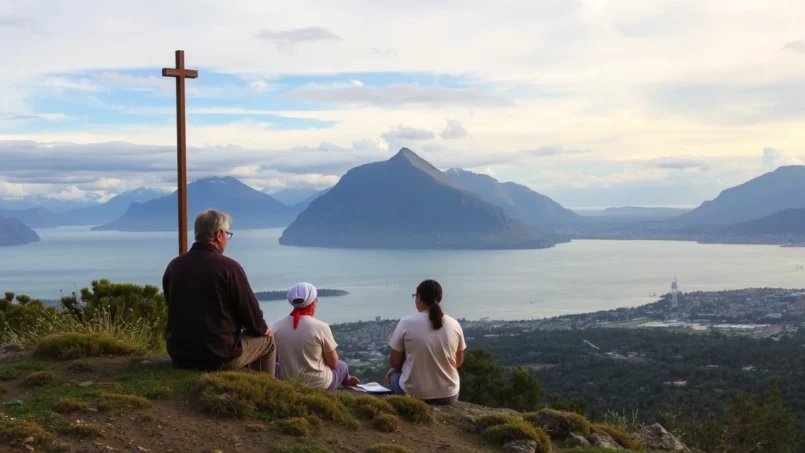
Moving to Tasmania means entering an island territory where ancient Christian traditions, growing Buddhist and Muslim communities, Indigenous spiritualities deeply rooted in the land, and a high number of people with no religion all intersect. For an expatriate, this landscape can be both stimulating and disconcerting: where to go to pray, how to behave in a temple or church, what does the connection to the land that Tasmanian Aboriginal people speak of really mean, and how to find your place when you are a believer… or not at all?
This guide provides essential reference points on demographics, places of worship, and etiquette to respect. It aims to help the expatriate respectfully participate in local life and, if necessary, seek social and psychological support from religious communities during their move.
An Atypical Religious Landscape: Tasmania, a “Majority No Religion” Land
Looking at the numbers, Tasmania stands out distinctly from the rest of Australia. The most recent census data shows a spectacular reversal compared to its very Christian past.
A Few Key Figures to Understand the Context
In about fifty years, the religious structure of Tasmanian society has shifted. The table below summarizes the major trends.
| Indicator (Tasmania) | 1971 | 2016 | 2021 |
|---|---|---|---|
| Share of Christian population | 88.7% | 49.7% | 38.4% |
| Share declaring “No religion” | 5.1% | 38.2% | 50.0% |
| Share of Non-Christian religions (total) | – | – | 4.5% |
| Hinduism | marginal | 2,550 people | 9,720 people (1.7%) |
| Islam | marginal | 2,498 people | 4,947 people (0.9%) |
| Buddhism | marginal | – | 1.0% |
Tasmania is thus the first Australian state where the majority of the population declares having no religion. This reality influences the social climate: atheism or agnosticism are common, and structured humanist or atheist organizations exist, such as the Tasmanian Atheists group. This does not mean general hostility towards religion; rather, a very strong expectation of secularism, state neutrality, and respect for freedom of conscience.
For a believing expatriate, religious practice is perceived as a personal and private endeavor, largely accepted as long as it is not imposed on others. Conversely, a non-believing expatriate will find in Tasmania an environment where humanist and skeptical options are visible and organized.
The Role of Religious Communities in Expatriate Integration
Moving abroad creates a well-documented uprooting effect: new social norms, sometimes a different language, a social network to rebuild, a heavy mental load related to administrative procedures. Research summarized in the report shows that religious communities can play a decisive role in this process.
Expatriates involved in a faith community experience approximately 25% less loneliness and adapt to the host country about six months faster.
In Tasmania, this phenomenon is not limited to a particular religion. Christian churches, mosques, Buddhist temples, Hindu or Sikh associations, but also humanist groups play this role of a “social hub” where, as an expatriate, you can turn a simple place of worship into a real base for rebuilding your network.
The challenge for a newcomer is therefore less about “labeling” oneself than identifying which type of community matches their values, their relationship to faith (or non-faith), and their need for social connection.
Christianity in Tasmania: Diversity of Practices and Welcome for Foreigners
Even though the proportion of Christians is declining, Christianity remains the main religious tradition in Tasmania, both historically and in terms of the number of institutions. For an expatriate from a Christian tradition, it is often the simplest gateway into local community life.
Hobart, Launceston and Beyond: What Churches Offer
In major cities like Hobart and Launceston, the offerings are very diverse, ranging from largely traditional churches to structures with a contemporary worship style, heavily oriented towards music, family, and young adults.
In the Hobart region, several churches offer Sunday services, often around 10am, sometimes with additional services. For example, C3 Church organizes various activities during the week and community events. Hobart Baptist Church stands out with services in multiple languages (English, Karen, Vietnamese), reflecting a multicultural community, making it a valuable meeting point for migrants and refugees.
In Launceston, communities like Pilgrim Uniting Church, St Andrew’s Presbyterian, or Grace Presbyterian structure local Christian life. They combine a Sunday service (generally around 10am) and weekly Bible studies, sometimes in the evening. Some welcome specific fellowships, for example, a Nepali assembly at St Andrew’s, illustrating the link between recent immigration and the renewal of some Churches.
More broadly, the Tasmanian Christian network includes Catholic and Anglican parishes, Baptist, and a range of Protestant evangelical communities. Catholic Education Tasmania manages a vast school system, which may interest expatriate families looking for institutions where pastoral care and Christian values are explicit.
A Practice Both Modern and Faithful to Tradition
Many Tasmanian churches like to present themselves as “modern in practice, but traditional in faith.” This translates into musical services, very concrete sermons, programs for children (C3 Kids, Grace Kidz, HBC Youth, etc.), and intensive use of digital tools: live streaming of services, sermon podcasts, social media.
A brief overview of elements frequently encountered in parishes and Christian communities on the island.
Sunday and weekday masses, often animated by local choirs and followed by a moment of fellowship.
Catechism programs for children, preparation for sacraments, and Bible study groups for adults.
Existence of various fraternities, charismatic groups, Rosary teams, and Catholic action movements.
Organization of soup kitchens, visits to the sick and elderly, and support for families in need.
Services provided by altar servers, readers, choir members, and members of pastoral councils.
Notable celebrations for the parish patron saint feast, National Pilgrimage to the Tomb of Father Laval, and integration of Mauritian cultural elements.
| Aspect | Common Characteristics in Tasmania |
|---|---|
| Language of Services | Predominantly English, sometimes Karen, Vietnamese, Nepali, or others |
| Worship Style | From traditional liturgical to very contemporary and musical |
| Service Duration | Approximately 1 hour 20 minutes to 2 hours |
| Children and Youth Programs | Dedicated classes, activities by age group, Boys’ Brigade clubs |
| Home Groups / Small Groups | Numerous: Bible studies, discussion groups, men’s/women’s groups |
| Welcome for Foreigners | Highly valued; no prior contact necessary to attend service |
| Communion | Often “open table” for all disciples of Jesus, frequency varies |
For an expatriate, the door is generally wide open, even if one is not accustomed to attending church. It is common to simply show up on Sunday morning without having announced oneself, with volunteers present to guide newcomers, indicate where to leave children, and explain the order of service.
Tithe, Donations, and Missions: Understanding the Culture of Giving
Many Tasmanian churches encourage a culture of financial giving, via collection basket or payment terminal during service, but also online donations. These contributions help fund the community’s daily life, meals, children’s programs, music, but also mission projects, sometimes abroad (e.g., works in Sierra Leone supported by some C3 Churches).
There is no obligation to give in order to participate. As an expatriate, it is perfectly acceptable to first explore the community before considering financial participation.
Buddhism: Meditation, Retreats, and Plurality of Schools
The Buddhist presence in Tasmania is more discreet than Christianity, but very real. It stems from both recent immigration (notably from South Asia and the Himalayas) and growing interest among some Australians in meditation.
Buddhist Centers and Represented Traditions
The report lists several Buddhist structures in the state, notably around Hobart, Launceston, Snug, Penguin, or Ulverstone. They represent different schools of Buddhism:
– Tibetan centers (affiliated with the Vajrayana tradition, notably via the FPMT network – Foundation for the Preservation of the Mahayana Tradition);
– Kadampa centers, stemming from a reformist current of Tibetan inspiration emphasizing meditation for laypeople;
– Zen and Pure Land type centers (like Buddha‑heart Fellowship on the northwest coast);
– Groups within Theravada Buddhism, sometimes linked to forest monasteries on the Australian mainland.
In Launceston, Palpung Kagyu Thigsum Chokyi Ghatsal, a Tibetan branch, organizes daily meditations, pujas, and annual retreats. On the north coast, Buddha‑heart Fellowship offers Zen meditations, study groups, and practice days.
Palpung Kagyu Thigsum Chokyi Ghatsal and Buddha‑heart Fellowship
In Hobart, structures like Hobart Buddhist Meditation Center or Samudra Kadampa Buddhist Centre offer introductory meditation classes, regular teachings, and sometimes urban retreats. A Tibetan FPMT center, Chagtong Chentong, is located in Snug, south of Hobart.
What an Expatriate Can Find There
One of the strong characteristics of these centers is their openness: most stress that there is no need to call oneself “Buddhist” to participate. Activities are often organized at two levels: introductory sessions accessible to complete beginners, and more in-depth study programs for regular practitioners.
A typical center offers: various services, recreational activities, community support, and educational resources.
The center offers guided meditation evenings, Tibetan chanting ceremonies, thematic workshops on subjects like compassion, as well as retreats of varying lengths.
The majority of centers operate on a donation basis, sometimes with fixed fees for certain structured courses. Book and item shops (prayer wheels, malas, incense) are common, which can facilitate access to resources in English on meditation.
Basic Etiquette in a Temple or Buddhist Center
Even if Tasmanian communities are generally lenient with newcomers, respecting some fundamental rules helps avoid blunders. The principles below, drawn from etiquette guides used in Australia, are widely applicable.
| Dimension | Recommended Behavior |
|---|---|
| Attire | Shoulders and knees covered, avoid tight or very low-cut clothing |
| Shoes | Remove before entering the main hall; place them neatly |
| Noise | Speak very quietly, phone off or on silent mode |
| Posture | Do not point feet towards statues or the altar; sit cross-legged or with legs tucked |
| Gestures of Respect | Slight bow or prayer gesture (hands together) when greeting |
| Photography | Always ask for permission; avoid photos during ceremonies |
| Offerings | Follow the example of devotees for the use of incense, candles, flowers |
Women should be aware that, in some Theravada contexts particularly influenced by Thai culture, physical contact with monks is avoided. To hand an object, one may place it on a table or cloth. This type of protocol is less strict in most urban centers, but it is useful to be aware of it.
Islam in Tasmania: Growing Communities and Daily Practices
Islam remains modest numerically in Tasmania (less than 1% of the population), but its growth over the last decade is very clear, driven notably by migrants born in Pakistan, Bangladesh, or the Middle East. For a Muslim expatriate, there is now a minimum of infrastructure allowing one to live their faith, at least in the main urban centers.
Mosques and Islamic Centers
The report mentions several major structures:
– the Islamic & Cultural Centre of Tasmania (ICCT), an independent non-profit organization whose mission is to serve the spiritual and social needs of Muslims in the state, while offering a space for cultural dialogue about Islam;
– Masjid Launceston, also called “The House of Guidance”, located in Kings Meadows, south of Launceston. It has a website, a Facebook page, and phone contacts, and functions as a mosque and community center;
– associations like the Tasmanian Muslim Association, which sometimes use shared premises (e.g., at the Hub of the Multicultural Council of Tasmania for weekly prayers).
In these mosques, one finds the five daily prayers, the Friday congregational prayer (Jumua), Quran classes for children and adults, Eid celebrations, and sometimes interfaith dialogue activities, like open days.
Living the Practice: Prayers, Calendar, and Resources
Prayer times obviously vary by season, but digital tools make tracking them easier: apps like Muslim and Quran, online calendars, or direct display on mosque websites. Masjid Launceston, for example, publishes detailed schedules, distinguishing the adhan (call to prayer) and the iqama (actual start of group prayer).
Major holidays like Ramadan, Eid al‑Fitr, or Eid al‑Adha are celebrated, with communal prayers, shared meals, and donation collections. The Islamic calendar being lunar, the exact dates vary each year; local mosques announce the chosen dates based on decisions by Australian or international religious authorities they refer to.
For Muslim expatriates, it is possible to find halal food, notably in larger cities, and specialized shops exist. In Tasmania, the offering is more limited but developing. For prayer at work or enrolling children in religious classes, it is recommended to inquire at the local mosque or Muslim association, which can provide appropriate information and advice.
Visiting a Mosque as a Non‑Muslim
Tasmanian mosques, in the spirit of many Australian Islamic institutions, are often willing to welcome non‑Muslim visitors, especially during dedicated events like open days. However, it is preferable to contact the center beforehand to ensure the visit is appropriate and to know the rules to respect.
Basic rules include:
– wearing covering clothing, particularly for women (who may also be invited to cover their hair with a scarf);
– removing shoes before entering the prayer hall;
– avoid walking in front of a person praying;
– do not take photos without explicit permission;
– respect the men/women separation if it is in effect.
For a non‑Muslim expatriate, this visit can be an opportunity to better understand a religious minority often poorly understood, and to build connections beyond clichés.
Indian Religions, Sikhism, and South Asian Communities
Among the non‑Christian religions growing fastest in Tasmania, Hinduism leads with a rise of nearly 300% between 2016 and 2021. This dynamic is closely linked to immigration from India and Nepal: over 5,000 Tasmanian Hindus were born in Nepal, nearly 2,800 in India.
These communities are structured around small cultural centers, student associations, and celebrations of festivals like Diwali. In Hobart, Hindu and Sikh groups sometimes rely on shared spaces to organize prayers and community events.
A Sikh gurdwara in Lauderdale, near Hobart, organizes open days. It offers langar, a free community kitchen providing vegetarian meals open to all, regardless of religion. It is an opportunity for expatriates to discover Punjabi culture and meet local Sikh families.
Etiquette rules in a gurdwara are similar everywhere:
– cover your head (turban, scarf, cap, any form is fine);
– remove your shoes before entering;
– sit on the floor in the prayer hall, men and women often mixed;
– accept respectfully the prasad (sweet offering) and the langar meal if offered.
Indigenous Spiritualities: Respecting an Ancient Relationship to the Land
It is impossible to understand local religious practices in Tasmania without mentioning the spirituality of the Indigenous peoples, the Palawa/pakana. Their relationship to faith does not fit into the classic categories of “church” or “temple”: it is rather an integrated system of law, morality, creation stories, and relationship to the land, often referred to by the term “Dreaming” or “Dreamtime” in the English-speaking world.
What the Concept of “Country” Encompasses
In Tasmania, traditional territory is often referred to by the term “Country”. For the Palawa/pakana, Country is not just a geographical space, but a living whole that includes ancestors, spirits, totem animals, ceremonial sites, and the stories that connect them. Sacred sites can be hills, rocks, caves, rivers, bays, trees, or even offshore reefs.
In the Tasmanian Wilderness World Heritage Area (TWWHA), caves like Kutikina or Warreen Cave attest to tens of thousands of years of human occupation. Other sites, with no visible marker, are nonetheless points of high spiritual intensity for Indigenous communities.
Protocols, Restrictions, and Protection Laws
Sacred sites and Aboriginal heritage are protected by a body of legislation, notably the Aboriginal Heritage Act in Tasmania, in addition to Australian federal laws relating to Indigenous heritage. But, beyond written law, they are governed by traditional protocols passed down through generations.
These protocols may include:
– access restrictions based on gender (sites reserved for women or men) or clan;
– prohibitions on naming or publicly locating certain places;
– prohibitions on photography, climbing, or swimming in sacred water bodies.
For an expatriate, the fundamental rule is simple: if a sign, a guide, or an Indigenous representative indicates that a place is closed, sensitive, or subject to conditions, these instructions must be strictly respected. Examples from other Australian states – destruction of Juukan Gorge in Western Australia, damage at Gunlom Falls, the long-controversial climbing of Uluru – show that harm to these places has a profound impact on Indigenous communities, far beyond the merely “scenic” dimension.
In Tasmania, the restoration and protection of sites are carried out by the Parks and Wildlife Service and Aboriginal Heritage Tasmania, in collaboration with Indigenous rangers. Aboriginal culture training programs are also offered to help all residents, including expatriates, understand the notion of “respecting Country.”
How to Behave on an Indigenous Site
In practice, when visiting a national park or an area identified as culturally sensitive, a few simple principles guide behavior:
– carefully read all on-site information before starting a trail;
– stay on marked trails, do not climb rocks or cliffs not explicitly open to the public;
– never remove stones, artifacts, or shell fragments, even if they seem abandoned;
– refrain from touching rock paintings or engravings, which degrade very easily upon skin contact;
– ask for permission before photographing people or ceremonies, especially in Aboriginal communities.
The challenge is not only to “not damage” a heritage, but to acknowledge the continuity of a spiritual relationship that the Palawa/pakana have maintained with these places for over 40,000 years.
Living Without Religion in Tasmania: Organized Humanism, Atheism, and Skepticism
Tasmania’s particularity also lies in the fact that a majority of residents declare having no religion. This reality translates into a rich associational life around humanism, militant atheism, or scientific skepticism.
National organizations (Humanists Australia, Rationalist Society of Australia) and the local group Tasmanian Atheists bring together non-believers. They organize meetings, debates, philosophy cafés, and activities. They also speak publicly on issues like secularism, church-state separation, school chapels, or euthanasia.
For a non‑religious expatriate who does not identify with faith communities, these groups can constitute an alternative for building a social fabric and debating big ethical questions without reference to dogmas. The form is often informal and friendly: hikes, brunches, discussions in cafés. There is no need to be “militant” to participate; intellectual curiosity is ample.
Interfaith and Multiculturalism: Dialogue Spaces for All
Tasmania fits into an Australian framework highly marked by cultural diversity: over 300 ancestries are represented, from the original Aboriginal people to successive waves of immigration. In this context, interfaith is a key tool for social cohesion.
Structures like the Multicultural Council of Tasmania, the Launceston Interfaith/Spiritual Community, and Religions for Peace (Hobart) organize events (meetings, conferences, shared prayers). Their goal is to foster understanding between traditions, prevent identity tensions, and promote inclusion, especially for newcomers.
These spaces are particularly suitable for expatriates who wish to discover several religious practices without identifying with just one. One can meet representatives of Buddhism, Christianity, Islam, Hinduism, but also Indigenous traditions, Baha’i, or contemporary paganism. Participation is generally free, with no requirement for commitment.
Getting Your Bearings: Research Methods and Choice Criteria
Finding “your” community, religious or not, doesn’t always happen in one visit. It is common to need to explore several avenues before identifying a place where you truly feel at home. An effective approach combines digital resources and on‑the‑ground exploration.
Social media, search engines, and platforms like Meetup allow spotting existing groups using simple keywords: for example “church Hobart”, “Buddhist meditation Launceston”, “Muslim Tasmania”, or “Atheist group Tasmania”. The report emphasizes the value of a “phygital” approach: identify online, then verify in person, because not all communities are equally active on the internet.
When visiting a group, a few criteria help evaluate it:
To identify a welcoming spiritual environment, evaluate several key aspects. Observe the diversity of members (ages, backgrounds, professions), a sign of general openness. Check explicit inclusivity: the community should explicitly welcome people of all genders, sexual orientations, ethnic origins, and levels of practice. Consider the language barrier: if you only speak French or English, a service entirely in another language may be hard to follow. Finally, examine the group’s social engagement: does it care about local needs (help for refugees, support for international students, charitable actions) or tend to turn inward?
Warning signs mentioned in research include: strongly nationalist or exclusionary discourse, excessive emphasis on separation from the rest of society, lack of attention to the needs of the most vulnerable. An expatriate should feel authorized to say “this group is not for me” and continue their search.
General Etiquette in Places of Worship: A Common Foundation
Beyond the specifics of each religion, some rules of conduct are valid almost everywhere and constitute a foundation of universal respect.
First, consider any place of worship as a living space, not a museum. The people there are not “extras” for exotic photos, but practitioners who have come to pray, meditate, or reflect. Therefore, be mindful of your voice volume, turn off your phone, avoid ostentatious behavior.
Before visiting a place of worship or institution, consult official websites or information boards at the entrance beforehand to learn the specific rules, particularly regarding dress code, permission to take photographs, and any areas off-limits to visitors. If information is unclear, politely ask a staff member or a present worshipper for clarification.
Finally, adopt an attitude of observation. When in doubt, follow what the local practitioners do: when to sit, when to stand, how to position oneself, how to participate or not in a ritual. If you are not a believer or do not wish to take part in a religious gesture (like receiving communion in a Christian church), it is perfectly acceptable to remain in your place, with head bowed or in silence.
This attention to detail is not just a matter of “good manners”: it demonstrates concrete respect for the diversity of beliefs that make up the richness of contemporary Tasmania.
Getting Your Bearings as an Expatriate: Faith, Identity, and Mental Health
Research cited in the report reminds us that religious life sometimes plays an unexpected role in migrants’ mental health. A meta‑analysis published in a major medical journal showed that what is called “religious coping” – that is, the use of prayer, spiritual meaning, or faith community to cope with stress – can strengthen psychological resilience.
For believers, neglecting the religious dimension during expatriation can accentuate a sense of loss. Conversely, finding a community practice in the host country can serve as a bridge between the old and new life, thus facilitating the transition.
The concept of “social capital” – a network of trust and mutual aid relationships – is central here. Faith communities foster both “bonding” social capital (among similar people) and “bridging” social capital (among different people). This double effect can help an expatriate feel less isolated while discovering the specifics of Tasmanian society.
Similarly, for non‑believers, connecting with humanist groups, debate clubs, or rights organizations can provide a similar framework of support and socialization, with more secular philosophical and ethical references.
Conclusion: Making Religious Diversity a Lever for Integration
In Tasmania, religious plurality coexists with a majority of people with no affiliation: centuries-old churches, Buddhist temples, recent mosques, Sikh gurdwaras, pagan circles, Baha’i communities, Quaker groups, humanist networks and, above all, the ancient fabric of Palawa/pakana spirituality. For an expatriate, this mosaic may at first seem bewildering. But, by taking the time to understand its broad outlines and respect its codes, it becomes a tremendous field for encounters.
The key is to approach these practices with three attitudes: curiosity to dare to discover new places or groups, prudence to inquire before participating in rituals (especially Indigenous or highly codified ones), and humility to recognize that you will never master all their complexity, the essential being the effort of respect.
In return, most Tasmanian communities – religious, spiritual, or humanist – are remarkably welcoming towards newcomers, whether they are fervent believers, seekers in search of meaning, or simply curious neighbors. Knowing how to find your way around is a cultural skill in itself, enriching both the expatriate’s personal experience and the social fabric of Tasmania itself.
Disclaimer: The information provided on this website is for informational purposes only and does not constitute financial, legal, or professional advice. We encourage you to consult qualified experts before making any investment, real estate, or expatriation decisions. Although we strive to maintain up-to-date and accurate information, we do not guarantee the completeness, accuracy, or timeliness of the proposed content. As investment and expatriation involve risks, we disclaim any liability for potential losses or damages arising from the use of this site. Your use of this site confirms your acceptance of these terms and your understanding of the associated risks.

Cyril Jarnias is an independent expert in international wealth management with over 20 years of experience. As an expatriate himself, he is dedicated to helping individuals and business leaders build, protect, and pass on their wealth with complete peace of mind.
On his website, cyriljarnias.com, he shares his expertise on international real estate, offshore company formation, and expatriation.
Thanks to his expertise, he offers sound advice to optimize his clients' wealth management. Cyril Jarnias is also recognized for his appearances in many prestigious media outlets such as BFM Business, les Français de l’étranger, Le Figaro, Les Echos, and Mieux vivre votre argent, where he shares his knowledge and know-how in wealth management.





