
 Published on and written by Cyril Jarnias
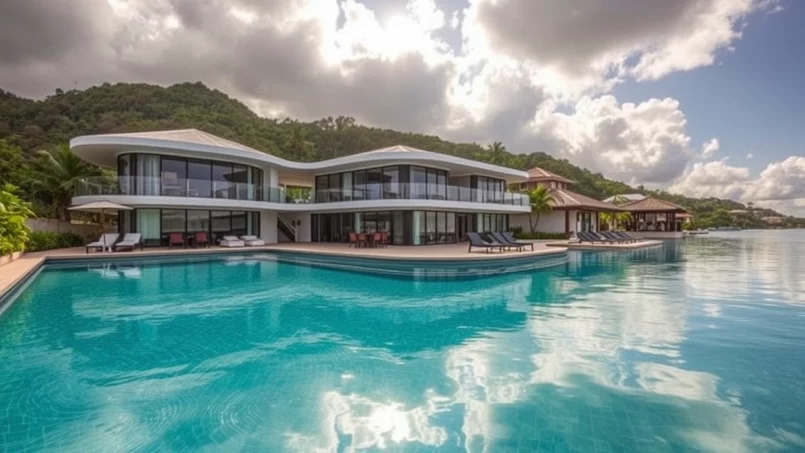
Trinidad and Tobago has established itself as one of the most unique real estate markets in the English-speaking Caribbean. Driven by a more industrialized economy than most of its neighbors, supported by oil and gas as well as services and growing tourism, the luxury property segment operates by its own codes, specific drivers, and a geography sharply contrasting Trinidad, the urban and busy island, with Tobago, the beach and eco-tourist retreat.
Two studies confirm the sector’s robustness, assessed through key indicators like the average price per square foot, occupancy rates, and time on market. The supply is structured around beachfront villas, view penthouses, private estates, and secure apartments.
A Market Supported by an Atypical Caribbean Economy
Trinidad and Tobago occupies a unique place in the region. It has the most industrialized and diversified economy in the English-speaking Caribbean. The energy sector – natural gas and oil – accounts for roughly 40% of GDP and 80% of exports, but the government is actively pushing diversification into finance, manufacturing, technology, and especially tourism, with Tobago as its beachfront showcase.
Trinidad and Tobago’s gross domestic product is estimated at just over 20 billion US dollars.
In real estate terms, this macroeconomic base translates into rather steady long-term price growth. Studies cite a period of marked appreciation between 2010 and 2014, with annual increases of 5 to 7% driven by high energy prices, followed by a phase of near-stagnation between 2015 and 2019, in sync with the slowdown in the energy sector, before a gradual rebound after the pandemic, around 2 to 4% per year. Rental yields, particularly for high-end properties targeting expatriates, executives, and tourism, have held up, reinforcing real estate as an investment vehicle.
The premium real estate market is primarily supported by the national economic dynamic, namely the recovery in hydrocarbon production, public investment in infrastructure, and the digital transition, rather than by global trends.
Trinidad: Prestige Corridor, View Towers, and Hill Villas
The island of Trinidad concentrates the majority of economic activity and population. The heart of the high-end residential market lies along a highly sought-after real estate corridor, anchored by Port of Spain – the capital and financial center – and stretching westward.
The Western Corridor, Backbone of Urban Luxury
From St. Clair to Westmoorings, through Maraval, Cascade, Federation Park, Goodwood Park, and Diego Martin, this urban ribbon gathers luxury apartments, villas in secure compounds, modernized traditional-style homes, and large complexes with hotel-style amenities. The address is an integral part of the value: proximity to embassies, international schools, corporate headquarters, the Queen’s Park Savannah, and major roadways.
This area is highly sought after for its proximity to the business center and quick access to coastal leisure and hills. Scarce land, strong local and expatriate demand, and a preference for secure residences maintain high prices and a low vacancy rate. Market reports consider it one of the corridors offering the best returns on investment in the country.
Examples of transactions cited in local real estate databases provide an idea of the order of magnitude. In Cascade, a seven-bedroom, five-bathroom house around 3,000 square feet is listed at nearly six million TTD. In Goodwood Park, some properties trade well above ten million TTD. Luxury apartments in secure complexes like One Woodbrook Place or in waterfront towers can exceed two million US dollars for the most prestigious units.
Penthouses, New Residences, and Lifestyle Concepts
Among the emblematic developments, The Renaissance at Shorelands, on the northwest coast of Port of Spain, illustrates the upscaling of the residential product. Penthouses spanning several thousand square feet, large picture windows overlooking the Gulf of Paria, hotel-style services, carefully designed common areas: everything is conceived for an urban “resort” lifestyle. One of the penthouses, designed by Brian MacFarlane, has been highlighted as embodying an exclusive art of living.
The maximum price in millions of Trinidad and Tobago dollars (TTD) for a high-end view apartment in The Grand Savannah project.
Further south, in areas like Claxton Bay, residential developments of the “community” type – such as Ocean Heights – complement the supply with plots and new homes, while in the valleys of Maracas or Santa Cruz, sloped land with mountain views attracts those prioritizing tranquility and space.
A Highly Tiered Price Grid
Analyses based on transactions from the last 18 months allow for mapping price ranges in Trinidad. A summary, in TTD, shows how budgets and available property types are positioned:
| Approximate Budget (TTD) | Typical Available Property Types | Dominant Buyer Profile |
|---|---|---|
| Up to 1 M | Small plots in rural or agricultural areas, modest older units, studios | Local first-time buyers, small investors |
| 1.25 M – 2 M | Medium-sized apartments or houses in the Eastern/Central suburbs, older units in the West | Upper-middle class, couples and families |
| 2.25 M – 3 M | Comfortable houses > 2,500 sq ft in the East/Center/Santa Cruz, townhouses in Westmoorings/Maraval | Executives, investors seeking executive rentals |
| 3.25 M – 4.5 M | Large 1980s houses requiring upgrades, development land on the outskirts of Port of Spain | Developers, established families |
| 4.5 M – 6 M | Villas with pools in Haleland Park/Maraval, high-end units in towers, beach or island houses | Local high-end clientele, high-level expatriates |
| > 6 M | Very contemporary villas in elite neighborhoods, large sea-view apartments, “Down the Islands” residences | Very high-income earners, local and regional HNWIs |
Even though this grid is not specific to the ultra-high-end segment, it illustrates how luxury products – often above six million TTD or the equivalent in USD – occupy a clearly identified niche, less sensitive to interest rate fluctuations and more governed by scarcity, location, and the lifestyle offered.
Tobago: Beach Villas, Eco-Developments, and Tourism Yields
Facing Trinidad, Tobago presents a completely different picture. Calmer, greener, the island is known for its unspoiled beaches, ancient forests, rich marine life, and a decidedly more relaxed atmosphere. Luxury real estate here takes other forms, often intimately linked to nature and the sea.
The Hotspots for Luxury Residential in Tobago
The key locations for high-end properties are concentrated on the west coast and around the capital Scarborough. Crown Point and its iconic beaches – Pigeon Point and Store Bay – form a hub mixing hotels, tourist villas, restaurants, and services. A bit further north, Mt. Irvine and Grafton line up golf villas, houses with sea views, and small residences with direct beach access. Buccoo, with its reef and developing marina, attracts projects blending yachting and hospitality.
Further east, Tobago Plantations Estate stands out as a prestige domain, with a golf course, beachfront villas, condos, and lagoon houses. Properties like Caribbean Dreams Villa or luxury apartments in the complex demonstrate sustained demand for secure, structured products offering on-site management and services.
Other pockets of value can be found in Bacolet, Old Grange, Bon Accord, Arnos Vale, or in gated communities like Samaan Grove. Property listings there regularly mention 4 to 6 bedroom villas on plots exceeding 10,000 to 15,000 square feet, with pools, tropical gardens, and unobstructed ocean views.
A few examples of properties for sale in Tobago provide a better grasp of this segment:
| Property (Tobago) | Location | Main Characteristics | Listed Price (USD, if indicated) |
|---|---|---|---|
| Medi Mansion | Bacolet | 4+1 bed, 4.5 bath, ~12,000 sq ft, freehold | 500,000 |
| Moments Villa | Bacolet | 6+ bed, 6 bath, ~15,952 sq ft, freehold | 675,000 |
| 6 Sugar Mill Road | Old Grange | 6 bed, ~12,000 sq ft, freehold | 1,399,000 |
| Tuscan Villa | Samaan Grove | 4+ bed, 5 bath, ~7,000 sq ft, leasehold | 4,399,000 (currency not specified) |
| Caribbean Dreams Villa | Signal Hill/Plantations | 3+ bed, 3 bath, ~10,000 sq ft, freehold | 3,999,999 (currency not specified) |
| Condo Tobago Plantations 9 | Tobago Plantations | 3 bed, 4 bath, apartment, leasehold | 2,900,000 (currency not specified) |
The beaches of the west coast, from Mt. Irvine to Englishman’s Bay, through Stonehaven Bay or Castara, also see charming residences blooming, sometimes colonial-style, sometimes Balinese-inspired, often integrated into the vegetation with large terraces, infinity pools, and panoramic views of the Caribbean Sea.
A Seasonal Rental Market with High Yields
The tourist positioning of Tobago directly fuels the luxury rental market. Well-located beachfront villas can generate daily rents ranging, in high season, between 200 and 800 US dollars per night, with advertised annual yields between 6 and 10% for professionally managed properties in the most sought-after areas.
Many platforms and agencies, such as trinidadandtobagovillas.com, Worldwide Dream Villas, or local operators linked to tobagoluxuryhomes.com, market luxury villas in Tobago for an international clientele. Their offerings are designed for high-end tourism and often include: private pools (sometimes saltwater), heated jacuzzis, fully equipped kitchens, home cinema rooms, gyms, high-speed Wi-Fi, workspaces suited for teleworking, nearly systematic cleaning services, and, on request, a private chef and concierge services.
Among the star properties, some have built a reputation beyond the island’s borders. Ohana Villa, for example, stands out with its two infinity pools, its 20,000-gallon koi pond, 180-degree ocean views, and direct access to a reef-protected beach. It has been distinguished by a major international magazine as one of the most remarkable places to stay in Tobago and is suitable for both family vacations and destination weddings.
Average occupancy rate of the short-term rental market in Tobago.
Eco-Tourism, Mixed-Use, and Sustainability
Tobago is also betting on a “green” upscaling. Areas near reserves like the Tobago Main Ridge Forest Reserve, or near diving sites in Speyside and Charlotteville, are seeing integrated eco-tourism projects emerge: small clusters of villas nestled in the forest, stilt houses, river lodges, often designed with sustainable materials, solar systems, rainwater harvesting, and limited ground footprint.
Residential communities like Hope Estate highlight their environmental commitment, with landscaped roads, buried utilities, and urban planning constraints prioritizing the landscape. These projects respond to a dual trend: travelers seeking more responsible experiences and wealthy buyers who now associate luxury and sustainability.
Global trends noted by regional real estate experts are found here: smart homes, integration of photovoltaic panels, generous outdoor spaces, kitchens and living rooms fully open to terraces, and bioclimatic design to limit air conditioning. Garages pre-equipped for electric vehicles, still rare, are beginning to appear in the specifications for new ultra-high-end villas.
An Open but Technical Legal Framework for Foreign Investors
Trinidad and Tobago differs from several neighboring islands in one important characteristic: there is no economic citizenship program directly linked to real estate purchase, unlike Antigua and Barbuda, Dominica, or St. Kitts and Nevis. However, the country allows property purchase by non-nationals within a precise legal framework.
The Foreign Investment Regime
The key legislation is the Foreign Investment Act, which replaced the former Aliens (Landholding) Act. It defines which real estate transactions require a government license. In Trinidad, a foreign buyer can acquire, without a license, up to one acre of land for residential use or five acres for commercial use. Beyond that, or for certain investor profiles, a license issued by the Ministry of Finance is required.
In Tobago, any land purchase by a foreigner requires a prior license, regardless of size. To facilitate tourism projects, the procedure is simplified in certain designated areas: Arnos Vale, Bacolet Estate, Buccoo, Golden Grove, Englishman’s Bay, Lowlands (including Tobago Plantations), Mt Irvine, and Grafton.
The license application – for the entire country – is made to the Ministry of Finance, incurs fees of approximately 10% of the property’s value upon approval, and is accompanied by more modest fixed duties. Announced processing times typically range between three and six months, sometimes longer. The license is attached to the property targeted by the transaction and must be registered to take full effect; in case of acquisition without complying with obligations, the theoretical penalty can go up to confiscation.
For an international buyer, the typical process includes a research phase, an offer with a deposit (often 10%), signing a conditional sales agreement contingent on obtaining the license if necessary, a comprehensive legal and technical audit, then finalization with payment of the balance, stamp duty settlement, execution of the deed of transfer, and registration. The total duration is generally six to nine months.
Taxation and Transaction Costs
The tax system of Trinidad and Tobago is described as investment-friendly. The personal income tax rate is progressive, up to 25% (with an additional tier of 30% above a certain income threshold), while the corporate tax rate is generally 25%, with lower rates for sectors considered priority.
VAT is 12.5% but does not apply to residential rentals. Transfer duties (stamp duty) range from 0 to about 7.5% of the property’s value, with partial exemptions for first-time Mauritian buyers according to price brackets. There is no real estate wealth tax, no inheritance tax, and no capital gains tax after 12 months of holding (quick resales remain taxable as income).
In parallel, a revamped land and building tax is based on the annual rental value of properties. For residential, the effective rate hovers around 2% of the taxable value, after accounting for standardized allowances. For an investor, this represents a reasonable recurring charge but one that must be factored into yield calculations, along with management, insurance, and maintenance costs.
Finally, non-tax transaction costs include attorney fees – often between 1.5 and 3% of the price – appraisal fees, survey costs, and dossier fees for the foreign investment license if applicable. For a purchase with a license in Tobago, the combination of these items can easily bring the total entry cost to around 15 to 20% above the net seller’s price, hence the importance of aiming for medium or long-term holding.
Financing, Banks, and Currency Management
The local financial sector is well-developed for the region, with an active stock exchange, the Trinidad and Tobago Stock Exchange, and several leading banks like Republic Bank, First Citizens, or Scotiabank Trinidad. These institutions offer mortgage solutions, including to non-residents, but generally under more stringent conditions than in the home countries of many foreign buyers.
For non-national investors, real estate loans typically require a down payment of 50 to 60%, a reduced term of about 15 years, and interest rates between 7% and 9%. Prior acquisition of a foreign investment license is mandatory to access financing. Consequently, many wealthy investors (HNWIs) opt for cash payment or for loans obtained in their country of residence.
The Trinidad and Tobago dollar being subject to exchange controls and little traded internationally, significant fund transfers involve detailed documentation on the source of funds, both for entry and exit. Repatriation of rental income is possible, subject to tax compliance, while the return of capital after resale requires, where applicable, the approval of the central bank.
Who Buys and Why? Profiles and Motivations
In the luxury market, studies converge: two main drivers fuel demand. On one hand, wealthy local individuals seeking proximity to business centers, quality schools, and desirable neighborhoods; on the other hand, an international clientele of HNWIs and expatriates, attracted by the combination of relative stability, pleasant climate, favorable taxation, and Caribbean lifestyle.
The typical buyer is generally a high-income local professional or entrepreneur, sometimes returning after a career abroad. They buy a villa in established neighborhoods (Valsayn, Maraval, Westmoorings) as a primary residence and a patrimonial asset. Part of the demand also comes from expatriate executives, who create a strong high-end rental market, although they more often rent than buy.
In Tobago, the range is more international: British, North Americans, Caribbeans from other islands, but also Trinidad residents seeking a second home or a rental investment with strong tourism potential. For many, Tobago represents a tropical “Plan B,” in a context where interest from Americans and other nationalities in the Caribbean as an alternative refuge is growing.
Luxury real estate investors prioritize legal and political security, quality infrastructure, and easy air access. They also seek a preserved natural environment, wellness and year-round outdoor living possibilities, robust digital connectivity for teleworking, and the availability of high-end services (concierge, staff, healthcare, dining).
Major Trends: Security, Turnkey, Smart, and Sustainable
Within the country as across the Caribbean, several major trends are shaping the luxury real estate product.
The first is the rise of gated and secure communities. Safety concerns, coupled with the desire for convenience, are pushing buyers towards guarded residential estates, equipped with shared amenities (pool, gym, green spaces) and professional management. Complexes like The Cascades, Millennium Park, or Samaan Grove illustrate this shift, with houses increasingly delivered “ready to live in,” furnished, and connected.
Buyers in the Trinidad and Tobago luxury real estate market are increasingly favoring properties requiring little to no work. Demand is for fully-equipped residences, integrating home automation, security, central air conditioning, and connected devices to manage lighting, access, and temperature. This trend applies to both penthouses in Port of Spain and villas in Tobago.
The third major trend is sustainability. Solar panels, water harvesting, low-impact materials, drought-resistant gardens, preparation for electric vehicle charging: what was once a plus is gradually becoming an expected standard at the top of the market. For a sea-view villa exposed to weather hazards, resilience to storms and structural quality are now selling points, as much as interior design.
Digitalization has transformed the presentation and analysis of real estate properties. The use of drones, virtual tours, 3D staging, and targeted campaigns on social media, as discussed during Association of Real Estate Agents (AREA) seminars, facilitates access to an international clientele and reduces the distance barrier. These tools also allow buyers to more easily compare the Trinidad and Tobago market with competing markets such as Barbados, the Bahamas, or the Cayman Islands.
Institutions, Regulation, and Professionalization
The development of the high-end segment has not occurred in isolation. It is driven by an increasingly structured ecosystem: agency networks, specialized lawyers, appraisers, developers, banks, and public authorities.
The Association of Real Estate Agents (AREA), founded over 30 years ago in Port of Spain, has advocated for the recognition of real estate as a regulated profession. Its efforts led to the adoption of a Real Estate Agents Act, which requires agent registration, an annual license, membership in a single professional body, and continuing education. Although the law is passed, its full implementation is still pending, but it establishes a clear trajectory for the sector’s professionalization.
AREA also promotes the creation of a national multi-listing system, to improve market transparency and efficiency, and works with partners like UWI–Roytec to offer certification training. The association engages on substantive issues: modernization of planning and land registration procedures, integration of artificial intelligence in the profession, promotion of sustainable construction, and advocacy for better housing accessibility.
For international investors, this upscaling of the ecosystem is a factor of confidence. The presence of law firms recognized for real estate transactions, agencies affiliated with AREA, and major international brands in prestige real estate offers a familiar and reassuring environment, all while being based on British-derived law.
Trinidad and Tobago in the Caribbean Concert of Luxury Real Estate
At the regional scale, the Caribbean is experiencing a true boom in the high-end segment. Sector data indicates regional residential real estate market growth exceeding 4% per year in the coming period, driven by the tourism recovery, interest from international investors, and the rise of nomadic teleworkers.
Experts mention an increase of about 20% in demand for high-end properties after the pandemic.
Trinidad and Tobago, without such a program, positions itself differently. Its strengths lie in the depth of its economy, its industrial base, its financial system, and a real estate offering that is more affordable, at comparable quality, than ultra-premium markets like Barbados or the Cayman Islands. For an investor seeking a Caribbean asset correlated with a diversified local economy rather than exclusively with tourism, this is a significant argument.
New citizenship rules in other Caribbean countries, imposing minimum stays, indirectly benefit Trinidad and Tobago. The search for secondary or primary residences in the region is expected to support demand for high-end properties (villas, condos, houses) on these islands, complementing the market of neighboring islands.
Opportunities and Risks: What an Investor Should Consider
The luxury property market in Trinidad and Tobago thus offers an interesting combination for investors: diverse products – from Port of Spain penthouses to Tobago beach villas –, attractive rental yields in some segments, relatively lenient taxation, and prospects for appreciation linked to regional growth and tourism development.
But several pitfalls require particular vigilance. The delays and costs associated with foreign investment licenses, especially in Tobago, require careful calibration of the project and its timeline. The economy’s dependence on energy remains a macroeconomic risk, with cycles that can affect both local demand for high-end housing and public budgets, hence infrastructure.
On a micro level, it is crucial to carefully examine construction quality, particularly its resistance to cyclone risk. It is also essential to meticulously verify property titles, the regularity of planning permits, and the property’s tax compliance. It is highly recommended to entrust this comprehensive audit to seasoned local lawyers and experts before signing any deed.
Finally, the very structure of demand is evolving. Expatriation linked to hydrocarbons has slowed, which is pushing part of the high-end rental stock to reposition towards local or tourist clientele, sometimes adjusting rents downward. In commercial real estate, the rise of hybrid work has generated vacancy in offices, pushing some owners to convert buildings to residential or mixed use. These adaptations show the market’s ability to reinvent itself, but they require investors to have a nuanced understanding of territories and usage patterns.
Conclusion: A Luxury Market Grounded in Reality
The luxury property market in Trinidad and Tobago is no tropical mirage. It is based on a real economy, on a state investing in infrastructure and digitalization, on a professional sector structuring itself around associations like AREA, and on multiple demand – local, regional, international – driven by diverse motivations: primary residence, pied-à-terre, portfolio diversification, rental yield, or simply the quest for an art of living between green hills and preserved beaches.
In Trinidad, luxury is expressed in luxury apartments and hill villas, intimately connected to decision-making centers and services. In Tobago, it is written in beach villas, eco-tourism estates, golf course developments, and discreet retreats between forest and coral reefs. In both cases, the investor who takes the time to understand the regulations, surrounds themselves with the right professionals, and chooses quality locations finds a market that is both singular and promising, at the heart of a Caribbean that remains one of the world’s most dynamic stages for prestige real estate.
Disclaimer: The information provided on this website is for informational purposes only and does not constitute financial, legal, or professional advice. We encourage you to consult qualified experts before making any investment, real estate, or expatriation decisions. Although we strive to maintain up-to-date and accurate information, we do not guarantee the completeness, accuracy, or timeliness of the proposed content. As investment and expatriation involve risks, we disclaim any liability for potential losses or damages arising from the use of this site. Your use of this site confirms your acceptance of these terms and your understanding of the associated risks.

Cyril Jarnias is an independent expert in international wealth management with over 20 years of experience. As an expatriate himself, he is dedicated to helping individuals and business leaders build, protect, and pass on their wealth with complete peace of mind.
On his website, cyriljarnias.com, he shares his expertise on international real estate, offshore company formation, and expatriation.
Thanks to his expertise, he offers sound advice to optimize his clients' wealth management. Cyril Jarnias is also recognized for his appearances in many prestigious media outlets such as BFM Business, les Français de l’étranger, Le Figaro, Les Echos, and Mieux vivre votre argent, where he shares his knowledge and know-how in wealth management.





