
 Published on and written by Cyril Jarnias
The real estate market in Southern Cyprus is approaching 2026 at a pivotal phase. After several years of rapid price increases, the island is entering a more mature cycle, where growth continues but on a healthier foundation. For an investor, this is a rare setup: solid macroeconomic fundamentals, favorable taxation, robust rental demand, and a record tourism dynamic, all within a country that is a member of the European Union and the eurozone.
This article analyzes the real estate outlook for 2026, the specific dynamics of each city, rental yields, the impact of short-term rentals (like Airbnb), and the concrete reasons to include Southern Cyprus in a wealth strategy.
A market past euphoria but far from a bubble
Since 2019, residential real estate prices in Southern Cyprus have increased by an average of 5 to 8 % per year, with even a peak of around 7.8 % annual growth for the Residential Property Price Index (RPPI) at the start of 2024. The year 2024 marked a turning point: the increase remained clear, around +5.6 to +8.7 % depending on the source, but the pace slowed.
Data published for the end of 2024 clearly illustrates this change in pace. The RICS/KPMG index indicates a 12.7 % increase for apartments and a 5.7 % increase for houses in the fourth quarter. The Central Bank of Cyprus RPPI index still shows a 6.51 % year-on-year progression in the third quarter, with +8.8 % for apartments and +6 % for houses.
Number of real estate sales contracts filed between January and September 2025, an increase of about 13 % year-on-year.
The message from all indicators is clear: the market is not in a speculative overheat but in a phase of stabilization after a strong post-pandemic expansion. Monetary authorities and local experts converge on the idea of “normal” growth, driven by fundamentals, rather than a bubble.
2026 Forecasts: Growth continues, but more reasonably
For 2026, the most credible scenarios converge on continued price increases, but at a healthier pace. Projections speak of an average progression of 3 to 7 % across the island, with a frequently cited central scenario of 5 to 8 %. In the most sought-after sectors, especially new waterfront properties in Limassol or Paphos, increases potentially approaching 10 % remain likely.
For the apartment segment, particularly sought after by expats, students, and foreign executives, an appreciation of +6 to +10 % is expected for 2026. This trend is part of an established dynamic, as apartments have already increased more than houses between 2020 and 2025, with no sign of reversal.
Two factors however explain the current moderation:
– a 10 % drop in purchases by non-residents in 2024, after the boom of 2022-2023;
– the arrival of new projects on the market, which slightly eases supply pressure, even though the shortage of quality properties in the best locations remains a recurring theme.
In other words, 2026 should resemble a year of controlled growth, far from euphoria but clearly tilted upward. For an investor, this is typically the window to favor medium-term “anchor” positions.
Rare economic fundamentals in the Mediterranean
If Southern Cyprus attracts so much, it’s not only for its beaches and 300 days of sunshine per year. The country offers a macroeconomic and fiscal cocktail that few Mediterranean destinations can claim.
Growth, inflation, employment: a stabilized environment
The Cypriot economy displays GDP growth of about 3 %, above the eurozone average, with a range of 2.5 to 3.7 % depending on recent years. Inflation is contained under 2.2 %, unemployment is low and continuing to decline, with a projection around 4.5 % in 2026. Public debt is on a downward trajectory, from over 70 % of GDP in 2024 to about 59 % expected in 2026.
This is the amount, in billions of euros, of planned investment programs in Croatia, particularly in infrastructure, tourism, and real estate.
This macroeconomic foundation reassures investors: the country combines growth, deleveraging, political stability, and anchoring in the eurozone. In a volatile global context, this profile of a small stable market is a strong argument.
A demographic driver fueled by skilled immigration
Demographically, Southern Cyprus has a population of about 1.27 million inhabitants, with moderate growth of about 0.63 % in 2025. Like many European countries, the population is aging (median age around 38.6 years), but progress is essentially driven by international immigration.
Projections indicate over 400,000 new arrivals in 2024, creating structural demand for housing.
This combination of a modest-sized market, immigration-driven demographics, and limited land supply in the most sought-after areas (coastline, city centers) naturally fuels upward price pressure in the medium term.
Who buys in Southern Cyprus? The weight of foreign investors
The Cypriot market is deeply internationalized. In 2024, 27.4 % of all transactions (4,321 out of 15,797) were officially carried out by foreigners, a proportion actually higher if purchases through Cypriot companies are taken into account. By mid-2025, foreigners represented about 40 % of purchase-sale transactions.
Three dominant customer blocs
Available statistics show that in 2026, three major blocs of foreign buyers structure the market:
| Foreign buyer segment | Estimated share of international transactions |
|---|---|
| Israeli citizens | 31 % |
| Central & Eastern European investors | 24 % |
| Middle Eastern buyers | 19 % |
Other nationalities remain very active: British, Russians, Greeks, Lebanese, Romanians, Ukrainians. By region, the profile varies: in Paphos, British dominate (890 purchases in a recent period), followed by Israel (683) and Russia (327); in Limassol, Russia and Israel lead.
This geographic diversity provides a cushion: if some flows contract, others take over. It also contributes to the depth of the rental market, whether for primary residences, pied-à-terre, or high-end furnished rentals.
Record tourism and short-term rentals
The market is also driven by thriving tourism. Over 4 million visitors per year, a season extending from March to November, accessible sea all year round with temperatures from 19 to 30 °C: for short-term rentals, it’s an ideal playground.
British tourists represent about 34.5 % of arrivals, Israelis 11 %, with Poland for example sending 337,000 visitors in 2024 (+23 %). This massive flow fuels demand for short-term rentals, particularly in the villas with pool and apartments near the sea segments.
Major cities under the microscope
The Cypriot market is far from homogeneous. Opportunities and entry tickets vary greatly depending on cities and neighborhoods. A few hubs clearly dominate: Limassol and Paphos leading, then Larnaca, Nicosia, and the seaside resorts of Ayia Napa and Protaras.
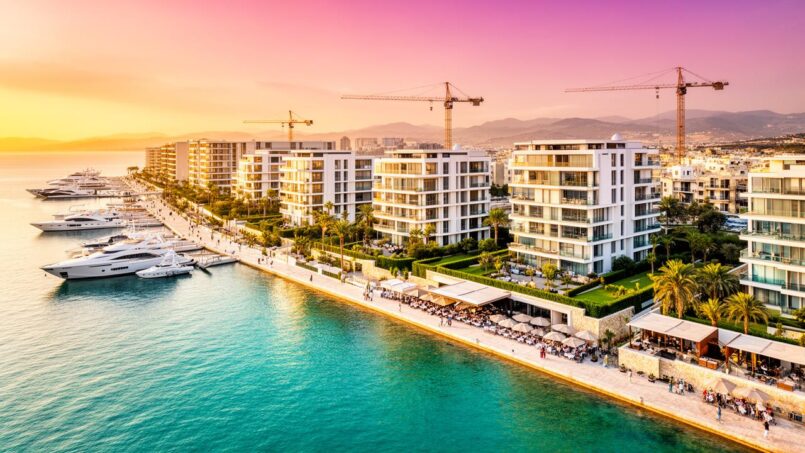
Limassol is the economic and financial heart of the island, the most expensive city but also the most liquid. It concentrates a large portion of offshore company headquarters, maritime groups, and financial services. The waterfront has been transformed with iconic projects like Limassol Marina, Limassol Del Mar, ONE, and ultra-contemporary luxury residential towers.
Prices reflect this high-end status:
| Limassol area | Indicative price per m² (new / high-end segment) |
|---|---|
| City center | ≈ 4,000 €/m² and above |
| Limassol Marina | ≈ 6,000 €/m² and above |
| Germasogeia (tourist zone) | ≈ 3,500 €/m² |
| Waterfront (apartments) | ≈ 5,500 €/m² and above |
| Premium waterfront projects | 4,850 to over 6,000 €/m² |
The average apartment was trading around 372,000 € in the first quarter of 2025 (+12.4 % year-on-year), and the median for an apartment is around 650,000 € in the district. In some segments, levels near 6,500 €/m² have been observed. A studio on the waterfront often sells for 350,000 to 450,000 €, a two-bedroom for 650,000 to 950,000 €, a three-bedroom for 950,000 to 1.5 million, with penthouses exceeding 2 to 3 million euros.
Over five years, the average annual price progression in the Limassol district is between 6 and 10 %. For 2026, projections still forecast +6 to +8 %, with well-located properties often reselling in a few months with a capital gain of 10 to 15 % over the original price.
For an investor, Limassol represents a market offering good capital appreciation and resale security. Rents are proportional to prices: a well-located two-bedroom apartment can rent for between 1,200 and 1,500 € per month. Gross yields are around 5 to 7 % for mid-range apartments, and can reach 6.5 to 8 % for very high-end villas targeting an international clientele.
Limassol, however, requires significant initial capital. It’s a market for investors with several hundred thousand euros, often with a wealth or very high standard perspective.
Paphos: Strong appreciation and price/yield trade-off
Paphos is the other flagship hub of Southern Cyprus, but with a different profile. A quieter seaside resort, classified as a UNESCO World Heritage site, it attracts a clientele of European retirees, families, and tourists looking for second homes.
Prices remain lower than in Limassol, while showing impressive momentum. In 2024, the city recorded an average increase of about 21.4 %, with over 13 % for houses and over 12 % for apartments. In the best locations, the average price per square meter is around 4,700 €/m², but with a wide range:
| Paphos area | Indicative price per m² |
|---|---|
| Historic center | from ≈ 2,500 €/m² |
| Kato Paphos (seafront) | from ≈ 3,500 €/m² |
| Chloraka (residential) | from ≈ 2,000 €/m² |
| Coral Bay (seaside resort) | from ≈ 3,000 €/m² |
| Secondary market | ≈ 2,400 €/m² |
For villas, a budget of 500,000 to 800,000 € allows you to acquire a 3 or 4-bedroom house with a pool in a quiet residential neighborhood. The average house was around 693,000 € at the end of 2024. In an area like Coral Bay, an apartment falls into the following range: 250,000–350,000 € for a studio, 350,000–500,000 € for a one-bedroom, 500,000–750,000 € for a two-bedroom, 750,000–1.2 million for a three-bedroom.
This is the forecast growth for the real estate market in Paphos for 2026, the strongest anticipated.
In terms of yield, Paphos is an interesting compromise. Announced gross rental income on some programs ranges between 7 and 9 %. On the market, a profitability of 5 to 8 % is considered realistic for short-term rentals, and 5 to 6 % for well-located long-term rentals. Villas with pools near the sea rent very well in summer, at the cost of more demanding management.
Larnaca: Value with potential
Larnaca is often described as the “rising star” for value investment. Cheaper than Limassol or Paphos, it benefits from an international airport, major modernization works on its port and marina, and new residential neighborhoods.
Current prices remain relatively affordable:
| Larnaca area | Indicative price per m² |
|---|---|
| City center | from ≈ 1,800 €/m² |
| Finikoudes waterfront | from ≈ 3,000 €/m² |
| Mackenzie Beach | from ≈ 2,500 €/m² |
| Secondary market | ≈ 2,200 €/m² |
The average house is around 389,000 €, and a small apartment can still be found from 150,000 €. The median apartment price is around 3,140 €/m², that of houses around 2,629 €/m².
Larnaca recorded a 36 % increase in real estate transactions, indicating a strong resurgence of interest. Forecasts for 2026 anticipate a price increase of 5 to 7 %, supported by infrastructure projects. This makes it an ideal option for a first rental investment with limited capital, aiming for steady property appreciation.
Nicosia: The rental safe haven
Capital city without sea access, Nicosia attracts fewer investors focused on second homes or vacations, but it plays a key role for long-term rentals. Ministries, large companies, and universities are located here, creating a stable year-round rental flow.
Prices are significantly lower than in coastal areas:
| Nicosia area (south) | Indicative price per m² |
|---|---|
| City center | from ≈ 1,500 €/m² |
| Residential neighborhoods | from ≈ 1,200 €/m² |
| Secondary market | ≈ 2,000 €/m² |
| Average apartment price | ≈ 191,000 € |
Price increases are more modest, but regular, driven by urban renewal programs and the arrival of technology companies. Nicosia saw its transactions increase by 13 % in 2025. For an investor, it’s a “blue-chip” value, offering stable rents rather than a price surge.
Ayia Napa and Protaras: Maximum seasonal yield
These two seaside resorts on the east coast are synonymous with turquoise beaches and massive tourist flows in summer. Prices are less extreme than in some areas of Limassol, but sufficiently high in the best locations.
| Area | Indicative price per m² |
|---|---|
| Ayia Napa center | from ≈ 2,500 €/m² |
| Ayia Napa waterfront | from ≈ 4,000 €/m² |
| Protaras | from ≈ 2,800 €/m² |
| Secondary market (region) | ≈ 2,300 €/m² |
These are quintessential seasonal yield markets: villas and apartments rent at high prices in high season, but demand drops in winter. An investor must therefore accept strong seasonality, while benefiting from high gross profitability over the year.
Short-term rentals in Southern Cyprus: Very telling figures
Platforms like Airbnb or Booking.com have profoundly transformed the Cypriot rental landscape. It is estimated that in 2024, over 20,000 homes were offered for short-term rental on the island, a constantly increasing number.
Income and profitability: A very competitive profile
Aggregated figures for seasonal rentals in Cyprus (mainly Southern Cyprus for coastal properties) provide a concrete overview of performance:
| Key indicator | Typical value |
|---|---|
| Average monthly Airbnb gross revenue | ≈ 2,000 € |
| Median monthly revenue | 1,600–1,800 € |
| “Realistic” revenue range | 1,200–3,200 €/month |
| Low season revenue (slow months) | 900–1,500 €/month |
| High season revenue | 2,500–4,500 €/month (and more for villas) |
| Coastal villa in August | > 4,500 €/month, often 4,500–6,000 €/month |
| Monthly net revenue (self-management) | ≈ 1,250 € |
| Monthly net revenue (professional management) | ≈ 850 € |
| Typical gross seasonal yield | 6–10 % per year |
An apartment purchased for 200,000 € can thus generate up to 10 % gross yield, 7 % net, and about 5.5 % “net-net” after taxes in a realistic scenario provided by analyses.
In certain tourist areas, the Airbnb model can generate up to 2.6 times more gross revenue than long-term rentals.
Nightly rates and occupancy rates
Nightly rates also show the premium given to good locations, particularly proximity to the sea:
| Pricing indicator | Observed value |
|---|---|
| Average price per night (island) | ≈ 100 € |
| Median nightly price | 85–90 € |
| Main range (≈ 80 % of listings) | 60–180 €/night |
| Most frequent band | 70–140 €/night |
| Waterfront apartments Limassol / Paphos / Larnaca (high season) | 120–180 €/night |
| Luxury villas with pool | > 300 €/night |
| Average nightly price in April | ≈ $146 (≈ 135 €) |
| Average nightly price in July | ≈ $189 |
| Average nightly price in August | ≈ $203, +19 % vs April |
Occupancy rates follow a similar logic. Top hosts achieve 70 to 80 % annual occupancy, some prime-location properties exceeding 85 % in high season. The average is more between 55 and 65 %, with a “country” rate around 60–65 %. In major cities, it often stays between 60 and 70 %, while in very touristy coastal areas, it exceeds 80 % in summer but can fall below 40 % in winter.
In other words, Southern Cyprus offers a remarkable risk/return ratio for short-term rentals: a more accessible entry ticket than on the French Riviera, high seasonal rents, a long tourist season, and strong structural demand.
Long-term rental yields: A solid foundation
For investors less tempted by the intensive management of seasonal rentals, long-term rentals remain a reliable baseline strategy, especially in major cities and areas with high concentration of jobs and universities.
Average rents observed are as follows:
| Property type / location | Typical monthly rent |
|---|---|
| 1-bedroom apartment city center | 750–930 € (≈ 843 € average) |
| 1-bedroom apartment outskirts | ≈ 700 € (500–1,250 €) |
| 3-bedroom apartment city center | 1,400–1,750 € (≈ 1,696 € average) |
| 3-bedroom apartment outskirts | ≈ 1,400 € (900–2,000 €) |
Average gross yields range between 4 and 6 % across the country, with an average around 5.2 % for Southern Cyprus. In good locations (near universities, business centers, urban waterfront), a yield of 5 to 6.5 % is common, sometimes higher on smaller units (studios, 1-bed/2-bed) in high demand from students, young professionals, or digital nomads.
For a diversified portfolio, it is recommended to combine one or two long-term yield properties in cities like Nicosia or Larnaca with one or two seasonal units in Paphos, Limassol, or Ayia Napa. This strategy helps smooth risks while maximizing overall performance.
Taxation: A decisive advantage for investors
Cypriot taxation is one of the major arguments in favor of real estate investment on the island. It combines several advantages rarely found together within the EU.
Main favorable tax features
– no annual real estate tax on property;
– no wealth tax and no inheritance or gift tax;
– competitive corporate tax base rate (12.5 %, increased to 15 % from 2026 under global minimum rules, while maintaining a very attractive regime for holdings);
– no withholding tax on outgoing dividends, interest, and royalties in most cases;
– “non-domiciled” (Non-Dom) regime offering up to 17 years of exemption from special contribution on dividends and interest;
– no capital gains tax for non-residents, except on gains from the sale of real estate located in Cyprus;
– possibility of reduced VAT of 5 % on the acquisition of a first residence under conditions (vs 19 % standard).
For the purchase of a new property from a developer, the standard VAT rate is 19%. A reduced VAT of 5% applies under cumulative conditions: the buyer must be an individual, the property must be their primary residence for at least 10 years, the habitable area must not exceed 130 m², and the value excluding VAT must not exceed 350,000 €. If these thresholds are exceeded, only the portion corresponding to 130 m² and 350,000 € benefits from the reduced rate; the surplus is subject to the full rate of 19%.
From 2026, a tax reform further strengthens the island’s attractiveness by notably abolishing the special contribution on rental income and eliminating stamp duties. Lifetime allowances on real estate capital gains are raised (30,000 € in general, 50,000 € for agricultural land), and super-deductions are extended for R&D expenses and “green” investments.
For a real estate investor, this Cypriot tax framework offers lightly taxed rents, moderately taxed capital gains, and facilitates wealth structuring through local companies.
The Permanent Residence by Investment Program (Golden Visa)
The Cypriot real estate market is closely linked to the permanent residence by investment program, often called the “Golden Visa”. This scheme is one of the simplest and fastest in Europe to obtain permanent residence in the EU.
Main conditions
– minimum real estate investment of 300,000 € (excluding VAT) in a new property or off-plan;
– deposit of at least 200,000 € (plus VAT) before filing the application;
– proof of a secure annual income of at least 50,000 € from abroad, increased for family members;
– clean criminal record, absence of sanctions, etc., and health insurance;
– mandatory visit to Cyprus at least once every two years, with no permanent residence requirement on the island.
The program includes immediate family members: spouse, dependent children up to 25 years old, and sometimes parents under conditions. The accelerated procedure (category 6.2) allows processing in 2 to 3 months, with the total process often completed in less than 9 months.
This residence is permanent and does not require renewal, except for the physical card every 10 years. It grants the right to live and study in Cyprus, access to EU health and education systems, and facilitated access to multi-entry Schengen visas.
Looking ahead to 2026, Cyprus’s planned accession to the Schengen Area could enhance the value of this status and lead to a gradual tightening of criteria (higher investment thresholds, administrative fees, increased scrutiny of eligible projects). Investors entering the program before any potential reform would however benefit from “grandfathering” clauses.
Acquisition rules for foreigners and future tightening
The Cypriot legal framework is based on British common law, with clear “Title Deeds” and strong property rights protection. This is another point that reassures investors.
Current rules
– for EU citizens, real estate purchase requires no specific authorization;
– for non-EU nationals, an authorization from the Council of Ministers is required, an essentially formal procedure but requiring documentation and time;
– the general rule limits to two the number of properties that can be directly acquired by a non-EU foreigner;
– a common practice is to set up a Cypriot company to hold assets, at the cost of additional tax and reporting obligations.
Politically, Cyprus is divided between the South (Republic of Cyprus, EU member) and the North, recognized only by Turkey. Investing in the northern part carries major legal risks: contestable property titles, unresolved rights of former Greek Cypriot owners, lack of European legal protection, and difficulties for resale or financing. For a secure investment, it is essential to focus on the Republic of Cyprus in the south.
Reforms in preparation for 2026
Under combined pressure from public opinion, security concerns, and European partners, the Cypriot Parliament is preparing a deep reform of access for third-country nationals to the real estate market. Several bills, notably spearheaded by the AKEL party, are being examined in the Interior Committee.
Stated objectives:
– protect access to housing for local residents;
– cool down overheating segments;
– contain land speculation;
– address national security concerns.
Envisaged measures include:
The regulation introduces surface area caps by property type (residential, office, commercial), geographic prohibitions near sensitive sites, prohibits residential purchases by companies controlled by third-country nationals, reinstates political review of files by the Council of Ministers, and strengthens transparency obligations for investment funds with non-European shareholders.
Properties already acquired would remain protected (“grandfathering”). Commercial properties would for now be excluded from quotas, but housing conditions for foreign employees could indirectly tighten.
A consolidated bill was adopted in parliamentary committee on February 26, 2026, pending a plenary vote. This prospect argues, for non-European investors, in favor of entering the market before restrictions fully apply.
How much to invest? Entry tickets and costs
Across the country, the median sale price for an apartment is around 4,285 €/m², that of a house around 3,658 €/m². The average price per square meter in the city is around 3,000 €, with extremes ranging from 1,800 to 5,000 € depending on location and period. This level remains about 42 % lower than in France, positioning Cyprus as a still-competitive “prime” destination.
For an individual investor, several levels of entry tickets can be distinguished:
Overview of price segments and types of properties available for rental or residential investment in Cyprus.
Small apartment in Larnaca or Nicosia, basic rental segment, for around 150,000 €.
Well-located 2- or 3-bedroom in Larnaca, Paphos, or outskirts of Limassol, yield-oriented, between 250,000 and 350,000 €.
Sea-view apartment in a new development in Paphos or Larnaca, or 2- or 3-bedroom in Limassol in a good neighborhood, from 400,000 to 700,000 €.
Waterfront apartment in Limassol, or high-end villa in Paphos, Ayia Napa, or Protaras, between 700,000 € and 1.5 million €.
Penthouses and exceptional villas, segment for international clientele, from 1.5 million € and can exceed 3 million €.
Fees and charges to anticipate for a seasonal rental investment include platform commissions (Airbnb, Booking), management (15 to 20 % of rent, up to 25–30 % for “all-inclusive” management), cleaning and laundry (about 40 € per turnover), condominium fees (often 80 to 300 €/month depending on services), insurance, and routine maintenance.
In a numerical example for a property worth 180,000 € intended for seasonal rental, the total annual charges amounted to 11,078 €, including: about 675 € in Airbnb commission, 4,503 € in concierge service (20 %), 2,400 € in cleaning, 1,800 € in residence fees, 800 € in taxes, 300 € in insurance, and 600 € in maintenance/consumables.
Bank financing: Leverage possible up to 70 %
Cypriot banks are willing to finance real estate acquisitions, including for non-residents, under certain conditions:
Key conditions to obtain a mortgage in France as a non-resident investor.
Financing can reach 60 to 70 % of the property’s value.
Minimum monthly income of about 2,500 € required for eligibility.
Repayment terms can extend from 25 to 30 years.
Annual rates generally between 3.5 % and 5.5 %.
Processing over 4 to 6 weeks, requiring proof of income, credit history, and employment certificate.
For investments qualifying for the permanent residence program, funds must come from abroad and cannot be borrowed from a Cypriot bank. But for a pure rental investment, using local borrowing allows optimizing leverage, especially in a context where rates remain controlled on the European scale.
Why invest in Southern Cyprus in 2026?
Bringing together all the elements studied, Southern Cyprus ticks an unusual number of boxes for a real estate investor.
An analysis of the main strengths and prospects of the Cypriot real estate market, offering an attractive framework for investors.
Expected increases between 3 and 7 % on average, potentially reaching 10–12 % in prime hubs like Limassol and Paphos.
Attractive: 4–6 % in long-term rentals, 6–10 % (or more) in well-optimized short-term rentals.
No wealth tax, no annual property tax, no inheritance tax. Non-Dom regime and no withholding taxes on most flows.
Strong and diversified: record tourism, skilled immigration, European retirees, digital nomads and students.
Reassuring: law inspired by British common law, secure title deeds, membership in the EU and eurozone.
Golden Visa from 300,000 €, among the simplest in Europe, set to gain value with Schengen accession.
Risks exist, of course: upcoming tightening for non-Europeans, social tension over housing access for locals, dependence on tourism, regional geopolitical risks, or construction cost overruns. But all things being equal, the combination of yield / appreciation / legal security remains hard to match in the Mediterranean.
For an investor already present in Western Europe, diversifying with real estate assets in Southern Cyprus in 2026 can be a profitable medium to long-term bet. Success depends on three key factors: being selective on location, surrounding oneself with serious local professionals, and closely monitoring regulatory developments.
Disclaimer: The information provided on this website is for informational purposes only and does not constitute financial, legal, or professional advice. We encourage you to consult qualified experts before making any investment, real estate, or expatriation decisions. Although we strive to maintain up-to-date and accurate information, we do not guarantee the completeness, accuracy, or timeliness of the proposed content. As investment and expatriation involve risks, we disclaim any liability for potential losses or damages arising from the use of this site. Your use of this site confirms your acceptance of these terms and your understanding of the associated risks.

Cyril Jarnias is an independent expert in international wealth management with over 20 years of experience. As an expatriate himself, he is dedicated to helping individuals and business leaders build, protect, and pass on their wealth with complete peace of mind.
On his website, cyriljarnias.com, he shares his expertise on international real estate, offshore company formation, and expatriation.
Thanks to his expertise, he offers sound advice to optimize his clients' wealth management. Cyril Jarnias is also recognized for his appearances in many prestigious media outlets such as BFM Business, les Français de l’étranger, Le Figaro, Les Echos, and Mieux vivre votre argent, where he shares his knowledge and know-how in wealth management.





