
 Published on and written by Cyril Jarnias
wp:paragraph
Northern Ireland enters 2026 in a singular position in Europe: legally anchored to the United Kingdom, but with direct access to the European single market for goods. This specificity, arising from Brexit and the Windsor Framework, reshuffles the economic, social, and political cards in a region where the constitutional question remains red hot. What does Northern Irish society look like in this context, and how is its relationship with the United Kingdom and the European Union being redrawn?
An aging, more urban, and still very British society
To understand the economic and political shifts, we must first look at who lives in Northern Ireland and how the population is evolving. Over the past century, population growth has been slow but steady: from about 1.26 million inhabitants in 1926, the region grew to nearly 1.93 million in 2024. The recent dynamic remains positive but significantly more moderate than in the neighboring state.
Between 2002 and 2022, the Northern Irish population increased by about 13%, while the entire island grew by 26% and the Republic gained 31% more inhabitants. In 2022, the island had 7.1 million people, nearly three-quarters of whom lived south of the border. Northern Ireland then had about 1.91 million residents, or 27% of the island’s total.
A demographic projection under strain
Official projections show that the region will continue to grow, but very slowly. By the mid-2020s, the population should be around 1.94 million, before slightly exceeding 2 million by 2050. This represents an increase of only 3.6% over nearly three decades, far below the forecasts for the United Kingdom (+12.7%) and the Republic (+19.9%).
The median age in France is around 40, compared to 38 in the Republic and an EU average of 44.
Projections for 2045 are telling: the proportion of young people aged 0-15 should fall from about 21% to 16%, while the 65 and over age group would rise from 17% to nearly 25%. The oldest age bracket (86 and over) could more than double, from 35,000 to 82,000 people. Meanwhile, the school-age population will decline, especially in primary education, and the core working-age population will remain broadly stable in number but much older.
Urbanization concentrated around Belfast
This aging is combined with a strong geographic concentration. Greater Belfast is home to more than a third of the region’s inhabitants. Half the population lives in just over 200 very dense local districts covering barely more than 3% of the territory, including most of Belfast, Lisburn, Newtownabbey, and Castlereagh. Local councils in the south and southeast (Lisburn & Castlereagh, Armagh City, Banbridge & Craigavon, Newry, Mourne & Down) are expected to grow, while others in the north and northwest (Derry City & Strabane, Causeway Coast & Glens) are likely to lose residents.
Northern Ireland remains overwhelmingly white, with 97% of its population belonging to this group.
Structural emigration to the rest of the UK
Northern Irish society is still largely composed of locally-born people: in 2021, nearly 87% of residents were born in Northern Ireland. Yet emigration is a long-standing phenomenon. Among generations born since the mid-1950s, nearly one-fifth are estimated to have left the region, and nearly a quarter among working-age adults. Most settled in England or Wales, but more than 60,000 people born in the North live in the Republic.
Migration flows changed after Brexit. Previously dominated by EU nationals, arrivals now come mainly from Asia and non-European countries, with a sharp increase in Irish citizens (+75% since 2015). Net migration is expected to become the main driver of population growth by the mid-2020s, offsetting the expected negative natural balance around 2034.
An economic model caught between British subsidies and European opportunities
Economically, Northern Ireland is often described as a territory halfway between a subsidized British economy and an Irish economy strongly driven by multinationals and attractive taxation. North-South comparisons highlight this duality.
Income, productivity and standard of living: a persistent gap
The latest available data show that Northern Irish households have on average a disposable income per household slightly lower than their southern neighbors. In 2022, this income stood at around 33,400 euros in Northern Ireland, compared to nearly 36,900 euros in the Republic, a gap of just over 10%. This gap has fluctuated but tends to narrow compared to previous years when it reached nearly 18%.
Measured per capita, the wealth produced remains significantly lower in Northern Ireland. Northern Irish GDP per capita (about 34,500 euros in 2023) is about 84% lower than the Republic of Ireland’s modified national income (GNI*) of 63,500 euros. Even with older calculation methods, per capita income in the South was already more than 50% higher than in the North. In terms of hourly productivity, the Republic of Ireland performs more than two and a half times better than Northern Ireland.
Wages partly reflect these differences: in a recent year, the average hourly wage in the Republic exceeded that of Northern Ireland by nearly 30%, then 36% in 2022. However, the debate on living standards is more complex. An indicator based on actual individual consumption (AIC) per capita even suggests that the Northern Irish standard of living is slightly higher – about 5% – than that of the Republic, while the latter remains below the UK average. Northern Ireland, however, would be about 7% below the UK average.
An economy heavily dependent on the state and lagging in high-value-added sectors
The productive structure also highlights different choices. In Northern Ireland, nearly 30% of jobs are in the public sector, compared to just over 25% in the South. Public spending per capita there exceeds the United Kingdom average by 10%, underscoring the importance of budget transfers from London.
The share of manufacturing in value added is much lower in Northern Ireland than in the Republic of Ireland, where it accounts for nearly 44% of wealth produced (more than two and a half times the Northern Irish share). Moreover, high-growth sectors such as information technology, financial services, or certain pharmaceutical segments account for half the employment weight in Northern Ireland (5.4% of jobs) compared to the Republic (9.8%).
Tax revenues confirm this gap in dynamism. The average income tax per capita is about twice as low in the North (around 2,980 euros) as in the Republic (nearly 6,725 euros). The gap is even more striking for corporate tax: about 1,000 euros per capita in Northern Ireland, compared to over 5,700 euros in the Republic. These figures reflect the concentration of multinationals and highly profitable activities in the South.
Despite this, some Northern Irish sectors show higher productivity, particularly in construction, agriculture, forestry and fishing. And sectors like aerospace, defense and space already employ more than 9,000 skilled workers, while logistics employs nearly 70,000 people, or about 8% of the workforce.
An economy at the heart of post-Brexit restructuring
Brexit has changed Northern Irish trade flows. Trade with Great Britain has declined since 2015, while trade with the Republic has increased significantly. Compared to 2020, Northern Ireland’s total sales of goods jumped 46% in three years; sales to Great Britain rose by about 68%, but those to the Republic more than doubled (+107%). Meanwhile, exports to the rest of the EU (excluding the Republic) fell over this period, suggesting the reorientation primarily involves the neighboring market to the south.
Since the protocol came into effect, Northern Ireland’s exports to the EU have increased by more than 44%.
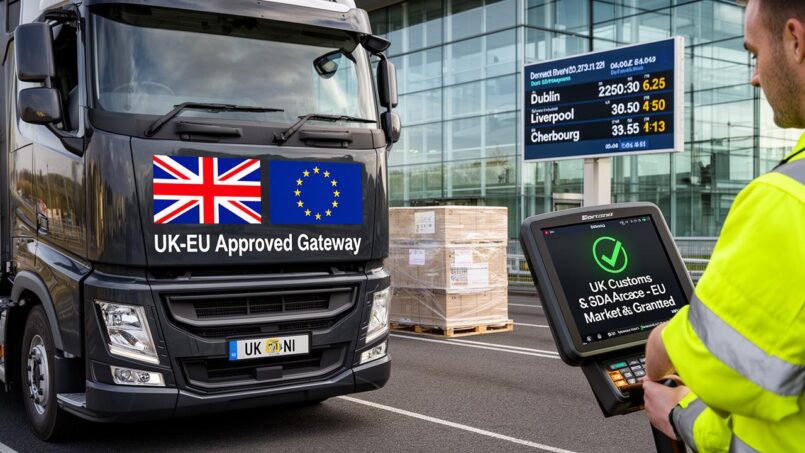
This relative performance feeds the discourse on the “dual advantage”: Northern Ireland is the only part of the UK with frictionless access to the EU’s internal market for goods, while remaining integrated into the British market. This dual gateway is regularly highlighted by London and Belfast to attract investment.
The Windsor Framework: a border in the Irish Sea, a bridge to the EU
This unique position stems from the post-Brexit legal architecture. Northern Ireland remains, unlike the rest of the UK, aligned with the EU internal market for goods. More than 300 European acts continue to apply in the region regarding the movement of goods, agriculture, sanitary and phytosanitary standards, VAT and excise on products, state aid, and electricity.
An economic border shifted but not eliminated
Concretely, this means a regulatory and customs border has moved into the Irish Sea. Goods arriving from Great Britain into Northern Ireland must comply with the European customs code, be accompanied by paperwork, and sometimes undergo checks – especially sanitary ones. Conversely, flows from Northern Ireland to Great Britain remain largely free of barriers.
Adopted in 2023, the Windsor Framework eased the initial protocol without changing its fundamental principle: Northern Ireland remains in the UK customs territory, but products that can enter the Republic of Ireland follow European rules. It introduced mechanisms such as the “green lane” and the UK Internal Market Scheme to facilitate and simplify controls on goods destined only for the British market. More than 15,000 businesses are already using these facilities.
A framework governed by democratic safeguards
To address criticisms of a local control deficit, the Windsor Framework also introduces specific political mechanisms. On the one hand, a “Stormont Brake” allows a group of at least 30 Assembly members, from at least two parties, to ask the British government to block the application in Northern Ireland of a future European act amending existing legislation. On the other hand, any extension of the list of applicable EU rules must, in principle, be validated by an Assembly vote with cross-community support, except in exceptional circumstances.
Every four years, Northern Irish elected officials vote by simple majority on maintaining the core provisions of the agreement, including regulatory alignment and controls. A broad consensus pushes the next vote to eight years, while a rejection leads to the end of the arrangements after a transition period.
In December 2024, the Assembly approved maintaining the existing framework by a simple majority, but without cross-community support from the two main communities. Unionist members generally voted against, triggering, under the texts, an independent review of the agreement entrusted to Lord Murphy. The British government then accepted all the recommendations of this report, promising notably a better-funded one-stop information shop (£16.6 million) for businesses, and enhanced dialogue with Northern Irish stakeholders.
An implementation that remains burdensome for part of the economic fabric
Despite efforts to simplify procedures, the implementation of the Windsor Framework is still experienced as complex by many actors. Identity checks on cargo, even reduced to about 8% and promised to 5%, the obligation to label certain products “Not for EU”, or the need to have a UKIMS authorization to use the green lane, are all obstacles for small structures.
Testimonies tell of British micro-enterprises giving up serving the Northern Irish market due to red tape, or distributors removing products from shelves. The British administration acknowledges these difficulties and announces improvements, notably through the Trader Support Service, a customs declaration assistance system that is to be extended for at least five years from 2026.
British Administration
The agri-food, horticultural and retail sectors have however welcomed some progress, particularly when the Sanitary and Phytosanitary (SPS) agreement negotiated with the EU began to reduce the frequency and cost of checks on fresh products.
International trade: between London, Brussels, Washington and New Delhi
Added to this particular foundation is now a series of broader trade agreements concluded by the British government with major partners. For Northern Ireland, the combination of these treaties and access to the European single market constitutes both an opportunity and a field of risk.
Three major agreements in just a few weeks
In a tight schedule, London highlighted the conclusion of three agreements: one with India, one with the United States, and a new package with the European Union, including notably a sanitary component and a rapprochement on carbon and energy.
In the Prime Minister’s view, these treaties are meant to guarantee “long-term security” and “skilled jobs” for Northern Ireland, by offering its businesses access to several very large markets. The Secretary of State for Economy and Trade stresses the billions of pounds expected for the British economy and the protection of key sectors such as automotive, steel, aerospace, and pharmaceuticals.
For Northern Ireland, the central challenge is to be able to exploit these agreements while maintaining its alignment with the EU for goods, and without losing the advantage of its dual access.
The agreement with India: an opening for aerospace and whiskey
The trade agreement with India aims primarily to gradually reduce very high customs duties. For Irish whiskey, tariffs currently at 150% are to fall to 75%, then 40% over a decade, significantly improving access to a giant market for producers in the region. Similarly, substantial reductions are announced on industrial products, benefiting aerospace, medical equipment or electronics factories, while advanced manufacturing already employs about 11% of Northern Irish employees.
About a hundred Northern Irish companies were already exporting around £65 million to India the previous year. The new trade agreement should amplify these exchanges, provided that SMEs receive sufficient support to master the new rules.
The agreement with the United States: an opportunity for agri-food
The treaty concluded with Washington fully opens the US market to British beef for the first time, offering Northern Irish farmers a gateway to more than 300 million consumers. Authorities also stress the protection of jobs in automotive, metals, pharmaceuticals and aerospace.
Negotiations are underway to extend the trade agreement beyond goods, including services, digital and supply chains. For Northern Irish exporting companies, this represents a major asset: they can now combine access to the US, British and European markets, thereby strengthening their competitiveness.
The new package with the EU: agrifood, security and carbon
The third component, concluded with the European Union, aims to further smooth agri-food trade between Great Britain and Northern Ireland via a strengthened sanitary agreement. The stated objective is to eliminate, for most foodstuffs, the need for export certificates, systematic checks or cumbersome formalities. Authorities estimate this could save up to one million pounds per month for companies still using the “red lane”.
This package also includes a reinforced partnership in security and defense, police cooperation, as well as the project to more closely link carbon emissions trading systems (ETS) on both sides of the Channel. The stake is crucial for Northern Ireland because of the European Carbon Border Adjustment Mechanism (CBAM), which is to be fully operational from the beginning of 2026.
Estimated additional annual costs on energy trade between Great Britain and Northern Ireland if the mechanism were applied without an agreement.
Regulatory pressures: small parcels, medicines and deforestation
Other upcoming European regulations also have concrete repercussions for Northern Irish society. From July 2026, the EU plans to levy a flat rate of 3 euros on low-value small parcels entering the single market, including those shipped to the Republic from the UK. The question of applying these rules to Northern Irish companies selling online to southern customers has sparked debates in the Assembly, without clear consensus.
Companies must also anticipate the effects of the European Deforestation Regulation (EUDR), which will impose strict supply chain tracking for agricultural or forest products, as well as those of the already mentioned CBAM. Added to this is the sensitive issue of veterinary medicines, for which grace periods ended in late 2025, forcing London and Brussels to urgently find solutions to ensure supply of the Northern Irish market without disruption.
Horizon Europe, PEACEPLUS and “Shared Island” cooperation
Northern Ireland’s particular access to the EU is not limited to trade in goods. The region continues to participate in several structuring European programs, often in close connection with the Republic of Ireland.
The British return to Horizon Europe
After a long standoff over the modalities of implementing the protocol, the United Kingdom finally officially joined the Horizon Europe program in late 2023. This gave Northern Irish researchers and businesses the opportunity to apply for European research funding on an equal footing with their counterparts in member states.
This is the budget, in billions of euros, of the Horizon Europe program for the 2021-2027 period.
By mid-2025, actors based in Northern Ireland were already participating in more than 90 supported projects, for an amount of over 37 million euros. A structure of specific contact points helps teams prepare applications, identify relevant calls for proposals and forge international partnerships, in connection with organizations such as InterTradeIreland which encourage North-South cooperation.
PEACEPLUS and cross-border cooperation
At the same time, the PEACEPLUS program, managed by the Special EU Programmes Body (SEUPB), extends the effort initiated in the 1990s to consolidate peace and prosperity in the border region. It brings together funds from the EU, the United Kingdom, Ireland and the Northern Irish administration around varied themes: economic development, social inclusion, environment, human capital.
Recent projects include strengthening cooperation between Northern Irish and Irish emergency services, with joint investments in training centers and equipment for flood or disaster response. Other actions fund cross-border cycle routes, cultural exchange programs, university partnerships or biodiversity projects, such as the all-island pollinators plan, which already involves more than 300 partners.
These dynamics are part of the broader ” Shared Island ” initiative led by the Irish government, endowed with several billion euros until 2035 to strengthen North-South ties in infrastructure, culture, education, employment and environment. Northern Ireland, while remaining an integral part of the United Kingdom, thus finds itself at the heart of a web of cross-cutting interdependencies.
A society divided between attachment to the United Kingdom and attraction to Europe
The institutional architecture and economic flows are not enough to describe Northern Irish society. Recent opinion polls show a more nuanced picture of a territory where traditional political identity (unionist or nationalist) coexists with a growing group of citizens declaring themselves “neither”.
Support for the Union remains majority, but less overwhelming
In recent surveys conducted for media and academic projects, a clear majority of Northern Irish still vote for remaining in the United Kingdom when asked about a referendum on Irish unity. According to a series of polls, around 48% would vote to remain British, against about a third (34-41%) in favor of a united Ireland. Since 2013, the gap between the two options has narrowed considerably: the pro-Union camp has lost more than 15 points, while support for unity has more than doubled.
More than 80% of Protestants in Northern Ireland say they oppose unification with the Republic of Ireland.
But the identity landscape is becoming more complex. Nearly 40% of adults now describe themselves as “neither unionist nor nationalist”, compared to 30% at the time of the Good Friday Agreement. Principled support for a model of devolved government within the United Kingdom remains strong – around 35% preference – but has declined compared to the 2000s, while the idea of unity progresses as a credible alternative project for about a third of respondents.
The ambivalent view of the EU and the idea of a united Ireland within the Union
The relationship with the European Union enjoys broader consensus than the constitutional question. Surveys indicate that about three-quarters of Northern Irish look favorably on Ireland’s EU membership, a level quite close to that observed in the Republic. More than half judge that the Union defends its values correctly, even if a significant proportion expresses reservations about the management of migratory, economic or security issues.
More than 60% of respondents in Northern Ireland would vote for a united Ireland within the European Union.
On the British side, weariness dominates: a significant proportion of citizens in England, Scotland and Wales say that a possible departure of Northern Ireland from the Union would not affect them emotionally. A small majority even believes that Northern Irish should decide their own future, and more than a third are in favor of holding a referendum, with relatively stronger support among Labour and Liberal Democrat voters.
Windsor Framework: more accepted than one might think
Another key element is the evolution of perceptions of the Windsor Framework. While the original protocol sparked virulent rejection among most unionists, more recent data show a moderate shift: a majority of Northern Irish now consider the compromise found between London and Brussels as a sincere effort to address local concerns, and nearly seven out of ten people think the regional economy could benefit from it.
Even among moderate unionists, some acknowledge potential economic benefits. The fiercest opponents remain the “hardest” unionists, who see a threat to Northern Ireland’s place in the United Kingdom. However, nearly two-thirds of the population want the devolved institutions to work, regardless of quarrels over the post-Brexit framework.
Education, health, poverty: structural social challenges
Beyond the big constitutional and trade questions, Northern Irish society faces social challenges that distinguish it from both the Republic and the rest of the United Kingdom.
An education system under pressure, between excellence and dropout
Northern Ireland displays paradoxes in education. On one hand, it has one of the highest proportions in the UK of higher education graduates, especially among young women: more than half of women in their twenties hold a level 4 degree or higher. The rate of young adults with no qualifications has fallen to around 8%, reflecting real progress.
On the other hand, the region also retains the highest overall proportion of adults without a degree in the UK, at nearly 24%. The oldest generations, particularly men over 70, benefited at the time from a strong apprenticeship culture: nearly one in five held an apprenticeship certificate. This legacy has largely eroded among 20-30 year olds, where only about 5% have followed such a path.
Nearly 30% of 15-19 year olds are out of the education system in Northern Ireland, compared to about 6% in the Republic of Ireland.
Demographic projections show that in the medium term, school populations will decrease significantly, especially in primary and upper secondary education. Official reports already stress the need to rationalize the school network, optimize the use of facilities and rethink the supply of vocational training to better meet a labor market that will not contract as much.
Health: a growing gap with the Republic
In health, the gaps with the Republic have reversed over the years. Once slightly higher than the South, Northern Irish life expectancy is now lower. In 2022, a man born in the Republic could expect to live nearly 81 years, compared to about 79 years in Northern Ireland; for women, the gap was similar, with over 84 years in the South against nearly 83 years in the North. For those aged 65, the advantage has also shifted to the Republic.
The differences in healthcare system performance, notably hospital waiting lists, are not explained solely by socio-economic factors. In 2024, Northern Ireland had about 86 patients per 1,000 inhabitants waiting for care for more than 18 months, compared to only 12 per 1,000 in the Republic of Ireland. For more than ten years, successive reports (such as “Transforming Your Care” and those by Donaldson or Bengoa) have warned about the sustainability of the system facing rapid population aging and chronic underinvestment.
Yet, health budgets are not negligible. But the structure of public spending differs strongly from that of the Republic: in the South, more than a quarter of the state budget is devoted to health, compared to about 17% in Northern Ireland. For education, the gap is less pronounced (10.7% vs. 9.5% of public expenditure), but it reflects a budgetary choice less favorable to social services in overall proportion.
Poverty and inequality: the importance of the tax-and-benefit system
Data on relative poverty also reveal a gap. After taxes and social transfers, nearly 24% of Northern Irish live on an income below 60% of the national average, compared to about 16% in the Republic. In other words, Northern Ireland has a significantly higher poverty rate, even if the level of inequality before redistribution appears slightly lower.
The difference in poverty levels between Ireland and Northern Ireland is mainly explained by the effectiveness of redistribution systems. The Irish system, considered progressive and efficient, significantly reduces poverty. Conversely, the United Kingdom (and therefore Northern Ireland) regularly adjusts its social benefits, sometimes reducing their redistributive character.
In terms of perception, well-being indicators remain relatively positive. Residents of both jurisdictions report being generally more satisfied with their lives than the OECD average, and about 90% say they can count on the support of those around them if needed. The rate of home internet connection – over 94% of households in Northern Ireland as early as 2019 – even exceeded that of the Republic at the same time, signaling good digital infrastructure.
The labor market: high participation, low unemployment, but skills in tension
On the employment front, Northern Ireland presents a rather robust picture. The labor force participation rate is around 76%, a level comparable to that of the Republic, and the employment rate is close to 74%, compared to just over 75% in the South. Unemployment is remarkably low: in a recent year, it fell to about 1.8%, well below the rate observed in the Republic (over 4%).
Job creation remains dynamic, with more than 20,000 additional jobs in one year for an increase of about 2.5% in total employment, slightly above the economy’s own growth (+2.8%). Business services are particularly driving growth, in line with forecasts from major banks and analysis institutes.
Despite positive indicators, the economy has structural fragilities. The weight of the public sector and low-value-added activities limits wage and productivity growth. Businesses report a lack of skilled labor as a major barrier to growth, along with labor costs and regulatory burden as main concerns.
The challenge for the coming years will therefore be twofold: accompany the demographic transition – with a relative influx of seniors in the workforce and a reduction in the pool of young people – and capitalize on Northern Ireland’s particular geographic and institutional position to attract a fabric of innovative companies capable of leveraging dual access to the British and European markets.
Conclusion: a society in unstable balance but rich in levers
In 2026, Northern Ireland finds itself at a pivotal moment. On one hand, it remains largely embedded in the British political and budgetary space, with an economy heavily supported by public transfers, a healthcare and education system organized within the framework of the NHS and UK common policies, and a population that is still mostly attached – for now – to the Union.
Belfast’s economy is deeply linked to that of the European Union and the Republic of Ireland. This reality manifests in growing trade flows to the South, active participation in European research, peace and cooperation programs, de facto regulatory alignment with the single market for goods, and recurring debates about the EU’s role in the city’s institutional life.
Social challenges – higher poverty than in the South, record healthcare waiting lists, persistent school dropout – remind us that the simple advantage of dual trade access is not enough to transform a society. But various reports and analyses converge on a few structuring levers: invest in education and training, especially for young men and intermediate career paths; modernize the health system to face the aging shock; develop high-value-added jobs in services and industry; and maintain, even deepen, the North-South and East-West cooperations that have proven their worth.
The constitutional future of Northern Ireland is uncertain and passionately debated. However, its daily life in 2026 depends above all on its ability to manage its unique status: it is part of the United Kingdom while having access to the EU market. This singularity offers the region real room for maneuver, provided it is turned into a concrete political project, and not simply a treaty clause, regardless of the more distant prospect of a change in sovereignty.
A heritage project or a question? Contact us now to speak with a wealth management expert.

Cyril Jarnias is an independent expert in international wealth management with over 20 years of experience. As an expatriate himself, he is dedicated to helping individuals and business leaders build, protect, and pass on their wealth with complete peace of mind.
On his website, cyriljarnias.com, he shares his expertise on international real estate, offshore company formation, and expatriation.
Thanks to his expertise, he offers sound advice to optimize his clients' wealth management. Cyril Jarnias is also recognized for his appearances in many prestigious media outlets such as BFM Business, les Français de l’étranger, Le Figaro, Les Echos, and Mieux vivre votre argent, where he shares his knowledge and know-how in wealth management.





