
 Published on and written by Cyril Jarnias
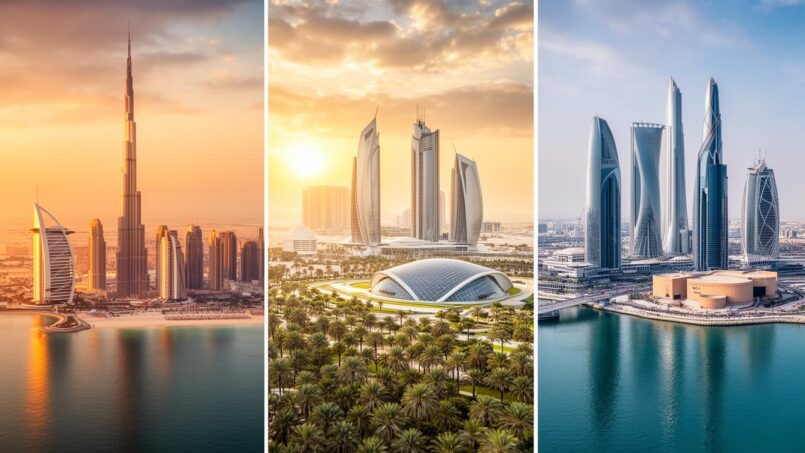
Choosing between Dubai, Abu Dhabi, and Doha in 2026 is no longer simply a matter of picking one of three Gulf postcards. It means comparing three development strategies, three tax regimes, and three real estate cycles that are not moving at the same pace. For an investor, each city tells a different story in terms of rental yield, capital appreciation, legal security, and tenant flow stability.
This article analyzes figures, laws, and economic trends to guide three types of investors in 2026: the yield hunter, the capital appreciation enthusiast, and the very cautious investor seeking stability.
Three markets, three logics
Behind the image of “Gulf cities” that look alike, Dubai, Abu Dhabi, and Doha actually follow very distinct dynamics.
Dubai remains the most liquid hub, the most international, and also the most speculative. The market massively attracts foreign investment, cycles are rapid, volumes are gargantuan, and volatility is higher.
Abu Dhabi, the political capital of the Emirates, follows a clearly planned strategy with real estate anchored to Vision 2030. This industrialization and diversification program aims for stability, upskilling jobs, and reducing oil dependence. The market is more regulated, less overheated, and yields are driven by long-term demand.
Doha, finally, plays the card of caution and gradual ascent. The country is emerging from the “post-World Cup” cycle, absorbing a regional geopolitical shock, but retains a solid demand base, an ultra-favorable tax framework, and often underestimated yields in certain districts.
To see clearly, you need to look at the numbers.
Taxation: structural advantage for Dubai, Abu Dhabi, and Doha
On the tax front, the three destinations share a key common point for the private investor: the absence of personal income tax.
Zero personal tax and very few capital taxes
In the Emirates (so in Dubai as well as Abu Dhabi), there is no income tax, no capital gains tax for individuals, and no wealth or inheritance tax. Profits generated from the resale of a property are taxed at 0% for individuals. VAT is limited to 5% on most goods and services, without directly affecting residential rents.
The federal corporate tax rate on profits exceeding AED 375,000 is 9%, but free zone exemptions keep some companies at 0% on their eligible income.
Qatar also offers a very attractive environment, but with a nuance: capital gains taxation exists at the corporate level, even though individuals remain largely protected.
Capital gains in Doha: mainly a concern for structures
The Qatari capital gains regime is structured around a standard rate of 10% for gains related to taxable activities (including real estate) and up to 35% for the oil and petrochemical sectors. This mainly targets companies. Individuals are often exempted provided the assets (real estate, securities) are not linked to a taxable professional activity.
Qatar does not tax personal income, does not levy an annual property tax on real estate ownership, nor private capital gains tax for an individual investor buying an apartment in Doha. This tax system is similar to the Emirati model with 0% income tax, 0% property tax, and 0% capital gains tax.
Thus, this trio of Dubai – Abu Dhabi – Doha shares a very favorable tax base for the private investor. The real difference lies elsewhere: in yields, price cycles, foreign investment rules, and the structure of rental demand.
Rental yields: who pays the most in 2026?
For an investor, the first concrete question remains: how much does a property earn in rent relative to its purchase price?
Dubai: solid yields, but compressing in some segments
Aggregated data for 2026 shows an average gross yield around 6 to 7% on residential, with strong disparities depending on the district and property type.
Studios and 1-bedroom units in mid-market areas like Jumeirah Village Circle (JVC), Sports City, Discovery Gardens, or International City continue to show gross yields in the range of 7 to 9%, sometimes up to 10% for entry-level small units. Villas, on the other hand, hover around 4.5 to 5.5% gross, especially in established communities like Arabian Ranches, Dubai Hills, or Emirates Living, where demand is very family-oriented and land values are higher.
Indices from 2025–early 2026 indicate that:
| Indicator (Dubai, residential) | Approximate Value |
|---|---|
| Overall average gross yield | ≈ 6.5–6.8% |
| Average apartment yield | ≈ 7.0% |
| Average villa yield | ≈ 4.6–5.0% |
| Typical mid-market range | 7–9% (studios/1BR) |
The rapid price increase over 2024–2025, combined with a wave of deliveries expected in 2026–2027, is starting to compress yields in some segments, particularly on off-plan resales between investors. Rents are already showing signs of softening in a few districts while sales prices remain high.
Abu Dhabi: tighter but more stable yields, with peaks above Dubai
Contrary to popular belief, Abu Dhabi is no longer the “soft little brother” of Dubai in terms of rental performance. Recent figures show a market capable of matching, or even exceeding, Dubai in several segments.
In 2025, gross yields for apartments on Al Reem Island, Masdar City, Al Reef Downtown, or Al Ghadeer often exceed 8%, sometimes reaching over 9%, while the general average is between 6 and 8%.
Some benchmarks:
| Area (Abu Dhabi, apartments) | Estimated Gross Yield |
|---|---|
| Al Reef Downtown | ≈ 9.3% |
| Al Ghadeer | ≈ 8.4–8.5% |
| Masdar City | ≈ 8.4% |
| Al Reem Island | ≈ 7.5–7.6% |
| Yas Island | ≈ 7.1–7.5% (net 7.5% cited) |
| Al Raha Beach | ≈ 6.5–6.6% |
Citywide, specialized reports place residential gross yield between 6 and 8%, with:
– Apartments around 6.5–7% gross,
– Villas around 4.8–5% gross, quite close to Dubai levels but with generally lower vacancy in communities linked to government, energy, and finance jobs.
When moving from gross to net (after charges, maintenance, and vacancy), comparative analyses show Abu Dhabi portfolios around 4–6% net, compared to 5–7% net for comparable properties in Dubai. But the difference narrows once tenant stability in Abu Dhabi is factored in.
Doha: lower average yield, but real “spots” at 6–9%
Qatar shows more contained yields on average, but with two very distinct realities: the overall market (all districts combined) and the truly investable areas for foreigners.
Aggregated data gives an average gross yield for Doha around 4.3–5.2%, depending on sources and periods. But once you zoom in on key neighborhoods (The Pearl, Lusail, West Bay, some mid-market areas), the numbers change significantly.
Real estate analysis
On The Pearl, for example, detailed estimates give:
| Property Type (The Pearl, Doha) | Average Price (US$) | Monthly Rent (US$) | Annual Gross Yield |
|---|---|---|---|
| Studio | 324,100 | 1,650 | ≈ 6.1% |
| 1 Bedroom | 425,800 | 2,250 | ≈ 6.3% |
| 2 Bedrooms | 604,300 | 3,020 | ≈ 6.0% |
| 3 Bedrooms | 846,000 | 4,120 | ≈ 5.8% |
| 4+ Bedrooms | 1,201,700 | 5,860 | ≈ 5.9% |
Outside of The Pearl, some areas of Doha show higher yields, especially on small units near employment hubs:
| Property Type (other Doha areas) | Average Price (US$) | Monthly Rent (US$) | Annual Gross Yield |
|---|---|---|---|
| Studio | 233,500 | 1,510 | ≈ 7.8% |
| 2 Bedrooms | 425,800 | 2,540 | ≈ 7.2% |
Overall 2025–2026 trends, however, converge toward a 4 to 6% gross range on average in Doha, with pockets of 6–7% in well-positioned districts, particularly in Lusail (4.3–6.9%) and some well-served mid-markets.
Comparative summary of typical gross yields in 2026:
| City / Segment | Typical Gross Yield Range |
|---|---|
| Dubai – mid-market apartments | 7–9% (peaks 10% on small units) |
| Dubai – villas | 4.5–5.5% |
| Abu Dhabi – targeted apartments | 7–9% (over 9% in Al Reef/Al Reem) |
| Abu Dhabi – villas | 4.8–5.5% |
| Doha (overall average) | 4–5.5% |
| Doha – The Pearl / Lusail | 5.5–7% |
For the sole logic of pure rental yield in the short to medium term, Dubai (mid-market) and Abu Dhabi (targeted investment areas) take the lead, with a slight edge for Abu Dhabi when factoring in tenant stability and lower volatility.
Price growth and cycles: rapid growth vs. stability
Rental yield isn’t everything. An investor buying in 2026 must also ask: what are the capital appreciation prospects over 5 to 10 years?
Dubai: a cycle reaching maturity, but not over
Recent figures illustrate a phase of prolonged outperformance. Over 2024 and 2025, residential prices rose by double digits, with:
– An annual increase of about 15% for apartments,
– Villas even more dynamic,
– An average value per square meter around 1,900–2,000 AED in Q1 2026.
Volumes remain impressive: over 200,000 residential transactions the previous year, for nearly AED 540 billion, then over 60,000 transactions for AED 252 billion in a single quarter according to some sources. The market has posted 22 consecutive quarters of growth.
But 2026 also marks a turning point: the first corrections are appearing, especially in off-plan resales, with discounts of 10 to 15% off initial prices in some projects and a temporary monthly decline in value indices. Several analysts (Fitch, Goldman Sachs, etc.) mention a moderate correction phase, with scenarios of an annual decline of 7% over 2026–2028 in the most pessimistic assumptions, or about 15% cumulative by end of 2026 relative to the 2025 peak.
However, the central scenario remains one of a soft landing rather than a crash, supported by:
– Rising demographics,
– Solid rental demand,
– Diversification of international demand.
The potential for capital gains remains but becomes highly segmented. Location, developer quality, connectivity, and land scarcity are now decisive for the long-term investor.
Choose sought-after areas with strong economic and demographic momentum.
Prioritize developers recognized for their reliability and quality of delivery.
Proximity to transport (metro, major arteries) to ensure the property’s attractiveness.
Invest in areas where land is scarce to secure long-term appreciation.
Abu Dhabi: the rise driven by Vision 2030
Abu Dhabi follows a very different trajectory. The Economic Vision 2030, launched over fifteen years ago, aims to transform the economy into a diversified, competitive system with little dependence on oil. This roadmap translates directly into real estate.
The strategy is clear: measured growth, strict supply management, massive investments in infrastructure and high-value-added sectors (finance, technology, green energy, health, education, logistics, advanced industry). Result:
– A real estate market described as “data-driven” and carefully managed,
– A deliberately limited supply to avoid oversaturation,
– Steady progression in rents and values without violent surges.
Commercial real estate performance attests to this solidity: prime offices offer average yields of 7 to 9%, and industrial/logistics assets in KIZAD show even higher returns, boosted by regional trade, manufacturing, and e-commerce.
On the residential side, transactions are also booming: early 2026, real estate activity hit records with over 160% volume growth to reach AED 66 billion in transactions in the first quarter. This momentum is less based on short-term speculation than on:
– The gradual opening of new freehold zones to foreigners (with a 15% increase in freehold areas for non-Emiratis in 2026),
– The rise of landmark projects: Hudayriyat (ultra-high-end coastal district), Fahid Island (wellness-focused residential), Saadiyat (global cultural hub with Louvre, Abrahamic Family House, future Guggenheim), and urban projects like Zayed City or Masdar City,
– A visa policy favoring skilled profiles and long-term settlement.
For a patient investor, Vision 2030 offers a readable framework until the end of the decade: the city is positioning itself as a global real estate hub with population growth, infrastructure (metro, tram, bus, bridges, roads), and highly skilled jobs driving demand for housing and offices.
Doha: between consolidation and the next wave
The residential market in Doha and Qatar has experienced several successive phases: expansion linked to World Cup projects, consolidation with pockets of oversupply, and since 2025–2026 a gradual stabilization, amid geopolitical uncertainties.
Macro figures show:
– A residential market estimated at $14.36 billion in 2026,
– Growth from $13.45 billion in 2025,
– A projection close to $20 billion in 2031,
– A compound annual growth rate around 6.8% over 2026–2031.
The value of residential sales increased by more than 43% in 2025 according to Knight Frank.
Doha remains a smaller and more segmented market: the choice of district weighs much more than the “city average.” The price stabilization observed through ValuStrat indices (residential index nearly stable, slight annual increase, especially on villas) suggests a market in a digestion phase rather than structural decline.
The next wave of growth could be driven by:
– Expansion of gas capacity (North Field East, coming online around 2026),
– The permanent residency program linked to real estate investment (long-term visa from USD 200,000 in property),
– Preparation for the 2030 Asian Games,
– Continued economic diversification toward finance, tourism, services.
For the investor, this means a terrain suited to careful selection: some areas outperform (Lusail, The Pearl, well-served districts) while others still suffer from excess supply or insufficiently deep demand.
Legal security and regulation: Abu Dhabi clearly takes the lead
Beyond yields and growth, the quality of legal protection matters enormously, especially for the foreign investor. On this front, Abu Dhabi stands out in 2025–2026 with a deep overhaul of its real estate framework.
Abu Dhabi: a pro-investor legislative arsenal
The amendment of Law No. 3 of 2015 by Law No. 2 of 2025 significantly strengthens buyer protection, particularly in the off-plan segment.
Some key points:
Buyers’ funds are mandatorily placed in regulated escrow accounts. Developers can only access them after 20% construction progress, unless a derogation with a bank guarantee is obtained. For early releases, developers must be registered for 4 years, have delivered 3 projects on time, and have a clean record. Escrow funds cannot finance land or commissions. In case of cancellation, full refund is provided in the early phase, with deductions of 10 to 40% depending on progress. Any amount collected illegally outside escrow must be refunded within 30 days of notification.
In parallel, Administrative Decision No. 25/2025, effective from February 2026, imposes a strict governance framework for condominiums and communities: mandatory appointment of an accredited management company, term limits for mandates, strict control of charges by ADREC and the Department of Municipalities and Transport (DMT), requirement for detailed budgets, and a ban on demanding a single annual payment (monthly or quarterly payment mandatory).
Finally, the distinction between service charges and maintenance fees is clarified, and any billing not approved by the authority becomes illegal and thus unenforceable.
In practice, Abu Dhabi thus offers the foreign investor:
– A very interventionist government environment favoring transparency,
– Strict oversight of developers and managers,
– Explicit compensation and refund mechanisms in case of contingencies.
Dubai: a very structured market but more exposed to cycles
Dubai also has a solid regulatory framework: mandatory escrow accounts, systematic registration of transactions, public databases, official designation of freehold zones, etc. But the enormous depth of the market, the explosion of off-plan (nearly 70% of sales in 2025–2026), and the fierce competition among developers mechanically create more volatility.
Free zones like DIFC offer legal security through common law but mainly concern commercial or high-end real estate.
On the residential side, legal security is good, but supply discipline remains looser than in Abu Dhabi. Dubai has often let the market correct after phases of exuberance, whereas Abu Dhabi strives to anticipate excess supply.
Doha: a protective framework but still under construction
In Doha, the legal environment has evolved significantly over the past decade, with:
– Opening of freehold and usufruct zones specifically for foreigners (The Pearl, Lusail, West Bay Lagoon, etc.),
– A permanent residency program linked to real estate investment above a threshold (approximately QAR 730,000 according to the mentioned scheme),
– Progressive regulation of projects and developers.
The capital gains tax for structures requires particular vigilance in structuring investments (individual vs. local or foreign company). However, a series of exemption measures cover many cases, particularly for individuals, transactions not linked to a taxable activity, and intra-group reorganizations.
For an individual, legal risk is not the main concern; the bigger issues are liquidity (ease of resale) and buyer market depth in each district.
All three cities have understood that you don’t sustainably attract capital without offering clear property rights and attractive residency statuses to foreigners.
Dubai and Abu Dhabi: massive freehold and Golden Visa
In the Emirates, the logic is simple: in freehold areas, a foreigner can buy a property in full ownership, with a registered title, possible mortgage from local banks, and free resale rights.
Since 2019, foreigners can own in full ownership in Abu Dhabi’s investment zones (Saadiyat, Yas, Al Reem, etc.), expanded by 15% in 2026. However, 40% of residential remains reserved for nationals and GCC, concentrating foreign demand on these zones and potentially supporting their prices.
Both emirates also offer investor visas and Golden Visas conditional on the property value, typically around AED 2 million net value (excluding debt) for 10-year long-term residents. The exact framework of thresholds and modalities evolves rapidly, but the strategic axis is clear: those who buy quality real estate and maintain a certain net worth level are offered an attractive resident status.
Doha: permanent residence and open to long-term expats
Qatar is not to be outdone. The country has introduced a permanent residency policy linked to real estate investment, with the possibility of obtaining long-term resident status from a real estate investment of approximately USD 200,000 in eligible areas.
Attractive zones for expats and foreign investors are well identified:
– The Pearl, high-end segment and pioneer of freehold,
– Lusail, iconic smart city, highly sought after for its modernity,
– West Bay, business and expat heart,
– Other increasingly accessible areas for foreign capital, particularly in integrated projects.
This policy gradually transforms some transient expats into long-term owners, which strengthens demand stability, especially for apartments and condos near employment hubs.
Investor profiles: who should go where in 2026?
With all this context, the real question becomes: for a given investor, which city stands out?
1. The “yield & cash-flow” investor: advantage Abu Dhabi, then Dubai mid-market
Those seeking above all a high and predictable rental yield, without aggressive price speculation, will find a prime destination in 2026 in Abu Dhabi.
Areas like Al Reef Downtown, Al Ghadeer, Masdar City, Al Reem Island, or Yas Island combine:
– High gross yields (often between 7 and 9%, sometimes more),
– Moderate vacancy thanks to a base of public sector jobs, energy, finance, education,
– Strict oversight of developers and condominium governance,
– Prospects for moderate but steady appreciation, driven by the major Vision 2030 projects, infrastructure, and growth in high-end tourism.
Dubai remains an excellent option for yield, particularly in highly liquid mid-market districts (JVC, Sports City, Discovery Gardens, International City), with 7 to 9% gross and easy exit. But competitive rental pressure could intensify as 2026–2027 deliveries hit the market.
Doha, with yields centered more around 4 to 6% gross, will be less attractive for a purely cash-flow-oriented investor, unless targeting specific niches (well-located studios, 1–2 bedrooms in Lusail or The Pearl).
2. The “capital appreciation & liquidity” investor: Dubai leads, Abu Dhabi rising
For those willing to accept more volatility in exchange for strong capital gains potential, Dubai remains the regional benchmark. The market is:
The annual number of transactions in this real estate market of unparalleled depth.
The flip side: a cycle already well advanced, prospects for partial correction in some segments, and significant performance gaps between the best and worst projects.
Abu Dhabi, with its more contained but better-controlled growth, offers an interesting profile for “reasoned” capital appreciation: gains of 15 to 20% have already been seen between off-plan launch and delivery on well-positioned projects, especially when they benefit from environmental requirements (Estidama label, Pearl Rating) that reduce operating costs and increase rental appeal.
In Doha, annual price growth is between 1 and 4%, mainly in premium districts where prices are already high. The interest is not in rapid capital appreciation, but in the gradual valorization of well-located assets, driven by major events and growth in non-energy sectors by 2030.
3. The “security and stability” investor: Doha and especially Abu Dhabi
For a very risk-averse investor, ready to forgo a few points of yield to maximize legal security, macroeconomic stability, and visibility of public policies, Abu Dhabi clearly stands out.
Vision 2030 is not just a slogan: it serves as a legislative and financial manual for the government to:
– Allocate infrastructure budgets,
– Reform foreign ownership,
– Steer transport development,
– Set environmental standards (via Estidama and the Pearl Rating),
– Diversify the economy toward high-value-added services.
The real estate laws of 2025–2026 further reinforce this “stability engineering” profile: no massive speculative overflow, rigorous developer selection, charge oversight, and controlled expansion of investment zones for foreigners.
Doha, for an ultra-cautious investor, also remains appealing: light taxation, reasonable yield, a stabilizing market, and infrastructure already in place thanks to massive World Cup cycle investments. But market depth is less than in the Emirates, and resale liquidity can be more limited depending on the district.
Dubai vs. Abu Dhabi vs. Doha: strategic synthesis
In 2026, saying that a single city “wins” the match would be misleading. Each market offers a different “package,” and the right choice will depend on the investor’s profile, horizon, and risk appetite.
We can, however, summarize the relative strengths as follows:
| Main Criteria | Dubai | Abu Dhabi | Doha |
|---|---|---|---|
| Gross rental yield | 6–7% (7–9% mid-market) | 6–8% (7–9%+ on some apartments) | 4–6% (5.5–7% in best spots) |
| Capital appreciation potential | High but highly cyclical | Moderate but guided by Vision 2030 | Modest to medium, depending on district |
| Price volatility | High | Low to medium | Medium |
| Depth and liquidity | Very high | Strongly increasing | Medium |
| Legal protection | Good | Very strong (2025–2026 reforms) | Fair, improving |
| Taxation for individuals | 0% income, 0% capital gains, 0% wealth | Same as Dubai | 0% income, 0% property tax, private capital gains often exempt |
| Demand profile | Very international, multi-segment | Governments, energy, finance, high-end tourism | Expats, energy, services, post-2022 projects |
In practice:
Three distinct real estate investment strategies depending on your objectives: moderate yield, liquidity and capital appreciation, or conservative profile.
Well-located apartments (Al Reef, Al Reem, Masdar, Yas) offer attractive net yields at moderate risk, among the best in the Gulf in 2026.
Dubai’s mid-markets and some prime districts combine yield and high liquidity, with substantial capital appreciation potential, but require selectivity and awareness of correction risks.
Well-chosen assets in Doha (Lusail, The Pearl, West Bay) offer diversification with a conservative profile and light taxation, in a market consolidating before new growth (gas, tourism, sports events).
Ultimately, the best answer to “Dubai vs. Abu Dhabi vs. Doha: where to invest in real estate in 2026?” is probably not an exclusive choice, but an intelligent allocation across these three markets, leveraging their complementarities: Dubai for liquidity and global visibility, Abu Dhabi for disciplined yield and long-term stability, Doha for the rare combination of no personal taxation, decent yields, and gradual rise.
For a well-constructed regional portfolio, it is essential to include all three elements. The key is to buy quality assets in districts supported by solid economies (jobs, infrastructure, public policies), avoiding the chase for headlines and short-term surges.
A wealth project or a question? Contact us now to speak with a wealth management expert.
Disclaimer: The information provided on this website is for informational purposes only and does not constitute financial, legal, or professional advice. We encourage you to consult qualified experts before making any investment, real estate, or expatriation decisions. Although we strive to maintain up-to-date and accurate information, we do not guarantee the completeness, accuracy, or timeliness of the proposed content. As investment and expatriation involve risks, we disclaim any liability for potential losses or damages arising from the use of this site. Your use of this site confirms your acceptance of these terms and your understanding of the associated risks.

Cyril Jarnias is an independent expert in international wealth management with over 20 years of experience. As an expatriate himself, he is dedicated to helping individuals and business leaders build, protect, and pass on their wealth with complete peace of mind.
On his website, cyriljarnias.com, he shares his expertise on international real estate, offshore company formation, and expatriation.
Thanks to his expertise, he offers sound advice to optimize his clients' wealth management. Cyril Jarnias is also recognized for his appearances in many prestigious media outlets such as BFM Business, les Français de l’étranger, Le Figaro, Les Echos, and Mieux vivre votre argent, where he shares his knowledge and know-how in wealth management.





