
 Published on and written by Cyril Jarnias
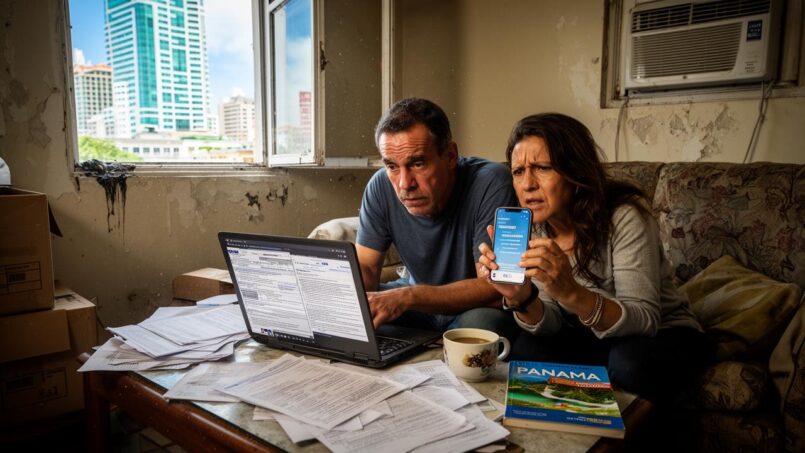
Moving to Panama is a dream for many: tropical climate, territorial tax system, cost of living often lower than in North America or Europe, and a pleasant lifestyle for retirees and working people alike. But behind the postcard, the same mistakes keep recurring among newcomers, to the point that some end up leaving just a few months later.
Visas, documents, banking, real estate, healthcare, rentals, climate, taxes: most problems are predictable and avoidable with minimal preparation, without involving bad luck or scams.
This article reviews, in a very concrete way, the main pitfalls and mistakes to avoid before moving to Panama, based on factual information from specialized reports and feedback from expats already living there.
Poorly preparing your project before even setting foot in Panama
Before talking about visas, bank accounts or real estate, the first major pitfall is psychological: leaving without having tested the country, or with completely unrealistic expectations.
Many newcomers arrive with a fantasy image of a “cheaper, simpler, warmer” life and discover, once there, that reality doesn’t match their imagination. They often leave after six months, frustrated, when minimal preparation could have prevented the shock.
Skipping the scouting trip and neglecting regional research
One of the most common mistakes is to decide everything from your couch, without actually spending a real exploratory stay in Panama. Data shows that moving to a country you’ve never really tested very often ends in a quick return.
Better to plan at least two scouting trips, 10 to 14 days each, in different seasons (dry season and rainy season). The goal is not to tour the country as a tourist, but to experience daily life: grocery shopping, using transportation, visiting residential neighborhoods, and talking to expats and locals on the ground.
It is crucial to test several areas: Panama City, Pacific beaches like Coronado, small mountain towns like Boquete or Volcán, or more local provincial cities. Each region offers a different trade-off between cost of living, climate, healthcare access, infrastructure, and social atmosphere.
Relying on Facebook groups and forums
Another major pitfall: treating social networks as reliable sources. Expats groups are full of strong opinions, often contradicted three posts later. Many of those who respond are themselves recent arrivals, have only a partial view of the country, and spread outdated or incorrect information, especially about immigration laws.
Discussing your financial situation or investment plans on these forums attracts shady characters and scammers. Better to use them for social networking than as a source of legal or financial information.
Refusing to learn Spanish and wanting to live “in English”
Many reassure themselves by saying that “in Panama City everyone speaks English.” In practice, some Panamanians speak very good English, especially in tourist-heavy areas or large private clinics. But it’s not the norm, and even less so once you leave the business districts.
Living permanently in Panama without speaking Spanish complicates everything: administrative procedures, healthcare outside high-end private clinics, everyday small services, relationships with neighbors. Cultural integration comes through language: Spanish is the key to understanding society, making local friends, and avoiding misunderstandings.
Not learning Spanish locks you into an expat bubble and makes you vulnerable in delicate situations like healthcare, paperwork, or a conflict with a landlord.
Miscalculating the real cost of living
Many arrive with the myth of a “cheap” country without nuance. The reality is more subtle: Panama can be affordable if you adopt a lifestyle close to that of locals and avoid the most expensive neighborhoods and consumption habits.
Available figures show that a single person can live very reasonably in the interior (Boquete, Coronado…) with a monthly budget around 1,600 to 2,200 USD, including rent. But a couple living comfortably in Panama City in a decent neighborhood runs more like 2,800 to 3,800 USD per month, and a family of four in a “premium” mode in the capital easily climbs to 4,500 – 6,500 USD.
The table below broadly illustrates a few realistic monthly budget profiles:
| Profile and location | Estimated total monthly budget | Main expense item |
|---|---|---|
| Single – interior (Boquete…) | 1,600 – 2,200 USD | Rent 1-bedroom: 700 – 1,000 USD |
| Couple – Panama City (comfortable) | 2,800 – 3,800 USD | Rent 2-bedroom: 1,200 – 1,800 USD |
| Family of 4 – Panama City (premium) | 4,500 – 6,500 USD | Rent 3-bedroom: 2,000 – 3,000 USD |
Thinking you can live “very well” on 1,000 USD in Panama City in a central neighborhood is an illusion. Yet, leaving with an unrealistic budget leads straight to debt, stress, or even a forced return.
Panama’s visa system attracts many expats, especially thanks to the famous Pensionado visa and visas for investors or citizens of friendly countries. But here again, the most common mistakes are avoidable.
Choosing the wrong visa type or believing in “shortcuts”
A first pitfall is following the advice of a pseudo-intermediary who offers “the easiest path” without checking with a real immigration lawyer. Some jump into a residence category that doesn’t suit their profile, simply because an agent told them it was easy.
However, each visa has specific criteria. For example, the Retiree (Pensionado) visa is based on proof of a lifetime guaranteed pension income of at least 1,000 USD per month (or 750 USD if you buy real estate worth at least 100,000 USD). Showing you have savings is not enough: this visa is based on the structure of the income (lifetime pension), not on assets.
Other visas require well-defined investments: a time deposit of 300,000 USD, real estate purchase of at least 300,000 USD (Decree 193 of 2024), or minimum amounts of investment in securities. Jumping into the wrong category because you didn’t fully understand the requirements wastes months and a lot of money.
Believing you can live on “visa runs” without residency
Another pitfall is imagining you can do border runs every few months to renew your tourist stay, as was sometimes done in the past. Immigration authorities are increasingly monitoring these practices, and staying in a gray area is neither comfortable nor sustainable.
To obtain permanent residency in Panama, you must first get a provisional residence title valid for two years, according to Executive Decree 197 of 2021.
Underestimating the complexity of documents (apostilles, translations, deadlines)
The biggest source of rejection or delay in residence applications comes from documents, not from ineligibility. Informal statistics from law firms are very revealing: apostille and translation errors are the number one cause of problems.
Some documents must be apostilled in the country of origin: birth certificate, criminal record, marriage or divorce certificate, pension letter, university degrees for certain specific visas. Others must never be apostilled (CV, employment letters, personal bank statements, pension payment screenshots, utility bills).
The typical mistake: having everything apostilled, including bank statements or screenshots, which costs time and money with no use for Panamanian authorities. Panama seeks to verify the authenticity of government documents or pension agency documents, not the layout of an online bank PDF.
The full apostille + translation sequence can take 6 to 12 weeks.
The real trap is treating the apostille as a two-week formality, and starting the process too late. Result: documents are ready too old or expired when you arrive in Panama City.
The following table summarizes, for guidance, some validity rules and apostille requirements that often cause problems:
| Document | Apostille required? | Typical accepted validity | Common errors |
|---|---|---|---|
| Birth certificate | Yes | < 6 months | Document too old, illegible apostille |
| Criminal record | Yes | < 90 days | Wrong authority level, incorrect apostille |
| Marriage/divorce certificate | Yes (if used) | < 6 months | Using original instead of certified copy |
| Pension letter | Yes | < 6 months | Does not mention “lifetime” or “permanent” |
| Online bank statements | No | Approx. 30 days | Apostilling wrongly, non-official documents |
| CV, employment letters, bills | No | — | Apostilling when completely unnecessary |
Added to this is the question of translations: any foreign document must be translated into Spanish by a sworn translator in Panama (“traductor autorizado”). Translations done abroad, even by professionals, are generally not accepted.
Again, a common pitfall is to translate the documents before the apostille, or by a translator not recognized by Panamanian authorities. This leads to paying twice.
Letting your documents expire before filing the application
Documents have strict expiration dates: criminal record valid for 90 days, bank statements often 30 days, civil status certificates and pension letters generally accepted if less than 6 months old. Additionally, an apostille older than six months at the time of filing is often considered problematic.
Many make the mistake of gathering all their documents way too early, having them apostilled, then planning the trip several months later. By the time they submit the application, the documents are partially expired, forcing them to start over.
The right strategy is to work closely with a Panamanian immigration lawyer, send them scans BEFORE any apostille for validation, and then launch the authentication procedures as close to your departure date as possible.
Poorly wording the pension letter and fabricating fake “regular income”
For the Pensionado visa, the pension letter is a key document. It must explicitly state that the income is guaranteed for life (“lifetime” or equivalent), specify the amount and its source. Many applications are rejected because the letter mentions a temporary income, or simply describes monthly payments without specifying it is a lifetime right.
Another common mistake: trying to “simulate” a retiree profile by making large transfers into your account to fake income, or presenting investment income, rents, or dividends as a “pension.” Immigration authorities are very sensitive to these setups, which trigger in-depth checks.
Believing the Pensionado visa allows you to work
The Pensionado visa grants permanent resident status, but it explicitly prohibits taking a job in Panama or selling your services on the local market. A retiree who plans to supplement their income by working for a Panamanian company or offering services locally cannot rely on this visa.
Regarding remote work for a foreign employer, public texts are often ambiguous. Do not assume everything is allowed simply because the employer is abroad. If remote work is part of your plan, it is prudent to clarify the situation with a lawyer specialized in immigration and, if needed, in labor law and taxation.
Bank accounts: underestimating the system’s rigidity
Opening a bank account in Panama is another major minefield for newcomers. The belief that it’s a two-day formality like in the US or Europe leads to big disappointments.
Trying to open an account without residency
The main pitfall is wanting to open an account as a non-resident, before obtaining at least a provisional residence card. Panamanian banks have very strict policies regarding anti-money laundering and international compliance (FATCA, CRS).
Result: a non-resident often faces high minimum deposits (sometimes 10,000 to 250,000 USD), enhanced monitoring, or outright refusal. However, once you have a residence card (temporary or permanent) and a resident ID (cédula E), opening an account becomes much simpler, with deposit thresholds around 500 to 5,000 USD at many banks.
In most cases, it is better to finalize your residency before opening a bank account, not the other way around.
Arriving with outdated or inconsistent documents
Banks require recent documents (often less than 3 to 6 months), legible, and mutually consistent: valid passport, second ID, proof of address, bank reference letters, sometimes a credit report from your home country, proof of economic activity (contracts, tax returns…).
Arriving with a bank reference letter dated six months ago, or a passport close to expiration, very often leads to a refusal. Similarly, if information diverges (different declared address, profession incompatible with the nature of expected flows, declared income too low relative to amounts that will pass through), the bank may block or refuse the opening.
Overlooking bank reference letters
Another very common mistake: ignoring that Panamanian banks almost always require one or two reference letters from other banks where you’ve had a long-term relationship (often at least two years). These letters must be on official letterhead, mention the length of the relationship and good account standing.
Not preparing the letters in advance or arriving with a simple self-printed bank statement greatly complicates opening the account.
Spreading yourself across multiple banks and showing up without an appointment
Submitting opening requests at five or six banks at the same time, hoping one will eventually accept, is also a pitfall. Each request can trigger a credit check, and the accumulation of such inquiries ends up harming your file, not to mention the confusion it creates.
Most institutions do not accept account openings for foreigners “on the spot” without an appointment. Showing up unannounced, without preparation or an intermediary, generally leads to a polite refusal. Again, going through a lawyer who knows the requirements of a given bank and makes an appointment on your behalf avoids many disappointments.
Real estate: confusing tropical dream with legal reality
The Panamanian real estate market attracts many expats: ocean-view apartments in Panama City, mountain houses in Boquete, beachfront lots… But it’s also an area full of pitfalls.
Buying too quickly, without a rental phase
The first major mistake is wanting to buy during or right after the move, without a prior rental period. The recommendation from most serious players is clear: rent for at least 6 to 12 months before considering a purchase.
It takes time to understand neighborhood dynamics, the reality of the climate, access to services, even concrete factors like flood or landslide risk. Many people buy a property in a city they can no longer stand six months later and find themselves trapped.
Confusing “title deed” and “possessory right”
The biggest legal pitfall in land matters is called “derecho posesorio” (possessory right, or ROP). This is a right to use a piece of land that remains, in principle, state property. ROP does not offer the same guarantees as a true title deed (finca) registered in the Public Registry.
Buying land in the Republic of Panama (ROP), especially in rural or coastal areas, exposes a foreigner to several risks: inability to obtain a mortgage, difficulty reselling, potential disputes over possession, overlapping rights, or lack of recognition by certain institutions.
The common mistake is to believe that a notarized contract is enough to secure ownership. In Panamanian law, it is registration in the Public Registry, with a finca number, that gives general enforceability to property rights. Without this registration, the buyer’s position remains fragile.
A basic reflex is therefore to demand the finca number before any serious negotiation. If there isn’t one, you are at best dealing with a possessory right, with a completely different risk profile.
Trusting an agent or developer without an independent lawyer
Another pitfall: thinking that the real estate agent “represents” the buyer’s interests. The Panamanian system does not work like in some countries where the agent has strong fiduciary obligations toward the client. Here, the buyer’s protection depends essentially on the lawyer they hire.
Not hiring an independent Panamanian lawyer specialized in real estate to check the title, tax status, mortgages, easements or litigation exposes you to nasty surprises like a property encumbered with debts, a registration defect, zoning restrictions, or a non-compliant building. Given the slowness and cost of legal proceedings, it is more cost-effective to pay for thorough due diligence than to hope to win a later lawsuit.
Many focus on the purchase price of an apartment or house and neglect associated costs. In practice, a buyer should anticipate at least:
– a 2% transfer tax,
– a 3% capital gains withholding in some cases,
– legal and notary fees typically between 1 and 2% of the price,
– possible arrears on HOA fees or unpaid taxes.
On a property worth 300,000 USD, the transfer tax alone is about 6,000 USD, excluding fees and other costs.
Ignoring climate risks (floods, landslides)
Panama experiences a marked rainy season, generally from May to November. Heavy rainfall, especially at the end of the season (September–October), causes floods and landslides every year in certain areas, particularly in vulnerable neighborhoods of the capital and in mountain regions like Boquete, Volcán, or El Valle de Antón.
In the absence of a national public flood zone mapping system (like FEMA), the buyer must analyze topography using tools like Google Earth, ask neighbors if the street has ever flooded, check with the municipality if the land is in a risk area, and inspect drainage infrastructure.
Failing to do this preparatory work, or buying a house at the foot of an unstable slope just because the view is great, is a very common pitfall… one you only discover once heavy rains return.
Falling for promises of Airbnb income
With the rise of short-term rentals, many developers sell apartments promising spectacular returns through Airbnb or similar platforms. However, in Panama City, rentals of less than 45 days are prohibited in standard residential buildings, unless the building has a specific tourism permit.
Buying a property thinking you can turn it into a cash machine through short-term rentals, without checking the building and neighborhood regulations, is an expensive pitfall. You absolutely must inquire about the HOA rules, zoning, and tourism permits before basing any economic model on this type of rental.
Rentals and scams: getting tricked before even getting the keys
Even without buying, the rental phase has its own risks, both legal and fraudulent.
Renting without seeing the property, based solely on an online ad
Rental scams have multiplied, especially on Facebook Marketplace or English-language ads targeting foreigners. The most common schemes involve offering an attractive property at an abnormally low price, asking for a security deposit or months of rent in advance to “hold” the unit, then disappearing.
Some ads use stolen photos from platforms like Zillow or other portals to give a veneer of credibility. Others stage fake engineers or contractors who claim to be renting to house their workers and send fake wire transfer confirmations, then ask the owner to “send back” a small amount to cover an emergency.
Red flags of a rental scam include an absent landlord, refusal to allow a visit, pressure to pay quickly, rents well below market rate, and no formal contract. The golden rule is never to send money for a property you haven’t physically visited and for which you haven’t signed a proper lease.
Neglecting the lease contract and its clauses
In Panama, a written lease is the norm, with mandatory elements: description of the property, duration, rent amount, security deposit, termination conditions, maintenance responsibilities, etc. Each lease renewal requires a new signature.
Signing a contract without a reliable translation or explanation is risky, especially without mastering legal Spanish. Paying a year’s rent upfront for a discount increases exposure in case of disputes or problems with the landlord.
Paying through non-traceable methods and not keeping evidence
Sending money through unsecure transfer services, or agreeing to pay a deposit into a personal account without an invoice or receipt, is another frequent pitfall. Keeping screenshots of the ad, correspondence, payment receipts at least gives you evidence in case of dispute or attempted fraud.
Working with a licensed agent, whose license number you can verify with the relevant authorities, and asking for property ownership documents (or a recent certificate from the Public Registry) are basic protections.
Healthcare: idealizing the system or getting the wrong coverage
Panama has a three-tier healthcare system: two public (CSS and MINSA) and one private, the latter being the one most expats use daily. Again, misunderstandings are numerous.
Thinking everything is “almost free” and that you don’t need insurance
It is true that public care is very cheap for those who are affiliated (a few dollars for a CSS consultation, for example). But the public system (especially MINSA) suffers from chronic underfunding, long waiting times, and material conditions sometimes far from Western standards.
The cost of a private hospitalization in Panama City can reach several thousand dollars per day for complex cases.
Not taking out insurance, thinking “at worst I’ll pay out of pocket” is therefore a potentially dramatic mistake. The most sensible recommendation is to look for appropriate private insurance BEFORE moving, carefully examining: coverage limits, exclusions, pre-existing condition coverage, age limits, and third-party payment arrangements in Panamanian hospitals.
For Americans, Medicare or Medicaid cannot be used in Panama. Many discover too late that these programs do not cover care outside the US, leaving them without a local safety net. For Europeans, public health insurance schemes are also limited or inoperative abroad, except for temporary stays.
From a healthcare perspective, you essentially start from scratch in Panama. Access to the private sector depends on your ability to pay or the quality of your private insurance.
Ignoring the geographic dimension of healthcare access
The level of care is not uniform across the country. Panama City has the best hospitals and most specialists, followed by David (Chiriquí) which offers solid services. The farther you are from these major centers, the more limited the supply, both in quantity and quality.
Choosing to live in a very remote area without considering access to specialized care, or without a clear plan for evacuations to the capital in case of a problem, is a common pitfall. This risk is even greater for retirees or people with chronic medical conditions.
Climate, rainy season, and natural hazards: confusing tropical with paradise
Panama’s tropical climate is attractive, but don’t underestimate its practical implications.
Underestimating the rainy season and flood risk
The rainy season (roughly May to November) follows a fairly regular pattern: often clear mornings, humidity building through midday, heavy downpours in the afternoon for one to a few hours. In some recent years, episodes of intense rainfall late in the season have become particularly pronounced, with consequences in terms of flooding and landslides.
The majority of natural disasters recorded in Panama province are related to floods, which account for most economic losses.
Living in Panama therefore requires integrating this risk: choose a house on higher ground if possible, check the quality of drainage, observe the surroundings during rainy periods, avoid driving during violent storms on unfamiliar roads, and stay alert to civil protection alerts (SINAPROC).
Ignoring the difference between the Pacific coast, Caribbean coast, and highlands
The country has marked microclimates. The Caribbean coast (Bocas del Toro, Colón) is much wetter than the Pacific coast; mountain regions like Boquete receive more precipitation than the capital. Some high-altitude areas also have an increased risk of landslides during heavy rains.
Not accounting for differences in heat and humidity between areas can cause concrete problems: damp house, cut-off roads, flooded garden. A seasonal scouting trip on the ground is essential to grasp these nuances and avoid disappointments.
Taxation: believing you escape all taxes
Panama’s tax system is very attractive for expats, but it is often misunderstood.
Believing Panama taxes “at 0%” all income
Panama actually operates on a territorial principle: only Panamanian-source income is taxable locally. Foreign pensions, dividends from US stocks, rents from properties abroad, or salary paid by a foreign company for work done for it are in principle considered foreign-source income and therefore not taxed in Panama.
This does not mean everything is exempt: a salary paid by a Panamanian company for work performed in Panama, or rents from a property located in Panama, do fall into the local tax base, with a progressive rate that can go up to 25% for the highest incomes.
Forgetting about your home country’s taxes (especially for Americans)
For a US citizen or green card holder, the IRS continues to tax based on citizenship, regardless of residence. There is no comprehensive tax treaty between the US and Panama to avoid double taxation.
An American living in Panama must declare their income (Form 1040) and their Panamanian bank accounts via FBAR (FinCEN 114) once the total exceeds 10,000 USD, and via FATCA (Form 8938) above higher thresholds. To avoid double taxation, they can use the Foreign Earned Income Exclusion (FEIE) or the Foreign Tax Credit (FTC).
A tricky point: since Panama does not tax most of this foreign income, there is often no Panamanian tax to credit on the US side. Optimization therefore mainly goes through the FEIE for earned income, which requires meeting specific criteria (330-day test or bona fide residence test).
Setting up complex legal structures without specialized advice
Creating a Panamanian corporation or a private interest foundation can be perfectly legal and make sense for certain purposes (asset protection, estate planning, etc.). But for nationals of countries with complex tax systems, especially Americans, these structures can be considered foreign entities (trusts, controlled corporations, etc.), leading to heavy reporting obligations (Form 5471, 3520, 3520-A, 8621 for PFIC-type funds, etc.).
Launching a setup based solely on a commercial pitch about tax optimization or anonymity, without consulting a tax professional from your home country, can lead to penalties and costly litigation.
Culture, safety, and integration: behavioral mistakes
Finally, a set of difficulties stems simply from cultural gaps or careless behavior.
Imposing your cultural codes and openly criticizing the country
Panama has its own culture, marked by Catholicism, respect for elders, a certain distance from direct confrontation, and a more “tranquilo” relationship with time. Arriving demanding that everything work like “back home,” constantly criticizing the country, or making negative comparisons with your home country creates barriers with locals.
To avoid seeming disrespectful, it is important to greet people when entering a room, not to point fingers, raise your voice, or show impatience. Conversely, adopt simple codes like saying “por favor” and “gracias,” and avoid sensitive topics (politics, religion) before you know your interlocutor well, to facilitate relationships.
Sharing personal and financial information too quickly
Being very talkative about your pension level, the money in your accounts, or your home address with people you’ve just met is another pitfall. In a country where many expats are wealthier than average, this can attract exploitation, breaches of trust, or even opportunistic crime.
Avoid ostentatiously displaying expensive jewelry or high-end gear in inappropriate contexts. Although Panama is generally safe, discretion reduces exposure to risks, as anywhere else.
Overloading yourself and trying to do everything at once
Arriving with six suitcases, wanting to buy a car immediately, signing up for every expat association, starting a business, buying real estate, opening accounts, and doing all the paperwork in the first weeks is a recipe for exhaustion and mistakes.
An international move is already a logistical and emotional shock. Giving yourself a few months to settle in, understand your new neighborhood, get used to the bureaucracy and climate, and gradually start new projects significantly reduces the risk of hasty decisions.
In summary: moving to Panama without falling into traps
Moving to Panama can offer a real improvement in quality of life: pleasant climate, favorable territorial tax system, cost of living often lower than major Western cities, efficient private healthcare, possibility of long-term residency for retirees and investors.
But this potential materializes only if you avoid a series of predictable pitfalls:
Avoid leaving without a scouting trip or a realistic budget, choosing the wrong visa or neglecting your documents, opening a bank account too early, buying real estate without due diligence, renting remotely without verification, underestimating climate risks, ignoring international tax rules, or refusing to learn Spanish and local cultural codes.
Conversely, those who take the time to prepare their project, surround themselves with competent professionals (immigration lawyer, real estate lawyer, tax advisor), listen to feedback from experienced expats, and respect Panamanian pace and culture often experience a successful and lasting expatriation.
Panama does not adapt to the fantasies people project onto it; it is up to each person to adapt intelligently to the country, its laws, and its realities. It is precisely this lucidity that allows you to avoid the pitfalls… and to fully enjoy what Panama truly has to offer.
Panama
An estate planning project or a question? Contact us now to speak with a wealth management expert.
Disclaimer: The information provided on this website is for informational purposes only and does not constitute financial, legal, or professional advice. We encourage you to consult qualified experts before making any investment, real estate, or expatriation decisions. Although we strive to maintain up-to-date and accurate information, we do not guarantee the completeness, accuracy, or timeliness of the proposed content. As investment and expatriation involve risks, we disclaim any liability for potential losses or damages arising from the use of this site. Your use of this site confirms your acceptance of these terms and your understanding of the associated risks.

Cyril Jarnias is an independent expert in international wealth management with over 20 years of experience. As an expatriate himself, he is dedicated to helping individuals and business leaders build, protect, and pass on their wealth with complete peace of mind.
On his website, cyriljarnias.com, he shares his expertise on international real estate, offshore company formation, and expatriation.
Thanks to his expertise, he offers sound advice to optimize his clients' wealth management. Cyril Jarnias is also recognized for his appearances in many prestigious media outlets such as BFM Business, les Français de l’étranger, Le Figaro, Les Echos, and Mieux vivre votre argent, where he shares his knowledge and know-how in wealth management.





