
 Published on and written by Cyril Jarnias
Madeira, autonomous but part of Portugal, is a small archipelago in the Atlantic whose economy increasingly revolves around one key word: consumption. Consumption by residents, consumption by tourists, online consumption, wine consumption… On a territory of fewer than 300,000 inhabitants, an entire system of shops, services, and distribution channels has been built, with its own opportunities and tensions that are very visible in prices, housing, and lifestyles.
To understand this market, several interdependent factors must be considered: the local economic structure, the major influence of tourism, the presence of large retail chains, the purchasing habits of residents, the development of e-commerce, and the symbolic and economic importance of Madeira wine.
A service economy driven by tourism and retail
The economic profile of the autonomous region sets the tone right away: services account for about 85% of activity, while agriculture and fishing represent only 2% and industry 13%. The core of these services is hotels, restaurants, wholesale and retail trade, financial and technology services. In other words, everything that directly or indirectly fuels consumption.
The tourism sector accounts for nearly 20% of Madeira’s regional GDP.
This sustained visitor flow continuously fuels demand for goods and services: supermarkets, souvenir shops, shopping malls, restaurants, transportation, leisure, cleaning services, laundry, distribution of hygiene products, paper, plastics… Tourism irrigates a vast commercial ecosystem, but it also creates a structural dependency: when visitor numbers drop, the entire local consumer market suffers.
Funchal: commercial showcase and consumption laboratory
The center of gravity of consumption in Madeira is clearly Funchal. Half the population lives there, and nearly all the major shopping malls, shopping arcades, and international brands are concentrated in the capital. The atmosphere is described as “cosmopolitan,” with a mix of modern shopping centers, traditional shopping streets, markets, and small stores.
Shopping centers: the new cathedrals of consumption
Since the early 2000s, Funchal has developed a dense network of shopping centers that structure a large part of consumption by residents and tourists.
We can summarize the major centers in the following table:
| Shopping Center | Year Opened | Commercial Area (m²) | Number of Stores (approx.) | Main Features |
|---|---|---|---|---|
| Madeira Shopping | 2001 | ~26,600 | ≈ 100–106 | Large food court, 7 movie theaters, 1,000 parking spaces |
| Forum Madeira | 2004/2005 | ~20,000 | ≈ 60–80 | Open architecture, gardens, lighthouse, 800 parking spaces |
| La Vie Funchal | 2007 | n/a | > 50 | In the city center, near the port |
| Anadia Shopping | n/a | n/a | 48 | Near Mercado dos Lavradores, cinema, supermarket |
| Plaza Madeira | n/a | n/a | n/a | Supermarket, large dining area, kids club |
| Marina Shopping | n/a | n/a | n/a | Port view, shops and restaurants |
These centers all offer the same mix: fashion, electronics, cosmetics, fast food and more “sit-down” dining, sometimes a cinema or other leisure activities, free or cheap parking, and extended hours until 10 p.m. or even midnight on weekends. They host both major international brands (Zara, H&M, Bershka, Mango, Fnac, Douglas, etc.) and local or regional chains.
For residents, shopping centers are places to socialize and shop, especially appreciated on rainy days or by families with children. For tourists, they offer a modern alternative to souvenir shopping, ideal for buying clothes, electronics, or everyday necessities during their stay.
Shopping streets and markets: the other face of consumption
Alongside shopping centers, Funchal has kept a dense network of shopping streets and markets that play a key role in more “traditional” consumption and the sale of regional products.
Among the main arteries, three streets stand out:
– Rua Dr. Fernão de Ornelas, one of the liveliest shopping streets, a mix of historic stores and new boutiques, very popular with locals.
– Rua do Aljube, near the cathedral, historically aimed at a wealthier clientele, now full of trendy boutiques.
– Rua dos Ferreiros, one of the longest streets in the city, once one of the most vibrant, lined with iconic buildings.
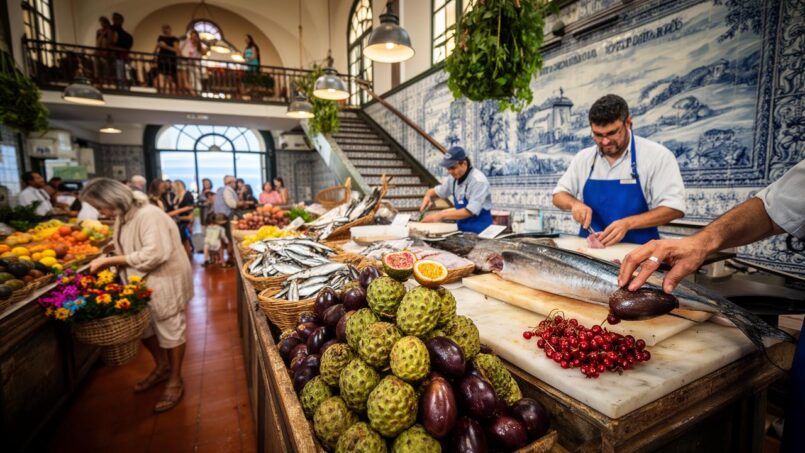
The Mercado dos Lavradores, in the heart of the old town, remains an institution. It sells tropical fruits, flowers, fish, handicrafts, wicker baskets, often by vendors in traditional costume. A supply point as well as a showcase for Madeiran identity, this market attracts both local households and tourists in search of typical products.
Other small galleries, such as Galerias de São Lourenço or Arcadas de São Francisco, complete the urban fabric. They offer a mix of boutiques, cafés, and bookstores, and provide direct access to iconic sites like the cellars of Blandy’s Wine Lodge.
Supermarkets: the grip of major chains
The daily grocery shopping of Madeirans, like elsewhere in Portugal, largely takes place in large supermarkets. Surveys show that more than 65% of residents do most of their grocery shopping in large supermarkets, compared to about 35% who prefer small grocery stores or local shops. Tourists behave similarly: nearly 62% do their food shopping in large supermarkets during their stay.
The main players are:
– Pingo Doce, a national chain, identified as the most price-competitive brand in a study covering more than 200 products.
– Continente (Sonae MC group), present in Madeira since 1996, employing over 1,150 people in the region and sourcing from about 80 local suppliers.
– Several chains created by Madeiran entrepreneurs: Central Madeirense, Excelsior Gama, Supermercados Unicasa, Automercados Plaza.
The following table summarizes some details about these brands:
| Brand | Origin | Presence in Madeira | Notable Positioning |
|---|---|---|---|
| Pingo Doce | Mainland Portugal | Several stores on the island | “Cheapest” supermarket (index 100) |
| Continente | Mainland Portugal | Since 1996, >1,150 employees | Very strong presence, local suppliers |
| Central Madeirense | Madeira | Regional chain | Historic local player |
| Excelsior Gama | Madeira | Regional chain | Food distribution |
| Unicasa | Madeira | Regional chain | Neighborhood supermarkets |
| Automercados Plaza | Madeira | Regional chain | Large supermarkets with diverse offerings |
The dominance of these chains structures access to essential goods. For many households facing rising prices, the battle over the “grocery basket” comes down to a few cents, pushing consumers toward supermarkets that are most aggressive with promotions and loyalty programs.
Tourists: the island’s main additional consumers
You can’t talk about the consumption market in Madeira without detailing the role of tourists, as their weight exceeds that seen in most other European regions.
In 2022, the archipelago recorded 8.4 million tourist overnight stays, a record level, or about 33 overnight stays per inhabitant. The main source markets are mainland Portugal, the United Kingdom, Germany, and France. In 2021 alone, there were 148,000 visits by Britons and 113,000 by Germans.
What tourists actually buy
A 2021 survey on visitor purchasing behavior provides a fairly accurate picture of their “Madeiran basket.” The most frequent purchases are:
| Product or Category Purchased | Share of Tourists Who Bought (%) |
|---|---|
| Madeira wine and small souvenirs (magnets, postcards) | 65.76 |
| Bolo do mel (traditional honey cake) | 60.87 |
| Other alcoholic beverages | 45.11 |
| Tropical fruits | 33.15 |
| Plant cuttings/seeds and flowers | 28.80 |
| Natural cork products | 27.72 |
| Aguardente, ceramics, azulejos | 26.09 |
| Handmade embroidery | 25.54 |
| Traditional clothing or headdresses | 18.48 |
You can see how much “identity” products – wine, honey cake, embroidery, handicrafts – are central. Madeira wine is by far the star, both as a souvenir to take home and as a drink consumed on the spot in bars, restaurants, and lodges.
Percentage of tourists who say they are familiar with the destination’s traditional cuisine.
Tourism as a cross-cutting driver of consumption
Tourist consumption goes far beyond souvenir shopping. It generates substantial demand for:
Economic activities that directly benefit from tourist numbers, with effects on prices and seasonal activity.
Increased visitor numbers lead to higher prices in restaurants and bars in tourist areas.
Sustained activity for taxis, buses, and car rentals, often offered as packages or bundled deals.
Stores in city centers and seaside areas see increased activity, especially during peak seasons.
Increased demand for laundries, cleaning companies, and suppliers of equipment for accommodations.
This tourist demand is also visible in banking figures: during Easter week 2024, spending with foreign cards accounted for 26% of total turnover in Portugal, but 47% in the Madeira region, with peaks in restaurants (53% of turnover from foreign sources) and especially hotels and tourist activities (86%).
In other words, in some segments, more than half of the consumption recorded on the island is by non-residents.
A fragile residential market: purchasing power under pressure and the housing crisis
Alongside this very favorable dynamic for tourist revenues, the situation of Madeiran households is much more strained. Several indicators point to a growing gap between economic growth and residents’ perceptions.
Income, poverty, and inflation
Regional GDP has almost quadrupled between the mid‑1990s and 2023, and GDP per capita is around 27,000 to 29,000 euros, about 73% of the EU‑27 average. Yet the average disposable income of households has fallen relative to the Portuguese average: over the period 1995–2021, it declined by more than 8% in relative terms.
A few figures summarize this fragility:
| Indicator (latest available data) | Approximate Value |
|---|---|
| Average gross monthly salary | €1,676 |
| Estimated net salary | €1,200–1,300 |
| Poverty risk rate | 1 in 4 people |
| Poverty threshold (monthly income) | €551 |
| Recipients of Social Integration Income | ≈ 6,500 people (2.9% of the population) |
| Share of the population saying they have difficulty paying for housing and food (Portugal) | 44% |
Inflation, especially in food, adds another layer of difficulty. At the national level, the rise in food prices recently exceeded 20% year-on-year; in Madeira, the 12-month consumer price index reached 3.5% in mid‑2025 (above the Portuguese average), with a spike in restaurant and hotel prices (+10.1%) and housing‑energy (+4.8%).
Testimonials converge: a vast majority of households feel they can no longer save, with 75% of Portuguese people saying it’s almost impossible to set money aside at the end of the month. To cope, many reduce consumption (fewer purchases, canceled subscriptions, more sparing use of electricity and water, shorter showers) and turn to complementary solutions: reselling items on second-hand platforms, thrift stores, second-hand shops like Cash Converters.
A housing crisis that reshapes consumption
Housing is undoubtedly the area where the tension between the tourist market and local life is most brutally visible. Several phenomena combine:
– scarcity of buildable land due to the very mountainous terrain;
– proliferation of tourist accommodations (hotels, resorts, short-term rentals);
– influx of foreign retirees and “digital nomads” with much higher purchasing power than locals;
– real estate speculation fueled by sometimes absent investors who leave buildings empty.
The figures for rents are telling:
| Housing indicator (recent values) | Madeira | Portugal (average) |
|---|---|---|
| Median rent (€/m²) | €10.44/m² | €8.22/m² |
| Gap Madeira / national average | +27% | — |
| Estimated average monthly rent | ≈ €1,725 | ≈ €1,300 |
| Annual rent inflation | ≈ 7% | ≈ 3.5% |
| Average rent increase over 10 years | +35.3% | n/a |
| Proportion of homes occupied by owner | 74.4% (of which 66.3% without mortgage) | n/a |
One can understand why many Madeirans believe that buying a home is now unaffordable on an “average income”, especially since banks generally require a down payment of at least 10% for a mortgage in a context of rising interest rates. The gap is striking: the median net salary does not even cover the average rent for an apartment in the most pressured areas. Households fall back on less central areas (Câmara de Lobos, Santa Cruz, Machico), but supply there remains limited and prices are pushed up by external demand.
The housing crisis significantly affects household consumption behaviors. By reducing their budget margin, it forces them to cut spending on leisure, cancel subscriptions, make stricter choices in supermarkets, and rely more on promotions and store brands.
Residents’ perceptions: when the consumption of some impoverishes others
Qualitative studies conducted among residents highlight growing resentment. Nearly 45% of respondents work directly in tourism, but many feel they do not benefit fairly from the economic spin-offs.
The main negative effects perceived from the tourism boom are:
| Negative impact cited by residents | Share of responses (%) |
|---|---|
| Real estate speculation and rising prices | 24.64 |
| Pollution and waste | 19.81 |
| Overcrowding / overpopulation | 17.87 |
| Traffic jams | 10.63 |
| Gradual disappearance of local culture | 9.66 |
| Noise | ≈ 8 |
Added to these are criticisms of the rise of outside investors controlling large hotels, the slow growth of wages in tourism jobs, the arrival of workers from other regions, and the perceived lack of effective regulation of short-term rental platforms.
Tourist consumption, the engine of local commerce, is thus also experienced as something that drives up the cost of living, changes the face of neighborhoods too quickly, reduces housing availability for families, and fosters a two-speed economy.
Madeira wine: an iconic consumer product but under-promoted
In this ecosystem, Madeira wine holds a special place. It is both a historic pillar of the island’s economy, a niche export product, and a strong symbol of tourist consumption.
An international market growing, but a limited island production
Estimates of the Madeira wine market vary by source, but converge on the idea of a growing segment, driven by renewed international interest in fortified wines and origin products. Some reports value the global market at several hundred million dollars, with a compound annual growth rate of around 5–6% over the current decade.
Key elements of the global market:
| Madeira Wine Market Indicator | Indicative Value |
|---|---|
| Estimated annual growth rate (CAGR) | ≈ 5–6% |
| Europe’s share of the global market | > 60% |
| Main export markets | UK, USA, France, Germany |
| Estimated share of “Food Service” segment | 40–50% of revenue |
| Estimated share of “Retail” segment | 35–45% |
On Madeira itself, production is constrained by the terrain and the small size of the territory. Available vineyard areas are scarce, and legally licensed vineyards are very expensive: the average price per hectare of licensed vineyard is around 375,000 euros, making any expansion or entry of new producers extremely difficult.
The Madeira wine market is dominated by a handful of large historic family houses, such as Blandy’s, Henriques & Henriques, Vinhos Barbeito, Pereira d’Oliveira, Justino’s, HM Borges, Cossart Gordon, Leacock’s, and Miles. These players concentrate more than half of the market. Their business model is focused on quality, export, and a clientele of connoisseurs.
Consumption segmentation: gourmets, tourists, and the curious
Consumption of Madeira wine is divided among:
– upscale restaurants, wine bars and hotels, which represent a large share of the value (“food service” segment);
– specialized wine shops, airport boutiques, online sales, and large supermarkets (retail segment);
– direct sales at cellars, wine clubs, corporate gifts, private collections.
From a style perspective, “Medium Sweet” wines dominate sales, with about 35% of revenue, well suited for aperitif or dessert consumption and an international clientele. The Bual and Malvasia grape varieties, richer and sweeter, are expected to account for nearly half of sales in the coming years, while drier styles (Sercial, Verdelho) appeal to a connoisseur clientele.
Madeira has a comparative advantage here: its unique organoleptic profile and extraordinary aging capabilities (bottles kept for decades without losing quality) create strong added value for collectors and rare wine enthusiasts. Demand for premium cuvées and old vintages is increasing.
But the sector also faces several obstacles:
– production volume inevitably limited by geography;
– an image that can be daunting, “serious,” making the wine seem expensive and reserved for experts;
– significant competition from other fortified wines (Port, Sherry) that have larger marketing budgets;
– local promotion deemed insufficient, despite collaborations with the “Wines of Portugal” organization.
Local consumption: still an under-exploited potential
One question comes up repeatedly among professionals: do Madeirans actually drink their own wine, especially in its more recent forms (still wines “DO Madeirense”)? These wines, which appeared more recently, still have low recognition among the general public, including locally. They represent a marginal share of exports and struggle to compete with wines from the mainland or other regions available in supermarkets at aggressive prices.
In an island market where the population is relatively modest and price-sensitive, still wines from Madeira, often positioned in quality segments and produced in small quantities, remain more of a niche product than a mass-consumption one. A strategy of affordable tastings, increased presence in large retailers, and education about local grape varieties appears essential to create stronger internal demand.
Retail, franchises, and local merchants: a fragile balance
Madeira’s commercial landscape is marked by a constant tension between large chains – often Portuguese or international – and small local businesses.
The rise of large chains and franchises
The 1990s–2000s saw the establishment in Madeira of major retail and organized commerce players: Continente in 1996, dozens of fashion, cosmetics, and electronics franchises, as well as major fast-food chains (McDonald’s, KFC, Burger King). This profoundly transformed the consumer offering, broadening the range available and aligning Madeirans’ habits with those of mainland Portugal and the rest of Europe.
The Portuguese retail sector is experiencing projected annual growth of about 3% for 2021–2026. This growth is driven by food, home appliances, and especially duty-free, the latter boosted by tourism. Madeira, a major tourist destination with a large cruise port, particularly benefits from this dynamic in tax-free sales.
This rise of large chains, however, comes with a risk: that of “homogenization” of commerce, where city centers end up looking like any European city, with the same storefronts and the same products, to the detriment of neighborhood shops.
SMEs and local shops facing competition
Small and medium-sized enterprises nevertheless numerically dominate Madeira’s economic fabric: more than 99% of the region’s companies are SMEs, mostly local businesses. These structures, often family-run, occupy the most diverse segments: renowned bakeries-pastry shops, cafés, clothing boutiques, hardware stores, stationery shops, small grocery stores, jewelry shops, perfume shops, computer stores…
Their challenge is twofold:
– to resist the price and marketing competition of large chains;
– to adapt to changing consumer behaviors (rise of e-commerce, search for promotions, increased price sensitivity).
Examples from the mainland are worrying: between November 2022 and January 2023, more than 1,600 businesses permanently closed in mainland Portugal, twice the number of openings over the period, with particularly affected sectors (restaurants, hairdressers, kiosks, small boutiques). For now, Madeira seems to be withstanding better, especially in tourist areas like Funchal where businesses “turn over” more thanks to visitor flows. But in towns like Santa Cruz, a significant number of empty storefronts in the center are already visible, along with cafés less busy than in the past.
E-commerce and digital consumption: a catch-up in progress
The consumption market in Madeira no longer takes place only in streets and shopping centers. As across Europe, online purchases are gaining ground, even if the archipelago still lags behind more advanced countries.
Consumer adoption: now a majority practice
A specific study on online shopping habits of residents in the autonomous region shows that about 92% of respondents have already made purchases on the Internet. The main advantages cited are very similar to those mentioned elsewhere in Europe: more competitive prices, convenience (shopping from home, at any hour), and a greater variety of products (especially items not available on the island).
The main barriers are just as classic:
Online shopping has several specific disadvantages: the inability to see or test the product before buying, potentially higher shipping costs for an island region, and longer delivery times, especially for goods coming from other EU countries or internationally.
At the European level, about 70–75% of Internet users already shop online, with champions like the United Kingdom or Nordic countries where more than 90% of Internet users buy on the web. Portugal, long lagging behind (only 31% of Internet users shopped online in 2015), has made significant progress since, also pushed by the COVID‑19 pandemic which brutally accelerated digitalization.
Madeiran SMEs and e-commerce: much room for improvement
While consumers have taken the turn, businesses, especially small ones, are moving more slowly. A study dedicated to SMEs in Madeira highlights that 99.9% of the region’s companies are small structures, often focused on a local market, with little tradition of internationalization or distance selling.
The factors that condition the adoption of e-commerce by these SMEs are typical:
Before launching into online sales from an overseas territory, it is crucial to analyze several key factors. First, assess the potential benefits, such as increased sales, access to new customers, improved visibility and customer satisfaction. Then examine your level of technical and financial readiness, including your digital skills, budget, and available tools. Also consider the specific constraints of insularity, such as high logistics costs, delivery times, and complex merchandise returns management. Finally, anticipate challenges related to a legal and tax framework sometimes perceived as complex.
The most frequently cited barriers are lack of technical knowledge, fear of high initial costs, and a still vague perception of return on investment. Yet European studies show that companies that adopt digital well gain in logistical efficiency and commercial reach, including in peripheral regions.
Madeira, classified as an “ultra-peripheral region” of the EU, could find in e-commerce a way to overcome some of the disadvantages of its geography, by selling more to the outside without entirely relying on physical stores. Provided that the logistics infrastructure follows and that public authorities clearly encourage the transition (training, financial support, administrative simplification).
Madeiran consumers: trade-offs, preferences, and contradictions
In this context, how do the island’s residents consume, beyond budget constraints and price pressure?
Local or imported: an unstable balance
Global research on consumer preferences shows that about 58% of people surveyed in various countries say they prefer to buy local products, while 42% prioritize imported products. This preference for local is often linked to values: support for the regional economy, perception of better quality or authenticity, cultural attachment.
But these same studies also show that: results can vary significantly depending on the populations studied.
When income increases, demand for imported products tends to grow, often at the expense of local goods perceived as inferior. In times of economic crisis, consumers generally turn to the cheapest products, which may be imports produced on a large scale at lower cost. Moreover, the perceived quality, variety, and brand image of foreign products can sometimes outweigh attachment to local products.
In Madeira, this tension is visible in several areas: food (local fruits and vegetables vs. imported products), beverages (mainland wines vs. local wines), handicrafts (“typical” products made locally or imported and simply rebranded), durable goods (appliances, electronics mostly imported).
The island imports most of its manufactured goods (processed foods, clothing, vehicles, machinery, fuels), while its exports are concentrated on a few flagship products: Madeira wine, bananas, tobacco, embroidery, handicrafts, pharmaceuticals and specific electronics. The local trade balance therefore depends heavily on the ability to sell these products abroad, while the domestic market absorbs a growing volume of goods from elsewhere.
New forms of frugality and resourcefulness
The cost-of-living crisis and soaring rents are pushing part of the population to make more trade-offs:
To reduce expenses, several concrete actions can be taken: cut back on spending deemed non-essential such as fashion, leisure, and eating out; actively look for promotions, use coupons and loyalty cards; prioritize second-hand purchases via platforms like OLX or Vinted, thrift stores, or charitable associations; extend the lifespan of goods by opting for repair rather than replacement; and finally, reduce energy consumption by lowering heating or the use of power-hungry appliances, for the sake of savings.
National figures also indicate a rise in difficulties paying regular bills (housing, food, energy) for nearly half the population, including in Madeira. In this context, consumption behaviors become more rational, but also more fragile: the slightest shock (job loss, illness, further rent increases) can upset already tight budgets.
Toward which consumption model for Madeira?
The consumption market in Madeira thus finds itself at the intersection of several dynamics:
– a thriving tourism industry, which fuels revenues and massively supports commerce and restaurants, but drives up the cost of living and housing;
– a local economy still marked by relatively low wages and a high poverty risk;
– distribution dominated by a few large chains, with a dense network of shopping centers in Funchal bringing the offering closer to that of major European cities;
– numerous but fragile SMEs, which must digitize and differentiate to avoid disappearing;
– an iconic wine sector, both a showcase of the island and an example of the physical limits to growth on an island territory;
– a gradual rise in e-commerce and online consumption, hindered by logistical peculiarities and market size.
In the short term, consumption is supported by tourism, restaurants, and real estate. However, in the medium and long term, several risks threaten its sustainability: demographic aging, the housing crisis, vulnerability of tourism jobs, and dependence on imports.
For the Madeira consumer market to remain viable for its residents, several levers appear essential:
To support the local economy, several actions are essential: more firmly regulate tourist real estate to contain soaring rents; strengthen labor income, especially in vulnerable sectors like hospitality, restaurants, and retail; actively support the valorization and visibility of local products (wine, handicrafts, agri-food) to improve their competitiveness against imports; assist SMEs in developing e-commerce and multi-channel strategies to overcome the constraints of the island market; and preserve commercial diversity in city centers to avoid a homogenization that harms both residents and tourist appeal.
Madeira is often presented as an “intelligent island” in the making, betting on connectivity, renewable energies, and innovation. The challenge now is to ensure that this intelligence also applies to its consumption model: a model that does not simply feed the growth of tourism numbers and shopping center surfaces, but protects purchasing power, social cohesion, and the local economic fabric.
In this context, the consumption market in Madeira is not just a set of commercial flows. It is a revealer, almost under a microscope, of how a small island society confronts globalization, reconciles international attractiveness with the well-being of its population, and tries to find a balance between the spending of passing visitors and the daily life of those who live there year-round.
A patrimonial project or a question? Contact us now to speak with a wealth management expert.
Disclaimer: The information provided on this website is for informational purposes only and does not constitute financial, legal, or professional advice. We encourage you to consult qualified experts before making any investment, real estate, or expatriation decisions. Although we strive to maintain up-to-date and accurate information, we do not guarantee the completeness, accuracy, or timeliness of the proposed content. As investment and expatriation involve risks, we disclaim any liability for potential losses or damages arising from the use of this site. Your use of this site confirms your acceptance of these terms and your understanding of the associated risks.

Cyril Jarnias is an independent expert in international wealth management with over 20 years of experience. As an expatriate himself, he is dedicated to helping individuals and business leaders build, protect, and pass on their wealth with complete peace of mind.
On his website, cyriljarnias.com, he shares his expertise on international real estate, offshore company formation, and expatriation.
Thanks to his expertise, he offers sound advice to optimize his clients' wealth management. Cyril Jarnias is also recognized for his appearances in many prestigious media outlets such as BFM Business, les Français de l’étranger, Le Figaro, Les Echos, and Mieux vivre votre argent, where he shares his knowledge and know-how in wealth management.





