
 Published on and written by Cyril Jarnias
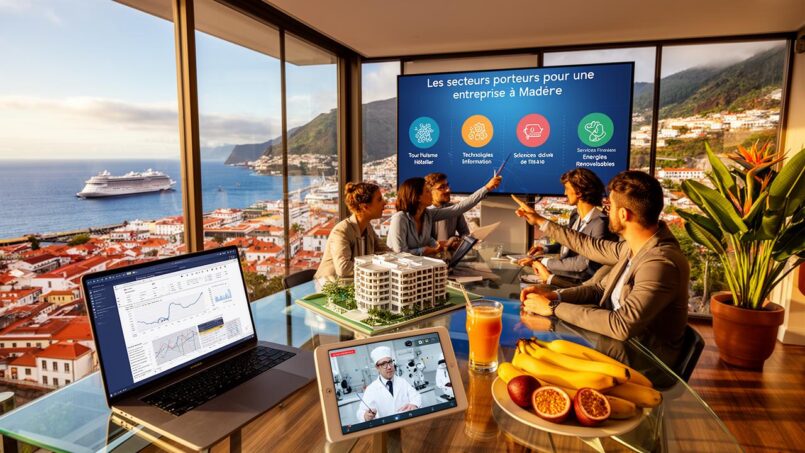
Between a tourism boom, attractive tax policies, and a pivot toward the blue economy and technology, Madeira is scaling up. Long associated with its wine and spectacular landscapes, the archipelago has become one of Portugal’s most dynamic regions, with an economy largely dominated by services and a deliberate diversification strategy. For an entrepreneur, the question is no longer whether opportunities exist, but where to position themselves in this rapidly evolving ecosystem.
An economic and tax environment tailored for investment
With nearly 85% of its GDP generated by services and only 2% by the primary sector, Madeira has already transitioned to a service-based economy. Over the past ten years, the region has been the fastest-growing in Portugal, while maintaining contained inflation and productivity above the national average. All within a framework perceived as safe, stable, and offering a very high quality of life.
Madeira is an autonomous region of Portugal, fully integrated into the European Union. Companies established on the island have direct access to the European single market, with no customs duties or intra-EU transaction costs. Due to its geographic position at the crossroads of Europe, Africa, and the Americas, the archipelago has significant connection infrastructure, including a well-served international airport and a port that handles both freight and cruise ships.
The real accelerator, however, remains the Madeira International Business Centre (MIBC / IBCM), a privileged tax regime zone strictly regulated by Brussels. Companies licensed there that meet economic substance criteria can benefit from a corporate income tax capped at 5% for income from non-resident clients or other MIBC entities, exemptions from withholding tax on dividends, interest, and royalties paid to non-residents, as well as no taxation on capital gains from the sale of shares.
Starting October 2024, the reduced VAT rate in Madeira will be one of the lowest in the country, at just 4%.
The MIBC alone accounts for nearly 15% of regional economic activity and more than 40% of corporate income tax revenue in the region, with about 3,000 jobs created, often well-paid. The investment and employment obligations (€75,000 investment within two years or, alternatively, six employees with no capital requirement) are designed to attract real projects, not mere shell companies.
For a business founder, the combination of a safe environment, moderate operational costs, a skilled (and largely English-speaking) workforce, and a stable tax regime validated by the OECD and the European Commission provides a solid foundation. On this basis, several “families” of promising sectors emerge.
Tourism and hospitality: a diversifying engine
Tourism remains the cornerstone of Madeira’s economy. It directly accounts for 20 to 25% of the region’s GDP, 9% of value added through hotels and restaurants, and fuels trade, transport, and a multitude of related activities. Recent figures confirm a market that is not only solid but accelerating.
In 2024, the archipelago welcomed nearly 2.23 million visitors for more than 11.7 million overnight stays, generating approximately €761 million in revenue, a record. The first months of 2025 continue this momentum with double-digit growth in revenue per available room (RevPAR) and occupancy rates regularly exceeding 75%. In April 2025, Madeira surpassed one million overnight stays in a single month for the first time.
To visualize activity levels, here are some recent benchmarks:
| Indicator (tourist accommodation) | Value | Approx. annual change |
|---|---|---|
| Visitors 2024 | 2.23 M | +6.7% |
| Tourism revenue 2024 | €761 M | historical record |
| Visitors Jan‑Apr 2025 | 697,500 | +7.7% |
| Overnight stays Jan‑Apr 2025 | ~3.7 M | +9% |
| Accommodation revenue Jan‑Apr 2025 | €236.4 M | +21.1% |
Beyond the volumes, two structuring trends are redefining opportunities.
Authorities and professionals are seeking to transform the aging image of the destination by promoting active, cultural, and event-based tourism. Identified high-potential niches include nautical activities, outdoor sports, gastronomy, and wellness.
Second, the diversification of accommodations. While hotels still concentrate nearly two-thirds of overnight stays, tourist rentals and rural accommodation are growing faster, with double-digit increases. Short-term rentals and guesthouses are absorbing a growing share of demand, especially during peaks (a major European sporting event is expected in 2026, with a surge in flight and hotel bookings).
Where are the opportunities for a tourism entrepreneur?
In this context, several business models stand out.
Differentiated accommodations first, combining comfort, character, and local roots. Whether it’s charming guesthouses, renovated rural units in the mountainous interior, or hybrid concepts blending coworking and coliving for digital nomads, demand exists. The strong growth figures for “local accommodation” and rural tourism confirm this.
The restaurant sector, the main tourism employer, offers opportunities by targeting both residents and visitors. The rise of city breaks and international clientele opens space for well-positioned concepts: modernized local cuisine, plant-based offerings, bistronomy, or quality street food. This dynamic also benefits the entire supply chain, from bakeries and pastry shops to fresh produce, packaging, and hotel supplies.
Experience engineering and tourism services is another niche. Thematic excursions, guided hikes, products combining sea and mountain, offers centered on wine tourism (cellar visits, Madeira wine tastings, vineyard terrace discovery), nautical activities, niche events, and scientific or wellness tourism are all segments far from saturated.
Finally, tourism asset management and concierge services are on the rise. The stock of second homes, short-term rental apartments, and small hotel units generates growing demand for rental management, revenue management, online marketing, multilingual reception, or personalized services (transfers, private chefs, tailor-made experiences).
The blue economy: a source of long-term projects
With more than 13% of regional gross output, nearly 12% of employment, and just over 11% of value added directly or indirectly linked to the sea, the blue economy is already a pillar of Madeira. The sea contributes approximately €2.049 billion to Madeira’s economy, and its impact extends well beyond coastal activities alone, with measurable effects on other Portuguese regions.
Several sub-sectors are explicitly identified as promising: aquaculture, marine biotechnologies, coastal and maritime tourism, transport, ports and logistics, shipbuilding and repair, marine energies, desalination, mineral resource exploitation.
Aquaculture and improved fisheries
Madeira has very favorable natural conditions for marine aquaculture, especially between Ponta do Sol and Calheta, where currents limit the environmental impact of cages. Current production, focused on sea bream, is around 500 to 600 tons per year for two companies, with productivity approximately 30% higher than in the Mediterranean. Nearly 70% of production is shipped to the mainland and other markets.
Portugal, although a major consumer of seafood products reliant on imports, has considerable room for growth in its national aquaculture. The country is pursuing a development strategy based on sustainable aquaculture, diversification of cultivated species, and the creation of synergies with the processing and logistics sectors.
Opportunities for an entrepreneur range from establishing new offshore units (in partnership with existing players and the Calheta mariculture center) to developing solutions for valorizing by-products (animal feed, cosmetics, functional ingredients), as well as related activities such as maintenance, monitoring systems, or cold-chain logistics.
Strategies for developing and upgrading artisanal fisheries, centered on scabbardfish and tuna, aiming to strengthen their economic and social importance.
Implementing projects to modernize artisanal fishing techniques and infrastructure.
Developing traceability systems to guarantee the origin and quality of fish, especially scabbardfish and tuna.
Valorizing products through processing and obtaining quality labels to increase market value.
Promoting short supply chain sales to bring fishermen closer to consumers and improve incomes.
Developing fishing-related tourism activities in an environmentally and resource-respectful manner.
Marine biotechnologies and circular economy
Madeira is beginning to develop a network of marine biotechs. A recent project, conducted with the University of Madeira, aims to produce refined oils from fishery by-products. A microalgae production unit is also operational in Porto Santo, near the port.
These initiatives illustrate the prospects offered by the sustainable exploitation of marine biodiversity: high-value ingredients for cosmetics, pharmaceuticals, nutrition, development of bioplastics or dietary supplements, etc. The archipelago, with the Madeira Ocean Observatory, has research centers capable of supporting innovative projects, while European programs (Horizon Europe, maritime funds) encourage such initiatives.
For innovative startups and SMEs, Madeira offers a real-world testing environment. It combines a favorable scientific framework, easy access to diverse marine resources, and increased visibility as a pilot region for the ocean economy.
Coastal tourism and cruises
The link between sea and tourism is particularly strong in Madeira. Coastal and maritime tourism accounts for more than 70% of blue economy growth at the Portuguese level, and the archipelago is no exception to this trend. Sea excursions, whale and seabird watching, diving, water sports, pleasure boating, or cruises are all segments that are already active but still expandable.
The port of Funchal is a major cruise stop: on average, several hundred ships call each year, with traffic that can exceed 500,000 transit passengers. Each cruise passenger spends enough to inject more than €40 million annually into the regional economy. For local businesses, opportunities range from organizing tailor-made excursions (culture, nature, shopping, gastronomy) to providing services to ships (light maintenance, logistics, supplies) or creating products combining cruises and land stays.
Technology, digital, and innovation: a deliberate bet
Madeira is not content with optimizing its traditional strengths; the region has a clear ambition: to make information and communication technologies, as well as innovation, a driver at least as powerful as tourism in the medium term. The regional smart specialization strategy (RIS3) aims to position the archipelago among the most innovative Portuguese regions, with a focus on tourism, biosustainability, and ICT.
The figures give an idea of the ongoing shift. Between 2019 and 2022, ICT sector revenue soared by 300%, as did employment. Technology companies based in Madeira now generate a business volume exceeding €300 million (with estimates surpassing €350 million). About 200 to over 400 ICT companies are active, with a growing number based within the MIBC. Nearly 30% of new companies licensed in this center are from the digital sector, coming from at least 13 different countries (from Germany to the United States, including France, the Netherlands, and the Baltic states).
A rare digital infrastructure foundation for an island
Madeira benefits from full fiber optic coverage and a complete 5G network in all municipalities, a first in Portugal. The island is also a hub for several international submarine cables and has a modern data center (MEO CTM) hosting a cable landing station, redundant infrastructure, advanced security systems, and secure power supply.
Telecom costs are at or below the European average, and the entire public administration has embarked on an advanced digitalization process, with many services accessible online.
For digital companies, this level of infrastructure significantly reduces technical frictions and allows serving global markets from the archipelago, whether in SaaS, outsourced IT services, or product development.
A growing support ecosystem
Founded in 1997, Startup Madeira acts as the main incubator and animator of the local entrepreneurial ecosystem. Certified as a Business Innovation Center by the European BIC Network (EBN) and integrated into the national network of incubators, the organization manages spaces in Funchal and Ribeira Brava and offers a full range of services: equipped offices, coworking, administrative support, mentoring, connections with accountants, lawyers, investors, venture capital funds, and business angels.
That’s the number of international startups attracted by the Madeira Startup Retreat program since 2018.
The digital nomad community has also become a structuring player. The Digital Nomads Madeira Islands project claims more than 16,800 registered remote workers, and Funchal appears in rankings of attractive cities for startups, even though the local ecosystem remains small in terms of number of players.
Which niches for technology companies?
Several axes clearly emerge for startups and innovative SMEs.
Madeira’s tourism sector, characterized by a high density of accommodations, controlled seasonality (one of the lowest in the country), and preparation for major events like a European sports competition in 2026, offers fertile ground for developing digital solutions. These opportunities include reservation management platforms, yield management tools, integrated payment solutions, ticketing systems, and immersive experiences (AR/VR), responding to the growing importance of online bookings.
Gaming and creative industries constitute another niche, already targeted by regional programs, with a first Gaming Startup Retreat organized in partnership with the eGamesLab consortium. Between the digital infrastructure, attractive living environment, and tax incentives, the archipelago positions itself as a production base for content aimed at international markets.
Green and blue economy technologies, next, benefit from the convergence of climate goals, investments in renewables, and maritime positioning. Startups in cleantech, agritech, smart energy management, environmental monitoring, or circular economy are choosing Madeira to develop and test their solutions, in connection with projects like the Renew Energy Hub.
Finally, Web3 and blockchain receive special attention. The region is exploring the use of blockchain for unified tourism payment solutions, tested at the archipelago scale, and attracts crypto and Web3 entrepreneurs through dedicated initiatives, while remaining within the prudent framework of European regulation.
International Business Centre: services, holdings, logistics, and industry
The MIBC is not limited to technology players. It serves as a platform for a wide range of internationally oriented activities: trade, logistics, light industry, asset management, intellectual property, shipping.
Typical activities include B2B service companies operating at European or global level (consulting, IT support, shared service centers), holdings (SGPS) optimizing shareholdings, intellectual property rights management structures, e-commerce businesses, or logistics entities leveraging the industrial free trade zone.
The industrial free trade zone and logistics
Madeira’s Industrial Free Trade Zone is a 130-hectare industrial park, located very close to the port and a few kilometers from the airport. Companies established there benefit not only from the MIBC tax regime, but also from customs exemptions on imported inputs and no quotas for exports to the rest of the EU. Customs duties, if applicable, only apply to the value of non-European raw materials incorporated into finished products.
The island has a diversified industrial fabric including agri-food, electronics, plastics, metallurgy, cosmetics and hygiene products, recycling, ship repair, automobile assembly, furniture manufacturing, industrial inks, and orthopedic shoes. Composed mainly of SMEs, this sector demonstrates that niche industrialization is viable despite the constraints of insularity.
Companies that contribute to economic modernization, sectoral diversification, environmental improvement, or the creation of skilled jobs can also obtain an additional reduction in tax on the taxable base, up to 50%, provided they maintain at least 15 jobs over five years.
For high-value-added, high-margin production projects (such as premium cosmetics, electronic components, pharmaceuticals, or medical devices), Madeira offers attractive tax policies, direct access to the European market, and controlled operational costs.
Shipping, maritime registry, and yachting
The Madeira International Ship Register (MAR) is one of the most competitive registers in Europe. It allows the registration of commercial vessels and yachts with a favorable tax and social framework, while remaining fully compliant with EU and IMO rules. For shipping companies, fleet management firms, yacht owners, or maritime service providers (technical assistance, crew management, legal services), this register is a major asset.
Combined with a network of marinas and pleasure ports, and a strategy for developing nautical activities, the yachting sector and related services (maintenance, charter, concierge, equipment) appear as a growing segment.
Renewable energy and energy transition: a living laboratory
Madeira has set itself the goal of exceeding 50% renewable electricity in the short term. Today, the share of renewables is around 30 to 40%, primarily through hydro and wind (the Paul da Serra wind farm alone provides about 20 MW, or 10 to 15% of the island’s electricity needs). A series of projects, several already financed through European recovery and resilience plans, should enable a new threshold to be crossed.
Planned investments up to 2026 amount to approximately €69 million for energy, in particular to strengthen storage, modernize hydro plants, and deploy smart meters. A 21 MW / 27 MWh battery park and a 22.5 MVA / 15.6 MWh installation are being implemented, capable of stabilizing an island grid vulnerable to wind and solar fluctuations and, notably, enabling autonomous restart (“blackstart”) of part of the system.
Percentage of the island’s electricity demand that the OTEC pilot project could cover if deployed at scale.
To support the decentralization of production, the “+ENERGIA” program offers subsidies covering up to 85% of investment (up to €8,000 to €10,000) for individuals, SMEs, cooperatives, and associations wishing to install photovoltaic panels, storage systems, solar water heaters, or biomass solutions for self-consumption. This program alone should add 2.5 MW of behind-the-meter storage capacity.
What prospects for energy transition companies?
In this context, Madeira appears as a privileged testing ground for players in energy and cleantech.
Integrators and installers of photovoltaic and storage solutions, first, can benefit from demand driven by subsidies and climate goals. Engineering firms, consulting firms, certified installers, and maintenance companies have a direct role to play.
The region offers a unique ecosystem to test and develop energy management solutions, smart grids, and AI-based optimization tools. Local challenges of grid stability and renewable energy integration are particularly acute. The large-scale deployment of smart meters, the generalization of 5G, and the isolation of the grid make it a complete, human-scale testing ground.
Players specialized in marine technologies (OTEC, offshore wind, wave energy) can leverage Madeira’s geography and energy strategy to design, test, and deploy prototypes, in partnership with local institutions like the Ocean Observatory or the Renew Energy Hub located in the special economic zone.
Finally, all trades associated with energy efficiency – audits, renovation, building solutions, electric mobility, community services – benefit from a favorable institutional environment, with the stated desire to reduce dependence on fossil fuel imports and position the archipelago among island leaders in sustainability.
Niche agriculture, Madeira wine, and local products
The weight of the primary sector in GDP is low, but agriculture and fisheries retain major social and territorial importance. About a quarter of the population still works in agriculture, often on small terraced plots, and certain products play an emblematic or strategic role.
Key crops are bananas, subtropical fruits (mango, passion fruit, soursop), potatoes and sweet potatoes, flowers, and of course, grapes for the famous Madeira wine. Tubers and grapes, along with bananas, are the main sources of agricultural income. Floriculture and horticulture are also experiencing sustained growth.
Madeira’s vineyards, an export-oriented wine heritage, are in continuous decline. Their area, once over 5,000 hectares in the 19th century, is now only 400 to 500 hectares. This reduction is due to land pressure from tourism, aging winegrowers, and vine diseases.
Nevertheless, production of fortified wine under the “Madeira” appellation remains significant, on the order of several million liters per year, with a market estimated between $100 and $150 million and expected growth of about 5% per year until 2033. A few major historical operators (Justino’s, Blandy’s, Henriques & Henriques, Vinhos Barbeito, D’Oliveira, etc.) dominate exports, but the trend is toward premiumization, terroir cuvées, old vintages, limited editions, and wine tourism.
Innovative strategies to valorize the wine heritage and develop new market offerings.
Targeting specific niches with limited, high-quality productions.
Creating immersive experiences: visits to quintas, tastings, and food-and-wine pairings.
Exploiting local varieties like Terrantez, Bastardo, or Moscatel, supported by subsidies.
Developing non-fortified wines from Madeira and Porto Santo, an emerging promising segment.
Beyond wine, organic farming and medicinal plants benefit from special interest from the regional government, which relies on a natural park, specialized laboratories, and a university heavily focused on biology. Processed products based on tropical fruits, honey, sugar cane (aguardente, syrup), flowers, or medicinal plants can find their place in tourist and export markets, especially since tourism generates a significant local market for quality food products, gourmet souvenirs, and natural cosmetics.
Real estate, construction, and development: a controlled boom
Without being a strictly “productive” sector, real estate and construction constitute a promising sector in Madeira, with a marked rise in prices and a proliferation of residential, hotel, and infrastructure projects. Recent data show an annual increase of more than 24% in real estate prices in the region, well above the national average, and rents reaching high levels, driven by international demand and the scarcity of developable land (due to topography and protected areas).
More than 1,100 affordable or social housing units are planned by 2026 under the recovery plan.
For construction companies, engineering firms, designers, and craftsmen, this boom translates into sustained demand for projects, but also for specialized services: energy efficiency in housing, renovation of old buildings, urban planning, mobility solutions, condominium services, sustainable materials, etc.
At the same time, the rise in housing costs and pressure on agricultural land fuel a need to reconcile real estate development, preservation of landscapes (especially vineyards), and residential accessibility. Projects integrating approaches of sustainable cities, material circularity, water and biodiversity management can therefore benefit from special political and financial support.
How to position yourself in Madeira: sectors, structures, and strategies
Faced with this mosaic of opportunities, the key for an entrepreneur is to match the island’s strengths with their own business model.
Activities focused on high-value-added services (experiential tourism, IT, consulting, R&D, asset management, shipping, energy) fully leverage the MIBC and the European anchor. Niche industries, low in heavy logistics but intensive in technology or know-how, benefit from the industrial free zone and preferential tax treatment. Innovative projects with an environmental, social, or digital dimension can also mobilize European funds managed locally by IDE or IDERAM.
The choice of legal structure depends on the project. The most common form is the limited liability company (LDA), which can be set up with a symbolic capital and a single shareholder or manager. Public limited companies (SA) are suitable for more capital-intensive projects or holdings. Branches are a solution for foreign groups wishing to operate through the MIBC without creating a new legal entity.
The regulatory calendar of the MIBC, which sets deadlines for registering new companies and granting certain benefits, remains a parameter to monitor, even though an extension of the regimes is regularly discussed. In any case, obtaining a license requires formalizing the project (activity, investment, jobs), having a physical address, and meeting substance requirements.
The limited local market requires a global vision, especially for technology and specialized sectors. Madeira offers an ideal framework to test, optimize, and operate exportable models, thanks to its attractive living environment, stable business environment, and competitive tax regime.
In this perspective, the most promising sectors – tourism and experiences, blue economy, technology and digital, international services, renewable energy, niche agri-products, and sustainable real estate – are not watertight silos. The most promising projects are often those that cross several of these dimensions: a digital platform for sustainable maritime excursions, an environmental data startup applied to aquaculture, an eco-energy tourist residence with coliving for digital nomads, a logistics hub for local agri-food products, etc.
Madeira, long perceived as a mere Atlantic postcard, is becoming a laboratory for insular economic diversification. For entrepreneurs capable of combining innovation, local roots, and international openness, the promising sectors are plentiful: it’s just a matter of coming to explore them on the ground and building them over time.
Have a project or a question? Contact us now to speak with a wealth management expert.
Disclaimer: The information provided on this website is for informational purposes only and does not constitute financial, legal, or professional advice. We encourage you to consult qualified experts before making any investment, real estate, or expatriation decisions. Although we strive to maintain up-to-date and accurate information, we do not guarantee the completeness, accuracy, or timeliness of the proposed content. As investment and expatriation involve risks, we disclaim any liability for potential losses or damages arising from the use of this site. Your use of this site confirms your acceptance of these terms and your understanding of the associated risks.

Cyril Jarnias is an independent expert in international wealth management with over 20 years of experience. As an expatriate himself, he is dedicated to helping individuals and business leaders build, protect, and pass on their wealth with complete peace of mind.
On his website, cyriljarnias.com, he shares his expertise on international real estate, offshore company formation, and expatriation.
Thanks to his expertise, he offers sound advice to optimize his clients' wealth management. Cyril Jarnias is also recognized for his appearances in many prestigious media outlets such as BFM Business, les Français de l’étranger, Le Figaro, Les Echos, and Mieux vivre votre argent, where he shares his knowledge and know-how in wealth management.





