
 Published on and written by Cyril Jarnias
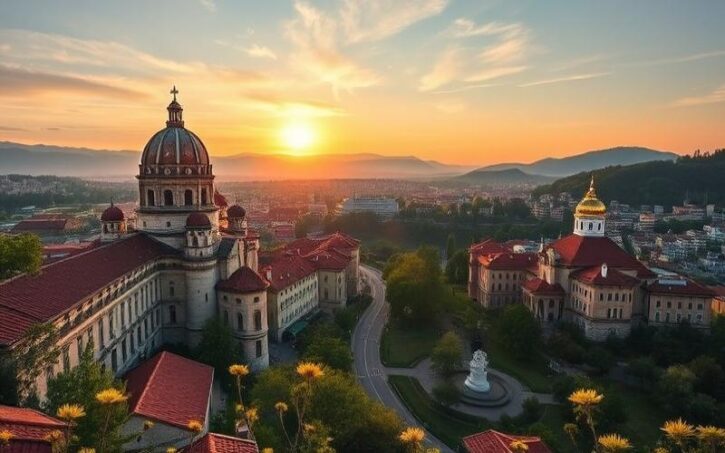
Bulgaria, a country in Southeast Europe, offers remarkable geographical diversity despite its relatively modest size. Located in the heart of the Balkan Peninsula, this nation of varied landscapes captivates with its majestic mountains, fertile plains, and enchanting coastline. Let’s dive into the discovery of Bulgarian geography, a territory rich in contrasts and natural beauty.
Strategic Geographical Location
Bulgaria occupies a strategic position at the crossroads of Europe and Asia. This Balkan country spans an area of 110,994 km², making it the 16th largest country in Europe. Bordered to the east by the Black Sea, Bulgaria shares its land borders with five countries:
- To the north: Romania (608 km of shared border)
- To the west: Serbia (318 km) and North Macedonia (148 km)
- To the south: Greece (494 km) and Turkey (240 km)
This unique geographical position gives Bulgaria a role as a bridge between Western Europe and the Near East, fostering cultural and commercial exchanges for centuries.
Good to know:
Bulgaria became a member of the European Union in 2007, strengthening its integration with the rest of Europe while maintaining its position as a crossroads between East and West.
Varied Relief: From Plains to Mountains
The Bulgarian territory is characterized by great topographical diversity, offering contrasting landscapes over a relatively small area. Several major geographical regions can be distinguished:
1. The Danube Plain
In the north of the country, this vast fertile plain stretches along the Danube, which forms the natural border with Romania for nearly 470 km. This region, also called Moesia, is Bulgaria’s breadbasket and is home to many important cities like Ruse and Pleven.
2. The Balkan Mountains (Stara Planina)
This mountain range crosses the country from west to east for nearly 600 km. It peaks at Mount Botev at 2,376 meters above sea level. The Balkans play a crucial role in the country’s climate and hydrography, influencing the distribution of precipitation and the course of rivers.
3. The Thracian Plain
Located south of the Balkan Mountains, this vast fertile plain is watered by the Maritsa, Bulgaria’s longest river. It is in this region that the country’s second-largest city, Plovdiv, is found, along with important agricultural areas.
4. The Rila-Rhodope Massif
In the southwest of the country, this mountain massif is home to the highest point in Bulgaria and the Balkans: Mount Musala (2,925 m). The Rila and Rhodope Mountains offer spectacular landscapes, glacial lakes, and dense forests, making them a popular destination for nature tourism.
5. The Black Sea Coast
The Bulgarian coast stretches for 378 km, alternating between fine sandy beaches, steep cliffs, and lively seaside resorts. This region plays a major role in the country’s economy through tourism and port activities.
Good to know:
The diversity of Bulgaria’s relief allows you to go from the sunny beaches of the Black Sea to the snowy peaks of the Rila Mountains in just a few hours, offering a variety of unique tourist experiences.
Major Bulgarian Cities
Bulgaria has several important urban centers, each with its own identity and role in the country’s economy:
1. Sofia: The capital and largest city in the country, Sofia has about 1.3 million inhabitants. Located at the foot of Mount Vitosha, it is the political, economic, and cultural center of Bulgaria.
2. Plovdiv: The second-largest city in the country with about 350,000 inhabitants, Plovdiv is renowned for its historic center and cultural dynamism. It was the European Capital of Culture in 2019.
3. Varna: The third-largest city in Bulgaria and the main port on the Black Sea, Varna is nicknamed the “maritime capital” of the country. It has about 330,000 inhabitants and is an important tourist and economic center.
4. Burgas: The fourth-largest city in the country, Burgas is also located on the Black Sea coast. With its 200,000 inhabitants, it is an important industrial and tourist center.
5. Ruse: Nicknamed “Little Vienna” due to its architecture, Ruse is the largest Bulgarian city on the Danube, with about 150,000 inhabitants.
Good to know:
Despite the predominance of Sofia, Bulgaria benefits from a network of medium-sized cities well distributed across its territory, contributing to a balanced development of the country.
Administrative Regions
Bulgaria is divided into 28 administrative regions (oblasti), each named after its main city. These regions are grouped into 6 planning regions:
- Northwest Region
- North Central Region
- Northeast Region
- Southeast Region
- Southwest Region
- South Central Region
This administrative division allows for decentralized management of the territory and better consideration of local specificities in development policies.
A Country with Varied Natural Resources
Bulgaria’s geographical diversity is also reflected in its wealth of natural resources:
Mineral resources: The country has deposits of copper, lead, zinc, and coal, mainly in the mountainous regions.
Water resources: Besides the Danube, Bulgaria has many rivers and lakes, offering significant hydroelectric potential.
Agricultural land: The fertile plains of the Danube and Thrace make Bulgaria a major agricultural producer, especially of cereals, fruits, and vegetables.
Forests: About one-third of Bulgarian territory is covered by forests, mainly in mountainous regions, providing timber resources and habitat for diverse flora and fauna.
Good to know:
Bulgaria is renowned for its mineral water springs and spa resorts, attracting many visitors for their healing properties.
Conclusion
The geography of Bulgaria, characterized by its diversity and contrasts, plays a fundamental role in the country’s history, economy, and culture. From the fertile plains of the Danube to the snowy peaks of the Rila, passing through the golden beaches of the Black Sea, Bulgaria offers a condensed version of Balkan landscapes on a relatively compact territory.
This geographical richness is a major asset for the development of tourism and agriculture, while also posing challenges in terms of land use planning and environmental preservation. Bulgaria’s strategic position, at the crossroads between Europe and Asia, continues to influence its geopolitical and economic role in the region.
As the country continues its European integration, its unique geography remains a key element of its identity and attractiveness, promising many more discoveries for visitors curious to explore its many facets.
Disclaimer: The information provided on this website is for informational purposes only and does not constitute financial, legal, or professional advice. We encourage you to consult qualified experts before making any investment, real estate, or expatriation decisions. Although we strive to maintain up-to-date and accurate information, we do not guarantee the completeness, accuracy, or timeliness of the proposed content. As investment and expatriation involve risks, we disclaim any liability for potential losses or damages arising from the use of this site. Your use of this site confirms your acceptance of these terms and your understanding of the associated risks.

Cyril Jarnias is an independent expert in international wealth management with over 20 years of experience. As an expatriate himself, he is dedicated to helping individuals and business leaders build, protect, and pass on their wealth with complete peace of mind.
On his website, cyriljarnias.com, he shares his expertise on international real estate, offshore company formation, and expatriation.
Thanks to his expertise, he offers sound advice to optimize his clients' wealth management. Cyril Jarnias is also recognized for his appearances in many prestigious media outlets such as BFM Business, les Français de l’étranger, Le Figaro, Les Echos, and Mieux vivre votre argent, where he shares his knowledge and know-how in wealth management.





