
 Published on and written by Cyril Jarnias
Located at the western edge of Europe, the island of Ireland majestically spans approximately 84,421 square kilometers, offering a rich mosaic of varied and breathtaking landscapes.
Covered in lush green hills, fertile plains, and crisscrossed by a network of winding rivers, Ireland is often called the “Emerald Isle” due to its luxuriant greenery.
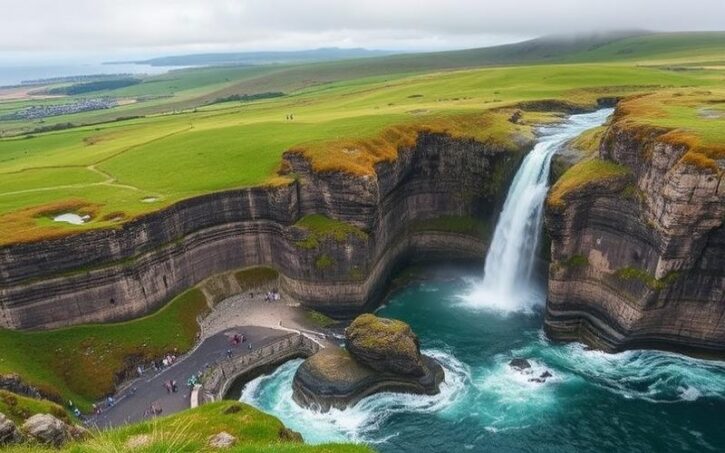
Bathed by the Atlantic Ocean to the west, it is sculpted by a multitude of spectacular cliffs, notably the Cliffs of Moher, and dotted with sparkling lakes like Lough Corrib.
This captivating island nation also reveals a fascinating geological history that includes karst formations in the Burren and imposing mountains such as the MacGillycuddy’s Reeks.
Add to this a mild yet unpredictable oceanic climate, and you get a picture of striking contrasts that continually attracts nature lovers and seekers of stunning panoramas.
Geographical Location of Ireland
Ireland is located in the Northern Hemisphere, northwest of the European continent, and is an integral part of Western Europe. It occupies most of the island of Ireland, within the archipelago of the British Isles. The country is bordered to the west and north by the Atlantic Ocean, to the south by the Celtic Sea, and to the east by the Irish Sea which separates it from Great Britain (United Kingdom).
| Location | Detail |
|---|---|
| Hemisphere | Northern |
| Continent | Europe (Western Europe) |
| Latitude/Longitude | Approx. 53° 25′ N, 8° 0′ W |
| Land Borders | United Kingdom (Northern Ireland) |
| Maritime Borders | Atlantic Ocean, Irish and Celtic Seas |
Proximity and Separation from Neighboring Countries
Ireland shares a 360 km land border with Northern Ireland, a constituent nation of the United Kingdom, in the northeast of the island.
Its closest international neighbor is therefore the United Kingdom, from which it is separated to the east by the Irish Sea.
Geographical Coordinates
Latitude: around 53° 25′ N
Longitude: around 8° 0′ W
Coastline
The western and northern coasts are extensively bordered by the Atlantic Ocean, giving the country an oceanic climate and a great diversity of coastal landscapes.
Major Topographical Features
- Central Plains: Ireland features a vast central plain, characterized by numerous bogs, lakes, and rivers.
- Mountain Ranges: The terrain rises mainly on the periphery, with several mountain ranges:
- The Macgillycuddy’s Reeks in the southwest (Carrauntoohil, highest peak at 1,038 m)
- The Wicklow Mountains in the east
- The Donegal Mountains in the northwest
- Rivers and Lakes: The River Shannon (386 km) traverses the country from north to southwest, and Lough Corrib is the largest lake.
List of Main Topographical Elements and Their Influence
- Mountain ranges: promote a humid climate by retaining precipitation from the Atlantic
- Central plains: conducive to agriculture and rich in peat bogs
- Presence of numerous lakes and rivers: diversity of aquatic ecosystems
- Highly indented coastline: alternation of cliffs, bays, and beaches, hosting significant biodiversity
Good to know:
Ireland is situated between 51° and 55° north latitude and 5° and 10° west longitude, separated from the United Kingdom by the Irish Sea; its coasts, exposed to the Atlantic Ocean, are influenced by coastal mountains like the Wicklow ranges and the central plains which moderate the temperate oceanic climate.
Ireland, located in the Northern Hemisphere and in Western Europe, occupies most of the island of Ireland, separated from the United Kingdom to the east by the Irish Sea. It is characterized by a central plain surrounded by mountains, bordered to the west by the Atlantic Ocean, which strongly influences its climate and ecosystems.
Main Irish Regions
Leinster
Geographical Characteristics:
Located in the east, includes Dublin, the capital. Mostly flat terrain, fertile valleys, and gentle hills (Wicklow Mountains). Temperate, humid climate with moderate rainfall.
Culture and Economy:
Major economic center, home to most of the country’s large companies and universities. Architectural blend: medieval, Georgian, Norman, and modern. Dublin, cosmopolitan, renowned for its museums, literature (Joyce, Beckett), and nightlife.
Iconic festivals: Bloomsday, St. Patrick’s Day. Tourist sites: Trinity College, Dublin Castle, Glendalough, Powerscourt Gardens.
Statistics and Anecdotes:
Over half of the Irish population lives in the province. Formerly renowned for its wine and silk trade. The people of Leinster are often perceived as refined and elegant.
Munster
Geographical Characteristics:
Southern province, the largest. Varied topography: mountains (MacGillycuddy’s Reeks), valleys, spectacular coasts (Wild Atlantic Way). Mild climate, influenced by the Atlantic.
Culture and Economy:
Strong tradition in arts and music; birthplace of groups like The Cranberries. Prosperous agriculture, notably dairy (Kerrygold butter). Historical importance of the port of Cork and Viking settlements (Waterford, Limerick).
Festivals: Cork Jazz Festival, Rose of Tralee.
Tourist Sites:
Ring of Kerry, Cliffs of Moher, Blarney Castle, city of Cork.
Particularities:
The inhabitants are reputed for their friendliness and creative spirit. Munster is often associated with Gaelic culture and the sport of hurling.
Connacht
Geographical Characteristics:
Located in the west, the least populated province. Wild landscapes: lakes, bogs, mountains (Connemara, Twelve Bens), rugged coastline. Oceanic climate, often windy and rainy.
Culture and Economy:
Region historically dedicated to learning and wisdom. Strong presence of the Irish language (Gaeltacht). Economy focused on agriculture, fishing, and nature tourism.
Festivals: Galway International Arts Festival, Oyster Festival.
Tourist Sites:
Connemara, Aran Islands, city of Galway, Sligo (inspiration for W.B. Yeats).
Particularities:
A place of spiritual and intellectual refuge, druidic tradition. The inhabitants are often considered warm and poetic.
Ulster
Geographical Characteristics:
Northern province, shared between the Republic of Ireland and Northern Ireland. Terrain marked by mountains and valleys, rugged coast (Giant’s Causeway). Temperate climate, cooler and wetter.
Culture and Economy:
History marked by conflict and identity pride. Industrial economy (Belfast, Derry), agriculture, fishing. Land of great warriors, symbols of bravery and resistance.
Festivals: Derry Halloween, Belfast Film Festival.
Tourist Sites:
Giant’s Causeway, Dunluce Castle, city of Belfast, Mourne Mountains.
Particularities:
Region renowned for its hospitality and attachment to tradition. Blend of Irish and British cultures.
| Province | Main Counties | Topography | Climate | Major Tourist Sites | Cultural Particularities | Contribution to National Identity |
|---|---|---|---|---|---|---|
| Leinster | Dublin, Wicklow, Meath | Plains, hills | Temperate, humid | Dublin, Glendalough, Powerscourt | Literature, cosmopolitanism | Economic and political center |
| Munster | Cork, Kerry, Limerick | Mountains, coasts | Mild, Atlantic | Cliffs of Moher, Ring of Kerry, Cork | Music, arts, friendliness | Cradle of Gaelic culture |
| Connacht | Galway, Mayo, Sligo | Lakes, mountains | Oceanic | Connemara, Aran Islands, Galway | Irish language, poetry | Guardian of Gaelic tradition |
| Ulster | Antrim, Down, Donegal | Valleys, coasts | Temperate, cool | Giant’s Causeway, Belfast, Derry | Pride, resistance, diversity | Irish and British identity |
Cultural Anecdotes:
- Connemara is celebrated in song by Michel Sardou, a symbol of Ireland’s wild beauty.
- Ulster’s Giant’s Causeway is associated with the legend of the giant Finn McCool.
- Galway is famous for its bohemian atmosphere and lively streets.
Each province, through its geographical, cultural, and historical particularities, shapes the Irish national identity, blending Celtic tradition, international openness, and regional pride.
Good to know:
Munster, famous for its breathtaking coastal landscapes like the Cliffs of Moher, is also an economic pivot thanks to the city of Cork, while Connacht, with its temperate climate and fertile farmland, is renowned for its living Gaelic traditions, notably in County Galway.
Largest Cities in Ireland
| City | Population (2025) | Location | Economic and Cultural Importance | Historical Facts | Distinctive Features |
|---|---|---|---|---|---|
| Dublin | 1,299,110 | East coast, mouth of the Liffey | Capital and major economic center; financial, technological (Silicon Docks), and academic (Trinity College) hubs; cultural heart with theaters, museums, and nightlife | Founded by Vikings in the 9th century; epicenter of the independence movement; strong literary tradition (Joyce, Beckett, Yeats) | Dublin Castle, Trinity College, Temple Bar, Guinness Storehouse, St. Patrick’s Festival, Dublin Theatre Festival |
| Cork | 190,384 | South, on the River Lee | Second largest city in the country; international port; agri-food and pharmaceutical industry; strong cultural identity | Medieval city founded in the 6th century; role in the Irish Civil War; former butter capital | English Market, University College Cork, Cork Jazz Festival, Cork Midsummer Festival, Port of Cork |
| Limerick | 90,054 | West, on the Shannon | Industrial and technological center; strong development of services and education (University of Limerick); rich artistic life | Founded by Vikings; site of the Battle of the Boyne; medieval city with fortifications | King John’s Castle, Hunt Museum, Milk Market, Riverfest, University of Limerick, rugby (Munster Rugby) |
| Galway | 70,686 | West, on the Atlantic coast | Cultural capital of the west; university hub (NUIG); major center for traditional music and arts | Medieval port city; former prosperous trading town; strong Gaelic heritage | Claddagh, Galway Arts Festival, Galway International Oyster Festival, Salthill, bohemian atmosphere and festivals |
| Waterford | 47,904 | Southeast, mouth of the Suir | Historic port city; crystal and tourism industry; growing regional center | Oldest city in Ireland (founded by Vikings in 914 AD); importance in the Middle Ages | Waterford Crystal, Reginald’s Tower, Waterford Walls, Spraoi Festival, Viking Triangle |
Key Points on the Geographical and Cultural Contribution of These Cities to Ireland:
These five cities structure the Irish territory, each being the main center of its region.
- Dublin concentrates the majority of the urban population, national institutions, the service economy, and diplomacy.
- Cork and Waterford are essential ports, historical points of access to international trade.
- Limerick and Galway energize the west of the country, notably through their university role, industry, and cultural influence.
- The diversity of festivals, universities, and historical heritage in these cities shapes contemporary Irish identity and attracts numerous visitors each year.
Examples of Major Attractions and Institutions:
- Dublin: Trinity College, Guinness Storehouse, Temple Bar, National Museum.
- Cork: English Market, University College Cork, Shandon Bells.
- Limerick: King John’s Castle, University of Limerick, Milk Market.
- Galway: National University of Ireland Galway, Salthill Promenade, Eyre Square.
- Waterford: Waterford Crystal, Reginald’s Tower, Medieval Museum.
Major Festivals:
- Dublin: St. Patrick’s Festival, Dublin Theatre Festival.
- Cork: Cork Jazz Festival, Cork Midsummer Festival.
- Limerick: Riverfest, Limerick Literary Festival.
- Galway: Galway Arts Festival, Galway Oyster Festival.
- Waterford: Spraoi International Street Arts Festival, Waterford Walls.
Geographical Summary:
The major cities of Ireland form a balanced urban network, each playing a key role in regional development and the diffusion of Irish culture. They embody the diversity of the country’s heritage, traditions, and innovation.
Good to know:
Dublin, the capital, is the economic and cultural center of Ireland, popular for its historical institutions like Trinity College; Cork, often nicknamed the “real capital,” is distinguished by its port and lively festivals.
Disclaimer: The information provided on this website is for informational purposes only and does not constitute financial, legal, or professional advice. We encourage you to consult qualified experts before making any investment, real estate, or expatriation decisions. Although we strive to maintain up-to-date and accurate information, we do not guarantee the completeness, accuracy, or timeliness of the proposed content. As investment and expatriation involve risks, we disclaim any liability for potential losses or damages arising from the use of this site. Your use of this site confirms your acceptance of these terms and your understanding of the associated risks.

Cyril Jarnias is an independent expert in international wealth management with over 20 years of experience. As an expatriate himself, he is dedicated to helping individuals and business leaders build, protect, and pass on their wealth with complete peace of mind.
On his website, cyriljarnias.com, he shares his expertise on international real estate, offshore company formation, and expatriation.
Thanks to his expertise, he offers sound advice to optimize his clients' wealth management. Cyril Jarnias is also recognized for his appearances in many prestigious media outlets such as BFM Business, les Français de l’étranger, Le Figaro, Les Echos, and Mieux vivre votre argent, where he shares his knowledge and know-how in wealth management.





