
 Published on and written by Cyril Jarnias
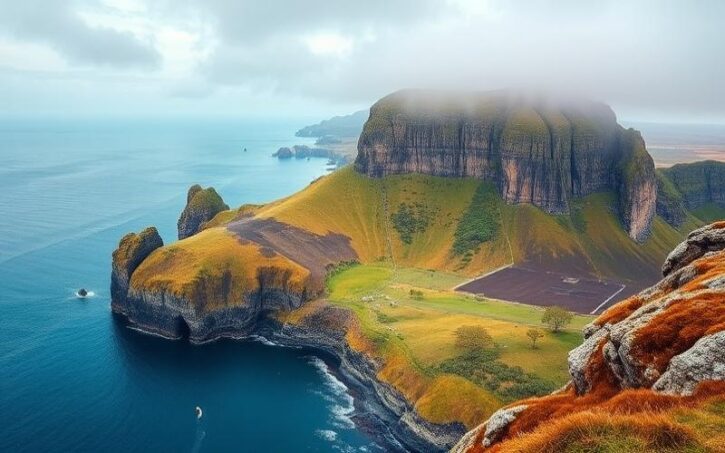
Nestled in the heart of the Atlantic Ocean, Ireland stands out not only for its lush green landscapes and towering cliffs but especially for a rich and complex history that spans millennia.
From prehistoric times to Celtic dynasties, from Viking invasions to the Anglo-Irish conflict, each period has left an indelible mark on the unique character of this island.
Irish history is marked by the struggle for identity and independence, events that forged a resilient people and a vibrant culture.
Delving into Ireland’s historical journey is to discover how this country overcame trials to become the dynamic nation it is today, all while preserving its rich Celtic tradition.
From Celtic Origins to the Founding of a Nation
The Celtic presence in Ireland dates back to the late Bronze Age, around 500 BCE, marking a pivotal period in the island’s history. The earliest archaeological evidence of this presence is primarily associated with sites like the Hill of Tara and Brú na Bóinne, where traces of ritual structures, passage tombs, and artifacts typical of Celtic culture are found. Excavations at the Hill of Tara have uncovered circular enclosures, megalithic tombs, and artifacts dating back to the 4th millennium, while Brú na Bóinne, with its tumuli of Knowth, Newgrange, and Dowth, testifies to a complex social and religious organization.
| Period | Characteristics | Key Sites |
|---|---|---|
| Bronze Age (1200-500 BCE) | Development of pagan ceremonies, first circular structures | Hill of Tara, Brú na Bóinne |
| Iron Age (500 BCE – 400 CE) | Arrival of the Celts, emergence of the Gaelic language, hierarchical social structures | Hill of Tara, Rathcroghan, Monasterboice |
| Early Middle Ages (400-800 CE) | Christianization, fusion of Celtic and Christian traditions | Monasterboice, Skellig Michael |
Celtic influence manifested through language, culture, and social structures. The Gaelic language, derived from Celtic languages, became dominant and profoundly marked Irish culture. The Celts introduced a social system based on clans and kingdoms, with chieftains and druids playing central roles. Legends and mythological tales, such as those of the Tuatha Dé Danann, shaped the perception of Ireland as a unique nation, endowed with a distinct identity and a rich history.
| Aspect | Celtic Influence |
|---|---|
| Language | Gaelic, the basis of modern Irish |
| Culture | Myths, legends, pagan festivals |
| Social Structures | Clans, kingdoms, chieftains, druids |
The transition from independent Celtic tribes to a unified political entity was gradual. The Hill of Tara, considered the seat of the High Kings of Ireland, played a central role in this political consolidation. The five main ancient roads converged at this point, facilitating trade and the unification of kingdoms. Legend has it that 142 High Kings were inaugurated at the Hill of Tara, symbolizing the unity and continuity of the Irish nation.
Historical and legendary accounts, such as those of Saint Patrick and the conversion of Ireland to Christianity, also helped shape the perception of Ireland as a unique nation. The statue of Saint Patrick at the Hill of Tara recalls this foundational episode, where King Laoghaire is said to have granted permission to evangelize the Irish, marking the beginning of the island’s Christianization.
In summary, the Celtic presence in Ireland profoundly marked the culture, language, and social structures of the time. Key archaeological sites, such as the Hill of Tara and Brú na Bóinne, testify to this influence and the gradual transition towards a unified political entity, forming the basis of the modern Irish nation. Legends and historical accounts helped shape the perception of Ireland as a unique nation, endowed with a distinct identity and a rich history.
Good to Know:
The earliest evidence of a Celtic presence in Ireland dates back to the early Iron Age around 500 BCE, with key sites like Tara and Newgrange testifying to their cultural and linguistic influence. The legend of Cú Chulainn and the tales of the Ulster Cycle were also essential in forging a distinct national identity during the transition towards a unified political entity.
English Colonization: An Era of Turmoil
English colonization of Ireland constitutes one of the most turbulent periods in Irish history, marked by a succession of major events, profound political and social upheavals, and a series of resistances that durably shaped relations between Ireland and England.
Key Events of English Colonization
| Date | Event | Main Consequences |
|---|---|---|
| 1171 | Landing of Henry II in Ireland | Beginning of English rule |
| 1366 | Statutes of Kilkenny | Prohibition of Gaelic and Irish customs |
| 1541 | Henry VIII becomes King of Ireland | Intensification of colonization |
| 1550-1610 | Plantations (confiscation and colonization of land, especially in Ulster) | Arrival of English and Scottish settlers, increased tensions |
| 1641 | Irish Rebellion in Ulster | Massacres, fierce repression |
| 1649-1653 | Cromwell’s Campaign | Massacres, massive land confiscations |
| 1690 | Battle of the Boyne | Affirmation of Protestant dominance |
| 1798 | Rebellion of the “United Irishmen” | Repression, end of parliamentary autonomy |
| 1801 | Act of Union | Ireland integrated into the United Kingdom |
Political, Social, and Economic Factors
- Political Factors:
- English desire to control a territory perceived as strategic for the kingdom’s security.
- Establishment of an Anglo-Norman, then English, administration and aristocracy.
- Gradual introduction of English laws and marginalization of Irish customary law.
- Social Factors:
- Confiscation of lands from Gaelic elites and redistribution to Protestant settlers.
- Imposition of the English language and prohibition of Gaelic in official spheres.
- Religious division: Protestants (settlers) vs. Catholics (natives), a source of lasting conflict.
- Economic Factors:
- Massive expropriation of land for the benefit of settlers, especially in Ulster.
- Decline of the Irish peasantry, impoverishment of the Catholic population.
- Development of an economy oriented towards British interests.
Impact on Social Structures and Relations Between Nations
- Disruption of traditional social structures: gradual disappearance of Gaelic clans and weakening of the chieftain system.
- Rise of a Protestant minority (often called the “Ascendancy”) that monopolized political, economic, and land power.
- Marginalization and discrimination against Irish Catholics through the Penal Laws (prohibition of property ownership, access to education, etc.).
- Strengthening of antagonism between Irish and English, but also within Irish society itself (religious and identity divide).
Long-Term Repercussions and Resistance Movements
- Repercussions:
- Construction of an Irish national identity in opposition to English rule.
- Transmission of the memory of massacres, confiscations, and repressions in popular culture.
- Persistence of religious and community tensions, especially in Ulster.
- Resistance Movements:
- Regular uprisings (1641, 1798), often violently suppressed.
- Emergence of secret societies and nationalist movements (e.g., United Irishmen).
- Easter Rising of 1916, prelude to the War of Independence and the partition of the island.
Concrete Examples
- Statutes of Kilkenny (1366): laws forbidding the English from adopting Irish language, dress, or customs, to prevent cultural rapprochement.
- Ulster Plantations (early 17th century): over 100,000 Protestant settlers placed on confiscated lands, causing a major demographic upheaval.
- Massacres of Drogheda and Wexford (1649): symbols of the brutality of the Cromwellian conquest.
- Rebellion of 1798: a general uprising suppressed by British forces, illustrating the persistence of resistance and the brutality of repression.
English colonization profoundly marked Ireland, disrupting its political, social, and cultural structures, and leaving a legacy of conflict, but also of resilience and the quest for national independence.
Good to Know:
English colonization profoundly transformed the Irish agrarian structure, causing a division of land that fueled social and economic tensions. It also spawned resistance movements like the rebellions of 1641 and 1798, illustrating the persistent rejection of English rule.
Towards Independence: The Struggles for Irish Freedom
The struggles for Irish independence in the early 20th century revolve around three major events: the Easter Rising of 1916, the War of Independence (1919-1921), and the signing of the Anglo-Irish Treaty of 1921. These events transformed Irish society, engendered deep divisions, and redefined the geopolitical balance between Ireland and the United Kingdom.
Key Events
| Year | Event | Main Description |
|---|---|---|
| 1916 | Easter Rising | Armed uprising in Dublin to proclaim independence. Brutally suppressed, it galvanized the nationalist movement. |
| 1919-1921 | Irish War of Independence | Guerrilla conflict between the IRA and British forces. Began after the proclamation of independence by Dáil Éireann. |
| 1921 | Signing of the Anglo-Irish Treaty | Creation of the Irish Free State (26 counties), partition of the island, Northern Ireland remaining in the UK. |
Iconic Figures
- Patrick Pearse: Leader of the Easter Rising.
- Michael Collins: Military leader and treaty negotiator.
- Arthur Griffith: President of Dáil Éireann, treaty negotiator.
- Éamon de Valera: Major political figure, opposed to certain terms of the treaty.
- Constance Markievicz: Female figure of the movement.
Role of Sinn Féin and the IRA
- Sinn Féin: Political party founded in 1905, it became the main bearer of independence demands after 1916. Overwhelming victory in the 1918 elections, boycott of the Westminster Parliament, proclamation of independence, and creation of Dáil Éireann.
- IRA (Irish Republican Army): Armed wing of the movement, born from the Irish Volunteers. Conducted guerrilla actions against the British army and the Royal Irish Constabulary (RIC).
Impacts on Society and Internal Divisions
- Polarization: British repression (executions, arrests, violence) radicalized part of the population, while others remained loyal to the Crown.
- Internal Divisions: The Anglo-Irish Treaty divided nationalists between pro-treaty (favoring compromise with London) and anti-treaty (committed to a full Republic). This division led to the Irish Civil War (1922-1923).
- Partition: The retention of Northern Ireland within the UK created a lasting religious, political, and social fault line on the island.
Consequences and Geopolitical Implications
- Creation of the Irish Free State: Autonomous entity of 26 counties, dominion status within the Commonwealth, evolving into the Republic of Ireland in 1949.
- Institutionalized Partition: Northern Ireland (6 counties of Ulster) retained a local parliament under British sovereignty, laying the groundwork for the future Troubles (Northern Ireland conflict).
- Repercussions for the United Kingdom: Loss of control over most of Ireland, weakening of its imperial position, adaptation to new political realities.
- Global Echo: The Irish process inspired other decolonization movements in the 20th century, highlighting the right of peoples to self-determination.
In the Context of Decolonization
The Irish experience is part of the vast movement challenging colonial empires after World War I. The Irish struggle for independence became a model for many colonized peoples, demonstrating the effectiveness of a combination of armed resistance, political mobilization, and international diplomacy.
Summary of Main Dynamics
- The Irish quest for independence relied on the synergy between military action (IRA) and political action (Sinn Féin).
- The successes achieved came at the cost of deep internal divisions and a partition that still shapes the island’s geopolitics today.
- Ireland became one of the first Western European countries to break free from a colonial empire in the 20th century, paving the way for other national liberation movements.
Good to Know:
The Easter Rising of 1916, led by figures like Patrick Pearse and James Connolly, marked a crucial turning point despite its initial failure, by rekindling Irish nationalism and foreshadowing the War of Independence of 1919-1921, which led to the signing of the Anglo-Irish Treaty of 1921, creating the Irish Free State while dividing the country and leaving Northern Ireland under British control, generating persistent tensions. The role of Sinn Féin and the IRA was central in the struggle for autonomy, illustrating the internal and geopolitical complexities of this period, resonating with other global decolonization movements of the 20th century.
Contemporary Éire: A Meeting of Tradition and Modernity
Ireland has undergone a remarkable transformation since the 1980s, moving from a country marked by poverty and emigration to a prosperous, dynamic, and globally open nation. This upheaval is largely explained by the economic boom of the “Celtic Tiger” in the 1990s and early 2000s.
Main Factors of Economic and Social Evolution:
- Economic Reforms and International Openness: From the late 1980s, the government implemented tax reforms and a favorable environment for foreign investment, attracting numerous multinationals, particularly in the technology sector.
- Spectacular Growth: Between 1995 and 2007, average annual GDP growth reached 6 to 7.5%, unemployment fell below 4%, and the standard of living caught up with and then surpassed the European average.
- Urbanization and Modernization: The influx of investment and job creation accelerated urbanization. Cities, especially Dublin, became technological and cultural hubs, marking a profound change in urban lifestyles.
| Period | Annual GDP Growth | Unemployment Rate | Main Driving Sectors |
|---|---|---|---|
| 1995-2007 | 6 to 7.5% | 15% (peak) | Real estate collapse |
| 2014-2025 | 3 to 4.5% | ≈ 4% | Recovery, exports |
Impacts on Urban Lifestyles:
- Infrastructure Modernization: New tram lines, business districts, rise of start-ups.
- Internationalization: Welcoming a cosmopolitan population, English dominant in business, cultural dynamism.
- Challenges: Rising real estate prices, polarization between social classes, pressure on public services.
Preservation of Cultural Traditions in a Globalized Context:
- Gaelic Language: Although English dominates, Gaelic is still taught in schools and symbolically important. It is present in signage and public media.
- Music and Festivals: Traditional music sessions, dances (céilí), and festivals like St. Patrick’s Day or Fleadh Cheoil continue to punctuate local life, even in large cities.
- Intergenerational Transmission: Families, schools, and associations play a key role in transmitting culture.
Rural vs. Urban Dynamics:
| Urban Area | Rural Area |
|---|---|
| Strong population growth | Aging population |
| Easier access to employment and services | Dependence on agriculture, tourism |
| Rapid modernization | Preservation of local identity |
| Housing pressures | Depopulation and isolation |
| Cosmopolitan cultural life | Strong community tradition |
- Rural Challenges: Youth exodus, limited access to services, economic fragility.
- Advantages: Preservation of an authentic lifestyle, development of green tourism, valorization of local products.
Reflection on the Future:
- Brexit: Strategic positioning of Ireland as the only English-speaking country in the European Union, but risks for the Northern Irish border and trade.
- Strengthened European Role: Growing weight in European decisions, attractiveness for companies seeking access to the single market.
- Climate Challenges: Need to green the economy, develop renewable energies, and support sustainable agriculture.
- New National Identity: Ireland increasingly defines itself as a society that is both modern, European, and proud of its roots. The balance between tradition and innovation, openness and preservation, will shape its future trajectory.
Contemporary Ireland thus embodies the meeting of an embraced modernity and a deep attachment to its traditions, in a context of unprecedented challenges and opportunities.
Good to Know:
Ireland, once nicknamed the “Celtic Tiger,” underwent a radical transformation with a thriving economy that spurred a dynamic urban lifestyle while preserving its cultural traditions like Gaelic and its festivals. Despite the challenges posed by Brexit and climate change, Ireland seeks to redefine its national identity within a strengthened Europe, harmoniously balancing urban and rural life.
Disclaimer: The information provided on this website is for informational purposes only and does not constitute financial, legal, or professional advice. We encourage you to consult qualified experts before making any investment, real estate, or expatriation decisions. Although we strive to maintain up-to-date and accurate information, we do not guarantee the completeness, accuracy, or timeliness of the proposed content. As investment and expatriation involve risks, we disclaim any liability for potential losses or damages arising from the use of this site. Your use of this site confirms your acceptance of these terms and your understanding of the associated risks.

Cyril Jarnias is an independent expert in international wealth management with over 20 years of experience. As an expatriate himself, he is dedicated to helping individuals and business leaders build, protect, and pass on their wealth with complete peace of mind.
On his website, cyriljarnias.com, he shares his expertise on international real estate, offshore company formation, and expatriation.
Thanks to his expertise, he offers sound advice to optimize his clients' wealth management. Cyril Jarnias is also recognized for his appearances in many prestigious media outlets such as BFM Business, les Français de l’étranger, Le Figaro, Les Echos, and Mieux vivre votre argent, where he shares his knowledge and know-how in wealth management.





