
 Published on and written by Cyril Jarnias
New Zealand is an island country located in the southwestern Pacific Ocean, offering a unique geography and breathtaking landscapes. This isolated archipelago, made up of two main islands and numerous smaller islands, stands out for its topographical diversity and exceptional natural beauty.
Location and Geographic Isolation
New Zealand is located about 1,500 miles east of Australia, its closest continental neighbor. This considerable distance makes it one of the most isolated countries in the world. Situated on the opposite side of the globe from Europe, New Zealand is approximately 11,800 miles from mainland France.
The country’s geographic coordinates are roughly between 34° and 47° south latitude, and between 166° and 178° east longitude. This position gives it a temperate oceanic climate, with significant regional variations from north to south.
- New Caledonia, about 930 miles to the northwest
- Fiji, about 1,240 miles to the northeast
- Tonga, also about 1,240 miles to the northeast
- Australia, over 1,240 miles to the west
This unique geographic location has allowed New Zealand to develop endemic flora and fauna, with many species found nowhere else in the world.
Good to know:
New Zealand’s geographic isolation explains why it was one of the last habitable lands to be colonized by humans. The first inhabitants, the Māori, only arrived around 1200 AD.
The Two Main Islands
New Zealand is primarily composed of two large islands: the North Island (Te Ika-a-Māui in Māori) and the South Island (Te Waipounamu). These two islands are separated by the Cook Strait, which is about 14 miles wide at its narrowest point.
The North Island is characterized by its volcanic and geothermal activity. It features numerous volcanoes, some still active, as well as hot springs and geysers, particularly in the Rotorua region. The landscape is generally more hilly and lush than the South Island.
The South Island, on the other hand, is dominated by the Southern Alps, a mountain range that stretches almost the entire length of the island. This is where you’ll find the country’s highest point, Aoraki/Mount Cook, which rises to 12,218 feet above sea level. The South Island is also known for its spectacular fjords, glaciers, and alpine lakes.
Good to know:
Although the South Island is larger in area, the majority of New Zealand’s population lives on the North Island, mainly due to its milder climate and more fertile land.
Main Regions and Cities
New Zealand is divided into 16 administrative regions, each with its own geographic and cultural characteristics. Here is an overview of the most important regions:
- Auckland: the country’s largest urban area
- Wellington: the capital and seat of government
- Waikato: known for its pastures and dairy industry
- Bay of Plenty: famous for its beaches and kiwifruit
- Northland: the northernmost region, with a subtropical climate
- Canterbury: vast agricultural plain and home to Christchurch
- Otago: famous for its spectacular landscapes and the city of Queenstown
- Southland: the southernmost region of the country
- West Coast: known for its rainforests and glaciers
In terms of population, the main cities of New Zealand are:
1. Auckland: The country’s largest city with about 1.5 million residents. Located on the Auckland Isthmus, it is surrounded by two natural harbors and numerous extinct volcanoes.
2. Christchurch: The largest city on the South Island, with about 380,000 residents. It is known as the “Garden City” of New Zealand.
3. Wellington: The country’s capital, located at the southern tip of the North Island, has about 215,000 residents. It is renowned for its cultural activity and natural harbor.
4. Hamilton: The fourth-largest city in the country, located in the Waikato region on the North Island, with about 170,000 residents.
5. Tauranga: A coastal city on the North Island, in the Bay of Plenty region, with a population of about 135,000 residents.
Good to know:
Despite its relatively modest size, Auckland is home to nearly one-third of New Zealand’s total population, making it a major metropolis for the country.
A Varied and Spectacular Geography
The geographic diversity of New Zealand is one of its main assets. Traveling through the country, you can observe:
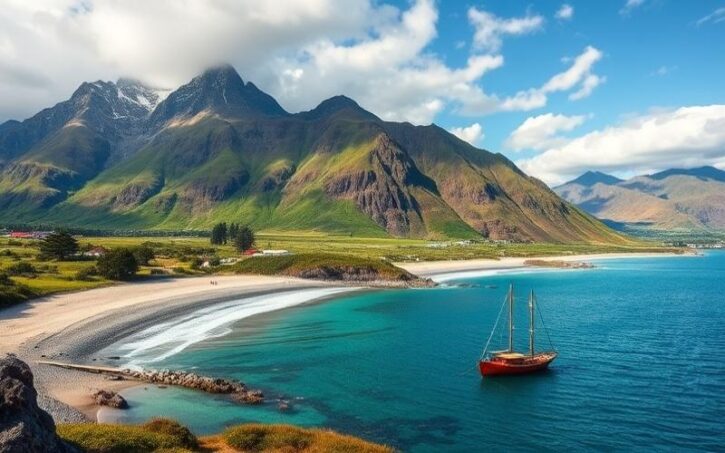
– White sand beaches and rocky coastlines – Tropical rainforests and temperate forests – Active volcanoes and geothermal springs – Glaciers and fjords – Alpine lakes and crystal-clear rivers – Lush meadows and fertile plains
This variety of landscapes, concentrated on a relatively small territory, makes New Zealand a popular destination for nature and adventure enthusiasts.
The country’s geology is also fascinating. New Zealand sits on the “Pacific Ring of Fire,” at the junction of the Pacific and Australian tectonic plates. This position explains the country’s seismic and volcanic activity, particularly visible on the North Island.
Good to know:
New Zealand has an exclusive economic zone (EEZ) of over 1.5 million square miles, about 15 times its land area. This vast marine expanse significantly contributes to the country’s economy and maritime identity.
In conclusion, New Zealand’s geography is a unique blend of island isolation and topographical diversity. From the subtropical beaches of Northland to the glacial fjords of Fiordland, passing through the active volcanoes of the central North Island, the country offers an impressive variety of landscapes for its size. This geographic richness, combined with its isolation, has shaped the history, culture, and identity of New Zealand, making it a fascinating destination for travelers from around the world.
Disclaimer: The information provided on this website is for informational purposes only and does not constitute financial, legal, or professional advice. We encourage you to consult qualified experts before making any investment, real estate, or expatriation decisions. Although we strive to maintain up-to-date and accurate information, we do not guarantee the completeness, accuracy, or timeliness of the proposed content. As investment and expatriation involve risks, we disclaim any liability for potential losses or damages arising from the use of this site. Your use of this site confirms your acceptance of these terms and your understanding of the associated risks.

Cyril Jarnias is an independent expert in international wealth management with over 20 years of experience. As an expatriate himself, he is dedicated to helping individuals and business leaders build, protect, and pass on their wealth with complete peace of mind.
On his website, cyriljarnias.com, he shares his expertise on international real estate, offshore company formation, and expatriation.
Thanks to his expertise, he offers sound advice to optimize his clients' wealth management. Cyril Jarnias is also recognized for his appearances in many prestigious media outlets such as BFM Business, les Français de l’étranger, Le Figaro, Les Echos, and Mieux vivre votre argent, where he shares his knowledge and know-how in wealth management.





