
 Published on and written by Cyril Jarnias
New Zealand, a country of spectacular landscapes and unique culture, has a rich and complex history spanning over 700 years. From the first Polynesian navigators to European settlers, through conflicts and reconciliations, let’s discover the captivating journey of this South Pacific nation.
Aotearoa: The Land of the Long White Cloud
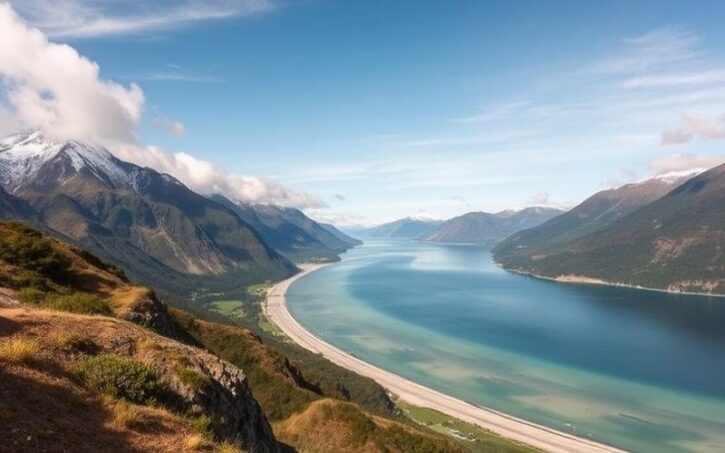
Before becoming New Zealand, this country was known as Aotearoa, which means “the land of the long white cloud” in the Māori language. This poetic name originates from the legends of the first Polynesian inhabitants. According to tradition, when Polynesian navigators first sighted these distant lands, they saw a long white cloud on the horizon that guided them to their future home.
Even today, the name Aotearoa is commonly used in New Zealand, both in everyday language and in official documents, symbolizing the importance of Māori culture in the national identity.
The First Inhabitants: The Arrival of the Māori
The history of New Zealand truly begins with the arrival of the first Polynesian inhabitants, the ancestors of the Māori, between 1250 and 1300 AD. These intrepid navigators, departing from the islands of Central Polynesia, traveled thousands of kilometers across the Pacific Ocean in large double-hulled canoes called waka hourua.
Upon arrival, they found a virgin land, rich in natural resources and populated by unique species like the moa, a giant bird now extinct. The Māori quickly adapted to their new environment, developing a distinct culture and a structured society around tribes (iwi) and sub-tribes (hapu).
Māori culture, with its oral traditions, wood carving art, and famous haka, would profoundly shape the identity of the future New Zealand nation.
European Discovery: From Tasman to Cook
New Zealand remained isolated from the rest of the world for several centuries, until European explorers “discovered” it in the 17th century. The first European to sight these lands was the Dutch navigator Abel Tasman in 1642. He named the country “Staten Landt,” thinking it was part of the hypothetical southern continent.
However, it was the famous British explorer James Cook who, during his first voyage to the Pacific in 1769-1770, mapped the coasts of New Zealand and established the first prolonged contacts with the Māori. Cook renamed the country “New Zealand,” after the Dutch province of Zeeland.
Encounters between Europeans and Māori were often marked by cultural misunderstandings and conflicts, but also by trade and cultural exchanges that would permanently transform both societies.
British Colonization: Birth of a New Nation
At the beginning of the 19th century, New Zealand increasingly attracted the attention of European powers, notably Great Britain and France. To prevent possible French colonization, the British decided to officially annex the territory.
On February 6, 1840, the Treaty of Waitangi was signed between the British Crown and many Māori chiefs. This foundational document, though controversial, is considered the birth certificate of modern New Zealand. It established British sovereignty while guaranteeing certain rights to the Māori.
The signing of the Treaty of Waitangi marks the beginning of British colonization and a period of rapid transformation of New Zealand society.
In the decades that followed, thousands of British settlers arrived in New Zealand, founding new cities like Wellington, Auckland, and Christchurch. This wave of mass immigration led to conflicts with the Māori over land control, culminating in the New Zealand Wars of the 1860s and 1870s.
Toward Independence: The Emergence of a National Identity
From the late 19th century, New Zealand began to develop a distinct national identity and assert greater autonomy from Great Britain. The country gained attention for its progressive social policies, notably becoming the first country in the world to grant women the right to vote in 1893.
In 1907, New Zealand obtained dominion status within the British Empire, granting it broad internal autonomy. Full independence was achieved gradually, culminating in the adoption of the Statute of Westminster in 1947, which made New Zealand a fully sovereign state.
Despite its independence, New Zealand has maintained close ties with the United Kingdom, notably by remaining a member of the Commonwealth and keeping the British monarch as the symbolic head of state.
Modern New Zealand: Reconciliation and Multiculturalism
The last decades of the 20th century and the beginning of the 21st century have been marked by efforts at reconciliation between the Māori and Pākehā (New Zealanders of European descent), as well as the emergence of a multicultural society.
The Waitangi Tribunal, established in 1975, has allowed for the examination of historical breaches of the Treaty of Waitangi and the negotiation of settlement agreements. The Māori language became an official language in 1987, and Māori culture now holds a central place in New Zealand’s national identity.
New Zealand has also opened up to immigration from Asia and the Pacific, enriching its cultural diversity. The country has built an international reputation for its commitment to the environment, its anti-nuclear stance, and its active role in international affairs.
Today, New Zealand is recognized as a stable democracy, a developed economy, and a popular tourist destination, famous for its breathtaking landscapes and unique culture.
Good to Know:
New Zealand’s history is a fascinating blend of Polynesian traditions, British colonial heritage, and social innovations. This complex history has shaped a modern nation, proud of its cultural diversity and unique identity in the South Pacific.
Disclaimer: The information provided on this website is for informational purposes only and does not constitute financial, legal, or professional advice. We encourage you to consult qualified experts before making any investment, real estate, or expatriation decisions. Although we strive to maintain up-to-date and accurate information, we do not guarantee the completeness, accuracy, or timeliness of the proposed content. As investment and expatriation involve risks, we disclaim any liability for potential losses or damages arising from the use of this site. Your use of this site confirms your acceptance of these terms and your understanding of the associated risks.

Cyril Jarnias is an independent expert in international wealth management with over 20 years of experience. As an expatriate himself, he is dedicated to helping individuals and business leaders build, protect, and pass on their wealth with complete peace of mind.
On his website, cyriljarnias.com, he shares his expertise on international real estate, offshore company formation, and expatriation.
Thanks to his expertise, he offers sound advice to optimize his clients' wealth management. Cyril Jarnias is also recognized for his appearances in many prestigious media outlets such as BFM Business, les Français de l’étranger, Le Figaro, Les Echos, and Mieux vivre votre argent, where he shares his knowledge and know-how in wealth management.





