
 Published on and written by Cyril Jarnias
Traveling in Cambodia means accepting a transportation network that is both abundant, sometimes chaotic, but undergoing rapid transformation. Between air-conditioned public buses, revived train services, express minivans, app-connected tuk-tuks, and boats speeding across the Tonlé Sap, the options are far richer than they appear at first glance. To navigate it, you need to understand the on-the-ground realities, new digital tools, accessibility issues, and the cultural codes that frame mobility.
This guide covers public transportation networks in the cities of Phnom Penh and Siem Reap, as well as intercity connections. It also addresses accessibility for people with disabilities.
Understanding Cambodia’s Transportation Context
Cambodia relies almost entirely on roads for movement, whether for travelers or goods. Studies place the share of road transport at over 90% of trips, sometimes even up to 95% when including freight. The road network has seen significant improvement over the past decade, with thousands of kilometers of national roads now paved and new infrastructure like the Phnom Penh–Sihanoukville expressway.
While the main national roads are in good condition, provincial and rural networks are fragile, often unpaved and poorly maintained, especially during the rainy season. This situation is worsened by massive traffic jams in the capital, rapid growth in the number of vehicles, and a still-young public transportation system.
The country has also embarked on several national and sectoral plans to structure this evolution: industrial strategy, logistics plans, sustainable transportation roadmaps, with support from donors like the Asian Development Bank, Japan’s JICA, or South Korea’s KOICA. These actors finance roads and railway lines as well as electric bus projects or road safety improvements.
Getting Around Town: An Overview of Options
In Cambodian cities, getting around relies on a mix of formal and informal modes. Each city has its own balance, but a few strong trends emerge.
City Buses: Mainly in Phnom Penh
The only structured city bus network is currently in Phnom Penh. Launched in 2014 with support from JICA, the Phnom Penh City Bus system started modestly with three pilot lines, before gradually expanding to about twenty lines covering main arteries and outskirts.
The buses are air-conditioned, identified by numbers or combinations (1A, 2B, 4A, 11C, etc.), and now serve 14 administrative districts, including peripheral areas like Prek Pnov to the north, Ta Khmau to the south, Chbar Ampov to the east, or the Special Economic Zone to the west. Authorities chose a very low flat fare to encourage use: 1,500 riels per ride, or about 0.37 US dollars, regardless of the number of stops. Payment is made in riels (cash) or via ABA transfer for banked users.
A key feature is free travel for a whole series of groups: seniors over 70, small children, people with disabilities, students, monks, teachers, and factory workers, provided they show valid identification. This policy reflects a stated will for social inclusion through transportation.
Buses run from 5:30 AM to 8:00/8:30 PM, with frequencies varying from 10 to 30 minutes depending on the line. There are no printed schedules. To check real-time schedules and routes, it’s necessary to use dedicated mobile apps (City Bus Official, Phnom Penh Bus, Stops Near Me) or the network’s integration into Google Maps, which is more reliable on a mobile phone than on a computer.
The network structure remains very radial, organized around main boulevards (Monivong, Norodom, Mao Tse Toung, Russian Boulevard) and hubs like the railway station, major markets, or shopping malls. Several lines are among the most used, particularly those crossing industrial areas or dense neighborhoods.
An overview of a few iconic lines helps visualize the capital’s network coverage.
Examples of Phnom Penh City Bus Lines
| Line | Main Route | Approximate Distance | Indicative Frequency |
|---|---|---|---|
| 1A | Bus Depot ↔ Veal Sbov Bus Station (Monivong, Monivong Bridge) | 27 km | 10–15 min |
| 3 | Km 9 ↔ Borey Santepheap 2 (NR5, downtown, Russian Blvd, NR3) | 27.3 km | 10–15 min |
| 4A | Russey Keo Park ↔ Borey Santepheap 2 (via factory zones) | 19.5 km | 20–30 min |
| 4B | Borey Santepheap 2 ↔ Special Economic Zone | 25 km | 20–30 min |
| 5 | Depot ↔ Aeon Mall 2 ↔ Km 9 | 25 km | 20–30 min |
| 6 | Kouch Kanong Roundabout ↔ Sokha Hotel ↔ Depot | 32.5 km | 15–20 min |
| 7 | Km 9 ↔ Veal Sbov (via Boulevard 271 and Monivong Bridge) | 23 km | 20–30 min |
| 9 | Borey Santepheap 2 ↔ Special Economic Zone | 31 km | 15–20 min |
| 11A | Pong Teuk ↔ Olympic Stadium | 37 km | 20–30 min |
| 12A | Kouch Kanong ↔ AEON 1, Koh Pich ↔ Peng Hout Boeung Snor | 34 km | 20–30 min |
| 13 | Depot ↔ Special Economic Zone | 25.5 km | 20–30 min |
In practice, the network still suffers from several drawbacks: no dedicated lanes, mixed traffic with general flow, sometimes poorly marked stops, cluttered sidewalks making access difficult, and a recurring “last-mile” problem between the stop and the final destination. These limitations reduce the bus’s appeal compared to two-wheelers or tuk-tuks.
Nevertheless, for a budget-conscious traveler or to avoid long fare negotiations, the city bus remains the most economical option and one of the safest, with air conditioning as a welcome bonus.
Tuk-tuks and Trailers: The Backbone of Urban Transport
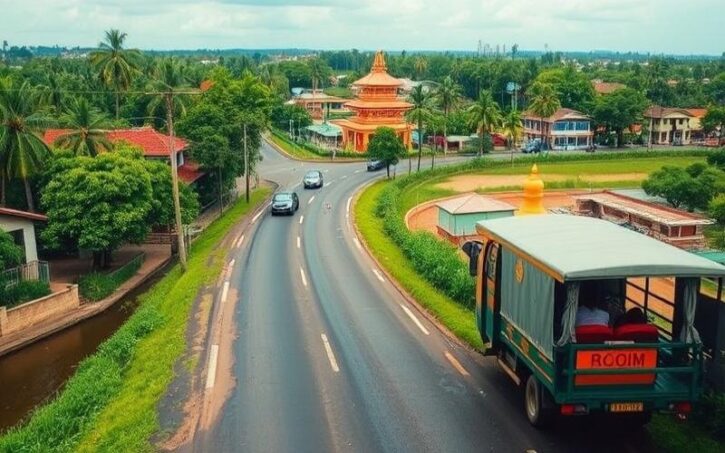
The true face of urban Cambodian transport is the tuk-tuk, called locally a trailer or remork-moto for the traditional version. There are two main variants. The first is an assembly of a motorbike towing a covered, two-wheeled cart, accommodating four people (or more). The second, more recent, is the Indian-style auto-rickshaw, a motorized three-wheeled vehicle with an enclosed cabin, often running on gas.
These vehicles dominate the streets of major cities like Phnom Penh and Siem Reap, as well as smaller towns. Their success is explained by their relatively low operating costs, flexibility in congested traffic, and strong tourist demand. They’re found everywhere: at market exits, in front of hotels, near bus or train stations, and around tourist sites.
Their fare is not regulated and is based on negotiation. Amounts remain modest for urban distances: often around $1 to $2 for short trips, $3 to $6 for longer distances within the city. The price rises for trips to outside sites like the Killing Fields in Phnom Penh or, in Siem Reap, for a full day at Angkor.
In practice, their frequency of use makes tuk-tuks a de facto form of collective transport, even though they operate in “taxi” mode. Entire families or groups of friends share a ride, locals use them for daily commutes, and many digital platforms have been built on this mode.
Motorcycle Taxis and Motorbike Rentals
Motos or moto-dops are the fastest and cheapest alternative for short trips, especially for a single person. They are found at all major intersections, near markets or bus stations. The prices are close to those of tuk-tuks for short distances, sometimes with a price advantage for slightly longer trips.
Two important reservations apply for travelers using moto-dops in Cambodia: safety and difficulty of communication.
Renting motorbikes or scooters is also very common, particularly in Siem Reap, Kampot, Battambang or on the islands. Daily rates generally range between $5 and $15 depending on engine size and location. This option offers total freedom, but it’s no longer strictly in the public transport category; it requires good driving experience and awareness of the risks related to road conditions and traffic.
Car Taxis and Private Hire Services
Traditional car taxis are not omnipresent like in other Asian capitals. In Phnom Penh or Siem Reap, you almost never hail them on the street: you must book them by phone, through an agency, via your hotel, or through an app like Grab or PassApp. They are favored for airport transfers, night travel, or private intercity trips.
Comfort is higher (air conditioning, safer seats), but the cost is unsurprisingly higher than for tuk-tuks. For long distances, private drivers often charge by the day or per trip, with amounts ranging from $50 to $80 or more depending on the destination.
The Digital Revolution: Ride-Hailing and Taxi Apps
A major turning point in Cambodian transport is the rise of ride-booking applications. From the mid-2010s, the country saw the appearance of a series of local and regional platforms that profoundly changed the way people get around cities.
Key Players: PassApp, Grab, Tada and Others
Among the most used apps, several stand out:
– PassApp, locally developed, has established itself as a go-to for booking tuk-tuks, rickshaws, and cars in urban areas. The app operates primarily on a cash-on-arrival payment basis, which fits well with a still very cash-based economy. It shows an estimated fare upfront, uses a digital meter, and sends a trip receipt by email.
Grab, the regional leader, offers a practical and transparent mobility solution for travelers in Cambodia.
The Singapore-based regional leader took over Uber’s operations in Southeast Asia. The service is available in Cambodia’s main cities: Phnom Penh, Siem Reap, and Sihanoukville.
Grab offers different transport modes adapted to needs: cars, tuk-tuks, and motorbikes, for all kinds of trips.
A practical app for international users: payment via registered credit/debit card, use of a foreign phone number, and one app for multiple countries in the region.
A fixed fare is quoted and guaranteed before each ride, eliminating negotiations and unpleasant surprises.
– Tada, born in Singapore, stands out by promoting a no-commission model for drivers, who keep 100% of the ride fare. It offers tuk-tuks and cars, with competitive pricing and a security SOS button in the app.
Alongside these three major players, a galaxy of smaller or specialized apps exists: WeGo, EagleApp, SmartRide, Zelo, Yango, LM Car, and even inDriver. Some focus on metered taxis, others on advance booking, others still on intercity trips or premium services.
Why These Apps Have Changed the Game
Before these platforms arrived, most trips were negotiated verbally, with no price reference, and a very low degree of safety and traceability. Today, the apps bring several concrete benefits:
– A price displayed upfront, or at least an estimate, which lets you know immediately if a street offer is exaggerated.
– Vehicle geolocation, useful both for reassurance and to anticipate arrival time.
– A driver rating system, encouraging better behavior and giving users a way to report problems.
– For some, cashless payment (card, e-wallet), appreciated when you’re short on small riel change.
Beyond traveler convenience, these applications are part of a broader transformation of the Cambodian economy, driven by a connected youth, the falling cost of smartphones, and the widespread adoption of mobile networks. They have created new income opportunities for thousands of drivers, even though the latter still face expenses (fuel, maintenance, commissions) and fluctuating demand.
Quick Comparison of the Most Used Apps
| Application | Origin | Modes Offered | Main Payment | Primary Coverage |
|---|---|---|---|---|
| PassApp | Cambodia | Tuk-tuks, rickshaws, cars, SUVs | Cash | Phnom Penh, Siem Reap, other cities |
| Grab | Singapore | Cars, tuk-tuks, motorbikes, delivery | Cash or card | Phnom Penh, Siem Reap, Sihanoukville |
| Tada | Singapore | Tuk-tuks, cars | Cash / varies by country | Phnom Penh (primarily) |
| WeGo | Cambodia | Taxis, tuk-tuks | Cash | Phnom Penh and surroundings |
| Zelo | Cambodia | Taxis, tuk-tuks, rickshaws | Cash | Phnom Penh (base), other cities |
Installing several apps is often wise: depending on the neighborhood, time, or weather, one will be faster or more advantageous than another.
Intercity Buses and Minivans: The Backbone of Travel Between Cities
For traveling between Phnom Penh, Siem Reap, Battambang, Sihanoukville, Kampot, and other major cities, the most used option remains the intercity bus or minivan. These are essentially private offerings, operated by a multitude of companies of varying sizes.
Companies and Comfort Levels
Over the years, a relatively clear landscape has emerged, with some operators leaning towards “budget” and others positioning themselves in the “premium” or “VIP” category. In the latter category, you notably find Giant Ibis or Mekong Express, known for their more modern fleet, air conditioning, sometimes Wi-Fi, snacks, and better safety oversight. Other companies, like Rith Mony or Angkor Express, are often cited as having a more problematic safety history.
Standard buses, called *laan tom* in Khmer, offer reclining seats, sometimes video screens, and occasional stops. For long distances, especially overnight, sleeper buses with semi-reclining berths are also available.
Minivans play the speed card: fewer passengers, more aggressive driving, but variable comfort levels and cramped spaces. Some “express” services promise a “one seat, one passenger” principle, while more classic minibuses don’t hesitate to overload, especially on rural roads.
Fares and Travel Times
Even though travel times vary depending on road conditions and the season, a few major routes give a good idea.
| Main Route | Indicative Time | Approximate Price Range |
|---|---|---|
| Phnom Penh → Siem Reap | 5 to 8 hours | 6 to 15 USD |
| Phnom Penh → Sihanoukville | 4 to 7 hours | 6 to 20 USD |
| Phnom Penh → Battambang | 4 to 6 hours | 5 to 12 USD |
| Siem Reap → Sihanoukville | 10 to 12 hours | 15 to 25 USD |
| Siem Reap → Battambang | approx. 3 to 5 hours | ~8 USD |
| Kampot → Kep | 2 to 3 hours | 2 to 5 USD |
Prices remain overall very affordable on a European traveler’s scale, but the differences between companies and vehicle types can be significant. Some tickets also include a transfer from the hotel to the departure point.
Bus reservations can be made at company offices, through accommodations (guesthouses/hotels), or online (BookMeBus, 12Go, Camboticket). It is recommended to allow some extra time, as departures can sometimes happen before the official time if the bus is full.
Safety and Service Quality
Studies on bus quality in Cambodia highlight a central point: safety and trip efficiency are the primary determinants of passenger satisfaction. However, the reality is mixed. Roads, even improved, can be narrow, bumpy, poorly marked, and the fast driving of some drivers increases the risk of accident.
In surveys conducted among passengers, criteria like punctuality, good vehicle condition, ease of ticket purchase, and regularity of schedules emerge as key elements. On these points, the best-known companies catering to international clients generally get better feedback than more modest local operators.
For a traveler wanting to limit risks, choosing companies with a good safety record, avoiding night trips when they are reputed for driver fatigue issues, and buckling up whenever possible are basic reflexes.
The Return of the Train: A Slower but Pleasant Mode
The Cambodian railway network was heavily affected by the country’s recent history. For years, no regular passenger service existed, and it was only from 2016 that a revival began, with the gradual resumption of lines.
The Two Main Lines: From the South to the Gulf of Thailand and Towards the Thai Border
The country essentially has two railway lines:
The southern line connects Phnom Penh to Sihanoukville over about 254 km, passing through Takeo and Kampot. Restarted in 2016, it offers trains with modern, air-conditioned carriages on some runs, and diesel railcars on others. The journey takes about 6 to 8 hours, for a fare often between 6 and 11 dollars depending on the class.
Cambodia’s Southern Railway Line
– The northern line connects Phnom Penh to Poipet, on the Thai border, over about 388 km, via Pursat, Battambang, and Sisophon. After decades of abandonment, rehabilitation work allowed services to resume in 2018, but the pandemic disrupted operations again. To date, a Phnom Penh–Battambang connection is operational, while the portion to Poipet still awaits full resumption.
Train tickets are sold at stations, sometimes only a week before departure for some connections, and tend to sell out very quickly, especially for weekend and holiday trips. To plan ahead, you can use online booking platforms like Easybook or Baolau, which offer this service on certain lines.
Battambang’s “Bamboo Train”
A railway curiosity closely linked to Cambodia’s imagery is the norry, better known to travelers as the bamboo train. It is a bamboo platform mounted on axles that runs on the rails, propelled by a small engine. Today, this system is mainly a tourist attraction in Battambang: visitors embark on a roughly one-hour round-trip excursion, for a fare around $5 per person.
This is not public transport in the strict sense, but it illustrates the local inventiveness born from the lack of railway services for years.
Boats and Ferries: Another Way to Travel the Country
Cambodia has thousands of kilometers of waterways: the Mekong, the Tonlé Sap, and numerous tributaries have long served for transporting people and goods. Their role has diminished with road improvements, but some river or lake lines remain active.
Price in dollars for the fast boat trip between Phnom Penh and Siem Reap.
Another route appreciated for its picturesque aspect is the one between Siem Reap and Battambang, via the Tonlé Sap then the Sangker River. The trip, sometimes 8 to 10 hours long, offers rather spectacular scenes of rural and fishing life.
In the south, the sea takes over. From Sihanoukville, ferries and speedboats connect several times a day to the islands of Koh Rong and Koh Rong Samloem. Fast shuttles usually cover the crossing in 60 to 90 minutes, for a fare of about $12 one-way. Further east, from Kep, small boats go to Rabbit Island, with round-trip tickets at fares below $10.
These services remain sensitive to weather conditions: during the rainy season, delays or cancellations are frequent.
Air Travel and Domestic Flights
To save time on long distances, Cambodia has several airports, including three main ones open to commercial traffic: Phnom Penh, Siem Reap, and Sihanoukville. Domestic flights connect these cities in less than an hour, with tickets generally between $50 and $120 one-way depending on demand and how far in advance you book.
Air travel is the most expensive option. It can still be justified for travelers in a hurry, to avoid a long road journey, or when an international connection is added to the trip.
Furthermore, a new international airport, Techo Takhmao International Airport, is nearing completion south of Phnom Penh. Designed to accommodate very large capacity aircraft, it is meant to eventually replace the current airport and should integrate into a broader reflection on connections between the capital, the periphery, and this new hub.
Accessibility and Inclusion: A Major Challenge
Discussing public transportation in Cambodia without mentioning the issue of accessibility would be incomplete. The country has nearly 690,000 people with disabilities, with a slight majority being women. A good portion of them live in urban areas, but the offer of truly inclusive transport remains very limited.
Studies show that about 37% of people with disabilities surveyed report difficulties accessing transportation. The obstacles are numerous: impassable or nonexistent sidewalks, degraded road surfaces, lack of ramps and wheelchair spaces on buses, lack of audio information for visually impaired people, or sometimes excluding behavior from certain operators (refusing to board a wheelchair, demanding a surcharge for mobility equipment).
To guarantee the rights of persons with disabilities, Cambodia adopted a law in 2009. In 2018, an inter-ministerial Prakas defined mandatory technical accessibility standards for public infrastructure, including roads, public buildings, and transport. These standards specify, among other things, limited slopes and minimum path widths (2 meters minimum, 2.5 meters in highly frequented areas).
In practice, their implementation remains patchy. Assessments conducted in Phnom Penh using a tool called the Journey Access Tool highlighted the persistence of sidewalks blocked by vehicles or stalls, insufficient pedestrian crossings, difficult-to-access bus stops, and a lack of assistance from transport staff.
Faced with this, new projects are trying to integrate the inclusive dimension from the design stage. One of the most emblematic is the future electric bus system in Siem Reap.
Siem Reap and the Promise of Accessible Electric Buses
To date, Siem Reap does not have a structured city bus network. Getting around is done by tuk-tuk, motorbike, bicycle, or via a few private services. Yet the city, which welcomes millions of tourists each year to visit Angkor, is at the heart of an ambitious project to implement an electric bus network.
The program plans to deploy several dozen 100% electric buses on three major lines, aiming to reduce environmental impact and improve mobility.
A major line along National Road 6, helping reduce congestion and emissions.
A line running in a loop around the city, limiting noise and pollution in dense areas.
A line connecting downtown to heritage areas, offering affordable service to residents and visitors.
Studies by organizations like the Global Green Growth Institute and the Asian Development Bank emphasize the need to integrate low floors, ramps, dedicated spaces for wheelchairs, and accessible real-time information systems. The plan also includes using contactless ticketing systems, which, if well designed, can facilitate access for people who have difficulty handling cash.
This project also reveals a delicate social issue: over 95% of Siem Reap residents surveyed say they prefer private transport. Any introduction of buses must therefore be done in consultation with tuk-tuk and moto drivers, to avoid tensions and a sudden loss of income. Consultations have been organized to this end, with the idea of building a model where different modes coexist, each with its role.
Culture, Etiquette, and Safety: Traveling Respectfully
Beyond technical aspects, using public transport in Cambodia involves understanding certain cultural codes and adopting a few safety reflexes.
The country remains deeply marked by Buddhism. On an intercity bus or in the city, giving up your seat to a monk or an elderly person is the norm. Women, in particular, should avoid all physical contact with monks, including when passing a ticket or change: in this case, placing the object within reach rather than handing it over directly is seen as more respectful.
In Asia, the notion of “face” is paramount. Getting loudly angry at someone, like a driver or employee, even in case of a legitimate problem, is very poorly perceived and often counterproductive. To resolve a situation effectively, it is advised to keep calm, smile, and explain your point of view in a composed manner. This approach usually leads to finding a solution more quickly and with mutual respect.
Regarding attire, a minimum of decency is expected, especially if the transport is part of visiting religious sites. On buses or boats frequented by locals, very revealing clothing can cause discomfort or silent disapproval.
Personal safety also calls for a few precautions. Snatch thefts from motorbikes targeting people sitting in a tuk-tuk or walking on the street are documented. Placing bags in the center of the seat rather than on the street side, keeping your phone put away during the trip, carrying your bag in front of you on a motorbike or on foot are simple actions that reduce risks.
Towards a More Sustainable and Structured Transport System
Cambodia is at a pivotal moment. Its main road network has modernized, railway links are taking shape again, city buses have been introduced in Phnom Penh, and clean transport projects are emerging in Siem Reap. Mobile apps have, for their part, professionalized part of the informal taxi offering by providing transparency and traceability.
At the same time, challenges remain immense: chronic congestion in the capital, a shortage of safe pedestrian infrastructure, public offerings still insufficient to compete with private cars or moto-taxis, strong territorial inequalities between served areas and peripheral neighborhoods, and slow progress on accessibility for aging people or people with disabilities.
For travelers, getting around requires using hybrid solutions (buses, tuk-tuks, minivans, train, or boat) and relying on digital tools. For residents, cars and motorbikes remain dominant, but public transport is starting to develop.
The challenge of the coming years will be to transform these scattered initiatives into a truly coherent, inclusive, reliable, and more environmentally sustainable system. Until then, a good knowledge of the terrain, a sense of adaptation, and a dose of patience will remain the best allies of anyone wishing to explore Cambodia using its public transport.
Disclaimer: The information provided on this website is for informational purposes only and does not constitute financial, legal, or professional advice. We encourage you to consult qualified experts before making any investment, real estate, or expatriation decisions. Although we strive to maintain up-to-date and accurate information, we do not guarantee the completeness, accuracy, or timeliness of the proposed content. As investment and expatriation involve risks, we disclaim any liability for potential losses or damages arising from the use of this site. Your use of this site confirms your acceptance of these terms and your understanding of the associated risks.

Cyril Jarnias is an independent expert in international wealth management with over 20 years of experience. As an expatriate himself, he is dedicated to helping individuals and business leaders build, protect, and pass on their wealth with complete peace of mind.
On his website, cyriljarnias.com, he shares his expertise on international real estate, offshore company formation, and expatriation.
Thanks to his expertise, he offers sound advice to optimize his clients' wealth management. Cyril Jarnias is also recognized for his appearances in many prestigious media outlets such as BFM Business, les Français de l’étranger, Le Figaro, Les Echos, and Mieux vivre votre argent, where he shares his knowledge and know-how in wealth management.





