
 Published on and written by Cyril Jarnias
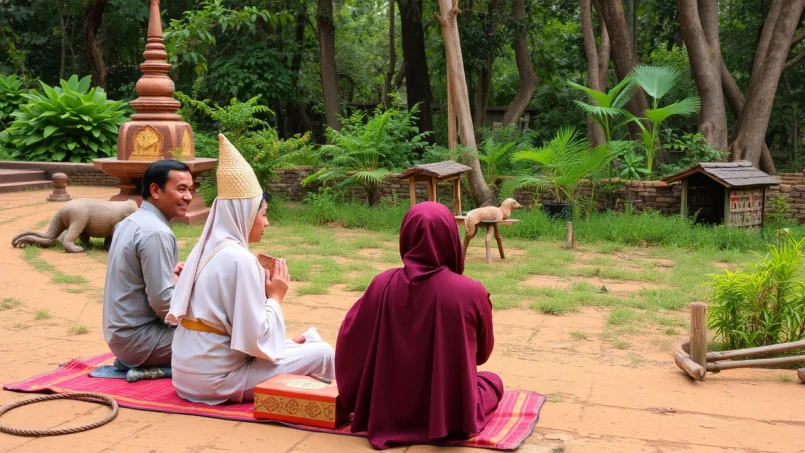
Moving to Cambodia means entering a world where religion is not confined to temples, but permeates daily life, family, the calendar, and even the architecture of homes. For an expatriate, understanding this spiritual landscape is essential to avoid missteps, gain the trust of neighbors, and simply better appreciate the country you live in.
In Cambodia, religion permeates all aspects of social life, from the rhythm of the days to public behavior. This guide aims to help newcomers understand the most visible practices, so they can observe, participate tactfully when appropriate, and avoid unintentional faux pas.
Religious Landscape in Cambodia: More Than One Religion
Cambodia is officially a Buddhist kingdom of Theravada tradition. This starting point is essential, but it doesn’t tell the whole story. In practice, Cambodian spirituality is a subtle blend of Buddhism, animism, Hindu heritage, and ancestor worship.
Available figures show a very homogeneous landscape at first glance, but nuanced upon closer examination.
Who Believes What?
Censuses and studies converge: almost the entire population identifies as Theravada Buddhist, with small Muslim, Christian, and animist minorities.
Here is an overview of recent estimates:
| Source / Year | Buddhists | Muslims | Christians | Other / No religion |
|---|---|---|---|---|
| 2024 National Census | 96.5 % | 2.6 % | 0.3 % | 0.5 % |
| Pew Research (2010) | 96.9 % | 2.0 % | 0.4 % | 0.7 % |
| 2019 Estimates | 97.1 % | – | – | – |
Beyond these numbers, what often surprises expatriates is how Cambodians combine different beliefs. Buddhism occupies the center, but many continue in parallel to honor local spirits, consult fortune tellers, have their house blessed, wear amulets, or respect animist-type taboos.
In this system, religion is not conceived as an exclusive choice that invalidates others, but as a set of effective practices for managing two levels of life.
Religious System
| Level of Concern | Common Religious Response |
|---|---|
| Karma, rebirth, future life | Theravada Buddhism, meditation, merit-making, observing precepts |
| Health, money, protection, daily life | Guardian spirits, neak ta, amulets, astrology, offerings, fortune tellers |
Understanding this “functional” logic – where people seek less doctrinal truth than practical solutions – helps interpret many behaviors that, seen from the outside, may seem contradictory.
Buddhism in Daily Life: Monks, Pagodas, and Merit
For an expatriate, the most visible presence of religion remains the pagodas (wat) and monks in saffron robes. Theravada Buddhism, which became established in the 13th century, still structures space and time today.
The Central Role of Pagodas
The pagoda is not just a place of worship. It is a community center: people learn to read there, organize funerals, house blessings, ceremonies for ancestors, and charitable events. In many villages, the wat is the heart of social life.
A typical wat includes a main sanctuary, dormitories for monks, a meeting hall, stupas for the ashes of the deceased, and often a pond. In large cities, some pagodas also host NGOs or informal schools associated with the monks.
It is acceptable for an expatriate to enter a pagoda to pray, observe, or participate in a ceremony upon invitation. The main thing is to respect a few simple rules of conduct.
The Sangha: Who Are the Monks You Encounter?
The monastic community (sangha) is highly structured. Two major orders coexist:
| Monastic Order | Main Characteristics |
|---|---|
| Maha Nikaya (Mohanikay) | Majority order, more traditional, strongly linked to the state |
| Dhammayuttika Nikaya | Small reformist order that arrived from Thailand in the 19th century |
Monks follow 227 disciplinary rules. They live on alms, eat only before noon, practice celibacy, and devote their days to study, meditation, rituals, and community service. Many young men become monks temporarily, sometimes for a few months to a few years, to bring merit to their family and receive an education.
This social importance explains the great respect monks enjoy. For an expatriate, how to behave with them is an immediate test of their understanding of local codes.
How to Interact with Monks
A few practical pointers, often overlooked by newcomers:
Monks, particularly in the Theravada tradition, must not be touched by women. If a woman needs to hand them an object, she should place it in front of them or pass it through a man. In their presence, sit at a lower level than them and ensure you do not point your feet in their direction. To greet them, use the *sampeah* (palms together), often raising your hands higher than for a layperson. Finally, always ask their permission before taking a photograph, even if other tourists seem to do so without authorization.
A good rule: imitate the Khmer laypeople around you. If they bow deeply, kneel, or avoid getting too close, do the same.
Giving to Monks: The Morning Alms Round and Making Merit
The alms-giving ritual is one of the oldest expressions of Buddhism, traditionally dating back to the time of the Buddha over 2,500 years ago. In Cambodia, even if the practice is sometimes less conspicuous than in some Thai cities, it remains very present.
What Does a Cambodian Alms Round Look Like?
At dawn, groups of monks in saffron robes leave the pagoda, walk in single file, sometimes barefoot, with a metal alms bowl. Laypeople wait in front of their houses or by the roadside, barefoot, often kneeling or sitting on a low stool, ready to place rice, fruit, or other food into the monks’ bowls.
Unlike Western-style begging, Buddhist monks offer laypeople the opportunity to make a meritorious donation. In return, they do not thank verbally but respond with a blessing or a brief chant. The collected food is then shared at the monastery among the monks and sometimes with attending devotees.
During certain periods, like Pchum Ben, monks go out less: it is then the families who come to the pagoda with large quantities of food.
Can Expatriates Participate?
Foreigners can give alms, provided it is done with respect. Some very concrete pointers:
To show respect, wear clothing that covers shoulders and knees. In a clearly ritualized context, remove shoes and socks. Women should sit or kneel at a height lower than the monk. For offerings, avoid touching the bowl and simply place the item in it.
To avoid a “tourist performance” effect, it is advisable to prepare the offering with the help of locals – neighbors, colleagues, or hotel staff – and not turn the moment into a photo session. If you wish to document it, do so from a distance, without flash, and remain silent.
Buddhist Holidays and Major Gatherings: The Calendar that Structures the Year
An important part of religious life is reflected in the official calendar. Cambodia has more than twenty public holidays, largely linked to Buddhist or royal festivals. For an expatriate, these times are both risks (crowded transport, closed shops) and great opportunities to observe local religiosity.
Pchum Ben: When the Dead Return Among the Living
Pchum Ben is probably the most puzzling festival for foreigners, as it touches on the Cambodian relationship with the dead and the afterlife. It is a fifteen-day religious festival that usually falls in September or October, in the tenth month of the Khmer calendar, and marks the end of the Buddhist Lent.
The first fourteen days, called Kan Ben, constitute the “observation period.” The fifteenth day, Pchum Thom (“Great Gathering”), is the climax. According to belief, the gates of hell open: the spirits of the deceased, particularly the “hungry ghosts” (preta), can receive the merits and offerings from their descendants.
An emblematic practice is the making of *bay ben*, sticky rice balls sometimes mixed with sesame seeds and coconut cream. They are mainly offered to monks, but can also be thrown into fields or placed around pagodas. This offering aims to feed wandering spirits who no longer have family to care for them.
For families, it is a moral obligation: they visit several pagodas – traditionally at least seven – make donations of food, incense, candles, listen to the monks’ chants in Pali, and sometimes attend night ceremonies. A “sending off the ancestors” ceremony concludes the period, the spirits being symbolically escorted back to their world.
For expatriates, Pchum Ben means:
– Three official public holidays at the peak of the festival, with a massive exodus to the provinces.
– Crowded pagodas, congested roads, closed shops in the city.
– An excellent opportunity to observe the very concrete relationship Cambodians have with their ancestors, but while remaining discreet.
Khmer New Year, Meak Bochea, Vesak, Bon Kathin: Other Annual Markers
The Khmer New Year (Choul Chnam Thmey), in April, is both a religious and social festival. People clean the house, go to the temple to make offerings, pour water on each other to symbolize purification, and play traditional games. The capital empties, tourist cities like Siem Reap fill up.
Other important celebrations that mark the year in the Buddhist tradition.
The most important Buddhist holiday, celebrating the birth, enlightenment, and death (parinirvana) of the Buddha. It takes place on the full moon in May.
Commemorates a spontaneous gathering of 1250 disciples of the Buddha. Celebrated on the full moon day of the third lunar month.
Marks the Buddha’s first sermon (setting in motion the wheel of Dharma) and the beginning of the rainy season (Vassa).
Monthly observance days, roughly every lunar week, when laypeople practice more intensively and renew their commitment.
Ceremony at the end of the rainy season retreat (Vassa), where laypeople offer robes and requisites to monks.
Festival of lights (mainly in Thailand) where decorated rafts are floated on water to honor spirits and purify oneself.
– Meak Bochea, with candlelit processions around temples to commemorate a great sermon by the Buddha.
– Visak Bochea, which celebrates the birth, enlightenment, and death of the Buddha.
– The Buddhist Lent (Vassa), three months of retreat for monks, followed by the Bon Kathin ceremony where laypeople offer them robes and supplies.
To these events are added festivals with both religious and agricultural dimensions, like the Water Festival, which gives thanks to the river and marks the reversal of the Tonlé Sap river’s current.
For an expatriate, these dates are important to know for three reasons: they impact logistics (transport, administration), they are privileged moments to observe religious practice, and they often constitute neutral and appreciated topics of conversation with Khmer colleagues or neighbors.
Spirits, Spirit Houses, and Animism: The Other Side of Religion
Even though most Cambodians call themselves Buddhists, belief in invisible forces, protective or dangerous spirits, remains omnipresent. For an expatriate, this dimension is mainly seen through the small colorful “houses” found almost everywhere.
Spirit Houses: Those Little Shrines You’ll See Everywhere
In front of a house, at the entrance of a business, on a street corner, near a big tree, a hotel, a gas station: these small elevated structures, sometimes very elaborate, are spirit houses, called rean tevoda or, depending on the type, shrines for neak ta (place spirits) or tevoda (more general deities).
Their function is twofold:
– To provide a proper “home” for the spirit of the place, so it is appeased and does not disturb humans.
– To serve as a point of contact for regular offerings: incense, flowers, fruit, water, sweets, cigarettes, alcohol, etc.
This is the cost a spirit house can reach, ranging from a simple bamboo hut to a gilded concrete mini-temple.
For an expatriate, a few implicit rules apply:
– Do not touch the house or the offerings, even if they seem rotten or attract ants.
– Avoid pointing your feet in its direction when sitting nearby.
– Do not take selfies posing with the offerings, which is perceived as deeply disrespectful.
It is not necessary to “believe” in spirits yourself to respect these places. Cambodians take them seriously enough to devote time and money to them.
Neak Ta, Bray, Ghosts: A Populated World
Neak ta are guardian spirits linked to a specific territory: a village, a mountain, a crossroads, a remarkable tree. They watch over the inhabitants but can also punish disrespect. Some have regional or even national renown, like Lok Yeay Mao, the emblematic protector of Bokor Mountain and the coast.
Besides official spirits, there are feared entities like the *bray*, spirits of women who died tragically (e.g., in childbirth), considered dangerous but also endowed with magical powers. Ghosts (*arb*, *khmaoc*) are also very present in folk tales.
To manage these relationships with the invisible, Cambodians resort to various specialists: achar (ceremony masters), kru khmer (healers, shamans, holders of magico-religious knowledge), possessed mediums (kru boramei). They organize rituals ranging from a simple promise (asking for protection before a trip) to more elaborate ceremonies to deal with illness, drought, or serious conflict.
Here again, the boundary with Buddhism is porous. Monks may recite sacred texts during these ceremonies, without being the main officiants. Monastery and spirit world coexist, often in the same physical space: it is not uncommon to see a neak ta statue within a pagoda compound.
Understanding Religious Etiquette: What an Expatriate Must Absolutely Know
Beyond broad principles, it’s the small daily gestures that betray – or reveal – your understanding of the local culture. A few points deserve to be internalized very early.
Body, Gestures, and Objects: What to Do and What Not to Do
The human body is symbolically hierarchical:
– The head is the most sacred part. Do not touch a person’s head, even a child’s, out of familiarity.
– The feet are the lowest part, associated with impurity. Pointing your feet towards a person, a monk, or a Buddha statue is very poorly viewed.
This implies several reflexes in daily life:
In a religious context, such as a temple or ceremony, it is appropriate to sit cross-legged or with legs to the side, avoiding stretching legs forward. To indicate a Buddha statue, it is better to use an open hand, palm up, rather than pointing a finger. When handing or receiving an object, especially to/from an elder, a monk, or an authority figure, it is recommended to use the right hand (considered cleaner) or both hands.
In pagodas and sacred places, other rules apply:
– Remove your shoes before entering a sanctuary or prayer hall.
– Speak softly, turn off your phone ringer.
– Do not lean on statues, do not climb on bas-reliefs to take a “funny” photo.
These codes also apply to famous sites like Angkor Wat, which, despite their tourist crowds, remain first and foremost places of worship.
Dress Code: How to Dress in a Buddhist Country
On the street in Phnom Penh or Siem Reap, fashion is relatively relaxed. But as soon as you enter a temple, pagoda, the Royal Palace, or a memorial, the rule is clear: shoulders and knees covered for everyone, men and women.
The Angkor National Authority has tightened its regulations in recent years to ban behaviors deemed unacceptable on the site, including taking nude photos or wearing transparent clothing.
– Tank tops, sleeveless tops, very low-cut t-shirts, short shorts, skirts above the knee are denied entry to certain areas, notably the top of Angkor Wat.
– Clothing that is too tight or transparent is considered disrespectful.
– A simple scarf draped over the shoulders may be deemed insufficient; it’s better to have at least a short-sleeved garment.
A summary table can serve as a reminder:
| Situation | Recommended Attire |
|---|---|
| Visiting a neighborhood pagoda | Legs and shoulders covered, sandals easy to remove |
| Angkor Wat, Royal Palace | Long pants or skirt, short sleeves minimum |
| Religious ceremony (funeral, blessing) | Somber clothing, often in light or neutral dark colors |
| Street, cafes, bars in the city | Casual style accepted, but avoid extreme provocation |
| Beach, islands | Proper swimwear on the beach, cover up to leave the sand |
Complying with these requirements is not just a matter of politeness. At Angkor, for example, inappropriate attire can get you denied access to entire sections of the site.
Cambodian Weddings: When Religion Enters the Celebration
Many expatriates receive a wedding invitation during their first year in Cambodia. It’s one of the rare moments when a foreigner can closely observe family rituals, deeply marked by Buddhism and local beliefs.
Why Are Weddings So Important?
Marriage is not just the union of two individuals. It links two families and, symbolically, their ancestors. Celebrations can last from one day to a week depending on the household’s means, with a succession of ceremonies inspired by ancient Khmer tales.
You find:
The traditional Khmer wedding incorporates several symbolic rituals, including monk blessings (Soat Mun), where the couple receives flower water; symbolic hair-cutting rituals (Gaat Sah), meant to signify leaving the past behind; homage to parents (Bang Chhat Madaiy), where the newlyweds hold a parasol over their parents; and the ceremony of tying red strings (Sompeas Ptem) around the wrists of the couple to seal their union.
More animist and esoteric elements are woven into the décor: amulets, an ornate sword brandished by the groom, fruits chosen for their symbolism of luck or misfortune, etc.
How to Behave as a Foreign Guest
For an expatriate, most invitations concern mainly the final grand reception. Etiquette is more relaxed, but a few points remain expected:
For attire, opt for neat ‘smart casual’ style: trousers and shirt for men, dress or long skirt for women, with shoulders covered, especially in the provinces. Regarding gifts, the norm is to give money in an envelope provided on-site, to be placed in an urn upon exit; the amount varies depending on your relationship with the couple and your means. For behavior, it is common to be asked to dance in a circle to Khmer music, to be photographed with the couple, or to toast repeatedly (‘Chol muoy!’); polite refusal is possible, but minimal participation is appreciated.
Understanding the religious dimension in the background helps avoid faux pas. For example, do not joke about monks, amulets, or superstitions, even if the atmosphere is festive.
Visiting Angkor and Major Sites: Tourism or Pilgrimage?
Angkor Wat is often one of the first images associated with Cambodia, but for Cambodians it is not reduced to a tourist monument. It is a living space of worship, where monks and residents still pray.
Angkor: From Hindu Temple to Buddhist Center
Built in the 12th century as a temple dedicated to Vishnu under King Suryavarman II, Angkor Wat gradually became a major site of Theravada Buddhism from the 14th century. Today, it is a national symbol, protected by UNESCO, managed by the APSARA National Authority.
For visitors, strict rules must be respected: no smoking, climbing on fragile structures, or using drones without written authorization. It is mandatory to respect areas closed to the public. Furthermore, proper attire and dignified behavior are required, including a ban on ostentatious displays of affection and poses deemed disrespectful in front of statues.
Tourist or Resident: A Different Perspective
As an expatriate, you do not experience Angkor as a one-time trip, but as a potential recurring destination, or a reference in conversations with your colleagues, neighbors, host family.
This position places you in an intermediate role: you are a foreigner, but a resident, therefore more is expected of your ability to respect the codes than a passing tourist. Showing curiosity about the site’s religious history, asking a colleague what a particular carved scene represents, taking an interest in the ceremonies held there (e.g., for Visak or Meak Bochea) are good ways to engage in deep conversations without falling into superficial folklore.
How to Participate (or Not) in Religious Practices as an Expatriate
Faced with this profusion of rites, an expatriate might wonder: how far can I go? Should I participate? Is it hypocritical if I don’t share the same beliefs?
Most Cambodians make a clear distinction between: traditional values and modern influences.
– “Doing like everyone else out of respect” (e.g., joining hands in a pagoda, putting a small bill in a donation box, bowing slightly before a statue).
– “Adopting the faith” in the strict sense.
They expect the first from foreigners, rarely the second.
Discreet Observer vs. Involved Participant
A few useful guidelines:
During a religious ceremony (funeral, ordination, blessing), it is advisable to sit discreetly at the back and remain silent. Follow simple gestures, like joining hands, without seeking to put yourself forward. If you are invited to participate in a ritual (pouring water, holding an object), you can accept out of politeness, unless it offends your convictions; in that case, calmly explain your position. Avoid taking photos during solemn moments (chants, prostrations) without prior permission; prioritize break times.
A general principle applies: what might be an “exotic experience” for you can, for your hosts, be a moment deeply charged emotionally and spiritually.
Living with Local Beliefs: Typical Case Studies for Expatriates
In practice, religious questions often arise in very concrete situations. A few common cases for an expatriate in Cambodia help you prepare.
Moving into a House Already “Connated” Religiously
It often happens that the house you rent has a small spirit house in the garden, amulets hanging on the walls, a corner with used incense sticks. For the owners, these elements are part of a “total security” strategy, mixing alarms, cameras, and spiritual protection.
Two pitfalls to avoid:
It is essential not to throw away or move these objects without prior consultation, as this can be perceived as an affront to the family and the protective spirit. Moreover, avoiding making fun of these practices in front of the owner or neighbors is crucial to preserving relationships and mutual respect.
If these elements bother you on a personal or religious level, it is preferable to discuss it calmly with the owner, explaining your position without contempt. Some will agree to move the altar, others will prefer to leave it in place but allow you not to touch it.
Children, Money, and Misguided Compassion
Another area where personal values and local context intersect is charity. Many newcomers, driven by good intentions, give money or treats to children begging or selling small items near temples.
Local NGOs advise against giving directly to children on the street, as it perpetuates circuits that keep them on the street rather than in school. For a more ethical gesture aligned with local practices, it is better to donate to established structures (like pagodas that run schools or reputable associations) or buy from adult vendors.
Again, we find the importance of “merit”: Cambodians highly value donations, but increasingly care about their real impact.
Keys for Discussing Religion with Your Khmer Colleagues
Bringing up religion at work can seem delicate. In Cambodia, the subject is omnipresent but rarely treated as a ground for theological debate. A few pointers:
To engage in enriching conversation about Khmer culture, prioritize open questions about cultural practices, such as festivals (e.g., ‘What do you do for Pchum Ben?’) or the meaning of objects (amulet, sak yant tattoo). This approach, based on curiosity and non-judgment, is generally appreciated and opens up personal stories. On the other hand, avoid directly polemical questions or those that could make your interlocutor uncomfortable, such as questioning the coherence of their beliefs.
Understanding that for many Cambodians, spirituality is not an exclusive belief system but an “ecosystem” of intertwined practices, avoids trying to forcibly “coherentize” what is lived in a pragmatic way.
Conclusion: Integrating Without Denying Yourself
Understanding local religious practices in Cambodia does not mean adopting all the beliefs of its inhabitants. It rather implies recognizing how much religion structures social relations, time, space, family rituals, and accepting to play the game of cultural politeness.
As an expatriate, a few attitudes make all the difference: dressing decently in sacred places, greeting with an appropriate sampeah, keeping silent during prayers, respecting spirit houses, avoiding pointing your feet at statues, asking before photographing a monk, inquiring about major holidays to organize your schedule.
Cambodians are very tolerant of foreigners who do not master all the cultural codes, but they greatly appreciate efforts to understand. Showing respect, for example by kneeling correctly in a pagoda, keeping a distance during a blessing, or explaining rules of conduct (like not climbing on Angkor’s bas-reliefs), allows you to quickly gain the trust of locals.
Ultimately, living in Cambodia means accepting that “Nation, Religion, King” is not just a motto inscribed on a pediment, but an invisible fabric connecting inhabitants to their ancestors, their monks, their protective spirits, and their millennial temples. Entering it with respect is already a significant step toward true integration.
Disclaimer: The information provided on this website is for informational purposes only and does not constitute financial, legal, or professional advice. We encourage you to consult qualified experts before making any investment, real estate, or expatriation decisions. Although we strive to maintain up-to-date and accurate information, we do not guarantee the completeness, accuracy, or timeliness of the proposed content. As investment and expatriation involve risks, we disclaim any liability for potential losses or damages arising from the use of this site. Your use of this site confirms your acceptance of these terms and your understanding of the associated risks.

Cyril Jarnias is an independent expert in international wealth management with over 20 years of experience. As an expatriate himself, he is dedicated to helping individuals and business leaders build, protect, and pass on their wealth with complete peace of mind.
On his website, cyriljarnias.com, he shares his expertise on international real estate, offshore company formation, and expatriation.
Thanks to his expertise, he offers sound advice to optimize his clients' wealth management. Cyril Jarnias is also recognized for his appearances in many prestigious media outlets such as BFM Business, les Français de l’étranger, Le Figaro, Les Echos, and Mieux vivre votre argent, where he shares his knowledge and know-how in wealth management.





