
 Published on and written by Cyril Jarnias
Off the coast of Senegal, the Cape Verde archipelago tells a singular story in the Atlantic: that of islands born of fire, devoid of any human presence until the 15th century, which became a pivot of the slave trade, an early laboratory for a Creole society, and then a small republic exemplary in its democracy. To understand the history of the country of Cape Verde is to follow a thread connecting lava flows to the morna, treaties dividing the world to migrations to New England, colonial famines to today’s indicators of political stability.
From Islands of Fire to an Atlantic Crossroads
Before Portuguese navigators set foot there, Cape Verde was home to no humans. The archipelago was formed by successive episodes of volcanic activity on a vast submarine elevation in the Atlantic, the Cape Verde Rise. The eastern islands, like Sal and its neighbors, are among the oldest, born about 40 to 50 million years ago. Farther west, São Nicolau appeared nearly 12 million years ago, São Vicente nine million years ago, while Santiago and Fogo emerged some four million years ago. Brava completed the ensemble two to three million years ago.
During the last ice age, the drop in sea level enlarged the islands and connected some of them. Boa Vista and Maio were a single landmass, while a northwestern block united São Vicente, Santa Luzia, Branco, and Raso. An island now disappeared, Nola, emerged northwest of Santo Antão. With the melting of the ice, these landmasses fragmented, creating sea channels (like the 12 km one between São Vicente and Santo Antão) and submerging some reliefs, like Nola which became a seamount.
The first inhabitants of Cape Verde were not humans but plants, insects, and reptiles carried by currents from Africa. The archipelago is part of the large Macaronesia biogeographic region, with the Azores, Madeira, the Canary Islands, and the Selvagens Islands. In a largely arid territory, where less than 2% of the land is cultivable today, forests (recently expanding), high-altitude wetlands, and a remarkable endemic fauna nonetheless developed, from the Raso lark to the giant Cape Verde gecko.
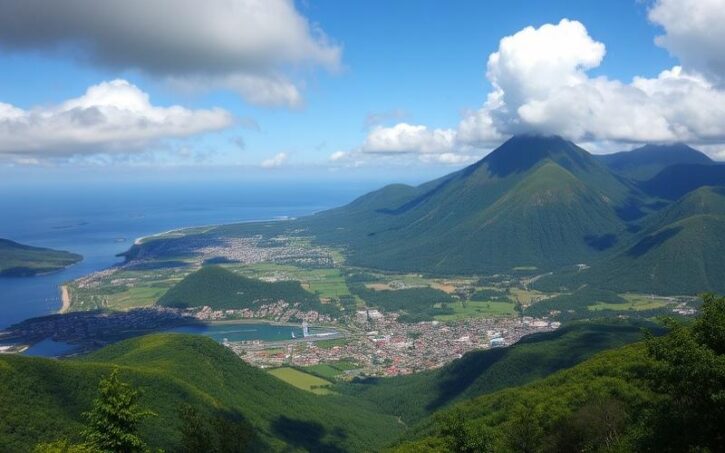
Pico do Fogo, the highest point in Cape Verde, rises 2,829 meters above the ocean.
Long before the arrival of caravels, it is possible these islands already fueled the imagination of the Ancients. Roman authors like Pomponius Mela and Pliny the Elder mention the “Gorgades”, located a few days’ sail from the Cape Verde peninsula on the African continent. Marinos of Tyre and Ptolemy speak of the “Fortunate Isles”. These descriptions could refer to the Cape Verdean islands, but no archaeological evidence confirms a human presence before the Europeans.
Oral traditions and hypotheses mention ancient visits by West African, Arab, Phoenician, Greek, or Chinese peoples to the Cape Verde archipelago. However, archaeological excavations have revealed no trace of permanent occupation before the 15th century, and Portuguese navigators described it as uninhabited.
The Age of Discovery: Birth of a Tropical Colony
Within the vast exploration movement launched by Portugal in the 15th century, the discovery of Cape Verde occurred after the capture of Ceuta, the development of Madeira and the Azores, and the first reconnaissances of the West African coast. Driven by Prince Henry the Navigator, caravels gradually sailed along the coast, passed Cape Bojador, reached the Cape Verde peninsula in the mid-1440s, and then sailed offshore to explore the open Atlantic.
In 1456, the Venetian explorer Alvise Cadamosto, accompanied by Antoniotto Usodimare and a Portuguese captain, reported a group of unknown islands. Soon after, the Genoese António de Noli, in the service of Portugal, confirmed the discovery and became its governor. The navigators Diogo Gomes and Diogo Afonso completed the exploration, naming some islands according to the saints’ calendar (São Nicolau, Santa Luzia, Santo Antão, São Vicente). The archipelago was finally named Cabo Verde, in reference to the green cape of the nearby Senegalese coast.
Colonial settlement began very quickly. In 1462, the Portuguese founded on Santiago the first permanent European settlement in the tropics, Ribeira Grande, the future Cidade Velha. It was also the first overseas colony in sub-Saharan Africa. The Crown granted the archipelago as a fief to Prince Fernando, brother of King Afonso V, and established the system of hereditary captaincies – *donatarias* – which would later be exported to Brazil.
The first inhabitants were not limited to Portuguese settlers. They included Genoese and Flemish adventurers, pardoned convicts, but also Sephardic Jews fleeing the Iberian Inquisition. From the end of the 15th century, then under the reign of Manuel I, thousands of converted Jews were deported to São Tomé, Príncipe, and Cape Verde. This initial mix laid the foundations for a mestizo society well before other Atlantic colonies.
Sephardic Jewish deportees and diverse settlers
On other islands, occupation followed. Fogo received a small colonial town, São Filipe, around 1500. Maio served as pasture, Boa Vista notably housed a leper colony, Brava opened later to settlers seeking new land. Over the following centuries, towns developed on Santo Antão, São Nicolau, Sal, or São Vicente, but Santiago long remained the nerve center.
Cape Verde, Warehouse and Marketplace of the Slave Trade
The real turning point was not just the settlement of a few European families, but the rise of the Atlantic slave trade. As early as 1466, King Afonso V granted the inhabitants of Santiago the right to trade on the African coast (except Arguim), with the obligation to pay a duty on imports. This concession stimulated colonization, but also a human traffic that would durably mark the archipelago.
In the 16th century, Ribeira Grande became one of the main slave-selling ports in the Atlantic. Captured between Senegambia and the Guinea Coast, thousands of Africans were landed there, sorted, sold, or re-exported to Brazil, the Caribbean, and other territories. On Santiago and Fogo, sugar and cotton plantations, worked by enslaved labor, fueled this network. Island workshops also produced cotton cloth, the famous *panos*, highly sought after on the African coasts where they served as exchange currency.
Beyond the slave trade, the pillar of the economy for three centuries, the archipelago developed other activities: salt harvesting on the islands of Sal, Maio, and Boa Vista, cattle raising for meat and hides, horse breeding on Santiago destined for African markets, and the cultivation of certain plants used for dyeing.
The society that formed around this trade was highly stratified. At the top were Whites born in the Iberian Peninsula, followed by Whites born locally – *brancos da terra* – and the heirs of large estates, the *morgados*, owners of feudal entailed properties. Next came freed mestizos and blacks, and then, at the very bottom, a mass of slaves who were numerically the majority on some islands like Santiago. By the end of the 16th century, the latter had about 14,000 slaves for only 2,000 free people.
Despite social hierarchies, the lack of European women led to numerous unions between European settlers (Jews, Portuguese, Spanish, Italians, French, English, Dutch) and African women (of Mandingo, Wolof, Fula, Temne, Balanta, Manjaco origins). This mixing gave birth to a Creole population, the Crioulos, and a new language, Cape Verdean Kriolu, born from the intense contact between 15th-century Portuguese and West African languages.
A Creole Language and Society at the Heart of the Colonial Experience
While Portuguese remained the administrative language, the inhabitants very early developed an everyday language, today called Kabuverdianu. Its vocabulary is largely of Portuguese origin – about 90 to 95% of words – but it incorporates lexical contributions and structures from West African languages. Traces of Mandingo, Wolof, Fula, Temne, Balanta, or Mandjak can be found, and some linguists even see a possible influence of Judaeo-Portuguese, brought by Sephardic Jewish communities.
Specialists propose several models to explain its formation: a European simplified language that became a pidgin before creolizing, an African system that adopted a Portuguese lexicon, or a language born spontaneously in an island generation confronted with several idioms. Given the lack of early written documentation, it’s difficult to decide. But one point is consensus: Cape Verde is home to one of the oldest living Portuguese-based creoles, and the most widespread.
Over 70% of citizens wish to make Creole the main language of instruction.
This language, carried by music, literature, and the diaspora, became a strong marker of Cape Verdean identity. Poets like Eugénio Tavares or Sérgio Frusoni, novelists like Baltasar Lopes da Silva or Luís Romano, linguists like Manuel Veiga contributed to its recognition. A genetic and linguistic study conducted by the University of Michigan even shows that the use of lexical features of African origin in Kriolu is correlated with the percentage of African genetic ancestry, highlighting how demographic history and linguistic history are intertwined.
Pirates, Treaties, and the Relocation of the Capital
The prosperity of Ribeira Grande attracted covetousness. In the late 16th century, English, French, Dutch, and North African pirates and privateers multiplied their raids. The most famous among them, Francis Drake, attacked the island several times, striking Ribeira Grande and other localities on Santiago in the 1580s. In the 17th century, Algerian privateers used the islands as a base to launch expeditions to Madeira.
Signed in 1494, the Treaty of Tordesillas divided the world between Spain and Portugal. The line of demarcation was established about 370 leagues west of the Cape Verde islands, placing the archipelago at the heart of this Atlantic frontier. Lands east of this line went to Portugal, those west to Spain.
From the 17th century onward, the port gradually lost its splendor. Repeated attacks, added to defense difficulties, convinced the colonial authorities to move the center of power to a more easily fortifiable site. In 1614, a first part of the administration left Ribeira Grande for Praia, on the southeastern coast of Santiago. After the devastating expedition of the French privateer Jacques Cassard in 1712, which finished ruining Ribeira Grande, the transition accelerated. Praia officially became the capital in 1770.
The triangular trade reoriented with the emergence of new maritime routes. Brazil and the Antilles became structuring poles of the world economy, while Cape Verde retained a relay role but lost its unique pivotal position.
Islands of Drought, Islands of Famine
The other major actor in Cape Verdean history is the climate. Located in a semi-arid zone, the archipelago depends on rare seasonal rains, concentrated over a few weeks in late summer. The slightest variation in precipitation has formidable effects on harvests. From the 18th century onward, repeated droughts led to famines that superimposed on the social violence of slavery and the constraints of the land tenure system.
Number of people who died during the three major series of famines in the 18th and 19th centuries in the Cape Verde archipelago.
The table below illustrates some major food crises documented by historians:
| Approximate Period | Main Impact | Estimated Victims |
|---|---|---|
| 1747 and 1750s | First major widespread drought | tens of thousands |
| 1774–1777 | Famine affecting mainly Fogo and Brava | ~20,000 people |
| 18th–19th centuries | Three major series of famines | >100,000 deaths |
| 1941–1943 | Colonial famine, high mortality | part of the 45,000 total |
| 1947–1948 | “Fome 47,” one in five inhabitants dies | ~45,000 (period 41–48) |
In the 20th century, the scenario repeated. Between 1941 and 1943, then in 1947-1948, two waves of famine took about 45,000 lives, or one inhabitant in five. The authorities in Lisbon then censored information, denied the scale of the catastrophe, and provided very little aid. In the collective memory, these years of hunger remain a deep trauma, later immortalized by works like the novel “Chiquinho” by Baltasar Lopes and the song “Fome 47” by Codé di Dona.
Number of Cape Verdeans who left the archipelago to work in the Portuguese empire between 1900 and 1970, often under conditions close to slavery.
From Coal to Cable: The Turn of the 19th Century
As the economy based on the slave trade gradually collapsed, Cape Verde sought new roles in Atlantic circulation. The opening of steamship routes transformed some ports into refueling hubs. On São Vicente, the natural port of Porto Grande, associated with the town of Mindelo, attracted the establishment of a British coal depot as early as 1839. For several decades, hundreds of steamships came to replenish their stocks there.
Number of ships that called at Mindelo in 1890, illustrating its growing port importance.
This new vocation, however, clashed with two major developments: the opening of the Suez Canal, which diverted some traffic to the east, and the gradual transition from coal to oil, which reduced the interest of the old depots. In the early 20th century, port activity in Mindelo declined, causing unemployment and social movements, like the coal workers’ strike of 1912.
The island of Sal underwent two major transformations: the intensification of salt exploitation at Pedra de Lume at the end of the 18th century, then the construction of an airfield at Espargos in the 1940s. Thanks to its central position, this airport became a strategic stopover for transatlantic flights, notably serving Alitalia on the Portugal-Brazil route and allowing South African Airways to connect London to Johannesburg by bypassing the apartheid boycott.
Late Colonization of Some Islands and Regional Particularities
Not all islands followed the same rhythm of occupation or the same economic trajectory. Santiago was the first colonized, as early as the second half of the 15th century, and long concentrated the majority of the population and political power. Fogo was populated at the end of the 16th century, Sao Nicolau and Santo Antão mainly in the second half of the 17th, while Brava received a significant wave of settlers in the early 18th century, often originating from Fogo, notably after the 1680 eruption.
The settlement of the eastern islands of Cape Verde occurred according to distinct timelines. Boa Vista was mainly occupied in the early 18th century by inhabitants from São Nicolau and Santiago. The island of Maio was populated gradually in the second half of the same century. São Vicente remained almost deserted until the 19th century, where the development of the port of Mindelo attracted settlers from Santo Antão and São Nicolau. Finally, Sal was only truly populated in the 19th century, by families from Boa Vista and São Nicolau, initially attracted by salt exploitation, then by port and air activities.
Brava illustrates these dynamics well. First named São João Baptista at the time of its discovery in 1462, it was later nicknamed Brava – “wild” – because of its vegetation. Families from Madeira, Minho, or the Algarve settled there in the 16th century, accompanied by a small number of slaves whose proportion gradually increased until the mid-19th century. The island distinguished itself by the cultivation of dye plants, like the orchil introduced by the English captain George Roberts in the 18th century, and then by its intense ties with New England, due to the massive recruitment of sailors by American whalers. Many Bravenses ended up settling in New Bedford and other East Coast U.S. cities, inaugurating a diaspora still very active today.
Simplified overview of the main periods of colonization of the inhabited islands, presenting key dates and founding peoples.
Colonized between 900 and 1200 AD by Polynesian navigators.
Populated around 500 AD by Austronesian populations.
Colonized around 874 AD by Norwegian Vikings.
Arrival of the Māori between 1250 and 1300 AD.
First settlement by the Guanches around 1000 BC.
Polynesian colonization estimated between 800 and 1000 AD.
| Island | Main Phase of European Settlement | Dominant Origin of Settlers |
|---|---|---|
| Santiago | second half of 15th century | Portugal, Genoa, Flanders, Sephardic Jews |
| Fogo | late 16th century | Santiago and Portugal |
| São Nicolau | second half of 17th century | Santiago, other islands |
| Santo Antão | second half of 17th century | São Nicolau, Santiago |
| Brava | early 18th century (after 1680) | Fogo, European settlers |
| Boa Vista | first half of 18th century | São Nicolau, Santiago |
| Maio | second half of 18th century | Santiago, Boa Vista |
| São Vicente | 19th century | Santo Antão, São Nicolau |
| Sal | 19th century | Boa Vista, São Nicolau |
From Colony Status to the Struggle for Independence
While colonial empires began to falter in the 20th century, Salazar’s Portugal clung to its “overseas provinces”. In 1951, it officially renamed the colonies as “provinces”, without however changing the reality of an authoritarian and unequal system. Cape Verdeans formally obtained Portuguese citizenship in 1961, as well as slightly better access to education than in other African territories – at the time of independence, about a quarter of the population could read and write, compared to barely 5% in Portuguese Guinea.
In 1956, in Bissau, the intellectual Amílcar Cabral founded the African Party for the Independence of Guinea and Cape Verde (PAIGC). Initially peaceful, the movement opted for armed struggle after the massacre of dockers at Pidjiguiti in 1959. From 1963 onward, the guerrilla intensified mainly in Guinea-Bissau, taking advantage of favorable terrain, while the Cape Verde archipelago remained distant from direct combat.
In this binary project, Cape Verde nevertheless played a central intellectual role. It was on this archipelago that an educated Creole elite was born, in close contact with Portuguese universities, whose political reflections fed one of the most modern constitutional corpuses in the Lusophone space. Literature, journals like “Claridade,” debates on language, identity, and emigration nurtured a national consciousness that went beyond the simple colonizer/colonized opposition.
In 1973, as the colonial war bogged down, Guinea-Bissau unilaterally proclaimed its independence. A few months later, Cabral was assassinated in Conakry, under circumstances still debated. The same year, Lisbon attempted to organize parliamentary elections in Cape Verde, but only a small percentage of the population registered, a sign of massive rejection of the regime’s “representative” facade.
On April 25, 1974, the dictatorship in Portugal was overthrown by the Armed Forces Movement during the Carnation Revolution. The new power quickly engaged in negotiations with the African independence movements. In August 1974, an agreement signed in Algiers recognized the independence of Guinea-Bissau and the right to self-determination for Cape Verde.
A transitional administration was set up in Praia in December 1974, led by the local PAIGC around Pedro Pires and Aristides Pereira. In June 1975, elections for the National Assembly confirmed the party’s hegemony, which obtained over 90% of the vote. On July 5, independence was proclaimed. During a ceremony in Praia, the Portuguese Prime Minister Vasco Gonçalves officially handed over power to the president of the National Assembly, Abílio Duarte. Aristides Pereira became the first president of the young Republic of Cabo Verde, Pedro Pires its first head of government.
Building a State amid Drought and Poverty
At independence, Cape Verde inherited an exsanguinated territory. The land was degraded, water reserves limited, infrastructure reduced, the economy highly dependent on the outside. Recent famines had left deep scars, many young workers had left through emigration or as contract laborers. The small Portuguese administration, upon withdrawing, left behind almost empty public coffers and massive unemployment: according to estimates, over 60% of the active population found itself unemployed in the short term.
After independence, the power, first affiliated with the PAIGC then with the PAICV (name adopted in 1981 following the break with Guinea-Bissau after the 1980 coup), adopted a single-party model, similar to other newly liberated African countries. The main objectives were to consolidate national unity, educate the population, develop basic services, and reduce food dependency. Determined policies in education and health were implemented, often with the support of international cooperation.
The climatic challenge, however, remained omnipresent. Drought years succeeded one another, notably from 1958 onward and during the first decades of independence. The government of Marcelo Caetano, before the Carnation Revolution, had already attempted some development programs to limit the damage without great success. The Republic of Cabo Verde set about diversifying the economy, mobilizing the diaspora, and securing food aid. Multilateral organizations and some partner countries, including Portugal, played a role in rehabilitating infrastructure and supporting social policies.
From Single-Party Democracy to Institutionalized Pluralism
While Cape Verde initially adopted a single-party system, local political reflection did not stop there. The 1980s saw the emergence of internal debates on democratization, as other single-party regimes in Africa weakened. The fall of the Berlin Wall and the end of the Cold War accelerated this process.
The first Constitution of 1980, amended in 1981 to establish a single party (PAICV), was reformed in the late 1990s. The party monopoly was abolished in September 1990, after the creation in April of the same year of the Movement for Democracy (MpD), a liberal and pluralist alternative born in Praia.
In January 1991, Cape Verdeans participated in their first multiparty elections. The MpD won a large majority in Parliament, ending fifteen years of PAICV government. Soon after, the MpD candidate, António Mascarenhas Monteiro, was elected president with over 70% of the vote. A new Constitution adopted in 1992, then revised several times, established a semi-presidential regime with separation of powers, press freedom, and political pluralism.
Since this transition, political alternations have succeeded one another peacefully. After two terms of Monteiro, the PAICV returned to power in the early 2000s. Pedro Pires was elected president in 2001, following an extremely close election where he beat his rival Carlos Veiga by only a dozen votes. He was reelected in 2006, again narrowly. In 2011, Jorge Carlos Fonseca, supported by the MpD, succeeded him and was himself reelected in 2016. On the legislative front, the MpD and PAICV alternated at the head of the government, with figures like José Maria Neves or Ulisses Correia e Silva as Prime Ministers.
In 2021, José Maria Neves, former PAICV head of government, was elected president, while the MpD retained the parliamentary majority and the premiership. This power-sharing illustrates the competitive but calm nature of Cape Verdean political life. International observers regularly rank the country among the most stable and pluralist democracies in Africa, with a relatively free press, an independent judiciary, and recognized electoral processes.
The table below schematically summarizes some major political milestones after independence:
| Key Year | Main Political Event |
|---|---|
| 1975 | Proclamation of independence, PAIGC in power |
| 1980–1981 | Adoption of the Constitution, transformation PAIGC → PAICV |
| 1990 | End of single-party rule, creation of the MpD |
| 1991 | First pluralist elections, MpD victory |
| 1992–1999 | Constitutional revisions modernizing the institutional framework |
| 2001–2006 | Presidency of Pedro Pires (PAICV), political alternation |
| 2011–2016 | Presidency of Jorge Carlos Fonseca (MpD) |
| 2021 | Election of José Maria Neves (PAICV), MpD retains government |
Diaspora, Culture, and Identity: A Country Larger Than Its Islands
One of the most striking features of the history of the country of Cape Verde lies in the weight of its diaspora. From the times of New England whalers to contemporary migrations to Europe or Lusophone Africa, a significant – sometimes even majority – part of Cape Verdeans lives outside the archipelago. It is estimated today that nearly 800,000 Cape Verdean descendants reside abroad, for an internal population of about 600,000. The communities in New England, Portugal, France, the Netherlands, or Angola maintain close ties with the islands, whether through financial transfers, the circulation of ideas, or temporary returns.
This particular relationship with elsewhere nourishes a profoundly transnational culture. The morna, the national music popularized worldwide by the voice of Cesária Évora, often speaks of wandering, *saudade*, the nostalgia of those who left by boat, plane, or under contract. Other genres like the coladeira, funaná, or batuco express in turn celebration, social criticism, or the memory of slavery. The island of São Vicente, with Mindelo as the cultural capital, plays a crucial role in this musical effervescence, as does Santiago for rhythms more rooted in the African heritage.
Cape Verdean Creole culture expresses itself through cuisine, religious festivals, poetry, and theater (Mindelact festival). Although Portuguese is the official language, Kriolu is the language of daily life, music, and a growing literature. Its status is the subject of debate in education and administration, inheriting a long-standing demand marked by the creation of the unified ALUPEC alphabet and projects like the translation of the Bible.
At the same time, ties with Portugal are reconfigured in a postcolonial mode: the Republic of Cabo Verde is a member of the Community of Portuguese Language Countries, maintains relations deemed “excellent” with Lisbon, and even obtained a special partnership with the European Union. The country officially changed its designation at the United Nations in 2013, requesting to be called “Cabo Verde” in all languages, as if to reaffirm a distinct identity beyond the French translation “Cap-Vert.”
A Small Island State Facing Contemporary Challenges
Economically, the archipelago remains vulnerable. Arid lands, dependence on food imports, weak natural resources, and exposure to climatic hazards remain major constraints. The economy relies largely on services, particularly tourism, transport, and services related to the diaspora. Transfers from expatriates represent a significant share of GDP. In 2007, the country left the category of Least Developed Countries to join that of middle-income countries, a sign of a relative improvement in its indicators.
Amount in millions of euros of debt to be canceled in exchange for green financing as part of an agreement with Portugal.
On the health front, the country registers a strong symbolic success when the World Health Organization declared it malaria-free in February 2024, making Cabo Verde the third African state to obtain this status. This accomplishment echoes, in reverse, centuries of vulnerability to epidemics, malnutrition, and the absence of basic services.
Cape Verde is regularly ranked among the island states most exposed to the effects of climate change, notably sea level rise and extreme weather events. The increase in so-called “Cape Verdean” hurricanes in the Atlantic, like Hurricane Fred in 2015, illustrates this threat. Its geography, once a commercial asset, could make it a laboratory for global climate challenges.
A Singular History, an Atlantic Laboratory
To look back on the history of the country of Cape Verde is thus to traverse several intertwined temporalities. On a geological scale, the archipelago is a string of volcanoes born from the ocean floor and metamorphosed by the rising and falling of seas. On the scale of the modern Atlantic, it became one of the nodes of a brutal human trading system, a place of embarkation, transit, and sometimes refuge for slaves, settlers, and outcasts. On a political scale, it embodies a postcolonial trajectory marked by the influence of Creole thinkers, a peaceful transition to independence, and a rapid learning of democratic pluralism.
Cape Verdeans have transformed an arid environment into a habitable space through mobility, cultural mixing, and a remarkable capacity for adaptation. They have paid a heavy price to the whims of the climate, the decisions of a distant empire, and the vagaries of world trade. But they have also invented a language, a music, and a form of citizenship that transcend the strict geography of the islands.
Cape Verdean people
Today, whether one listens to a morna in Mindelo, walks the alleys of Cidade Velha, a UNESCO World Heritage site, or encounters a café run by Cape Verdeans in Lisbon or Boston, one finds the echoes of this long history. A history where the names of Pico do Fogo, Ribeira Grande, the “Fome 47,” or Amílcar Cabral dialogue, subtly, with the maps of Ptolemy, the Treaties of Tordesillas, the telegrams from Mindelo, and the ballots of the latest elections. A history small in the size of the territory, but vast in its Atlantic legacy.
Disclaimer: The information provided on this website is for informational purposes only and does not constitute financial, legal, or professional advice. We encourage you to consult qualified experts before making any investment, real estate, or expatriation decisions. Although we strive to maintain up-to-date and accurate information, we do not guarantee the completeness, accuracy, or timeliness of the proposed content. As investment and expatriation involve risks, we disclaim any liability for potential losses or damages arising from the use of this site. Your use of this site confirms your acceptance of these terms and your understanding of the associated risks.

Cyril Jarnias is an independent expert in international wealth management with over 20 years of experience. As an expatriate himself, he is dedicated to helping individuals and business leaders build, protect, and pass on their wealth with complete peace of mind.
On his website, cyriljarnias.com, he shares his expertise on international real estate, offshore company formation, and expatriation.
Thanks to his expertise, he offers sound advice to optimize his clients' wealth management. Cyril Jarnias is also recognized for his appearances in many prestigious media outlets such as BFM Business, les Français de l’étranger, Le Figaro, Les Echos, and Mieux vivre votre argent, where he shares his knowledge and know-how in wealth management.





