
 Published on and written by Cyril Jarnias
Moving to the Czech Republic means entering a paradoxical country: one of the most secularized in the world, yet dotted with churches, monasteries, and holidays on a calendar inherited from Christianity. For an expatriate, religion is not experienced here as it is in Poland, Italy, or the United States. It structures daily life less, but it still permeates symbols, public holidays, urban and rural landscapes, and even some political controversies.
Understanding the Czech religious landscape is essential to avoid faux pas, interpret certain attitudes, and appreciate the local culture. This guide deciphers the religious scene, customs in places of worship, and times of the year when religion, in a predominantly non-believing society, becomes more visible.
A largely non-religious country, but not simply “atheist”
The first surprise for newcomers is often statistical. The Czech Republic is consistently ranked among the most irreligious societies on the planet. The figures from the 2021 census measure this phenomenon.
A very singular religious landscape
The following table summarizes the main categories declared in the 2021 census.
| Category (2021) | Number of people | Share of population |
|---|---|---|
| No religion / Irreligious | 5,027,794 | 47.8 % |
| Believers with no defined religion | 1,005,788 | 9.6 % |
| Christians (total) | 1,241,214 | 11.7 % |
| – of which Catholics (all categories) | 985,318 | 9.3 % |
| Other religions and religious identities | 1,139 – approx? | 10.8 % |
| Religion not declared | 3,162,540 | 30.1 % |
| Total population | 10,524,167 | 100 % |
Behind these numbers, several key ideas to keep in mind when living here:
Sociologists estimate that the proportion of true convinced atheists in the population is between 10 and 20 %.
For an expatriate coming from a country where being a believer or not strongly structures social identity, this indifference can be disorienting. In conversation, religion rarely comes up spontaneously, and most Czechs have no reflex for evangelization or proselytism, regardless of their side.
A spectacular decline of Christianity
To grasp the rupture, one only needs to look at the historical evolution. In the mid-20th century, society was overwhelmingly Christian, and very largely Catholic. A century later, the situation is almost reversed.
| Census Year | Share of Christians | Share of Catholics | Synthetic Comment |
|---|---|---|---|
| 1921 | 91.5 % | 82.1 % | An almost entirely Christian country |
| 1950 | 93.7 % | 76.7 % | Very clear Catholic dominance |
| 1991 | 43.9 % | 39.1 % | Collapse after communism |
| 2001 | 30.2 % | 26.9 % | Continued decline |
| 2011 | 13.2 % | 10.5 % | Clear marginalization of Christianity |
| 2021 | 11.7 % | 9.3 % | Religion of a minority, an individual choice |
Two elements explain this trajectory: a long legacy of distrust towards the Catholic Church, associated with Habsburg domination and the Counter-Reformation, then four decades of communist rule promoting state atheism and strictly controlling all religious communities.
Today, being a Christian is more a matter of personal commitment than family tradition. Believers tend to be older, more often women, and are relatively more numerous in the Moravian countryside than in the large cities of Bohemia.
Understanding history to grasp current sensitivities
For an expatriate, a few historical landmarks are enough to explain many contemporary reactions, notably the reserve towards the Catholic Church and the valorization of certain figures considered “heretical” from Rome’s point of view.
From Byzantine missionaries to the Bohemian Reformation
The Christianization of the Czech lands dates back to the 9th and 10th centuries. Byzantine missionaries, saints Cyril and Methodius, introduced liturgy in Old Church Slavonic and a specific alphabet. The country then gradually entered the orbit of the Latin Church.
But it is especially the Bohemian Reformation, a century before Luther, that durably marks the local imagination. Jan Hus, a theologian and preacher, advocated in the early 15th century for a radical reform of the Church: preaching in the Czech language, communion under both kinds for the laity, criticism of the clergy’s wealth. Condemned for heresy, he was burned at the stake in 1415.
In many Catholic countries, Jan Hus is perceived negatively. In contrast, in the Czech Republic, he is celebrated as a national hero. His death is commemorated by a public holiday on July 6th, and his statue dominates Prague’s Old Town Square. For many non-religious Czechs, his story—that of a reformer burned at the stake for heresy in 1415—fosters a distrust of ecclesiastical institutions, particularly Roman ones.
The Counter-Reformation and the “dark night”
After the defeat of the Czech nobles at the Battle of White Mountain in 1620, the Habsburgs imposed brutal re-Catholicization: expulsion or forced conversion of Protestants, a Catholic monopoly, confiscation of property. For about a century and a half, religious tolerance was virtually non-existent. This period is sometimes described as “days of darkness” in national historiography.
This collective trauma fuels a latent anticlericalism. Several centuries later, part of the population continues to associate the Catholic Church with foreign domination, with Germans, with coercion. This substratum facilitated, in the 20th century, the adherence of part of the intelligentsia to Marxist atheism.
Communism: religion under surveillance
Between 1948 and 1989, the communist regime established tight control over all churches. The 1949 laws subjected the appointment of clergy to state approval; hundreds of priests and religious figures were imprisoned; convents were closed; religious properties were nationalized. The official ideology was openly atheist.
This period leaves several traces visible today:
– An entire generation grew up without catechism or regular religious practice, breaking the family transmission.
– Churches sometimes developed a culture of withdrawal and distrust towards strangers, which can still be perceived in some parishes that are not very welcoming to newcomers.
– The restitution of church property after 1989 fueled political controversies, reinforcing suspicion towards “the churches” among some voters.
For a believing expatriate, it is useful to remember that many Czechs have, in their circle, stories of religious persecution, forced collaboration, or painful compromises, which complicate their relationship with ecclesiastical institutions.
Who believes in what today?
The Czech religious mosaic is more varied than one might imagine at first glance, even if all communities remain numerically modest.
Christians: a diverse minority
Despite secularization, Christianity remains the first religious family, but it is a very small minority.
| Christian Group (2021) | Number of adherents | Share of population |
|---|---|---|
| Catholicism (broad sense) | 985,318 | 9.3 % |
| – of which Roman Catholic Church | 741,175 | ~7.0 % |
| – “Catholics without a church” | 235,834 | ~2.2 % |
| – Ruthenian Greek Catholic Church | 8,309 | 0.1 % |
| Evangelical Church of Czech Brethren | 32,577 | 0.3 % |
| Czechoslovak Hussite Church | 23,610 | 0.2 % |
| Lutheran Churches (Augsburg Confession) | 11,047 | 0.1 % |
| Orthodox Church (Czech and Slovak, etc.) | 41,178 | 0.4 % |
| Jehovah’s Witnesses | 13,298 | 0.1 % |
| Other Christians or unspecified “Christians” | 71,089 | 0.7 % |
For a Christian expatriate, several realities are worth noting.
Catholics still form the largest group, but in sharp decline. Sunday practice is low: estimates mention about 5% regular participation in parish life in the late 1990s, and the downward trend has continued. Masses are often sparsely attended in Bohemia, especially in large cities.
Historical Protestants are modest in number but sometimes well-structured. The Evangelical Church of Czech Brethren results from the union of Lutheran and Reformed traditions in the early 20th century, with a strong awareness of its lineage with the Hussite Reformation and the tradition of Jan Amos Comenius. It places great importance on the theological education of the laity, resulting in communities where intellectual discussion is comfortable.
Born in 1920 from a schism with Catholicism, it once embodied the hope for a modernized “national church.” It too lost a large part of its members during the communist period and after.
The Czechoslovak Hussite Church
Orthodox churches have been strengthened by waves of immigration from Ukraine or Russia. In large cities, one finds active and visible Orthodox parishes.
For an expatriate, the practical consequence is simple: the supply of Christian places of worship exists, but it is much more tenuous than in countries of massively Catholic tradition, and its dynamism varies enormously by region. Southeastern Moravia remains overall more observant, with villages where the Catholic Church still strongly structures local life, while the industrial northwest of Bohemia is among the most non-religious areas in Europe.
Buddhism, Islam, Judaism, and other minorities
Alongside Christianity and the non-religious, a non-negligible fringe of the population adheres to other traditions or atypical spiritual movements.
| Religion or movement (2021) | Number of adherents | Share of population |
|---|---|---|
| Buddhism | 5,757 | ~0.05 % |
| Islam | 5,244 | ~0.05 % |
| Judaism | 1,901 | ~0.02 % |
| Paganism (Rodnovery, Druids…) | 2,953 | ~0.03 % |
| Hinduism | 2,024 | ~0.02 % |
| Pastafarianism | 2,696 | ~0.03 % |
| “Jediism” | 21,539 | ~0.2 % |
| Biotronics (Zezulka Society) | 1,053 | ~0.01 % |
Buddhism relies largely on the Vietnamese community, over 60,000 people, the largest Asian group in the country. Many practice Mahayana Buddhism mixed with ancestor worship and Confucian or Taoist references. Alongside this, native Czechs turn to Theravada or Vajrayana, often through centers linked to the “Diamond Way” founded by Lama Ole Nydahl or to Tibetan and Korean schools.
Islam is a very small minority religion in the Czech Republic, with only a few thousand adherents. The community is diverse, composed of Turks, Bosniaks, Kosovars, former Middle Eastern students who became residents, and a few Czech converts (mostly women, according to some sources). The religious landscape includes few mosques, and their expansion projects sometimes face local resistance. Despite the community’s small size, anti-Islamic political discourse is regularly used by some populist parties, creating an occasional climate of suspicion.
Judaism, historically very present in Bohemia and Moravia, was almost annihilated by the Holocaust. Today, fewer than 2,000 people declare themselves Jewish, but restored synagogues, museums, and remembrance ceremonies recall this essential dimension of Czech history.
Finally, the presence of neo-pagan movements, Wiccans, Slavic Rodnovers, or even “Pastafarians” illustrates the diversification of the spiritual scene. These groups remain marginal numerically but contribute to the cultural landscape, notably in certain young, educated urban milieus.
Places of worship: monuments, practices, and etiquette
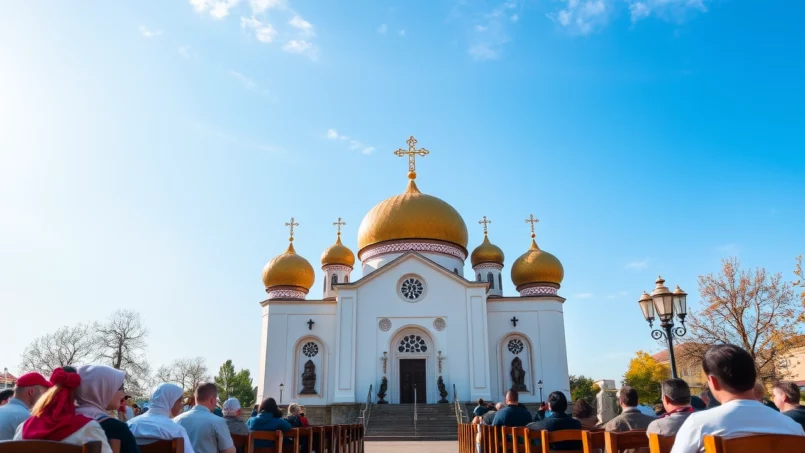
When walking around Prague, Brno, or Olomouc, expatriates are struck by the number of churches, monasteries, and chapels. Many function less as active places of worship than as historical monuments, concert halls, or museums. However, they are also spaces for prayer for a minority of believers. Knowing how to behave respectfully is essential.
Basic rules in churches and cathedrals
Those in charge of Czech churches set very clear rules for visitors, believers or not. A few main principles can be remembered.
Access is denied to persons who are intoxicated, under the influence of drugs, wearing obviously dirty clothing or emitting a strong odor, or not respecting basic hygiene rules. Animals are generally not allowed, except for guide dogs.
Inside, it is forbidden to smoke, drink, or eat. Noisy behavior, altercations, aggressive solicitation (like insistent begging), or gestures deemed inappropriate lead to immediate expulsion, potentially with a call to the police in case of serious disturbance.
The golden rule for an expatriate: consider every church as a place of contemplation and adapt your behavior accordingly, even if you are not a believer.
Speak softly and avoid unnecessary conversations to preserve the calm and solemnity of the place.
Prefer discreet and decent attire, covering shoulders and knees, according to local customs.
Observe and discreetly follow the gestures of the faithful (standing, sitting, crossing oneself) without necessarily participating if you are not a believer.
Avoid taking photos or using your phone unless explicitly permitted, and always disable flash and sound.
Stay in areas accessible to visitors, avoid crossing the choir or altar, and do not disturb ongoing services.
Adopt a respectful posture, avoid sudden or noisy gestures, and be discreet and attentive to the environment.
– speak very quietly, or even remain silent;
– put your phone on silent mode;
– avoid walking in the nave or taking photos during a service;
– refrain from touching liturgical objects or works of art.
When a service is in progress and there is no specific time slot for tourist visits, it is preferable either to leave or to sit discreetly at the back while observing silence. Walking around, taking pictures, or chatting during mass is considered deeply disrespectful.
Dress code and bodily attitude
The question of dress is particularly sensitive for visitors from more casual cultures. In Czech Catholic and Orthodox churches, a certain modesty is expected: covered shoulders, skirts or shorts at least knee-length, no beach flip-flops or very low-cut tank tops.
Customs differ depending on the place of worship. Men generally remove their hats when entering churches. For women, a veil is not mandatory in Catholic churches but may be required in some Orthodox (Russian or Eastern) places where shawls are sometimes provided. In synagogues, men must cover their heads (a kippah is usually available).
In Orthodox churches, many faithful pray standing and cross themselves frequently. It is recommended to discreetly follow the general movement (stand when everyone stands, avoid crossing legs when seated, do not walk in front of the iconostasis). Again, the principle is simple: look first, imitate if you wish, but never disturb.
Photography, recording, and donations
In most major monuments, photography without flash is tolerated, sometimes for an additional fee on the entrance ticket. On the other hand, filming or recording a service generally requires the priest’s permission. Taking photos of praying faithful without their consent is to be avoided.
The basic rule is to check the pictograms at the entrance or ask the attendant. Some places prohibit any type of photography in certain chapels or during ceremonies.
Lighting a candle is a particularly widespread gesture, which does not require being baptized. It is customary to leave a small offering in the designated collection box. In many churches with free entry, a modest donation is also appreciated for the upkeep of the building.
Public holidays, festivals, and religious traditions in daily life
Even in a very secularized country, the calendar remains deeply marked by holidays stemming from Christianity or religious memory. For an expatriate, these public holidays have very concrete implications: closed shops, modified transport schedules, social rituals to know.
The main public holidays with a religious coloring
Czech law lists thirteen official public holidays, several of which are directly linked to Christianity or religious figures.
| Date | Name (translation) | Main religious dimension |
|---|---|---|
| January 1 | New Year’s Day / Day of the Restoration of the Czech State | Mostly political reference, but against the backdrop of New Year |
| Good Friday (variable date) | Good Friday | Commemoration of the Passion of Christ |
| Easter Monday (variable) | Easter Monday | Easter holiday, specific rituals (pomlázka) |
| July 5 | Saints Cyril and Methodius Day | Tribute to the missionaries of the Slavs |
| July 6 | Jan Hus Day | Remembrance of the reformer burned for heresy |
| September 28 | Czech Statehood Day (Saint Wenceslas Day) | Feast of the country’s patron saint |
| December 24 | Christmas Eve | Major family celebration |
| December 25 | Christmas Day | Christmas Day |
| December 26 | Saint Stephen’s Day (Second Day of Christmas) | Liturgical extension of the holidays |
Other dates, not public holidays but meaningful, punctuate the year: Epiphany (January 6), All Saints’ Day and the commemoration of the faithful departed in early November, or certain days of remembrance (victims of the Holocaust, victims of the communist regime, etc.).
For an expatriate, two periods deserve particular attention: Easter and Christmas.
Easter: between liturgy and willow branches
While attendance at Easter services remains modest on a national scale, certain customs remain surprisingly alive, even among non-practicing families.
On Easter Monday, in the Czech Republic and Slovakia, boys and men use braided willow whips called *pomlázka* to lightly whip women in their surroundings. This tradition, said to transmit health and youth to them, is done in exchange for decorated eggs, sweets, or a glass of *slivovice*, a plum brandy.
In the contemporary context, this practice is sometimes criticized as sexist, but it remains widespread, especially in the countryside. For a female expatriate, it can be useful to know that this ritual persists, so as not to be caught entirely off guard in a traditional environment. Of course, nothing obliges participation; many urban Czechs view it with detached amusement.
The decoration of Easter eggs (kraslice) is an art in itself, with regional techniques (wax, scratching, dyeing) that can be discovered in workshops and museums. It is an excellent cultural entry point for expatriate children.
Christmas: a non-practicing country, but a very Christian holiday
The truly central holiday of the Czech calendar is Christmas, and more precisely the evening of December 24 (Štědrý den). Even less religious families adhere to certain elements:
– Christmas Eve dinner, traditionally fried carp and potato salad;
– distribution of gifts on the same evening, attributed not to Santa Claus, but to the Infant Jesus (Ježíšek);
– possible attendance at midnight mass, sometimes as a mere cultural ritual.
December 25 and 26 are public holidays, but it is the 24th that concentrates family intensity. For an expatriate, it is good to know that most shops close early on that day (large supermarkets are obliged to close at noon), and cities empty out in the evening.
Another highlight of the period: Saint Nicholas Day (December 5). That evening, a trio composed of Saint Nicholas, an angel, and a devil walks through streets and apartments to question children about their behavior over the year, distributing treats or small warnings. Again, the religious dimension is largely folklorized, but the scene remains striking for those not accustomed to it.
Beyond holidays, certain social attitudes sometimes puzzle expatriates, especially those from cultures where religious affiliation is openly asserted. In the Czech Republic, the norm is rather discretion, even reserve.
Talking about religion with Czechs
Czech communication is known to be direct on certain topics (domestic politics, criticism of the country), but religion often remains on the margins of daily conversations. Several elements can help navigate these exchanges:
Many Czechs distrust large institutions, including religious ones, often due to bad experiences in parishes perceived as closed or moralizing after communism. At the same time, a persistent interest exists for alternative spiritualities like Buddhism or New Age practices, seen as less dogmatic than Christianity.
For a believing expatriate, expressing one’s faith is not taboo, but it is wise to do so with modesty and without proselytism. Czechs appreciate honest exchanges but do not like triumphalist or moralizing speeches. Conversely, for a non-believing expatriate, joking aggressively about religion can offend practicing minorities who are already on the defensive.
Integration into local religious communities
Many historical churches have not developed a culture of welcoming foreigners. Testimonies from newcomers mention services where no effort is made to explain the liturgy, no warm greetings at the entrance, an impression of entering a closed circle. This lack of hospitality is not specific to the Czech Republic, but it is accentuated here by decades of clandestinity or suspicion under communism.
Exceptions exist within the Czech religious landscape, notably some dynamic Catholic parishes in Moravia, English-speaking evangelical assemblies in Prague, or more relaxed student communities in Brno. A concrete example is St. Clement’s Anglican Church in Prague, often cited for its welcoming efforts: it provides detailed booklets explaining the order of service and fosters conviviality with coffee time after the service and explanations given in English.
For a practicing expatriate, a few strategies are useful:
– inquire about communities speaking one’s language (English, French, Spanish);
– accept that several attempts may be necessary before finding a place where one feels truly welcomed;
– do not interpret an initial form of reserve as personal hostility, but as a cultural trait marked by history.
Legal framework: real religious freedom, cooperative secular state
The Czech Republic is a secular state in the constitutional sense, but not in a logic of aggressive separation like the French model. The legal framework aims for benevolent neutrality.
Freedom of religion and registration of communities
The Charter of Fundamental Rights and Freedoms, which has constitutional status, guarantees freedom of thought, conscience, and religion, including the right not to believe. It recognizes the right to manifest one’s religion in public or private, alone or in community. Churches administer their internal affairs autonomously, notably the appointment of their clergy.
The state keeps no register of individual religious affiliations, as these have no direct legal consequences. However, communities themselves can register with the Ministry of Culture to obtain legal personality and, potentially, “special rights.”
A two-tier system exists:
Minimum number of members required for a religious community to gain extended rights in Austria, representing 0.1% of the population.
Twenty-one religious communities have these “special rights.” This is notably the case for the Catholic Church, the Evangelical Church of Czech Brethren, the Czechoslovak Hussite Church, Orthodox communities, Jewish communities, Baptists, Adventists, Unitarians, Mormons, etc.
Funding and restitution of property
The Czech state long covered part of the salaries of clergy of recognized churches, as compensation for properties confiscated under communism. A 2012 law organized a gradual restitution, both in kind (return of properties still held by the state) and through a vast program of financial compensation spread over 30 years.
Direct subsidies for the operation of churches will gradually decrease to cease entirely in 2029. Religious communities will then have to cover their current funding themselves, compensated by the restitution of their patrimony.
For an expatriate, this means many churches are engaged in a delicate transition: they are restoring historical buildings thanks to this compensation, but also seeking to develop donations and income-generating activities (concerts, guided tours, space rentals), which explains the multiplication of ticket offices and shops inside some monasteries.
Monasteries and sacred heritage: spirituality, culture, and tourism
One of the most visible faces of religion in the Czech Republic is its exceptional monastic heritage. Even if religious life there is sometimes reduced, these places remain landmarks for understanding how the country today articulates culture, economy, and the sacred.
Strahov, Břevnov, Osek: three faces of the same legacy
Strahov, in Prague, is probably the most famous monastery for visitors. Founded in the 12th century by the Premonstratensian order, it survived the Hussite Wars, the reforms of Joseph II, and communism, not without periods of closure and confiscation. After 1989, the canons recovered the site, restored the library, and developed a model combining religious life, museum, concerts, and craft brewery. For an expatriate, a visit allows one to grasp how a religious order adapts to a largely non-believing society while preserving first-rate heritage.
This Benedictine monastery on the outskirts of Prague combines active religious presence with a tourist offering. The site includes a Baroque-style basilica, a Romanesque crypt, a garden, and even its own micro-brewery.
Osek, in North Bohemia, tells another story, more marked by the wounds of the 20th century: a Cistercian monastery used as a regrouping camp for religious figures after 1950, slow rehabilitation, recognition as a national cultural monument. Again, brewery and visits are added to the spiritual dimension.
For an expatriate, these places are ideal for approaching Czech religion through architecture, art history, and gastronomy rather than liturgy alone.
A protected and subsidized heritage
The most important monasteries, churches, and chapels benefit from the status of a cultural monument, or even a national cultural monument. The National Heritage Institute (NPÚ) manages dozens of sites belonging to the state and maintains a central register of nearly 89,000 protected entities.
The state and local authorities grant subsidies for restoring heritage, including that returned to churches. These aids concern architecture, movable works of art, historic urban ensembles, and sites inscribed on the UNESCO World Heritage list.
For the expatriate, this translates into a very dense offering of visits, exhibitions, and cultural events in religious settings: concerts in Baroque naves, exhibitions of sacred art in former convents, festivals of spiritual music. It is entirely possible to enjoy this heritage without being a believer, simply by respecting the behavior rules mentioned earlier.
Practical tips for expatriates: living your faith, or lack thereof, in the Czech Republic
At the end of this overview, a few simple recommendations can help with better integration, whether you are a practicing believer, agnostic, or atheist.
If you are a believer, start by identifying linguistic communities: in Prague notably, one finds masses and services in English, sometimes in French or Spanish. Local Czech parishes are more or less open to foreigners; patience and consistency often pay off in the end.
Religious practice is a minority in the Czech Republic. Inviting a colleague to a service may be perceived as a friendly curiosity, but it generally does not generate widespread enthusiasm. Personal relationships take precedence over religious convictions, and conversions are rare and often a long process.
If you are non-believing, you will probably feel comfortable in a society where the display of irreligion is commonplace. Keep in mind, however, that a non-negligible minority holds to its faith, sometimes at the cost of some social courage. Avoiding easy caricatures about “believers” or hurtful jokes about respected figures (Jan Hus, for example, or some committed priests) contributes to respectful coexistence.
Understanding the country’s religious history, from the missionaries Cyril and Methodius to the Velvet Revolution, passing through the Hussite Reformation and the Counter-Reformation, helps to grasp certain current attitudes: a distrust of authority, a preference for individualized spirituality, and an ambivalent relationship to churches, often perceived as monuments rather than living places of worship.
Living in the Czech Republic means experiencing a form of advanced secularization where faith, when it exists, is rarely a social given and almost always an intimate choice. For the expatriate, it is both a challenge and an opportunity: that of rediscovering religion—or one’s own lack of religion—in a context that never takes it entirely for granted.
Disclaimer: The information provided on this website is for informational purposes only and does not constitute financial, legal, or professional advice. We encourage you to consult qualified experts before making any investment, real estate, or expatriation decisions. Although we strive to maintain up-to-date and accurate information, we do not guarantee the completeness, accuracy, or timeliness of the proposed content. As investment and expatriation involve risks, we disclaim any liability for potential losses or damages arising from the use of this site. Your use of this site confirms your acceptance of these terms and your understanding of the associated risks.

Cyril Jarnias is an independent expert in international wealth management with over 20 years of experience. As an expatriate himself, he is dedicated to helping individuals and business leaders build, protect, and pass on their wealth with complete peace of mind.
On his website, cyriljarnias.com, he shares his expertise on international real estate, offshore company formation, and expatriation.
Thanks to his expertise, he offers sound advice to optimize his clients' wealth management. Cyril Jarnias is also recognized for his appearances in many prestigious media outlets such as BFM Business, les Français de l’étranger, Le Figaro, Les Echos, and Mieux vivre votre argent, where he shares his knowledge and know-how in wealth management.





