
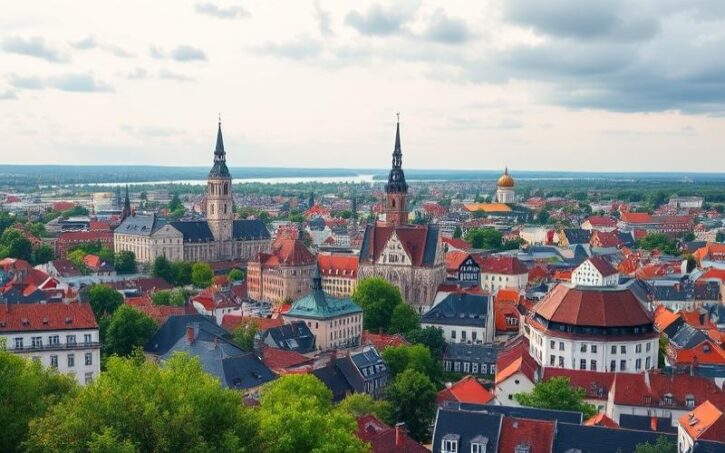
 Published on and written by Cyril Jarnias
Denmark’s national history resembles a long mural where icy landscapes, Bronze Age burial mounds, North Sea longships, cannons aimed at Copenhagen, smoking factories, and free schools for all follow one another. It is both the story of a small kingdom wedged between the North Sea and the Baltic Sea, and of a state that has managed, better than many others, to transform political crises, military defeats, and economic shocks into springboards for reinvention.
To understand contemporary Denmark, one must go back to a time before the Vikings. Its evolution, from reindeer hunting to today’s technological society, and from Viking raids to its role in the European Union, has shaped a prosperous parliamentary monarchy, a pioneer of the Nordic social model and the green transition.
From the First Human Occupations to the Viking Age
Danish soil holds the memory of human presence since the end of the last ice age. Around 12,000 years ago, as the ice retreated, groups of hunter-gatherers settled on what was not yet an archipelago but a peninsula dotted with lakes and forests. Archaeologists call the first stable inhabitants the Maglemosian culture. They set up seasonal camps, exploiting the fauna and flora of a territory where, around 7,000 BC, oaks, elms, and hazelnut trees appeared, along with wild boar and deer.
The skeleton known as the “Koelbjerg Man,” dated around 8,000 BC, is the oldest human remains found in Denmark. It already signals the antiquity of an occupation that would diversify: Kongemose, Ertebølle, and then Funnelbeaker cultures succeeded one another, marking the introduction of agriculture around 4,000 BC. During this time, dolmens, stone tombs, and large burial mounds created a funerary landscape still clearly visible in the Danish countryside.
From this date onwards, around 1500 BC, Denmark entered the Nordic Bronze Age, as evidenced by the bronze and gold objects found in burial mounds.
The period of the Scandinavian Iron Age incidentally provides historians with exceptional material: the “bog bodies.” Tollund Man or Grauballe Man, preserved in the marshes, are a striking testament to human sacrifices or ritual practices that still puzzle researchers.
Concurrently, written sources from outside begin to mention the Dani. As early as the 6th century, the historian Jordanes recounts how the Danes allegedly drove out the Heruli and took their lands. Later, Anglo-Saxon poems like Widsith or Beowulf feature this northern people who, a few centuries later, would sweep across European coasts.
The Birth of a Kingdom and Christianization
From the 8th century onwards, Denmark’s history pivots toward what would be called the Viking Age. The earthen fortifications of the Danevirke, near the trading town of Hedeby, were already in place by the mid-8th century and protected the southern border. Frankish chronicles describe, starting in 804, a King Gudfred who seems to dominate most of the territories corresponding to medieval Denmark. For the first time, a unified royal power emerges in the texts.
The initial Danish monarchy was pagan and warlike, as evidenced by the chieftain Hygelac, cited by Gregory of Tours for his unsuccessful expeditions against the Franks in the 6th century. The religious shift began with missionaries such as Ansgar in the 9th century, but it was truly in the following century that conversion to Christianity became a decisive political factor for the consolidation of the kingdom.
Gorm the Old, who reigned around 936–958, is the first Danish ruler clearly attested by sources. His son Harald Blåtand (Harald Bluetooth) inherited an already powerful kingdom, stretching from the Danevirke line to the Danish islands and Scania. Harald is the man of dual foundation: he durably unified the Danes and officially Christianized them around 965. This dual act is inscribed on the large Jelling Stone, often nicknamed Denmark’s “birth certificate.” The inscription proclaims that he “made the Danes Christian” and “won Norway,” marking both territorial ambition and religious legitimization.
Christianization allowed the king to ally with the Holy Roman Empire and stabilize the monarchy through the Church. By the early 12th century, the kingdom had become the seat of an independent ecclesiastical province for all of Scandinavia.
The Vikings, Masters of the North Atlantic
Between the 9th and 11th centuries, Danish Vikings disrupt the balance of Northern Europe. They plundered and traded in the British Isles, Ireland, northern France, Spain, Portugal, and Italy, reaching the shores of the Mediterranean. They established the Danelaw in northeastern England, trading posts in Ireland, founded Normandy, and participated in expeditions to Iceland, Greenland, and even Vinland, identified today as Newfoundland.
Under Sweyn Forkbeard, son of Harald Bluetooth, and especially under Cnut the Great, the kingdom reached its zenith. Cnut assembled a “North Sea Empire” comprising England, Denmark, and Norway, with notable influence on the German coast. This vast entity remained fragile and, after the death of Cnut and his successors, England definitively detached from the Danish sphere.
The end of the Viking Age is often associated with the death of Canute IV, known as “the Saint,” in 1086 or with the turning point represented by the Norman conquest of England in 1066. In any case, Denmark then entered a more “European” phase, marked by feudalization, the Baltic Crusades, and the rise of aristocratic power.
From Christianization to the Kalmar Union
After the consolidation of the kingdom in the 12th century, marked by the figures of Valdemar the Great and Bishop Absalon, Denmark became a major Baltic power. Absalon, by fortifying the village of Havn, laid the foundations for the future Copenhagen. Valdemar I and his successors undertook expeditions against the pagans of the southern Baltic, subjugated the Principality of Rügen in 1168, and briefly controlled Mecklenburg and Pomerania in the 1180s.
This Danish expansion southward was broken at the Battle of Bornhöved in 1227. The kingdom there lost most of its German conquests, retaining the Principality of Rügen only until 1325. But the memory of a powerful Denmark in the Baltic space would long nourish national memory.
Within the kingdom, the monarchy established a feudal system that strengthened the power of the great noble families. This balance of power reversed at the end of the 13th century when the nobility imposed a charter on the king, considered the country’s first constitution. Under the disastrous reign of Christopher II, crown lands were gradually mortgaged. This instability peaked after his death in 1332, leading to an eight-year period without a king, where the territory was controlled by provincial counts.
It was Valdemar IV, elected king in 1340 after the assassination of the powerful Gerhard III of Holstein-Rendsburg, who gradually restored the country’s unity and step by step regained the lost provinces. His daughter Margrethe I would propel Denmark to the heart of a much more ambitious project: the union of all Scandinavia.
In 1397, at Kalmar, the crowns of Denmark, Norway, and Sweden (which then encompassed most of present-day Finland) were united on the head of the young Eric of Pomerania, the grandnephew adopted by Margrethe I. This marked the birth of the Kalmar Union, a personal union that also included Norwegian dependencies: Iceland, Greenland, the Faroe Islands, Orkney, Shetland.
Formally, each kingdom retained its own laws, institutions, and status as a sovereign state. In practice, foreign policy and some major directions were dictated by a monarch who resided mainly in Denmark, supported by the Danish aristocracy. The union rested on a dual corpus of texts, revealing its internal tensions: a coronation charter favorable to a strong hereditary monarchical power, and a draft union charter emphasizing the autonomy of the kingdoms and an important role for aristocratic councils. This duality paved the way for a permanent conflict between the centralizing will of the king in Copenhagen and the Swedish or Norwegian elites, keen on defending their prerogatives.
The Kalmar Union
A table allows us to visualize the political architecture of the Kalmar Union and its territorial extent.
| Element | Main Content |
|---|---|
| Member Kingdoms | Denmark, Norway, Sweden (including most of present-day Finland) |
| Dependent Territories | Iceland, Greenland, Faroe Islands, Orkney, Shetland (under the Norwegian crown within the Union) |
| Nature of the Union | Personal union: common monarchy, legally distinct states |
| Overall Duration | De facto 1397–1523, with several crises and interruptions |
| Center of Gravity | Copenhagen and the Danish nobility dominated the political apparatus |
One of the major issues of the union was the confrontation with the Hanseatic League, a powerful coalition of Germanic trading cities that dominated trade in the Baltic and North Seas. The Danish kings sought to control trade routes and instituted, starting with Eric of Pomerania, a toll on ships passing through the Øresund – the famous “Sound Dues,” which would remain in force until the 19th century and provide significant revenue for the kingdom.
The tensions and revolts that gradually weakened Danish domination within the union, particularly in Sweden.
The major revolt of the 1430s that challenged Danish power in Sweden.
A regency period that weakened the Danish presence in Sweden.
Another regency that contributed to the gradual weakening of Danish power.
The most famous episode is that of the Stockholm Bloodbath in 1520. The Danish king Christian II, after defeating Swedish forces, had more than 80 Swedish nobles and notables executed. The event shocked the country and provoked the War of Liberation led by Gustav Vasa. The latter entered Stockholm in 1523 and was elected King of Sweden: the Kalmar Union shattered. Denmark formally renounced its claims on Sweden in 1570.
What remained was a binary union, Denmark–Norway, which would last until 1814.
From Denmark-Norway to the Absolute Monarchy
The union of the Danish crown and the Kingdom of Norway – with its Atlantic dependencies (Iceland, Greenland, the Faroe Islands) – constituted from the 16th century onwards the central political framework: commonly referred to as Denmark-Norway. The era is marked by two major evolutions: the Protestant Reformation and the rise of an increasingly centralized state, culminating in absolutism in the 17th century.
The Lutheran Reformation and the Birth of the National Church
From the 1520s, the writings of Martin Luther found a particular echo in Denmark. The New Testament was translated into Danish in 1524 by Hans Mikkelsen and Christiern Pedersen, and preachers like Hans Tausen spread reformist ideas, notably in Viborg which became a center of religious dissent.
The death of King Frederick I in 1533 opened a period of civil war, the “Count’s War” (Grevens Fejde), where Catholic supporters and Lutheran factions clashed over the succession. Christian III, favorable to the Reformation, ultimately prevailed after hard fighting and proclaimed Lutheranism the official religion of the kingdom in 1536. The property of the Catholic Church was confiscated, bishops imprisoned until conversion, and a national church, the Folkekirken (People’s Church), was instituted by the Lutheran Ordinances of 1537.
The break with Rome strengthened the royal power’s grip on ecclesiastical structures, but did not sever the link between crown and religion: on the contrary, the monarchy now presented itself as the pillar of Lutheran orthodoxy. The 17th century would be marked by strict religious orthodoxy, with heavy sanctions against Calvinists, Zwinglians, or Catholics.
Christian IV, the Thirty Years’ War, and the Shift to Absolutism
The reign of Christian IV, which began in 1588, illustrates both the ambitions and the limits of Denmark-Norway. He would later be nicknamed “the architect on the Danish throne” for how he marked the country’s landscape: creation or extension of cities, shipyards, fortresses, palaces, and even the first colony in India at Tranquebar (1620). He involved the kingdom in the Thirty Years’ War on the Protestant side, aiming to contain Habsburg power and establish Danish influence in northern Germany.
Year of the Treaty of Roskilde, where Denmark ceded significant provinces to Sweden.
Humiliation fueled a vast movement of reform. In 1660, King Frederick III managed to convince the nobility to renounce certain prerogatives. The old elective monarchy – even though in practice the eldest male was almost always chosen – became a hereditary throne. Five years later, the Royal Law (Lex Regia) enshrined in writing an absolute power, based on divine right and male succession. This marked the beginning of Danish absolutism, which would last until 1849.
State control then strengthened in all areas. In 1683, a code of laws, the Danske Lov (Danish Code), unified provincial legislation. Weights and measures were standardized, censuses were undertaken, an agricultural reform was sketched out, even though the attempt to diversify the economy beyond agriculture largely failed. Around 1700, about 300 large landowners owned nearly 90% of the country’s agricultural land, while Copenhagen had only about 30,000 inhabitants.
Colonial Expansion, Agrarian Reforms, and the Birth of a Nation
The modern era is not only that of absolutism internally. It is also, as elsewhere in Europe, that of overseas expansion. In the Danish case, this movement is inseparable from a mercantilist policy aimed at controlling trade flows and sustaining a state competing with more powerful neighbors.
A Modest but Global Colonial Empire
Driven by Christian IV and then his successors, Denmark in the 17th century acquired a constellation of posts and colonies on four continents. In Africa, forts were established along the Gold Coast – present-day Ghana – including Fort Christiansborg, bought from the Swedes in 1661 near Accra, which became the center of Danish power and the slave trade to the West Indies. Other fortifications like Fredensborg, Kongenstein, or Prinzenstein testify to this presence, of which mostly only ruins remain today, with the notable exception of Osu Castle, residence of Ghanaian presidents after independence.
In the 17th century, under the impetus of Ove Gjedde, Denmark founded Tranquebar in India (1620), then established trading posts at Serampore, Masulipatnam, Balasore, Calicut, and Colachel. The Danish East India Company, and later the Asiatic Company, integrated into the trade networks for spices, tea, and textiles. An attempt to colonize the Nicobar Islands, renamed “New Denmark,” failed due to malaria.
In the Caribbean, the islands of Saint Thomas (1671), Saint John (1718), and Saint Croix (purchased in 1733) formed the Danish West Indies, which became a center of sugar production based on the forced labor of enslaved Africans. It is estimated that about 110,000 Africans were transported on Danish ships, representing nearly 2% of the transatlantic slave trade. Denmark-Norway decided to abolish the slave trade in 1792 – effective in 1803 – but slavery was not abolished in the colonies until 1848, following revolts.
A table helps to grasp the scope and orientation of this colonial empire.
| Region | Main Possessions and Posts | Dominant Economic Role | Final Fate |
|---|---|---|---|
| Africa (Gold Coast) | Fort Christiansborg, Fredensborg, Kongenstein, Prinzenstein | Slave trade, gold trade, tropical products | Ceded to the United Kingdom in 1850 |
| Asia (India & Nicobar) | Tranquebar, Serampore, other trading posts, Nicobar | Spice, textile, tea trade, relay to China | Sold to the United Kingdom in 1845–1848 |
| Caribbean (Danish West Indies) | Saint Thomas, Saint John, Saint Croix | Sugar, rum, tobacco, cotton, slavery | Sold to the United States in 1917 |
| North Atlantic | Iceland, Greenland, Faroe Islands | Fishing, hunting, religious missions, strategy | Parts of the Realm until the 20th century |
The most flourishing phase of this trade is sometimes called the florissante handelsperiode: thanks to cleverly exploited neutrality during the American War of Independence, the Revolutionary and Napoleonic Wars, the Danish merchant fleet reaped exceptional profits. Copenhagen became the great redistribution center for colonial products in the Baltic. But this model was doomed in the long term by geopolitical upheavals.
The Napoleonic Wars and the Break with Norway
Danish neutrality shattered in 1801 when the Royal Navy attacked the Danish fleet in Copenhagen to break its participation in the League of Armed Neutrality. In 1807, the British again bombarded the capital and burned a large part of the city, seizing the Danish navy to prevent it from falling into Napoleon’s hands. The cost of the wars and the blockade, added to fragile financial management, led the government to bankruptcy in 1813.
Following the Treaty of Kiel, Norway was ceded to Sweden, ending four centuries of union with Denmark. Denmark retained Norway’s former Atlantic possessions: Iceland, Greenland, and the Faroe Islands. This loss was a major trauma for the Danish kingdom, reducing it to a more modest size and forcing it to rethink its future.
Agrarian Reforms and the Birth of Peasant Capitalism
Paradoxically, it was in the second half of the 18th century, under the influence of the Enlightenment, that the deepest internal transformations took place. A reformist current animated by figures like Crown Prince Frederick (the future Frederick VI) or the reformist physician Struensee – even if his measures were quickly annulled – paved the way for a challenge to the landowning order.
Between 1784 and 1815, serfdom was abolished, the medieval open-field system was dismantled, large manorial estates were broken up, and a growing mass of peasants became landowners. Freedom of trade, compulsory education (introduced in 1814), promotion of more scientific agriculture – supported by agricultural societies, schools, and later an agricultural university – accompanied this great shift.
These reforms created a solid group of peasant-proprietors, the gårdmænd, who would become the backbone of Danish rural society and a key political actor. They possessed powerful collective tools: cooperatives, credit unions, professional associations. This architecture, which appeared in the 19th century, is one of the decisive drivers of Danish industrialization.
Industrialization, Democratization, and the National Question
From the 1830s–1840s onwards, Denmark gradually engaged with industrial and political modernity. As elsewhere in Europe, liberal ideas spread, the urban bourgeoisie demanded reforms, the organized peasantry challenged the old oligarchies, and new technologies (railroads, steam engines, telegraph) transformed the economic landscape.
From Absolutism to Constitutional Monarchy
Under pressure from the movements of 1848, King Frederick VII agreed to renounce absolutism. On June 5, 1849, a constitution (the “June Constitution”) established a constitutional monarchy with a bicameral Parliament, a free press, and affirmed fundamental freedoms. Denmark then aligned with the continent’s liberal tendencies.
This political change did not prevent the outbreak of major identity conflicts surrounding Schleswig and Holstein, duchies with a mixed Danish- and German-speaking population, linked for centuries to the Danish crown but integrated into the Germanic system. Two wars – the First Schleswig War (1848–1851) and especially the Second Schleswig War (1864) – pitted Denmark against the German powers.
Percentage of Danish territory lost after the 1864 defeat to Prussia and Austria.
The question of Schleswig would only be partially resolved after World War I, when a plebiscite in 1920 allowed the northern part of Schleswig to join Denmark, drawing the current border.
Industrialization and the Cooperative Revolution
By the mid-19th century, the Danish economy remained largely agricultural, but signs of industrialization multiplied. The Freedom of Trade Act (Næringsfrihedsloven) of 1857 abolished the privileges of market towns and guilds, paving the way for a true market economy. The first railroads appeared as early as 1847 between Copenhagen and Roskilde, and the network expanded rapidly. Ports were modernized, notably Esbjerg, built after the loss of the Schleswig ports, which became an export gateway to Great Britain.
Faced with competition from American and Russian grain from the 1870s onwards, Danish agriculture underwent a major transformation. Peasants abandoned grain production to concentrate on dairy and pig farming for export, now using grain as cattle feed rather than as a primary product.
To succeed in this shift, farmers organized into cooperatives. The first cooperative dairy was founded in 1882. By 1909, there were more than 1,100. The principle was simple: producers became co-owners of the processing facility, each had one vote regardless of the number of cows owned, and profits were redistributed in proportion to deliveries. Whey and butter residue were used to feed pigs, increasing bacon production. Large slaughtering and processing cooperatives appeared in turn.
A table summarizes this agrarian and industrial mutation.
| Key Years / Trend | Main Situation and Evolution |
|---|---|
| Circa 1840–1870 | “Grain Period”: strong cereal export, especially to the United Kingdom |
| From the 1870s | Fall in grain prices (USA/Russia competition) |
| 1880s–1914 | Switch to dairy and pig farming, explosion of the cooperative model |
| Early 20th century | Butter and bacon represented the majority of exported agricultural value |
| 1914 | Agriculture still accounted for ~60% of total exports |
This transformation was accompanied by impressive technical progress: cream separators, agricultural machinery, new varieties, fertilizers, training in agricultural schools. Small agricultural machinery companies appeared in the provinces, feeding a manufacturing industry that developed simultaneously in the capital: shipyards, foundries, sugar refineries, cement works, breweries.
At the turn of the 20th century, Copenhagen was Denmark’s industrial center, marked by the presence of large groups like Burmeister & Wain in shipbuilding and engineering. However, the productive fabric remained mostly composed of small workshops and family businesses, often strongly linked to the rural world.
Social Movements and Parliamentary Democracy
Economic modernization was accompanied by growing social tensions. Urban and rural proletarians organized into trade unions from the 1880s. In 1878, the Social Democrats became an independent party, and in 1884 two of their representatives entered the Folketing, the lower house.
The founding moment of the Danish model of labor relations is the September Compromise of 1899. After a series of conflicts mobilizing tens of thousands of workers and resulting in enormous losses in wages and work hours, an agreement was concluded between the federation of trade unions (De Samvirkende Fagforbund) and the employers’ organization. Employers recognized the employees’ right to organize; in return, the unions accepted the principle of the employer’s right to manage. This pact founded a system of collective bargaining without strong state intervention, which persists to this day.
Politically, public life became pluralistic. The transition to a parliamentary system in 1901 consecrated the supremacy of Parliament over the king. The constitutional reform of 1915 further expanded democracy by granting voting rights to women, domestic servants, and farm laborers, and by introducing proportional representation. Denmark thus became one of the first countries in the world to introduce women’s suffrage at the national level.
World Wars, Occupation, and the Welfare State
The 20th century shook the country through two world wars, foreign occupation, and then the rise of a comprehensive welfare state, gradually built on the foundation of social reforms from the early century.
Neutral in 1914–1918, Occupied in 1940–1945
During World War I, Denmark managed to remain neutral, while being subjected to the economic strains of a prolonged conflict, especially regarding supplies and foreign trade. The outcome of the war was favorable on one essential point: the Treaty of Versailles stipulated that part of Schleswig be subject to a plebiscite. In 1920, the population of North Schleswig voted mostly for reunification with Denmark, partially correcting the defeat of 1864.
World War II constituted a more direct trauma. On April 9, 1940, despite a declaration of neutrality, Nazi Germany invaded Denmark in the early morning as part of Operation Weserübung. The Danish army resisted in places, but the government capitulated in less than six hours, considering that continued combat would lead to massive destruction. A singular period of “model” occupation then began: King Christian X and the government remained in place, the administration was largely Danish, and the country was presented by Berlin as a comfortable and quiet “cream front” (Sahnefront).
This policy, called ‘samarbejdspolitikken’, initially mitigated the brutality of the Nazi occupation and preserved the standard of living. After 1943, it gave way to an increasing logic of resistance. It remains a central subject of historical and moral debates.
The resignation of the government on August 29, 1943, after a German ultimatum demanding the introduction of the death penalty for sabotage and the repression of strikes, ended the “protectorate.” The German army took direct control, the Danish naval forces scuttled a large part of their fleet to avoid capture, and the Danish police were finally dissolved in 1944, with many policemen deported. Concurrently, the resistance movement organized itself, carrying out sabotage actions, intelligence gathering, and aiding persecuted people.
The most notable episode is the rescue of Danish Jews. In the autumn of 1943, warned of deportation preparations thanks to German diplomat Georg Ferdinand Duckwitz, Danish networks organized within a few weeks the evacuation by sea of the majority of the country’s Jewish community to neutral Sweden. Out of about 7,000 to 8,000 Jews, only 400 to 500 were arrested; over 90% survived. This episode led to the collective of the Danish resistance movement being honored as “Righteous Among the Nations” at Yad Vashem.
Total number of Danes who died in connection with World War II, including victims of the occupation and volunteers who fought on the German side.
Progressive Construction of the Welfare State
As early as the interwar period, Denmark initiated an ambitious social policy, notably under the influence of Social Democratic governments led by Thorvald Stauning. The Kanslergade Compromise, concluded in 1933 between Social Democrats, Agrarians, and Radicals, is often seen as the birth act of the Danish social model: currency devaluation, support for agriculture, and extension of social insurance formed a package aimed at fighting the crisis and unemployment.
After 1945, in a context of European reconstruction and sustained economic growth, this social edifice consolidated and expanded. The constitution of 1953 transformed Parliament into a unicameral assembly, the Folketing, introduced female succession to the throne (allowing for the later accession of Margrethe II), and strengthened the parliamentary framework.
The Danish welfare state is a universal social-democratic system, financed by high and progressive taxation. It guarantees equal access to services like free schooling, healthcare, family allowances, public pensions, unemployment compensation, and significant support for childcare. It is distinguished by the central role of the state and the near-total absence of means-testing.
The rise of this model is spectacular in numbers: the share of health and social service expenditures in GDP rose from about one-quarter in the 1970s to over one-third by the early 21st century. The female labor force participation rate became one of the highest in Europe, supported by a subsidized childcare system where nearly 98% of children aged 3 to 5 attend a daycare facility.
This system is not without tensions, particularly in the 1970s, when the oil crisis and economic slowdown caused an explosion in public spending, high unemployment, and intense debate about the “cost” of the social state. Successive governments – whether Social Democratic or Conservative – have since sought to adjust the model without fundamentally challenging it: reforms of unemployment insurance, retirement age, development of active labor market policies, and continued pursuit of a very open economy.
The Cultural Golden Age: A Country in Crisis that Invents its Modernity
A paradox runs through Denmark’s national history: some of its moments of greatest cultural creativity coincide with periods of political crisis and economic difficulties. This is particularly true for what is called the Danish “Golden Age,” the guldalderen, which extends roughly from 1801 to 1864.
Context: Bombardments, Bankruptcy, and Amputations
The period begins dramatically: bombardments of Copenhagen in 1801 and 1807, destruction of entire neighborhoods, loss of the fleet, state bankruptcy in 1813, cession of Norway in 1814. The capital, still confined within its ramparts, oscillated around 100,000 inhabitants. The countryside was just emerging from the great agrarian reforms, while the country digested its military setbacks.
Yet it is in this environment that new ideas, coming from German Romanticism, found fertile ground. In 1802, the philosopher Henrik Steffens gave a series of lectures in Copenhagen introducing the concepts of Romanticism: the organic unity of nature and spirit, the importance of the people and language in defining the nation, the creative value of the individual. Authors like Adam Oehlenschläger and N. F. S. Grundtvig seized these ideas and adapted them to the Danish context.
Concurrently, the reconstruction of Copenhagen after the fires of 1794–1795 and the bombardments of 1807 offered a vast building site to architects. Under the impetus of C. F. Hansen and, later, Michael Gottlieb Bindesbøll, the city was covered with neoclassical buildings of an almost austere sobriety: courthouses, churches, houses, the Thorvaldsen Museum. Streets were widened, alignments rethought. Copenhagen gained the structure we know today.
Painting, Sculpture, Architecture: A National Art
Danish painting experienced, between approximately 1800 and 1850, a true flourishing. Under the teaching of Christoffer Wilhelm Eckersberg at the Royal Academy, a generation of artists forged a national style inspired by Dutch masters but imbued with a soft northern light, both precise and poetic. Landscapes, interior scenes, and small group portraits dominated, often executed from meticulous drawings done from nature.
He encouraged this “national” orientation, inviting artists to draw their subjects from the country’s nature and history rather than from the then-fashionable Italian motifs.
The art historian Niels Laurits Høyen
Sculpture, meanwhile, was dominated by the figure of Bertel Thorvaldsen, who lived for a long time in Rome. In a pure neoclassical style, he created works that found an international echo: his Jason, praised by Antonio Canova, the Christ in Copenhagen Cathedral, or the Lion of Lucerne in Switzerland. His museum, inaugurated in Copenhagen in 1848, is a modernist architectural manifesto for the time, with its clean lines, inner courtyard, and relationship to urban space that would inspire urban planners for generations to come.
Literature, Philosophy, Sciences: A Proliferation
The literature of the period is equally rich. Oehlenschläger dominated Romantic poetry, Ingemann wrote historical novels and hymns, Grundtvig produced numerous religious, historical, and pedagogical writings that would deeply influence the Danish conception of school and nation. Hans Christian Andersen, for his part, invented a modern form of the fairy tale, blending personal memories, social observations, and abundant imagination. Of his 156 stories, barely a dozen are inspired by folk tales: the rest came from his pen, before conquering the world, translated into over 150 languages.
In the 19th century, Hegelian thought, championed by figures like Johan Ludvig Heiberg and Hans Lassen Martensen, dominated and influenced theology, law, and literary criticism. In opposition, Søren Kierkegaard developed an existential philosophy centered on the individual, subjectivity, choice, and anxiety. His major works, such as *Either/Or*, *Philosophical Fragments*, *Works of Love*, and the *Concluding Unscientific Postscript*, would have considerable influence beyond Denmark in the 20th century.
The sciences were no less active. Hans Christian Ørsted discovered the link between electricity and magnetism, laying an essential cornerstone of modern electromagnetism. He created a society for the dissemination of scientific knowledge, participated in the emergence of meteorology and patent protection, invented thousands of Danish neologisms to replace Greek or Latin terms, and sketched a philosophical vision of the unity of nature.
If the guldalderen ends symbolically with the defeat of 1864, its effects were long-lasting: it gave the country a cultural heritage and a self-awareness that would serve as the basis for the construction of the modern nation, especially when the era of parliamentary democracy and the welfare state fully opened in the 20th century.
From an Agrarian Kingdom to a High-Tech Country Integrated into Europe
Emerging from World War II, Denmark was a small agrarian-industrial-maritime country, relatively homogeneous, with stable democratic institutions and a rapidly growing welfare state. During the second half of the 20th century, it would integrate into major Western blocs, rethink its place in Europe, and, more recently, position itself as a pioneer in the green transition and biotechnology.
Western Anchorage: NATO, Council of Europe, EU
As early as 1949, Denmark was a founding member of NATO, affirming its integration into the Western bloc against the Soviet Union. It also actively participated in post-war economic cooperation via the OEEC (future OECD) and became a founding member of the Council of Europe the same year.
In the 1960s, Denmark, an EFTA member but economically dependent on the United Kingdom, applied to join the EEC in 1961 following London’s application. After delays due to French vetoes, a referendum in 1972 approved membership by nearly 63%. Denmark officially joined the European Communities on January 1, 1973, alongside the United Kingdom and Ireland.
Denmark’s relationship with European integration would be marked by a mix of economic pragmatism and political skepticism. In 1992, the Maastricht Treaty was narrowly rejected by referendum, leading to the negotiation of a specific agreement (the Edinburgh Agreement) granting the kingdom four “opt-outs”: on the single currency, common defense, European citizenship, and certain aspects of justice and home affairs. A second referendum in 1993 then ratified Maastricht with these guarantees.
Denmark retains its national currency, the krone, closely linked to the euro via the European Exchange Rate Mechanism, and rejected adopting the euro in a 2000 referendum. Its opt-outs have been gradually reassessed: a proposal to abandon the opt-out on the Common Security and Defence Policy was rejected in 2015, but, in the context of the invasion of Ukraine, Danes voted in 2022 to fully join the EU’s defence cooperation.
A table summarizes this particular European trajectory.
| Year | Key European Stage | Result for Denmark |
|---|---|---|
| 1972–1973 | Referendum then accession to the European Communities | Yes at 63%, entered the EEC in 1973 |
| 1986 | Referendum on the Single European Act | Approval after parliamentary debates |
| 1992–1993 | Double referendum on Maastricht | No, then Yes with 4 opt-outs (Edinburgh Agreement) |
| 2000 | Referendum on the euro | Rejection (53.2% against) |
| 2015 | Referendum on the Justice and Home Affairs opt-out | Rejection of transforming the clause into a flexible opt-in |
| 2022 | Referendum on the defence opt-out (CSDP) | Abolition of the opt-out, integration into the CSDP |
Today, Denmark is a fully integrated member of the single market and the Schengen Area, but retains its national currency and cultivates a form of moderate Euro-skepticism: a large majority of the population views EU membership positively, while being cautious about additional transfers of sovereignty.
Economic Transformation: From Agriculture to Biotech and Wind Power
Economically, the second half of the 20th century and the early 21st century saw Denmark shift from a country still dominated by agriculture to a service and high-tech industry economy. Agriculture, while representing only a small share of GDP and employment, remains highly productive and export-oriented, driven by large cooperative groups like Arla Foods (dairy) or Danish Crown (meat).
Danish industry has evolved from traditional sectors (textiles, heavy machinery, shipyards) to high-value-added domains. Pharmaceuticals, with players like Novo Nordisk and the success of treatments such as semaglutide, has become the main growth driver in the 21st century. The country also excels in biotechnology, attracting significant venture capital, and in high-end industrial equipment with global leaders like Danfoss (equipment), Grundfos (pumps), and Vestas (wind turbines).
The discovery of oil and gas deposits in the North Sea from the 1970s allowed Denmark to reduce its energy dependence and finance some of its ambitions. Very quickly, however, the focus shifted to renewable energy. Wind power became a pillar of energy policy: by the 2010s, wind supplied the equivalent of over 40% of the country’s electricity consumption, while a dense network of district heating and combined heat and power plants optimized energy use.
This transformation also relies on economic policy choices: firm anchoring of the krone to a fixed parity, active labor market policies, pension reforms, incentives for savings, and, more recently, digital and innovation strategies that place the country among the world leaders in public administration digitalization.
An Ancient Monarchy in a Very Modern Society
Throughout these centuries, one constant remains: the monarchy. It has profoundly changed its role, moving from absolute power to an essentially symbolic function, but it continues to provide a direct link to the Viking era. The current dynasty, that of Glücksburg – a junior branch of the House of Oldenburg – traces its lineage back to Gorm the Old and Harald Bluetooth, making it one of Europe’s oldest monarchies.
Since 1953, the Danish constitution has allowed female succession to the throne. Margrethe II, a popular queen who reigned for over 50 years, symbolized the country’s modernization. Her voluntary abdication in 2024, a first in centuries, in favor of her son Frederik X, illustrates a flexible monarchy, adapted to an egalitarian society and committed to democratic debate.
The royal function remains framed by the constitution: as head of state and commander-in-chief of the armed forces, the sovereign shares legislative power with Parliament and must in practice remain politically neutral. Major decisions are made by the government responsible to the Folketing, while the royal family assumes a role of representation, continuity, and soft diplomacy.
Conclusion: A Small Kingdom with Broad Shoulders
To recount Denmark’s national history is to follow the thread of a trajectory where a small territory has consistently punched above its weight: a maritime empire in the Viking era, the Scandinavian pivot of the Kalmar Union, a colonial actor present from the Caribbean to India, a victim of severe defeats but capable of rebounding by betting on education, cooperation, and innovation.
From the Jelling Stone to offshore turbines, from the Kanslergade Compromise to the Danish euro agreements, from Thorvaldsen’s lion to Andersen’s fairy tales, from the Jutland dairy cooperatives to pharmaceutical giants, this history forms a coherent whole: that of a country that learned to transform constraint into resource, defeat into a driver of reform, and periphery into a strategic advantage.
Today, as Denmark continues its green transition, strengthens its place within the European Union, and adapts its social model to demographic and technological challenges, this long past remains present as an undercurrent. Understanding how a kingdom originating from small hunter-gatherer communities, becoming a Viking power and then a high-tech welfare state, managed to find an original path, illuminates not only Denmark’s national history but also possible paths for other societies seeking a balance between tradition, social justice, and openness to the world.
Disclaimer: The information provided on this website is for informational purposes only and does not constitute financial, legal, or professional advice. We encourage you to consult qualified experts before making any investment, real estate, or expatriation decisions. Although we strive to maintain up-to-date and accurate information, we do not guarantee the completeness, accuracy, or timeliness of the proposed content. As investment and expatriation involve risks, we disclaim any liability for potential losses or damages arising from the use of this site. Your use of this site confirms your acceptance of these terms and your understanding of the associated risks.

Cyril Jarnias is an independent expert in international wealth management with over 20 years of experience. As an expatriate himself, he is dedicated to helping individuals and business leaders build, protect, and pass on their wealth with complete peace of mind.
On his website, cyriljarnias.com, he shares his expertise on international real estate, offshore company formation, and expatriation.
Thanks to his expertise, he offers sound advice to optimize his clients' wealth management. Cyril Jarnias is also recognized for his appearances in many prestigious media outlets such as BFM Business, les Français de l’étranger, Le Figaro, Les Echos, and Mieux vivre votre argent, where he shares his knowledge and know-how in wealth management.





