
 Published on and written by Cyril Jarnias
Moving to Puerto Rico means entering a world where religion permeates daily life, from greetings on the street to big village festivals. For an expat, this dimension can be both puzzling and fascinating. Understanding how faith structures society, how to behave in a neighborhood church, or what to do during a procession is essential for a smooth integration.
This guide provides factual information about the island’s religious landscape, including attitudes to adopt, major religious holidays, and available resources, such as celebrations in English. The data comes from studies, official calendars, and detailed descriptions of local life.
A Very Christian Religious Landscape, but Far from Uniform
The first thing to grasp is simple: Puerto Rico is overwhelmingly Christian, and religion remains a strong cultural reference point, even for those who don’t regularly practice.
Figures vary by source, but the big picture is clear.
| Religious Indicator (Puerto Rico) | Approximate Value |
|---|---|
| Population declaring Christian | ~89–94% |
| Population declaring Catholic (depending on source) | ~70–85% |
| Protestant / Evangelical population | ~25–33% |
| Other Christians (Adventists, Jehovah’s Witnesses, etc.) | ~2% |
| Jews | ~3,000 people |
| Muslims | >5,000 people |
| Non-religious / Agnostic / Atheist | ~2% |
Historically, Catholicism was introduced very early, at the beginning of the 16th century, when Spanish colonists and missionaries sought to convert the then-polytheistic Taíno population. A first diocesan structure was created in 1511, making Puerto Rico one of the oldest Catholic bastions in the Americas. During the Spanish colonial period, Catholicism was the only allowed religion; other faiths were either banned or tightly controlled.
The transfer to U.S. sovereignty in 1898 guaranteed freedom of worship, allowing many Protestant denominations to establish themselves (Baptists, Methodists, Pentecostals, Jehovah’s Witnesses, etc.). Today, though still majority Catholic, the landscape is interdenominational with a very visible Protestant presence, especially evangelical and Pentecostal, whose growth is anticipated.
Beyond this Catholic / Protestant divide, the island is also home to the largest Jewish community in the Caribbean, a small Muslim population organized around several mosques (notably in Río Piedras, Ponce, Vega Alta), as well as Hindu and Buddhist groups linked to more recent migrations. Finally, a whole segment of local religiosity involves syncretic practices: Santería, Espiritismo, Palo Mayombe, reinterpreted Taíno cults… We’ll come back to these later.
For an expat, living in Puerto Rico involves two concrete realities. First, it’s nearly impossible to avoid the presence of religion in daily life, media, or the political sphere. Second, there is notable diversity within Christianity itself, as well as coexistence with other beliefs, creating a surprisingly pluralistic social environment, despite the dominance of a largely Christian cultural and public discourse.
Culture, Family, and Faith: An Inseparable Trio
Puerto Rican culture is often defined as a blend of Spanish, African, and Taíno roots, crossed by a strong American influence. Religion is one of the arenas where this blend is most clearly expressed.
Society is known for being warm, family-oriented, and very sociable. The concept of familismo – the family as the central nucleus of social life – is partly rooted in Christian values widely disseminated by the Church and religious schools. Religious festivals are often seen first as family moments: people get together, eat, sing, sometimes pray, but always within the framework of a network of close ones.
Christian expressions and references are omnipresent in daily life and cultural identity, extending beyond religious practice. Criticizing the Church or beliefs can be perceived as an attack on the culture itself—an important sensitivity for an expat to be aware of.
At the same time, the island is not static. Research shows that weekly mass attendance is far from matching the percentage of people who identify as Catholic. You will also meet non-believers, especially in urban and educated circles, but even they grew up in a cultural environment deeply shaped by Christianity. Religion can be discussed, but the manner must remain respectful.
Churches, Processions, and Masses: How to Behave
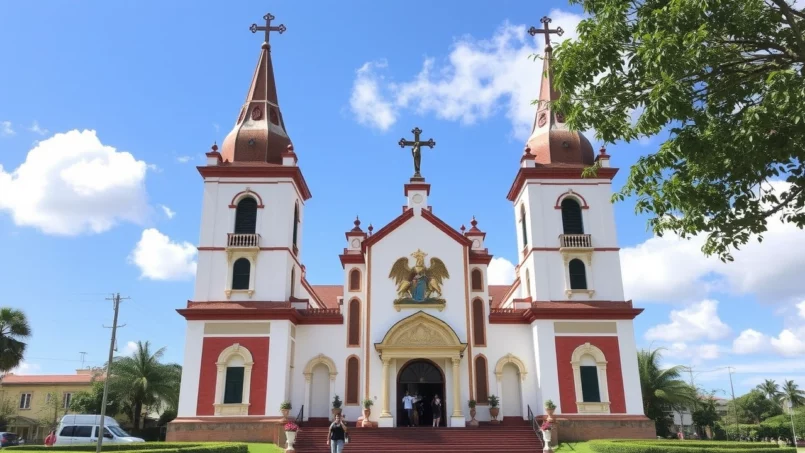
Puerto Rico is literally covered with churches: small village chapels, grand historic cathedrals in Old San Juan, evangelical temples on every corner, worship halls in urban neighborhoods. Most municipalities have at least one central Catholic church, often on the main square, and several Protestant places of worship.
For an expat, the central question is: how to behave, especially if invited to a mass, a religious wedding, or a fiestas patronales procession?
Dress Code: Modest and Respectful
Even though the island is tropical and people sometimes dress very casually at the beach, expectations are different when approaching a religious place or event. Some practical guidelines:
In places of worship, respectful attire is important. Shoulders and knees should be covered for everyone. Avoid swimsuits, short shorts, low necklines, overly tight or sheer clothing. For men, a tucked-in shirt is appreciated, while very sporty T-shirts or unbuttoned shirts can come across as sloppy.
Some parishes go further. One example of parish rules mentions, for women, the requirement to cover the head, a ban on pants and sleeveless tops, and skirts that fully cover the knees. For men, wearing a jacket and tie is presented as the norm, except in extreme heat. Even if these very strict rules are not universal, they give an idea of the level of respect expected in some conservative communities.
The underlying message is clear: it is better to cover too much than not enough. When in doubt, simple attire—pants or long skirt, short or three-quarter sleeve top—works well.
Behavior During Mass or Service
Etiquette in Puerto Rican churches is very similar to that in other Catholic or Protestant countries, but with a few points locals are attentive to.
Upon entering and leaving a Catholic church, many faithful perform a series of gestures: they bless themselves with holy water, then kneel on the right knee towards the tabernacle before taking their seat (or leaving). While not mandatory, this practice observed by believers signifies the sacred and solemn character attributed to the church space.
It is important to remain discreet: no loud conversations, no unnecessary coming and going once the celebration has started, and special attention during the sermon. The center aisle is generally avoided for moving around during mass; instead, use the sides to avoid drawing attention.
Children are welcome, but crying and running in the aisles will be frowned upon, especially near the altar. Some churches have cry rooms for families with babies, allowing them to follow the service without disrupting the celebration.
During communion, the faithful line up in silence and reverence. If you do not take communion, you can remain in your seat or, following local custom, go forward with arms crossed over your chest to receive a blessing.
Finally, wait until the priest or pastor leaves the altar before rushing out. Many people stay a few minutes for personal prayer or to greet other faithful.
Photography, Phones, and Discretion
One point not to overlook: photography. In some historic sites, photos are allowed, but you will be asked not to use flash and not to photograph faithful in the middle of devotion. In other churches, especially during mass, no photos are tolerated. So it’s wise to check for explicit signs and, if in doubt, refrain or ask.
Cell phones should be on silent mode, or even turned off. Taking calls or checking messages during a service will be considered extremely disrespectful.
Major Religious Festivals: A Calendar That Structures Social Life
In Puerto Rico, the liturgical calendar is not limited to Sundays. Many religious festivals structure the year, blending devotion, music, dance, and gastronomy.
The Long Christmas Season
The Christmas season, La Navidad, is particularly emblematic. It spans about 45 days, from late November to mid-January, making it one of the longest Christmas seasons in the world. It doesn’t end on December 25, but continues at least through Three Kings’ Day, and often further with a cycle called Las Octavitas.
On December 24 (Nochebuena), families gather for a big meal featuring typical dishes like lechón asado (spit-roasted pork), arroz con gandules (rice with pigeon peas), and pasteles (root-vegetable dough pastries filled with meat). They drink coquito, a sort of coconut eggnog, and you may see parrandas: groups of friends who show up at someone’s house late in the evening to sing traditional songs (aguinaldos) accompanied by percussion instruments (panderos, maracas, güiro, cuatros, guitars). The host offers food and drink, then joins the group to surprise another household, and so on.
The Christmas carols themselves are a mix of religious music and folk: villancicos of Spanish origin, local aguinaldos, and improvised trovas.
January 6, Día de los Reyes Magos (Three Kings’ Day), is the other major moment. The night before, children leave boxes of grass under their beds for the camels of the Three Kings, in exchange for gifts. Municipalities like Juana Díaz and Isabela organize spectacular parades with people costumed as the Kings, gift distributions, Nativity reenactments, and visits to the “House of the Three Kings” in Juana Díaz, which welcomes over 25,000 people.
A few days later in January, the cycle officially ends with the Fiestas de la Calle San Sebastián in Old San Juan: four days of parades, giant puppets (cabezudos), concerts, artisan booths, and street food. This event, though very festive, retains religious roots, as it is historically linked to a patron saint.
Holy Week, Christmas, and Major Catholic Feasts
Semana Santa (Holy Week) is everywhere marked by processions, reenactments of the Passion of Christ, and special services. Good Friday is solemn, while Easter Sunday is celebrated joyfully. For the expat, it’s good to know that some businesses reduce their hours, streets may be closed for processions, and the general atmosphere becomes more reflective.
December 8, the Feast of the Immaculate Conception (Día de la Inmaculada Concepción), is often considered the official start of the Christmas festivities. It is celebrated with masses, processions, and candlelight vigils. Cities like Guayanilla, Humacao, Juncos, and Vieques are particularly lively on this occasion.
Patron Saint Festivals: Every Town Celebrates Its Saint
The fiestas patronales are one of the best ways to grasp the link between religion and local identity. Each municipality—there are 78—has a patron saint, celebrated during festivals that often last about ten days.
They systematically include at least a religious component (solemn mass, procession with the saint’s image through the city) and a secular component: games, rides, concerts, food stalls (empanadillas, alcapurrias, codfish fritters, etc.), artisans displaying saint carvings (talla de Santos), paintings, ceramics. These wooden saints, sometimes inspired by ancient Taíno and African figures, represent centuries of local religious art.
Here is how the religious dimension and social life combine for a single event.
| Elements of a Typical Patron Saint Festival | Religious Dimension | Cultural / Social Dimension |
|---|---|---|
| Solemn Mass | Tribute to the patron saint | Community gathering moment |
| Street Procession | Carrying the saint’s image, prayers | Marching band, dance, decorations, broad participation |
| Artisan Stalls | Sale of saint carvings | Crafts, souvenirs, local identity |
| Concerts and Shows | Sometimes religious songs | Popular music, salsa, reggaeton, bomba |
| Street Food | Sometimes dishes linked to a confraternity | Culinary discovery for locals and expats |
Being present at these festivals, even without participating in the actual rites, is an excellent way to meet locals and understand what makes each community tick. You can stand along the route, observe the procession, respect the silence when the statue passes, then enjoy the stalls and music afterward.
Syncretism in Celebration: Loíza, Ponce, and Other Examples
Some festivals very visibly display the blend of Catholicism and African or Taíno heritages. In Loíza, for example, the Festival de Santiago Apóstol, on the last weekend of July, features a parade where masked characters, the vejigantes, confront Spanish knights. This staging represents the struggle between good and evil, but also references the history of African presence and symbolic resistance to colonization.
The music of *bomba*, characterized by call-and-response singing and drums that answer the dancer’s steps, is central to this culture. It often goes along with sampling popular dishes like *alcapurrias* (cassava or green banana fritters stuffed with meat), *piononos* (stuffed plantain), and *bacalaítos* (codfish fritters).
In Ponce, the Carnaval Ponceño, just before Lent, also features vejigantes, but with more reptilian, colorful, and extravagant masks. A character named King Momo, a carnival queen, a masquerade ball, and a ritual called “burial of the sardine,” simulating a funeral, mark the end of the festive period and the entry into the penitential season.
For an expat, these events are fascinating to observe, but also require tact: they are not simply folkloric “attractions,” but identity rituals in the strong sense.
Espiritismo, Santería, and Other Practices: What to Know
Beyond churches and processions, Puerto Rico is particularly rich ground for syncretic religious practices that blend Catholicism, African heritages, Taíno traditions, and European spiritism.
Espiritismo: The “Psychiatry of the Poor” and More
Espiritismo is one of the most widespread practices, so much so that a 1970s survey estimated that over 80% of the population had performed at least one ritual related to it, and that almost everyone had heard of it. Imported in the 19th century via France and the writings of Allan Kardec, spiritism first attracted an intellectual elite before spreading broadly through all social classes.
In Puerto Rico, spiritism transformed into a unique syncretism called Mesa Blanca. This common practice blends Catholic elements (prayers, saints, holy water), Afro-Caribbean ones (orishas, offerings of rum, drums), and Taíno (use of herbs, symbolism of the four directions, ancestor veneration). It takes place around a large table covered with a white cloth, adorned with candles, glasses of water, and sometimes cigars. Mediums act as intermediaries with the spirit world to offer services of healing, protection, or solving family and emotional problems for participants.
Botánica-type shops are the visible showcases of this universe. In these stores, you find an astonishing mix: statues of Christian saints, images of African deities, dried herbs, incense, colored candles with printed prayers, amulets, bottles of “holy water” or “protection oil.” They are frequented by believers from very different backgrounds—Catholics, Santería practitioners, espiritistas—and also serve as a connection point to healers or mediums.
From a mental health standpoint, studies have shown that many Puerto Ricans who consult an espiritista are also more likely to subsequently use services of psychologists or psychiatrists. Some specialists even recommend that therapists familiarize themselves with these practices to better understand their patients’ frame of reference.
For an expat, it is not appropriate to “try out” spiritual practices as a tourist attraction. Attending a session only happens by invitation and with deep respect. However, observing a *botánica*, cautiously discussing with the owner, or asking a local friend to explain the products on sale can be a rich entry point for understanding Puerto Rican cultural syncretism.
Santería, Sanse, and Other Currents
Santería, imported mainly via Cuba and populations of Yoruba origin, is also present. It pairs orishas (African deities) with Catholic saints, creating dual figures: Changó associated with Santa Bárbara, Ochún with the Virgin of Charity, etc. Rituals involve drums, offerings, sometimes animal sacrifice (a controversial practice but part of tradition in some communities), and a rich symbolic universe.
A current called Sanse has developed in some Afro-Puerto Rican circles, combining elements of local espiritismo, brujería (witchcraft), Dominican traditions (21 Divisiones), and Haitian Vodou. Again, this is a highly codified system, both religious and therapeutic.
For an expat, the crucial point is to remember that these practices, often stigmatized as “witchcraft” by some religious groups, play an important role in the identity balance of many people. Approaching these subjects with curiosity, but without exoticization or judgment, is a mark of respect.
Being a Believing Expat: Where to Pray, with Whom, and in What Language?
If you wish to continue practicing your Christian faith in your language, or at least a language you are comfortable with, you will find several suitable places in Puerto Rico, especially in the San Juan metropolitan area.
English Offerings and International Communities
Several interdenominational Protestant churches are explicitly English-speaking or bilingual.
For example:
An overview of main Protestant and interdenominational congregations offering services in English in Puerto Rico, welcoming a diverse community including expats.
Interdenominational English-speaking congregation (with some Spanish) welcoming a great diversity of profiles, including many expats. Main service Sunday morning with music and preaching, in an inclusive and open vision.
English-speaking interdenominational church founded in the 1960s, gathering members from over twenty Protestant denominations. Sunday service emphasizes children and lay participation.
Churches like Trinity in Bayamón, Connected Life in central San Juan, as well as bilingual Lutheran and Episcopal parishes enrich the English-speaking landscape.
A community Protestant church offers a contemporary service in English. The local Catholic church also celebrates a mass in English on Sunday morning.
Jehovah’s Witnesses have an English-speaking congregation in Fajardo, and a Catholic parish in Fajardo also offers an English mass on Sunday.
For other faiths, English is sometimes present in Jewish or Muslim services, but the dominant language is often Spanish. In any case, religious leaders are used to receiving international visitors and explaining, at least in a few words of English, the flow of a prayer or celebration.
How to Find “Your” Community
For an expat, joining a religious community often plays a crucial role in integration. Recent research shows that expats involved in religious groups tend to feel less lonely, adapt more quickly to local culture, and benefit from a denser social network. Religion is not necessarily a barrier to openness; it can instead serve as a bridge, provided you choose a welcoming and inclusive place.
Some practical advice, based on available resources:
To identify a suitable English-speaking Christian community during an expatriation, several approaches are effective. Use specialized directories like FindAChurch.com or *International Churches* networks. Then check church websites or Facebook pages for service languages, their vision of diversity, and activities (youth groups, social action, intercultural gatherings). Seek recommendations from other expats via forums or WhatsApp/Telegram groups. Finally, feel free to try several congregations before committing, as many are used to expat turnover and offer hybrid formats (in-person and online services) making it easy to make initial contact.
What If You Are Not Christian?
If you are Jewish, Muslim, Hindu, or Buddhist, the offerings are smaller but real. The Jewish community, the largest in the Caribbean, has synagogues of the three main movements (Orthodox, Conservative, Reform). Islam is practiced in several mosques, notably in the San Juan area. Major holidays—Passover, Hanukkah, Ramadan, Eid, Diwali, etc.—are celebrated, sometimes adjusting to the local context.
International lists of Chabad centers (for Jews), mosque locator apps, or community groups on social media are good starting points. Again, the key is to introduce yourself respectfully, explain your expat status, and ask how to participate appropriately.
Social Etiquette Related to Religion: What to Do… and Avoid
Beyond churches and festivals, certain norms permeate daily life. Puerto Ricans often blend humor, conviviality, and faith, but there are still implicit red lines.
Respect for Elders and Family
Society particularly values respect for the elderly. During a family meal or gathering associated with a religious rite (baptism, first communion, funeral), it is customary to greet the oldest first, give them the best seats, and not contradict them directly, especially on sensitive topics like faith.
During mourning periods, some relatives still wear black or a dark scarf, or keep a lock of hair from the deceased, following old traditions.
Sensitive Topics: Religion, Gender, Sexuality
Puerto Rico has a reputation, rightly, as a pioneer in LGBT rights in Latin America, with neighborhoods and beaches very welcoming to queer people (Condado, Santurce, Boquerón, etc.). At the same time, conservative religious currents retain real influence, including in how some media handle issues of gender and sexuality.
For an expat, it is advisable to approach religious subjects with tact, especially with very devout individuals. Legal protection of certain rights does not guarantee uniform acceptance in all religious circles. The most cautious approach is to let locals set the tone of conversations and to favor sincere questions rather than direct confrontation.
Laws and Daily Manners
Some legal rules intersect with social and sometimes religious practices:
Alcohol consumption is regulated (prohibited before age 18 and in certain public places), and excessive drinking is frowned upon in a sacred context, even during religious festivals. Smoking is banned in enclosed public places (bars, restaurants, casinos) and in vehicles transporting children, subject to fines. A tip of 15–20% is generally expected in restaurants, including for religious holiday meals served in commercial establishments.
An amusing point that often surprises newcomers: it is common for passengers to applaud when the plane lands. A mix of relief, gratitude (sometimes explicitly religious), and collective custom.
Participating Without Appropriating: Finding the Right Distance
The temptation for a curious expat is sometimes to want “to see everything”: attending masses, processions, espiritismo sessions, Santería rituals, or patron saint festivals. Yet not all these practices lend themselves to the same degree of openness.
Public festivals—Holy Week processions, fiestas patronales, big festivals like the Carnaval Ponceño or the Fiestas de la Calle San Sebastián—willingly welcome visitors, locals and foreigners alike. Families come, eat on the go, dance, take photos (without disturbing ongoing religious activities) and enjoy the atmosphere. Your presence, if respectful, is generally appreciated.
Intimate spiritual rituals (sessions at an espiritista center, consultations with a brujo or santera, ceremonies in a mosque or synagogue) are not shows but practices with strong emotional and spiritual weight. They require a high level of trust. If you are invited, accept with humility and find out in advance about expected behaviors, appropriate attire, and your role (observer or participant).
The important thing for an expat is not to turn these practices into “exotic curiosities” without measuring their role in the lives of those who experience them. A simple way to stay aligned is to always ask yourself: “If this were my most intimate ritual, how would I want someone from another culture to behave?”
Language, Integration, and Religion: Why a Few Words of Spanish Make All the Difference
Even though English is widely understood in tourist areas and in many Protestant churches, Spanish remains the majority language in daily religious practice, whether in prayers, sermons, or songs.
Making the effort to learn a few basic Spanish words—like *Hola*, *Gracias*, *Por favor*, *Mucho gusto*, *Dios le bendiga*—can significantly ease interactions, especially with older people or faithful not used to foreigners. Pastors and priests are often happy to briefly explain the meaning of a procession or feast, but they will appreciate feeling that you don’t take their availability for granted.
For believing expats, this is also a wonderful opportunity: by attending a mass or service in Spanish, even if you don’t understand everything, you immerse yourself in local sensibilities, discover another register of the language, and open the door to deeper connections with residents.
In Conclusion: Faith as a Gateway to Puerto Rican Society
Puerto Rico is a territory where religion is not confined to buildings or Sunday mornings. It runs through history, politics, community solidarities, art, music, cuisine, and everyday gestures. For an expat, becoming familiar with this dimension is not a luxury but a condition for integration.
To avoid missteps and better integrate, it is essential to know the main religious actors (Catholic Church, Protestant denominations, Jewish and Muslim communities), recognize the importance of syncretic practices like espiritismo, respect dress codes and behavioral norms in sacred places, and understand that some religious festivals may alter business and service hours.
Faith, in Puerto Rico, is not solely a matter of individual belief. It is also a shared language, a foundation of collective references, and for many expats, a space of welcome and support. Whether you are a believer or not, learning to read this language will help you better inhabit the island and forge richer ties with those who live there.
Disclaimer: The information provided on this website is for informational purposes only and does not constitute financial, legal, or professional advice. We encourage you to consult qualified experts before making any investment, real estate, or expatriation decisions. Although we strive to maintain up-to-date and accurate information, we do not guarantee the completeness, accuracy, or timeliness of the proposed content. As investment and expatriation involve risks, we disclaim any liability for potential losses or damages arising from the use of this site. Your use of this site confirms your acceptance of these terms and your understanding of the associated risks.

Cyril Jarnias is an independent expert in international wealth management with over 20 years of experience. As an expatriate himself, he is dedicated to helping individuals and business leaders build, protect, and pass on their wealth with complete peace of mind.
On his website, cyriljarnias.com, he shares his expertise on international real estate, offshore company formation, and expatriation.
Thanks to his expertise, he offers sound advice to optimize his clients' wealth management. Cyril Jarnias is also recognized for his appearances in many prestigious media outlets such as BFM Business, les Français de l’étranger, Le Figaro, Les Echos, and Mieux vivre votre argent, where he shares his knowledge and know-how in wealth management.





