
 Published on and written by Cyril Jarnias
The United States of America, the third largest country in the world by area, offers exceptional geographic diversity. From its ocean coasts to its majestic mountains, as well as its vast plains and deserts, the country presents a varied landscape that has shaped its history and development.
Geographic Location
The United States is located in North America, bordered by the Atlantic Ocean to the east, the Pacific Ocean to the west, Canada to the north, and Mexico to the south. The country covers a total area of approximately 9.8 million km², encompassing 50 states and one federal district (Washington D.C.).
The U.S. territory consists of three distinct geographic areas:
- The “Mainland” or the 48 contiguous states, forming the main part of the country
- Alaska, located northwest of Canada
- The Hawaiian archipelago, in the Pacific Ocean
Good to know:
The United States also has several island territories in the Caribbean Sea and the Pacific Ocean, such as Puerto Rico and Guam.
Main Geographic Regions
The United States Census Bureau officially divides the country into four major regions, each with its own geographic and cultural characteristics:
1. The Northeast
This region includes New England and the Mid-Atlantic states. It is characterized by its dense forests, rocky coasts, and harsh winters. Historic cities like Boston and New York are found here.
2. The Midwest
Often called the “heart of America,” the Midwest is known for its vast agricultural plains, the Great Lakes, and industrial cities like Chicago and Detroit.
3. The South
Stretching from Virginia to Texas, the South is characterized by its warm and humid climate, long coastlines on the Gulf of Mexico and the Atlantic Ocean, and unique cultural traditions.
4. The West
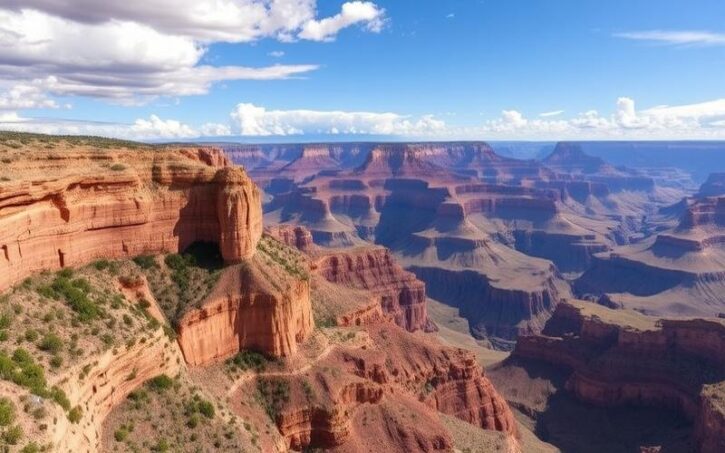
This vast region includes the Rocky Mountains, the deserts of the Southwest, and the Pacific coast. It is home to spectacular landscapes like the Grand Canyon and Silicon Valley.
Good to know:
Each region has considerable internal diversity, with sub-regions having their own geographic and cultural particularities.
Major Mountain Ranges
The United States is crossed by three major mountain ranges that have played a crucial role in the country’s development:
- The Appalachians: stretching from Canada to Alabama, they are the oldest mountains in the country.
- The Rocky Mountains: crossing the country from north to south, they are the highest in North America.
- The Sierra Nevada and the Cascades: located along the west coast, these younger ranges include several active volcanoes.
Major Cities
The United States has many dynamic metropolises, each with its own identity. Here are the ten largest cities in the country by population:
- New York (8.3 million inhabitants): the largest city in the country, a global financial and cultural center.
- Los Angeles (3.9 million): entertainment capital, known for Hollywood and its beaches.
- Chicago (2.7 million): a major transportation hub and economic center of the Midwest.
- Houston (2.3 million): center of the oil and space industries.
- Phoenix (1.7 million): a rapidly growing city in the Arizona desert.
- Philadelphia (1.6 million): rich in history, birthplace of American independence.
- San Antonio (1.5 million): known for its unique blend of American and Mexican cultures.
- San Diego (1.4 million): a coastal city renowned for its pleasant climate.
- Dallas (1.3 million): a major economic center in Texas.
- San Jose (1 million): heart of Silicon Valley.
Good to know:
Although Washington D.C. is not among the largest cities by population, it plays a crucial role as the federal capital and political center of the country.
Neighboring Countries
The United States shares land borders with only two countries:
- Canada to the north, with a border of 8,891 km, the longest undefended land border in the world.
- Mexico to the south, with a border of 3,141 km.
These borders have played an important role in the history and economic development of the United States, facilitating trade and cultural exchanges while presenting challenges in terms of security and immigration management.
Conclusion
The geography of the United States is as vast as it is diverse, offering a mosaic of landscapes and environments that have shaped the country’s history and culture. From the skyscrapers of New York to the beaches of California, from the Rockies to the Florida Everglades, this geographic diversity is one of the country’s major assets, contributing to its economic, cultural, and natural wealth.
Good to know:
The geographic diversity of the United States is also reflected in its biodiversity, making the country one of the 17 megadiverse countries on the planet.
Disclaimer: The information provided on this website is for informational purposes only and does not constitute financial, legal, or professional advice. We encourage you to consult qualified experts before making any investment, real estate, or expatriation decisions. Although we strive to maintain up-to-date and accurate information, we do not guarantee the completeness, accuracy, or timeliness of the proposed content. As investment and expatriation involve risks, we disclaim any liability for potential losses or damages arising from the use of this site. Your use of this site confirms your acceptance of these terms and your understanding of the associated risks.

Cyril Jarnias is an independent expert in international wealth management with over 20 years of experience. As an expatriate himself, he is dedicated to helping individuals and business leaders build, protect, and pass on their wealth with complete peace of mind.
On his website, cyriljarnias.com, he shares his expertise on international real estate, offshore company formation, and expatriation.
Thanks to his expertise, he offers sound advice to optimize his clients' wealth management. Cyril Jarnias is also recognized for his appearances in many prestigious media outlets such as BFM Business, les Français de l’étranger, Le Figaro, Les Echos, and Mieux vivre votre argent, where he shares his knowledge and know-how in wealth management.





