
 Published on and written by Cyril Jarnias
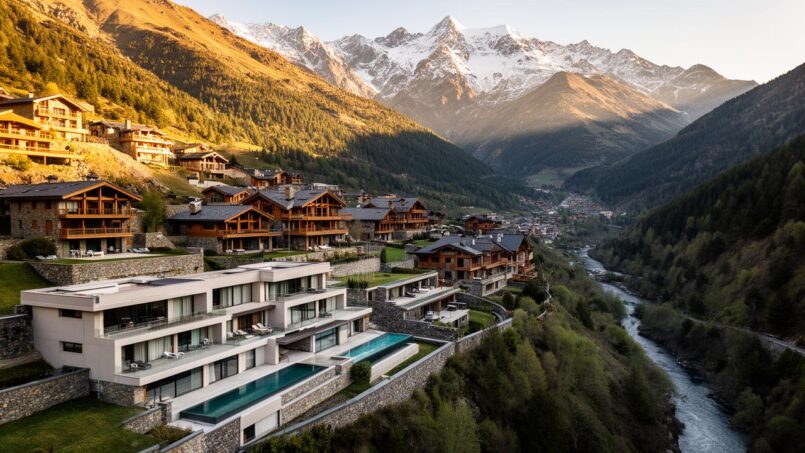
Nestled between France and Spain in the heart of the Pyrenees, Andorra has emerged in recent years as one of Europe’s most sought-after real estate markets for an affluent international clientele. A light tax framework, high quality of life, world-class skiing, and exceptional security have driven demand for upscale apartments, contemporary chalets, and premium residences through the roof.
Since 2024–2026, the Llei Òmnibus and Law 2/2026 have transformed the real estate market: ownership caps, a specific tax, stricter residency conditions, and priority for long-term rental housing.
Understanding this new framework has become essential before signing a sales agreement for a penthouse in Escaldes-Engordany, a chalet in Ordino, or a ski-in/ski-out residence in Soldeu.
Real estate in Andorra operates in a very unique context: a tiny territory, a mountainous topography that severely limits developable land, and a continuous influx of foreign capital. The result: an almost uninterrupted rise in prices and tight supply.
According to official statistics, the average price of apartments reached approximately 4,170 €/m² in the third quarter of 2024, an annual increase of over 12%. By the end of 2025, the national average for flats exceeded 4,500 €/m², nearly double the 2020 level. In January 2026, the average asking price hit 5,609 €/m², up more than 9% year-over-year.
Values vary significantly by property type:
| Property type (listings) | Indicative median price €/m² |
|---|---|
| Chalets | ≈ 4,368 €/m² |
| Duplex / townhouses | ≈ 4,821 €/m² |
| Apartments | ≈ 4,557 €/m² |
| Land | ≈ 824 €/m² |
In practice, a detached chalet easily trades above 1.5 million euros, and ultra-luxury properties—architect-designed chalets or ridge-top villas—can climb to 10 or 15 million euros. For apartments, a very basic older studio starts at around 100,000–250,000 €, while a high-quality new two- or three-bedroom can reach 900,000 € and more in premium zones.
Andorra’s real estate inflation is notably explained by a very attractive tax framework: no wealth tax, no inheritance or gift tax, a capped income tax of 10% for residents, and for non-residents, a flat 10% IRNR rate with exemption on dividends, interest, and passive income, and no recurring national property ownership tax.
Choosing the parish is now one of the most important strategic decisions for a foreign investor. Andorra’s micro-markets differ greatly in terms of price, demand profile, and capital appreciation potential.
Andorra la Vella and Escaldes-Engordany: urban core and ultra-luxury
Andorra la Vella, the capital and financial center, concentrates a large share of high-end real estate: apartments and penthouses with terraces, immediate proximity to shops, restaurants, banks, and government offices. The center and surrounding hillsides are considered a safe bet: high liquidity, steady rental demand, and stability.
Prices here are among the highest in the country: some residences reach 5,000 to 10,000 €/m², and up to 15,000 €/m² for the most exclusive properties. A complex like White Angel illustrates this trend: concierge services, luxurious common areas, enhanced security, and an international clientele seeking privacy.
Premium apartments in Escaldes-Engordany frequently sell for up to 11,000 €/m².
This Andorra la Vella / Escaldes-Engordany duo is the beating heart of the luxury segment, particularly suited for investors seeking either an urban pied-à-terre for tax residency or a stable long-term rental asset.
Ordino, La Massana, Canillo, Encamp: high-end mountain living
On the more mountainous side, certain parishes stand out for their appeal to an international clientele seeking nature, contemporary chalets, and direct access to the slopes.
Ordino, a UNESCO Biosphere Reserve, has become one of the country’s most expensive markets. Recent reports place the average sale price above 1.6 million euros, with per-square-meter values ranging from 6,500 to 9,000 €/m². The offering combines traditional stone chalets, modern villas, luxury duplexes, and new residences like Vermont or the Ordino Mountain Residential Resort, often south-facing with unobstructed valley views. The typical buyer profile: high-income international families seeking privacy, scenery, and quality schools.
In La Massana, standalone chalets are highly sought after, such as villas for 2.5 million euros perched above Anyós or chalets over 500 m² listed at 9.5 million euros in the La Massana area.
Canillo, Soldeu, El Tarter, and Encamp share access to Grandvalira, Southern Europe’s largest ski area (over 210 km of slopes, 128 runs, 3 snowparks). Here you’ll find numerous ski-in/ski-out developments, luxury chalets like L’Hermitage Mountain Résidences in Soldeu (9 apartments from 120 to 500 m²), as well as residences like La Pleta d’Incles, consisting of family homes with gardens and direct slope views. Prices remain slightly below urban premium areas, typically between 4,500 and 6,000 €/m² for good products, with strong seasonal rental potential.
Sant Julià de Lòria, Encamp: emerging and more accessible areas
Sant Julià de Lòria, on the Spanish border, and Encamp are often cited as more affordable options, with average price levels around 4,000–5,500 €/m². They appeal to families and younger investors looking for a first acquisition with value appreciation potential. Sant Julià stands out for its peaceful environment, lower entry prices, and stable local rental market, while Encamp benefits from direct access to Grandvalira’s slopes and sustained residential demand.
A market supported by solid rental yields
The appeal of the Andorran market is not solely based on potential capital gains. Rents have risen rapidly in recent years amid a shortage of rental housing, enabling attractive gross yields for investors.
Studies such as those from the Global Property Guide indicate, as of early 2025, average rents of around 1,450 € for a one-bedroom apartment, 2,100 € for a two-bedroom, 2,600 € for a three-bedroom, and 4,300 € for a large property (4+ bedrooms). Per square meter, data from local platforms show an average rent around 21–23 €/m² per month, with peaks above 23.5 €/m² in fall 2025.
Gross yields range from 3.5% to 5.5% per year depending on size and location, with better ratios for smaller units. In tight areas like Escaldes-Engordany or Andorra la Vella, yields close to 6% are possible for well-located apartments. Tourist residences in Soldeu or El Tarter can exceed 6% with seasonal rentals and the required municipal permits.
However, one must keep in mind that the rental market is very tight: very few listings, rents sometimes doubling or tripling upon lease expiration, and intense social debate about housing affordability. This context led the government to heavily regulate speculation and tax-reward investments dedicated to long-term rentals.
A deeply strengthened regulatory framework since 2024
For a foreign investor, the main change lies in the tightening of foreign real estate investment rules and the introduction of a dedicated tax: the Foreign Real Estate Investment Tax (often referred to as IIEI or FIT in the texts).
Any non-resident, as well as any resident who has not accumulated at least three years of effective residency in the last ten years, is now considered a “foreign investor” and must obtain prior government authorization for any real estate purchase.
This authorization—the “autorització d’inversió estrangera en immobles”—is a mandatory step, typically handled by a lawyer or agency, and is obtained within a few weeks if the file is complete. It requires providing an apostilled criminal record, passport copies, a civil status certificate, and precise information about the property in question.
The government can veto an investment contrary to public order, national security, the environment, or the general interest. Any circumvention exposes you to fines of 10,000 to 20,000 € and cancellation of the transaction.
Note that Andorran nationals are excluded from this definition of foreign investor, even if they do not reside in the country, and holders of a residence permit without paid activity are no longer treated as foreign investors for their purchases.
Ownership caps: maximum of 2 homes for foreigners
The Llei Òmnibus and its 2025–2026 texts introduced strict limits on the number of properties a foreign investor can acquire:
| Category of authorized property for a foreign investor | Regulatory cap |
|---|---|
| Land parcels for single-family homes | 1 parcel |
| Single-family home (chalet, villa) | 1 home |
| Apartments / studios | 2 units |
| Parking spaces | 6 total spaces |
| Annexes (cellars, lockers) per apartment | 3 cellars + 3 parking max |
These caps apply only to acquisitions after the law came into force; previously held properties are not counted. Beyond these limits, only transactions intended for long-term affordable rental housing (at least ten years) may obtain exemptions, subject to meeting specific energy and environmental standards.
Speculative real estate development by foreigners is almost banned: promotion projects for resale, tourist residences like Airbnb, and rent-to-own schemes are prohibited. The only exceptions: 100% long-term rental programs with at least 50% of units rented at affordable prices to Andorran residents for at least ten years.
Prohibition of pure development and use of Andorran companies
Foreign legal entities cannot directly purchase real estate in Andorra. They must use a dedicated Andorran company (SPV), itself subject to foreign investment authorization if the non-resident stake exceeds 10% of capital or voting rights.
Real estate developments led by foreign capital are no longer possible for condominium sales; only projects intended for permanent rental have a window, with significant constraints: holding the property for at least ten years, allocating at least half the units to regulated rents, and enhanced energy compliance.
The new foreign real estate investment tax: 6% then 10%
The most sensitive tax reform for foreign investors is undoubtedly the Foreign Real Estate Investment Tax, initially established by Law 3/2024 and then integrated and tightened by Law 2/2026.
The principle is as follows: any foreign investor (non-resident, resident for less than three years, or Andorran company controlled more than 50% by foreigners) must pay, in addition to standard transfer taxes, a tax calculated on the “real value” of the real estate investment.
The current scale, after the 2026 reform, is simplified but heavier:
| Acquisition by a foreign investor (individual or legal entity) | Foreign real estate investment tax rate |
|---|---|
| 1st unit (single-family home or apartment + annexes, within legal limits) | 6% of the actual price |
| 2nd unit and subsequent, or investment exceeding caps (multiple parcels, development project, etc.) | 10% of the actual price |
Some structural elements complete this system:
– the tax is non-refundable, even if the buyer later becomes a resident for more than three years;
– it must be paid before signing at the notary;
– low-value transactions (below 50,000 €) are exempt.
To give a concrete example, a non-resident buying an apartment for 800,000 € as their first property in Andorra would be subject to 6% foreign investment tax, i.e., 48,000 €. This amount is added to other acquisition costs.
Other taxes and fees when buying
Beyond the specific tax for foreigners, buying real estate in Andorra involves a set of transfer taxes and fees that should not be underestimated.
Transfer taxes: ITP or IGI + municipal taxes
For any resale purchase between individuals, the ITP (Impost de Transmissions Patrimonials) applies, equivalent to transfer taxes:
– current overall rate: approximately 4% of the actual property value, split between the state and the commune (Government: 1–2%, Comú: 2–3% depending on the parish);
– some sources detail a structure of 2% for the state and 2% for the commune, but in practice, the effective commune/state range varies slightly by transaction type.
The IGI (Impôt Général Indirecte) rate, equivalent to VAT, applicable to the purchase of a new property from a developer or company, is 20%.
– general rate: 4.5%;
– reduced rate: 3.5% if the home is used for permanent residential rental.
Notary, agency, and ancillary costs
Notary fees are borne by the buyer and amount to around 0.7 to 1% of the price, with a minimum of 600–1,200 € and a variable component of about 0.1% of the sale price. The buyer must also open an account with an Andorran bank and, if using local financing, a loan is typically based on 60–70% of the estimated price, requiring a down payment of at least 30%.
Agency commissions represent up to 5% of the sale price, usually paid by the seller.
Ultimately, for a foreign non-resident buying a resale property, the total charge—foreign investment tax, ITP, municipal taxes, notary fees—frequently reaches 10 to 12% of the price for a resident, and rather 14 to 16% for a non-resident subject to the full IIEI regime.
Taxation of ownership, rents, and capital gains
Once an owner, the foreign investor benefits from a still attractive tax environment, even though the country has tightened some levers to combat speculation.
Tax on rental income
Rents received by a non-resident are subject to IRNR (Non-Resident Income Tax) at the general rate of 10% on net income. Depending on the case, certain double taxation treaties may adjust this, but in the absence of a treaty, the Andorran rate prevails.
Municipalities apply a municipal tax on rental income, generally between 2 and 4% of the gross annual rent, depending on the parish.
Tax of 2 to 4% of gross annual rent for housing.
Tax of 2 to 4% of gross annual rent for commercial premises.
Tax of 2 to 4% of gross annual rent for parking spaces.
Tax of 2 to 4% of gross annual rent for tourist accommodations.
There is no recurring state-level “property tax”, but each commune levies a property tax calculated primarily per square meter, with a rate modulated by the property’s use (primary or secondary residence, rural, dilapidated, etc.). Additionally, a very moderate wealth tax of 0.1% on the average book value of buildings applies.
Capital gains on resale
Selling a property in Andorra triggers a capital gains tax payable by the seller. The rate is progressive, ranging from 1 to 15%, and decreases with the holding period: an anti-speculative surcharge of 5% may apply if the property is resold within the first two years, then the rate decreases by about one percentage point per year after the fourth year. After ten to twelve years of ownership, the real estate capital gain is fully exempt.
The exact terms vary depending on whether the seller is an Andorran company (taxed via corporate tax, nominal 10% modulated by holding period) or an individual (taxed via IRPF or IRNR, with a scale that can go up to 25% in some cases). In complex situations, consulting a local tax specialist is highly recommended.
Investing to obtain residency: the new threshold of €1,000,000
Andorra offers a residency without gainful activity (“passive residency”) regime that is especially popular with wealthy investors, particularly when real estate is the core of the asset strategy.
Investment condition: €1M in Andorran assets
Since 2026, the minimum investment amount to obtain this type of residency has been raised to €1,000,000 in Andorran assets. The holder must also pay a non-refundable deposit of €50,000 to the Andorran Financial Authority (AFA) for themselves and €12,000 per dependent.
The €1,000,000 investment can take several forms:
– residential or commercial real estate in Andorra;
– shares or stakes in Andorran companies;
– bonds or debt instruments issued by Andorran entities (including the state);
– units in Andorran investment funds;
– non-interest-bearing deposits with the AFA.
Each residential unit eligible for real estate investment must be worth at least €800,000.
A preferential mechanism theoretically exists: the possibility of obtaining residency with an investment of €400,000 allocated to the Public Housing Fund (Fons d’Habitatge), intended to finance social housing. However, this fund was not operational in spring 2026, so this path is currently limited.
Other conditions for passive residency
The investor must also: stay informed about market trends and diversify their portfolio to minimize risks.
To obtain passive resident status in Andorra, you must prove annual income of at least 300% of the Andorran minimum wage for yourself (around €50,000 to €55,000 per year), plus 100% per dependent. You also need to have a home in Andorra (purchase or rental separate from the investment), spend at least 90 days per year in the country, take out private health insurance covering 90% of costs, and provide a clean criminal record, a local medical certificate, and proof of lawful source of funds.
The first residency card is issued for two years, renewable, and the entire invested capital must be maintained for as long as the resident status is desired.
Note that the property purchased under this program cannot, in principle, be rented out, which clearly distinguishes “personal use” residential real estate from purely rental investment.
Massive tax reductions for long-term rentals
In a tight market, the Andorran government has aimed to steer foreign capital not toward short-term speculation but toward creating accessible rental supply.
This framework established a 90% reduction on the foreign real estate investment tax for projects meeting strict conditions:
The property must be rented as a primary residence for at least ten years at an affordable rent according to official scales, with no resale or private use by the owner during that period.
Concretely, a foreign investor buying a home for €600,000 and committing to rent it for ten years as a primary residence at a regulated rent could see their foreign investment tax drop from 6% (€36,000) to just 0.6% (€3,600). This mechanism opens a significant optimization window for strategies focused on long-term rental yield, provided the regulatory constraints are accepted.
Development projects carried out by foreigners can also benefit from a similar reduction if at least half the units are intended for affordable rental for ten years, making this segment a potential niche for institutional investors willing to adopt a long-term horizon.
Purchase process for a foreign investor
Beyond tax and legal considerations, the concrete mechanics of a foreign acquisition in Andorra follow relatively standardized but highly regulated steps.
The investor should first engage a local real estate agent to filter listings in a fragmented market, and a specialized lawyer to secure investment compliance with foreign investment regulations.
Once the property is identified and the price negotiated, the parties sign:
– a reservation contract (Contracte de Reserva) or a bilateral promise of sale (Promesa de Compra-Venda / Arras), accompanied by a deposit that very often reaches 10% of the price. This deposit is almost always non-refundable if the buyer withdraws without valid reason;
– simultaneously, the foreign investment authorization request is filed with the government, along with the required documents.
The due diligence phase typically lasts 4 to 12 weeks (title check, verification of charges, occupancy certificate, financing application). Closing takes place at the notary with the signing of the Escriptura Pública, payment of the balance (by bank check or transfer from an Andorran account), and delivery of keys.
The notary handles the registration of the deed, a process that can take two to four weeks. The buyer must then report to the Comú of the relevant parish to register as the new owner, which determines municipal tax collection and access to certain services.
In this new regulatory landscape, not all strategies are equal. Andorra in 2026 has become a “high-barrier”, selective market where a fine understanding of the regulations makes as much difference as the choice of address.
For a foreign investor, three main avenues emerge.
Central apartment for tax residency or long-term rental
This is the most common scenario: buying a 2- or 3-bedroom apartment in Andorra la Vella or Escaldes-Engordany, between €600,000 and €1,000,000, to combine personal use (tax residency or secondary home) with rental potential.
In this case, the points of attention are numerous:
Respect the cap of two homes to avoid any blockage. Choose between exclusive use (passive residency, without renting the property used for the permit) or renting. To optimize taxes, consider a long-term affordable rental commitment to benefit from a 90% reduction on the foreign investment tax.
Independent chalets in mountain areas—Ordino, La Massana, Canillo—are the holy grail for many buyers. They concentrate the strongest rarity characteristics: private land, unobstructed views, sunlight, quick slope access.
Prices often range from 2 to 5 million euros, and more for architect-designed projects. The investment is profitable in the long term thanks to the capital gains exemption after ten years, making it a solid wealth investment. The main focus is value preservation and personal use, rather than rental yield.
Finally, ski-in/ski-out residences in Soldeu, El Tarter, Pas de la Casa, or Arinsal target winter sports enthusiasts and seasonal rental strategies. The most sought-after products are 1–3 bedroom apartments in complexes with ski rooms, spas, and concierge services, like L’Hermitage Mountain Résidences or certain developments in La Pleta d’Incles.
In this segment, yields can exceed 6% in high season, but the investor must contend with two major constraints:
– obtaining a municipal tourist license, increasingly regulated;
– the new political direction that limits foreign investments in tourist housing, favoring permanent residence destinations.
A balanced approach is to target versatile properties that could also work for annual rental later, staying in the good graces of the regulations.
Conclusion: a still attractive market, but for prepared investors only
Real estate in Andorra remains, in 2026, a seductive bet for foreign investors: sustained capital gains for several years, decent rental yields, light tax environment, political stability, and quality of life hard to match in Europe.
But the combination of ownership caps, the Foreign Real Estate Investment Tax (6–10%), the mandatory prior authorization, and the regulation of tourist projects means the country is no longer a playground for short-term opportunistic arbitrage. Andorra has become a long-term holding market, geared toward profiles able to absorb high entry tickets (often starting at €400–600,000 for a quality property, €800,000 per unit for passive residency) and ready to adopt a wealth management logic.
The best real estate investments in Andorra no longer rely solely on finding the ideal chalet or penthouse. They require a suitable legal structure: choosing between personal use and rental, committing for ten years to benefit from tax reductions of up to 90%, and selecting the parish according to the desired profile. For example, Ordino or Escaldes offer prestige, Andorra la Vella guarantees security and liquidity, while Encamp and Canillo present emerging value.
For a foreign investor, the safest path remains approaching the Andorran market with a triple compass: solid local legal advice, a fine analysis of each parish micro-market, and a long-term vision incorporating the country’s new priorities on housing and sustainability. Within this framework, apartments, chalets, and premium residences in Andorra remain assets capable of combining enjoyment of use with a sophisticated wealth strategy.
Have a wealth project or a question? Contact us now to speak with a wealth management expert.
Disclaimer: The information provided on this website is for informational purposes only and does not constitute financial, legal, or professional advice. We encourage you to consult qualified experts before making any investment, real estate, or expatriation decisions. Although we strive to maintain up-to-date and accurate information, we do not guarantee the completeness, accuracy, or timeliness of the proposed content. As investment and expatriation involve risks, we disclaim any liability for potential losses or damages arising from the use of this site. Your use of this site confirms your acceptance of these terms and your understanding of the associated risks.

Cyril Jarnias is an independent expert in international wealth management with over 20 years of experience. As an expatriate himself, he is dedicated to helping individuals and business leaders build, protect, and pass on their wealth with complete peace of mind.
On his website, cyriljarnias.com, he shares his expertise on international real estate, offshore company formation, and expatriation.
Thanks to his expertise, he offers sound advice to optimize his clients' wealth management. Cyril Jarnias is also recognized for his appearances in many prestigious media outlets such as BFM Business, les Français de l’étranger, Le Figaro, Les Echos, and Mieux vivre votre argent, where he shares his knowledge and know-how in wealth management.





