
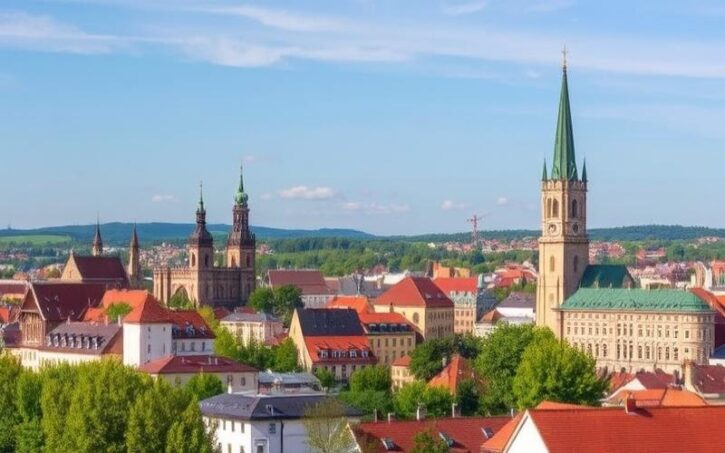
 Published on and written by Cyril Jarnias
Poland’s Real Estate Market: A Booming Sector
Poland, with its booming real estate market, offers numerous opportunities for both investors and individuals looking to settle there. However, venturing into property acquisition or rental in this country requires a thorough understanding of the specific laws and regulations governing this sector.
Key Regulations to Know
From the need for a permit for foreigners wishing to purchase agricultural land, to favorable tax regulations encouraging investment, and strict rules regarding tenant protection, it is crucial to familiarize yourself with these legal frameworks to secure any transaction and avoid potential pitfalls.
Good to Know:
Foreign investors often need to obtain specific permits to acquire certain types of properties, particularly agricultural or forest land.
Why Understanding Polish Legislation is Essential
This article aims to decipher the main legislations that every real estate investor must know to effectively navigate the Polish market.
Real Estate Acquisition in Poland: Foreigners’ Rights
Current Laws Regarding Real Estate Acquisition by Foreigners
Foreigners can acquire real estate in Poland, but conditions vary depending on their nationality.
- Citizens of the European Union (EU), European Economic Area (EEA), and Switzerland can freely purchase residential properties (apartments, houses) without a specific permit.
- Nationals from non-EU/EEA/Switzerland countries must obtain a permit issued by the Ministry of Interior and Administration to acquire single-family homes.
- For the purchase of commercial premises, no special authorization is required, regardless of the country of origin.
Permit Application Procedures and Relevant Authorities
Procedure for non-EU/EEA/Switzerland nationals:
- Submit an application to the Ministry of Interior and Administration.
- Provide a valid residence card or any other document proving the right to reside in Poland.
- Justify the legal origin of the funds intended for the purchase.
- Prove that the acquisition poses no risk to public order, security, health, or the environment.
Involved authorities:
- Ministry of Interior and Administration (main competent authority).
- Public notaries (for signing the deed of sale).
- Land and Mortgage Register (for property registration).
Accessible Property Types and Restrictions
| Property Type | EU/EEA/Swiss Citizens | Non-EU/EEA/Swiss Nationals |
|---|---|---|
| Apartments/houses | Free | Permit required (for houses) |
| Commercial premises | Free | Free |
| Agricultural/forest land | Permit required | Permit difficult to obtain |
– The purchase of agricultural and forest land is strictly regulated: even EU citizens must obtain a permit, except for exceptions provided by law.
– Permits for agricultural/forest land are rarely granted, except for specific reasons (e.g., sustainable agricultural activity, long-term residence).
Possible Exemptions to Restrictions
- Spouses of Polish citizens, foreigners holding a permanent residence permit, and foreign-capital companies established in Poland are exempt from the obligation to obtain authorization for certain types of properties.
- Citizens of the EU, EEA, and Switzerland benefit from a general exemption for the purchase of housing and commercial premises.
Impacts of International Agreements or Bilateral Treaties
- Acquisition rights for EU/EEA/Swiss citizens are facilitated through accession and free movement treaties, removing most restrictions for these nationals.
- Other bilateral agreements can also influence, particularly for companies or within the framework of economic cooperation.
Practical Tips for Foreigners Buying in Poland
- Hiring a lawyer specialized in Polish real estate law is highly recommended to secure the transaction and verify document compliance.
- Opening a bank account in Poland is generally required, especially for obtaining a mortgage.
- Consider additional costs: 2% PCC tax for secondary market purchases, notary fees, land register registration fees, real estate agent fees.
- Plan for the sworn translation of certain documents if they are not written in Polish.
Recent Examples of Legislative Changes or Proposals
- The Polish real estate market has seen a significant increase in foreign clients, especially since 2024, sparking debates on potentially tightening access conditions for non-EU non-residents.
- Several draft laws have been discussed to further limit access to agricultural and forest land, aiming to protect national land heritage.
- To date, no major changes have been adopted, but discussions continue, particularly regarding monitoring fund origins and combating money laundering.
Key Points to Remember
- EU/EEA/Swiss citizens are largely exempt from restrictions.
- Third-country nationals should anticipate a sometimes lengthy administrative procedure.
- Acquisition of agricultural/forest land remains highly regulated for all foreigners.
- It is essential to be assisted by professionals to secure the purchase and comply with Polish legal requirements.
Good to Know:
Foreigners wishing to acquire real estate in Poland must comply with certain laws, often requiring a permit from the Ministry of Interior for non-EU nationals, particularly for agricultural and forest land, while EU citizens may benefit from exemptions. Obtaining these permits involves consulting local and national authorities to assess the project’s integration into the land framework. Residential properties can be acquired without restrictions, but it is advisable to hire a lawyer specialized in real estate law to navigate these complex procedures. Recent legislative proposals aim to simplify processes to stimulate foreign investment, although they have not yet been enacted. Furthermore, bilateral treaties between Poland and certain countries can favorably influence these procedures for their nationals.
Key Polish Real Estate Sector Laws to Master
Polish real estate legislation is based on several fundamental laws governing property ownership, management, and development.
Fundamental Laws Governing the Real Estate Sector
| Law | Main Purpose |
|---|---|
| Land Property Law (June 24, 1994) | Definition of individual property and co-owners’ rights/obligations |
| Real Estate Management Law | Management, administration, and disposition of public and private real estate |
| Spatial Planning and Development Law | Land use rules, urban planning, and issuance of building permits |
| Agricultural System Organization Law (April 11, 2003) | Protection and management of agricultural land, acquisition restrictions |
Rights and Obligations of Owners and Tenants
- Owners have exclusive rights to their property, subject to compliance with condominium regulations, land register registration, and urban planning standards.
- Property rental is governed by the Civil Code and specific laws, distinguishing residential leases (more protective for tenants) from commercial leases (more flexible, with possibility for contractual negotiation).
- For condominiums, the 1994 Law requires drafting a notarial deed and mandatory registration in the Land and Mortgage Register, specifying share distribution and collective management procedures.
Regulation of Residential and Commercial Leases
- Residential Leases: The contract must specify duration, rent amount, charges, and termination conditions. The tenant benefits from enhanced protection against eviction and abusive rent increases.
- Commercial Leases: Subject to contractual freedom, but certain mandatory rules (minimum duration, renewal rights, etc.) may apply depending on the situation.
Real Estate Acquisition by Foreigners
- EU nationals can acquire real estate in Poland without a specific permit, provided they meet national requirements.
- For non-Europeans or in certain special cases (especially for agricultural land and forests), obtaining a permit issued by the Ministry of Interior remains necessary.
- Agricultural land acquisitions are strictly regulated: only persons with agricultural qualifications and local residence for at least five years can purchase, with a cap of 300 hectares per owner. The Agricultural Property Agency has a pre-emptive right.
- Temporary suspension of state agricultural land sales (5 years, except for exceptions).
Construction and Safety Standards
- Constructions must comply with the Polish Building Code, including safety, strength, accessibility, and environmental standards.
- Obtaining a building permit is mandatory before any project, issued based on local development plans.
- Compliance checks are ensured by local authorities.
Recent Reforms and Amendments
- Modernization of the land register system by the law of February 14, 2003: computerization of registers, simplification of procedures, and strengthening of land publicity.
- Regular adjustments to laws regarding acquisition by foreigners, especially after EU accession, with progressive easing of restrictions for European citizens.
- Periodic reforms of urban planning laws aimed at accelerating permit issuance and promoting urban densification.
Key Takeaways
The Polish real estate sector is governed by precise laws ensuring legal security, transparency, and protection of the various parties. The acquisition, management, and use of real estate are strictly regulated, both for nationals and foreigners.
Good to Know:
Real estate investors in Poland must master several key laws, including the Land Property Law, which structures land ownership and use, and the Real Estate Management Law, governing professional property management. The Spatial Planning and Development Law is essential for construction projects, defining standards to be met. For owner and tenant rights, the Civil Code regulates residential and commercial leases, detailing, for example, termination and maintenance conditions; notably, commercial leases can be more flexible than residential ones. Foreigners must comply with specific requirements to acquire properties, often requiring authorization from the Ministry of Interior. Recent amendments have strengthened regulations on construction standards, placing more emphasis on safety and energy efficiency. These reforms aim to align Polish practices with European standards, important for foreign investors accustomed to these norms.
Understanding Polish Real Estate Taxation
Real estate investors in Poland must anticipate several types of taxes: income tax, property tax, and VAT on real estate transactions. The Polish tax system distinguishes obligations for residents and non-residents, with specific rates and certain exemptions depending on tax status.
Main Taxes Applicable to Real Estate in Poland
| Tax Type | Main Base | Rates/Main Rules | Recent Observations |
|---|---|---|---|
| Income Tax (PIT/CIT) | Rental income, capital gains | Residents: progressive scale (18% up to PLN 85,528 then 32%) Lump-sum possible at 19% for certain income Companies: standard rate of 19% | Capital gains taxed at flat rate of 19%. Possible deductions for certain expenses. |
| Property Tax | Ownership of land or building | Calculated based on area (building), gross book value (structures), or cadastral area (land) | Major reform effective 01/01/2025: new definitions of buildings/structures; expansion of taxable scope. No introduction of cadastral tax for now. |
| VAT | New real estate transactions | General rate between 8% and 23% | Applies mainly to sales of new or commercial buildings |
Application to Residents and Non-Residents
- Persons domiciled in Poland for more than 183 days per year are subject to unlimited tax liability: they declare their worldwide income.
- Non-residents are taxable only on their Polish income.
- Bilateral tax treaties may provide exemptions or avoid double taxation.
- Capital gains from real estate located in Poland may be taxed locally even if the seller is a foreign resident.
Reporting Obligations & Deadlines
- Mandatory annual declaration for all taxpayers receiving real estate income
- Monthly or quarterly payment possible depending on professional status
- For property tax: declaration to local tax office within two weeks of acquisition; payment generally staggered quarterly
- Strict adherence to deadlines to avoid penalties
Recent Tax Reforms Influencing Real Estate Investment
The reform effective January 1, 2025, profoundly redefines what is considered a taxed structure:
- Introduction of an exhaustive list (28 categories) grouping technical equipment, industrial apparatus, special installations…
- Notable expansion of the taxable scope, especially for industrial actors
- Maintenance of calculation based on gross book value without immediate introduction of a general cadastral tax
However, certain activities related to renewable energies benefit from favorable tax treatment for some equipment.
Practical Tips for Optimizing Tax Management
- Systematically verify your tax status: resident vs. non-resident to determine precise obligations.
- Prefer a lump-sum regime when advantageous compared to the progressive scale.
- Deduct all admissible expenses including bank interest, operating costs, or renovation expenses.
- Seek assistance during major legislative changes like those introduced in early 2025 to fully benefit from potential temporary sectoral exemptions.
- Conduct regular monitoring of local regulatory changes through a specialized advisor;
- Anticipate declarations and payments through rigorous document organization;
- Consider structuring via a local company for significant volume/professional investment.
This framework thus allows investors – whether individuals or entities, resident or foreign – to optimize their strategy while scrupulously respecting their obligations to the Polish tax authorities.
Good to Know:
Real estate investors in Poland must be aware of several key tax aspects: personal income tax, applied to rental income with rates of 17% or 32% depending on income brackets, and property tax calculated based on the area and use of the property. VAT, generally set at 23%, may apply to certain real estate transactions. Non-residents are subject to tax on Polish-source income but may benefit from international tax treaties to avoid double taxation. Declaring annual income before April 30 is mandatory, and recent tax adjustments, such as increased exemption thresholds and relief for energy renovation, aim to stimulate investments. To optimize tax management, it is advisable to consult a local expert who will help navigate complex procedures, such as advantageous legal structures.
Property Owners’ Rights: What You Need to Know
Property owners in Poland benefit from fundamental rights guaranteed by the Constitution (Art. 21 and 64) and primarily governed by the Civil Code and the Real Estate Property Law. They notably have the right to use, enjoy, dispose (including selling or leasing), as well as make modifications to their property, subject to compliance with specific laws.
| Fundamental Rights | Description |
|---|---|
| Right to Use | Freely use the property within limits set by law and public order. |
| Right to Enjoy | Receive fruits and income generated by the property (e.g., rents). |
| Right to Dispose | Sell, gift, mortgage, or lease the property to a third party. |
| Right to Modify | Carry out works or developments subject to compliance with urban planning or heritage rules. |
Main Protective Laws:
- Polish Constitution: guarantee of property rights.
- Civil Code (Art. 140): specifies the scope of owner’s prerogatives.
- Real Estate Property Law: notably governs condominiums.
Tax Obligations:
– Annual payment of property tax.
– In case of sale: payment of a registration fee (2%).
– Possible exemptions if the property is held for more than five years after acquisition or if the proceeds are reinvested in a new acquisition/renovation within a specified period.
Registration Process:
- Mandatory notarial signature for any deed related to real estate transfer.
- Declaration to the national land and mortgage register (Księga Wieczysta) which provides publicity and enforceability of real rights on the property.
Legal Recourses in Case of Dispute:
– Eviction action against defaulting tenant via judicial procedure.
– Recourse for abnormal neighborhood disturbances: possible civil claim before competent court.
– Claim for damages caused to the property.
Applicable Specific Restrictions:
Non-exhaustive list:
- Strict rules regarding buildings classified as historical monuments; any modification requires prior administrative authorization
- Urban planning constraints related to local plans (miejscowy plan zagospodarowania przestrzennego) sometimes limiting certain uses, heights, or designations
- Possible pre-emptive right exercised by certain public entities during sales
Fundamental rights are protected but always subject to certain legal restrictions aimed at preserving the general interest.
Summary List of Main Obligations/Responsibilities:
- Comply with local rules (urban planning/heritage)
- Pay applicable taxes
- Formally register each transfer with the land register
- Properly maintain the property so it does not harm third parties
Good to Know:
In Poland, real estate owners enjoy fundamental rights such as the ability to lease, sell, or modify their properties, subject to local regulations and national laws like the Real Estate Property Law and Civil Code. They must fulfill their tax obligations, notably property tax, and register transactions and official modifications with cadastral authorities. In case of disputes with tenants or other parties, owners can resort to mediation or bring the matter before civil courts. However, certain restrictions apply, especially regarding heritage conservation and urban planning, limiting modifications in protected areas or imposing specific construction standards. Knowing these laws and restrictions is crucial to avoid costly disputes and ensures property management compliant with current standards.
Disclaimer: The information provided on this website is for informational purposes only and does not constitute financial, legal, or professional advice. We encourage you to consult qualified experts before making any investment, real estate, or expatriation decisions. Although we strive to maintain up-to-date and accurate information, we do not guarantee the completeness, accuracy, or timeliness of the proposed content. As investment and expatriation involve risks, we disclaim any liability for potential losses or damages arising from the use of this site. Your use of this site confirms your acceptance of these terms and your understanding of the associated risks.

Cyril Jarnias is an independent expert in international wealth management with over 20 years of experience. As an expatriate himself, he is dedicated to helping individuals and business leaders build, protect, and pass on their wealth with complete peace of mind.
On his website, cyriljarnias.com, he shares his expertise on international real estate, offshore company formation, and expatriation.
Thanks to his expertise, he offers sound advice to optimize his clients' wealth management. Cyril Jarnias is also recognized for his appearances in many prestigious media outlets such as BFM Business, les Français de l’étranger, Le Figaro, Les Echos, and Mieux vivre votre argent, where he shares his knowledge and know-how in wealth management.





