
 Published on and written by Cyril Jarnias
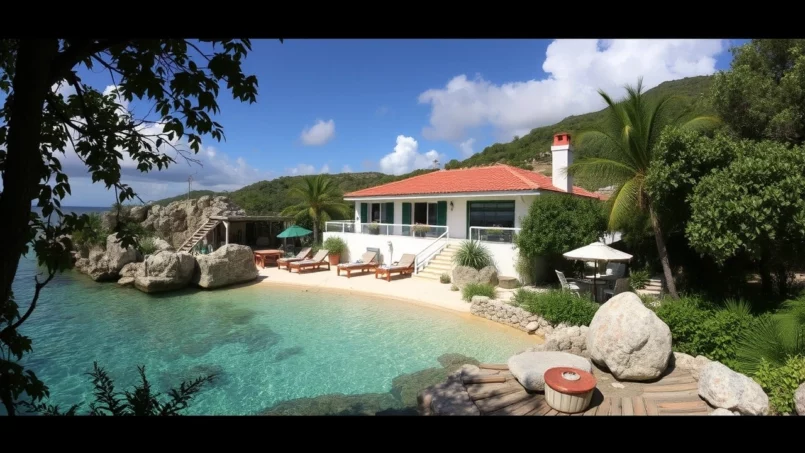
Unpacking your bags facing the turquoise waters of Saint-Barthélemy, descending a few steps to reach a nearly private cove, enjoying a sunset over the bay from your terrace… Behind this postcard lies one of the most exclusive real estate markets on the planet, extremely attractive but also highly codified. Buying a waterfront property in Saint-Barthélemy is not something to be improvised: peak prices, scarcity of land, specific French legal framework, advantageous yet technical taxation.
This guide details the key steps for a successful investment: market analysis, choice of coastal sector, budget, rental yield, acquisition process, risk management, taxation, and structuring options (in your own name or via a company).
Understanding the Saint-Barthélemy Real Estate Market
Saint-Barthélemy is a small island of just eight square miles, in the heart of the French Caribbean. This tiny territory, protected by strict urban planning regulations and non-buildable “green zones,” explains one of the market’s fundamentals: an extremely limited supply of properties facing very strong international demand.
The island attracts an ultra-high-net-worth clientele – industrialists, entrepreneurs, celebrities, mega-yacht owners – drawn by a unique blend of French sophistication and Caribbean ease. The setting is safe, life is peaceful, the climate is tropical, the gastronomy is world-class, and luxury boutiques are concentrated around Gustavia.
The structural imbalance between supply and demand has created a very resilient market, which has weathered external shocks (financial crisis, hurricanes, pandemic) better than other luxury destinations. Prices, among the highest in the Caribbean, follow a long-term appreciation trend, particularly for prime waterfront properties or those with breathtaking views.
A Niche Market, Few Transactions but Very Large Amounts
The number of annual sales remains low on the island’s scale: some sources mention 20 to 30 transactions per year, others around 100. This is very few, which further fuels scarcity. At the same time, each transaction often amounts to millions, even tens of millions of euros.
The main drivers of the market are:
– an almost fixed, heavily regulated land supply;
– sustained international demand, driven by high-end tourism and the destination’s ultra-premium image;
– a French legal framework perceived as very secure;
– attractive local taxation, notably the absence of an annual property tax and income tax for residents;
– exceptional rental potential during the high season.
For a buyer, this means two things: you must be ready to act quickly when a good waterfront property appears, and accept that the room for negotiation is limited, especially in the most sought-after sectors.
Where to Buy on the Waterfront: Tour of Key Coastal Areas
It’s impossible to talk about Saint-Barthélemy without mentioning its beaches: some are accessible in a few steps from villas, others require a hiking trail or a boat. For a “waterfront” purchase, it is crucial to distinguish between direct waterfront, private beach access, a dominant view a few minutes’ walk away, or simply a sea view from a height.
Here is an overview of the main coastal sectors that concentrate the majority of exceptional properties.
Gustavia and Shell Beach: The Urban Waterfront
Gustavia is the capital and the economic and historic heart of the island. Its marina hosts sailboats and superyachts, the streets are home to Louis Vuitton, Hermès, Cartier and a multitude of restaurants along the quay.
For a waterfront purchase in Gustavia, two scenarios emerge:
– apartments or duplexes directly on the harbor front, with direct views of the basin and sometimes Shell Beach, a small shell beach accessible on foot from the center;
– small plots or houses a few dozen meters from the water, extremely rare, ideal for those who want to be able to walk to restaurants, shops, and the beach.
This sector offers fewer very large villas directly on the sand, but concentrates properties with very high symbolic and rental value, especially for a clientele who loves alternating between sea, restaurants, and nightlife without using a car.
Saint-Jean: The Postcard Beach + Liveliness
Saint-Jean is the other major hub of the island: iconic beach, shallow water, windsurfing and snorkeling, beach restaurants (Nikki Beach, Gypsea, Nao Beach), and the famous Eden Rock hotel perched on its rocky spur.
Properties located directly on the waterfront or in immediate proximity to the sea are particularly sought after on the market, which generally translates to higher demand and higher prices for these properties.
– villas in the first row on the beach or perched on the hills immediately overlooking it, offering quick access to the sand;
– apartments in residences like “Les Jardins de St Jean” or “Les Suites du Roi Oscar II,” close to the beach, shops, and restaurants.
A typical example: a villa with five bedrooms, bay view and islets, a few minutes’ walk from the beach and restaurants like Eden Rock, sells for very high amounts and rents extremely well during the high season.
Saint-Jean combines assets: proximity to the airport, chic festive atmosphere, stunning beach. It’s one of the sectors where price pressure is strongest and where you’ll find many iconic villas.
Flamands and the North Coast: Large Beaches and Prestigious Hotels
Flamands is home to the island’s largest beach, lined with white sand, with a sometimes rougher sea. This bay is home to ultra-high-end establishments like the Cheval Blanc hotel, owned by the LVMH group.
Properties on the waterfront or a few steps away:
– luxury villas within walking distance of the beach and Cheval Blanc;
– buildable plots with sea views a few minutes’ walk from the sand.
Several plots and villas mentioned in listings show how this sector has become a sure bet: plots of over 2,500 m² with views and proximity to Cheval Blanc, villas signed by architects like François Pécard, or new residential complex projects.
Flamands Beach is an excellent choice for those seeking a large expanse of sand in a more peaceful setting than Saint-Jean, while being located in a very high-end neighborhood. It thus offers an ideal compromise between tranquility and standing.
Colombier, Marigot, Pointe Milou: The Northwestern and Northeastern Coast of Panoramic Villas
Colombier is famous for its beach accessible only on foot or by boat, sometimes nicknamed the “Rockefeller beach.” Many villas are not directly with their feet in the water but enjoy absolutely spectacular panoramic views of the sea and islets.
In private estates like Domaine de Montjean or Domaine du Levant, or the Domaine du Gouverneur, you find vast properties:
– villas with hectares of land overlooking Marigot Bay, Anse Maréchal, Îlet Tortue;
– properties with private access to the sea or a small beach, like some villas in Marigot with their own strip of sand (35 meters of waterfront for one of them).
Pointe Milou is renowned for its sunsets: villas like “Bel Amour,” “Los Leones,” or “Danse des Étoiles” illustrate these ridge or cliff properties with panoramic views, sometimes with rocky waterfront rather than a beach in the strict sense, but with direct proximity to the ocean.
For a buyer, these sectors offer two categories of waterfront:
– true “waterfront” with direct water access and sometimes private sand;
– the dominant villa a few minutes’ drive from beaches like Lorient, Grand Cul-de-Sac, or Marigot, but offering maximum privacy and a grandiose view.
Lorient, Anse des Cayes, Grand Cul-de-Sac: Surf, Lagoon, and a More Relaxed Vibe
Lorient is a developing village, very popular with surfers. Its beach is protected by a reef, offering different zones: a calm area and an area for surfing. On the waterfront, you find:
Discover the different categories of properties available for a stay with your feet in the water, ranging from prestigious villas to more intimate homes.
Villas located at the end of the bay, literally on the beachfront, sometimes renovated by renowned architects.
Smaller homes but benefiting from direct access to the sand or located just a few dozen meters from the beach.
Anse des Cayes, with its wild beach swept by waves, also attracts surfers. Here too, several prestige villas are a few steps from the water, some designed to enjoy the spectacle of the sea rather than swimming.
Grand Cul-de-Sac, to the east, offers a different configuration: a shallow lagoon, ideal for kitesurfing, paddleboarding, or windsurfing. Numerous beach hotels (Le Sereno, Le Barthélemy, Rosewood Le Guanahani) and villas line the lagoon or are set back immediately. For an investor targeting the surf and water sports market, this is a prime area.
Saline, Gouverneur, Toiny, Petit Cul-de-Sac: The Wilder Coast
Saline and Gouverneur are often cited among the most beautiful beaches in the Caribbean. Very few are built directly on the sand (protection rules are strict); they are rather surrounded by villas perched on the heights with plunging views and beach access a few minutes’ drive away.
Toiny and Petit Cul-de-Sac, on the east and southeast coast, are wilder, with rocky coastline, beaches for surfers, and Atlantic panoramas. You’ll find villas like ENZUMA or Tangara, generously open to the ocean, sometimes within walking distance of a beach frequented by surfers. Here, “waterfront” comes with a feeling of isolation and raw nature.
Summary of Main Coastal Sectors
To get your bearings, we can summarize as follows:
| Sector | Type of Waterfront | Main Atmosphere | Typical Buyer Profile |
|---|---|---|---|
| Gustavia / Shell Beach | Harbor, cove accessible on foot | Chic urban, restaurants, boutiques | Lovers of town life and yachting |
| Saint-Jean | Lively beach, beach clubs | Festive, trendy, very central | Rental investors, families who enjoy animation |
| Flamands | Large beach, 5* hotels | Chic calm, family-friendly | Long-term buyer, seeking beach + tranquility |
| Colombier / Marigot / Pointe Milou | Cliffs, coves, panoramic views, sometimes private beach | Ultra-residential, very exclusive | Ultra-high-end, seeking privacy and views |
| Lorient / Anse des Cayes | Surf beach, more relaxed waterfront | Sporty, authentic village | Surf enthusiasts and less formal atmosphere |
| Grand Cul-de-Sac | Shallow lagoon, beach hotels | Watersports, resort | Investors targeting kitesurf & family clientele |
| Saline / Gouverneur / Toiny / Petit Cul-de-Sac | Preserved beaches, wild coasts | Nature, discretion, spectacular landscapes | Buyers in search of tranquility and grandiose scenery |
Prices, Budgets, and Concrete Examples on the Waterfront
Prices in Saint-Barthélemy are among the highest in the entire Caribbean region. For a waterfront property or one with a prime sea view, you must start at a very advanced level.
General Price Ranges
Collected data shows several indicative levels:
This is the average price in millions of euros for a standard villa in Saint-Barthélemy, often with a sea view.
Some recent transactions or listings give an idea of the peaks reached:
| Type of Property (examples) | Location | Key Features | Indicative Price |
|---|---|---|---|
| 5-bedroom villa, sea view, bayfront | Waterfront, prestige | Mentioned in major international magazines | ≈ $26.8M |
| Villa Blue Dragon | Above Gouverneur | 7 bedrooms, infinity pool, fitness | ≈ $61.6M |
| Villa Linda (7 bedrooms, waterfront, private beach) | Marigot | 35 m of waterfront | ≈ €19.5M |
| Villa Neo | Saint-Jean | 1,339 m², 8 bedrooms, 6 bathrooms | ≈ €47M |
| Villa K | Anse des Cayes | 5 bedrooms, 4 bathrooms, 638 m² | ≈ €19.8M |
| Casa del Mar | Petit Cul-de-Sac | 7 bedrooms, 6 bathrooms | ≈ €17M |
| Villa Danse des Étoiles | Pointe Milou | 6 bedrooms, 5 bathrooms | ≈ €15.98M |
Even more “modest” homes compared to these icons, like a 2 to 3-bedroom villa with sea view and pool, frequently exceed $4 to $7 million.
The price per square meter reflects this tension:
– starting floor around €6,500/m² across the entire island (often not on the coast);
– average around €34,000/m²;
– peaks exceeding €70,000/m² for exceptional sectors.
In the most prestigious coastal areas, real estate prices generally reach the top of the value range, and can even exceed it for properties considered truly unique.
Total Acquisition Cost: Don’t Forget Additional Fees
In addition to the sale price, the buyer must add transaction fees, overall around 6 to 7% of the price, which cover:
– registration/transfer tax (approx. 5 to 6%);
– notary fees (often 1 to 3%, depending on a regressive scale);
– some administrative fees and, if applicable, translation fees.
An indicative summary:
| Cost Element | Who Pays? | Order of Magnitude |
|---|---|---|
| Sale Price | Buyer | Basis of the transaction |
| Transfer/Registration Duty | Buyer | ≈ 5–6% of price |
| Notary Fees | Buyer | ≈ 1–3% of price (incl. in 6–7% overall) |
| Agency Commission | Seller | Up to 5–6%, included in asking price |
| Mandatory Technical Diagnostics | Seller | A few thousand euros |
| Sworn Translations (if needed) | Buyer/Seller | Variable |
A waterfront villa project listed, for example, at €10 million will therefore involve:
– approximately €10.6 to €10.7 million to be committed by the buyer (price + fees);
– plus potential costs for renovation, furnishing, landscaping, etc.
Rental Potential of Waterfront Properties
A significant portion of waterfront buyers in Saint-Barthélemy also aim, at least partially, for seasonal rental. On this point, the island is particularly attractive.
Exceptional Weekly Rentals
The combination of a wealthy global clientele, a very marked high season (especially around Christmas and New Year), and a limited stock of prestige villas results in impressive rental levels:
– some villas rent for over $100,000 per week during the New Year period;
– “classic” waterfront villas already rent for $20,000, $30,000, $40,000 per week in high season, depending on size and location;
– even in mid-season, weekly rates remain well above most competing destinations.
In the best cases, rental yields for well-managed waterfront properties can reach 7.5%.
A Market Highly Managed by Agencies and Managers
Most seasonal rentals go through specialized agencies: St Barth Properties, Sibarth, Le Barth Villa Rental, RE/MAX St Barths, Saint Barth Lifestyle, etc. These players offer:
– international marketing of the villa;
– concierge service (arrivals, transfers, private chefs, boat trips, spa, etc.);
– house supervision (maintenance, cleaning, garden, pool, minor repairs);
– management of the tourist tax (5% on tourist accommodations);
– 24/7 assistance to tenants.
In return, rental management fees often range between 20 and 30% of rental income. This is a cost to factor in from the business plan phase, but it is difficult to reduce if targeting a demanding high-end clientele.
Impact of Waterfront Location on Profitability
For rentals, location on the map plays a huge role:
In Saint-Barthélemy, a villa’s rental price is heavily impacted by its location and access. An exceptional view of the beach (Saint-Jean, Flamands) or ocean (Pointe Milou) generates significant added value compared to a property without a view. Immediate proximity to a lagoon, like Grand Cul-de-Sac for water sports, increases appeal for families. Finally, private access to the sea, even on a rocky cove, is a decisive argument for a niche clientele.
Conversely, some very luxurious hillside villas can offer better privacy, but with a comparable or even higher rental price level, if the view and architecture are spectacular. “Waterfront” must therefore be weighed against:
– quality of the view;
– acoustic privacy (lapping waves vs. road noise);
– ease of access to the beach (on foot, by car, by boat);
– exposure to wind and sea spray.
The Step-by-Step Purchase Process
Despite the sophistication of the amounts and structures, the acquisition process itself is governed by French law and described as relatively linear, provided you are well accompanied.
1. Define Your Strategy and Requirements
Before starting viewings, it’s useful to clarify:
– overall budget (price + 6–7% fees + margin for work, furnishing, management);
– priority: second home for personal use, rental investment, or a mix of both;
– degree of requirement for waterfront: feet in the sand, private access, dominant view a few minutes away, harbor front, etc.;
– size (number of bedrooms), architectural style, presence of a pool, garden, parking, outbuildings.
The more precise the requirements, the more the agent can target relevant properties in a market where visible supply is limited and many properties circulate “off-market.”
2. Rely on a Local Agency and Specialized Advice
Faced with a multitude of agencies (RE/MAX St Barths, St. Barth Sotheby’s International Realty, BARNES Saint-Barth, Sibarth Real Estates, Coldwell Banker St Barth, etc.), it is recommended to:
To choose your real estate agency well, prioritize a serious and well-established firm with a good local network. Ensure you have a dedicated contact who accompanies you from the first contact until signing. Finally, verify that the agency masters aspects related to both purchase and resale and rental.
In parallel, for a significant investment, surround yourself with:
– a tax lawyer or structuring advisor (SCI, commercial company, direct ownership, etc.);
– potentially an architect or engineer expert to assess transformation potential, compliance, and risks.
3. Search, Visit, Make an Offer
Properties are identified via:
– agency and platform catalogs (some, like Propriétés de Charme, aggregate listings from agencies and private sellers);
– a “discreet” portfolio of unpublished offers, accessible through professionals;
– sometimes personal networks.
Once a coastal property is deemed interesting, the agent formalizes an offer, often in the form of a letter of intent to purchase. In a seller’s market, an offer without a financing contingency is generally better received.
4. The Preliminary Agreement / Promise: The Pre-contract at the Notary
After agreeing on the price, the file goes to the notary. In Saint-Barthélemy, the intervention of a notary (French notary) is mandatory for any real estate sale. This is a public officer:
The notary is a neutral public officer bound by confidentiality, guaranteeing the legality of the transaction. Their main missions are to verify the ownership title, the absence of undisclosed easements, and unpaid mortgage debts. They are also responsible for drafting the preliminary agreement and the final deed of sale, as well as calculating and collecting due taxes and duties.
The pre-contract (promise or sales agreement):
– outlines the sale conditions (price, deadlines, any contingencies, description of the property, list of diagnostics, origin of ownership);
– generally requires 4 to 8 weeks of preparation, depending on the speed of document production by the parties and administrations.
Upon signing, the buyer pays a deposit, usually 10% of the sale price, into the notary’s escrow account. For a non-professional, a 10-day withdrawal period applies from receipt of the signed pre-contract.
5. Verification Period and Preemption Right
Between signing the preliminary agreement and the final deed, the notary conducts the “due diligence”:
Before purchasing real estate in Saint-Barthélemy, it is crucial to perform several checks: consult the land registry for old mortgages or seizures, examine urban planning documents (zoning, easements, protected natural areas), verify compliance of building permits and previous works, and inquire with the Collectivity about its possible right of preemption.
This phase lasts at least two to three months. The total time between submitting the offer and the final signing is generally around 4 to 6 months, longer if the deed is conditional on obtaining bank financing.
6. Signing of the Final Deed and Property Transfer
Once verifications are complete and funds are transferred to the notary’s account (remaining price due + fees), the deed of sale is signed. The buyer’s physical presence is not mandatory: an authenticated power of attorney can be given to a representative.
The notary:
– reads and explains the deed, details the legal and tax consequences;
– collects signatures;
– releases funds to the seller;
– proceeds with the publication of the transfer in the land registry, which formalizes the property transfer.
From this date, the buyer officially becomes the owner of their waterfront villa.
Legal Specificities and Mandatory Diagnostics
The applicable framework is that of French law, but with specificities particular to the Collectivity of Saint-Barthélemy, especially on the tax front.
Technical Diagnostics at the Seller’s Expense
Before signing the pre-contract, the seller must provide a number of diagnostics:
– electricity: compliance check of the interior installation (valid for 3 years);
– gas: compliance check of the interior installation (valid for 3 years);
– termites: pest report (valid for 3 months);
– asbestos: for properties whose building permit predates July 1, 1997;
– individual sanitation: compliance of the septic tank or treatment system (valid for 3 years).
Unlike mainland France, the energy performance diagnosis (DPE) is not yet mandatory in Saint-Barthélemy, nor is a generalized structural diagnosis. In practice, for a multi-million euro waterfront villa, many buyers still commission an independent survey (structure, leaks, corrosion from sea spray, etc.) for protection.
Urban Planning, Green Zones, and Construction Constraints
The island has a local urban plan with very strict zones:
In certain zones, notably natural or ‘green zones,’ all construction is prohibited. Buildable area, volume, height, and sometimes colors or materials of buildings are limited to preserve the Caribbean aesthetic. Specific protections also apply in certain coastal sectors for environmental reasons.
For the purchase of waterfront land, or for a major transformation project of an existing villa, an in-depth study of these rules is essential before committing. It is necessary in particular to:
– verify that the property is not in a non-buildable zone;
– examine neighboring or planned projects (hotels, new villas);
– check easements for passage, beach access, service roads, etc.
Taxation: An Attractive Yet Technical Environment
The appeal of Saint-Barthélemy also lies in its particular taxation. However, one must distinguish between:
– local taxation (Collectivity of Saint-Barthélemy);
– the potential application of other French rules (notably regarding capital gains or social contributions);
– the taxation of the buyer’s country of residence.
What Does Not Exist or Exists Only Minimally
Several elements work in favor of property owners:
– no classic annual property tax on real estate;
– no local income tax or real estate wealth tax for residents, under certain residency conditions;
– no local VAT on most real estate income for individuals;
– absence of local tax on rental income: rents are not taxed on the island, even if the country of residence may tax them;
– no local inheritance tax on assets located in Saint-Barthélemy.
Acquisition and Resale Taxes
On purchase:
– payment of a registration duty (or transfer tax) of approximately 5 to 6% of the price;
– notary fees and charges included in the 6–7% overall fees.
On resale:
The capital gains tax on real estate applies a rate of 35% if the resale occurs within the first eight years of ownership, then 20% thereafter. After eight years, a 10% reduction per additional year reduces the taxable base. The capital gain is calculated on the difference between the sale price and the acquisition price, increased by justified fees and investments. Unlike mainland France, the sale of a primary residence may remain taxable in Saint-Barthélemy.
Beyond local rules, non-resident sellers may be subject to a social contribution (17.2%) in France on the capital gain, depending on their tax situation. Again, specialized advice is essential.
Rental Taxation
Income from seasonal rentals is not taxed by the Collectivity. However:
– a tourist tax of 5% applies on paid overnight stays (hotels, rented villas, etc.), generally collected and remitted by the agency or owner;
– the country of fiscal residence of the owner may consider this income taxable, sometimes under bilateral tax treaties.
Direct Ownership or Via a Company: The SCI Option
For high amounts, many buyers consider: the acquisition of real estate, works of art, or luxury cars.
– direct ownership in one’s own name;
– the creation of a structure, often a Société Civile Immobilière (SCI – French Civil Real Estate Company) under French law.
The Société Civile Immobilière (SCI) is a civil company for asset-holding purposes. It notably allows for the joint holding and management of real estate assets, thus facilitating estate planning, rental management, and offering flexibility in the distribution of shares among partners. For example, a family can create an SCI to acquire and manage a rental building, thereby separating professional assets from personal assets and optimizing transmission to heirs.
– to purchase with others (family, partners) in a structured way, each receiving shares instead of an undivided fractional interest;
– to organize the transmission to children by benefiting from gift allowances, by splitting the gift of shares every 15 years for example;
– to separate usufruct (right of use) and bare ownership to protect a spouse or partner;
– to facilitate financing and management structures, especially when combining an SCI (holding the building) and a commercial company like an SARL for the furnished rental activity.
The drawbacks:
– formation cost (approximately €1,500 to €3,000 in addition to notary fees);
– legal formalities (French-language articles of association, meetings, accounting);
– potentially more complex taxation (choice between transparency for income tax or corporate income tax, with effects on capital gains and dividend distribution);
– need to verify how the SCI shares will be treated by the investor’s country of residence.
For acquisitions above €500,000, practitioners often consider the SCI as an option to seriously study, especially in the presence of a family estate planning project.
Financing: Mostly Cash, Some Mortgages
The Saint-Barthélemy market is largely dominated by cash purchases. Local banks offer financing, but very selectively, especially for non-residents.
Possible options:
For international buyers, several financing avenues are possible for acquiring property in France, each with its specific conditions.
Loans from French mainland banks, for buyers who already have a solid banking history in France.
Recourse to private banks, often conditional on opening a wealth management relationship and depositing assets under management.
Financing in the buyer’s country of residence, using other assets as collateral.
In all cases, a purchase offer not contingent on obtaining a loan remains more attractive to the seller, especially for a highly coveted waterfront property.
Recurring Costs and Management of a Waterfront Villa
The absence of an annual property tax does not mean ownership is without cost. On the contrary, a coastal villa requires careful maintenance, all the more so as the sea and salt spray accelerate wear and tear.
Among the costs to anticipate:
To maintain a property in the Antilles, it is essential to budget for several expense and management items. Comprehensive home insurance, covering natural risks (like hurricanes), theft, and civil liability, is indispensable. Routine villa maintenance includes painting, joinery, air conditioning, and home automation systems. The exterior requires garden and pool upkeep, as well as anti-corrosion treatments for metal structures exposed to the marine climate. If the property is rented, rental management fees must be included: concierge, cleaning, marketing, and maintenance. Finally, for an apartment or residence, co-ownership fees should be added.
Companies like St Barth Villa Services or Ici et La Villas manage all or part of these aspects on behalf of owners (maintenance, household staff, work supervision, guest reception), for fees adapted to the chosen service level.
Specific Risks to Consider
Investing several million in a waterfront villa also requires identifying the risks:
Main risks include climatic hazards (cyclones, swells, sea level rise), evolving environmental regulations, dependence on high-end tourism sensitive to crises, a high cost of living and construction with extended delays, and legal risks related to verifying property titles.
A good portion of these risks can be mitigated by:
– using an experienced notary on the island;
– additional diagnostics and surveys;
– a detailed study of the rental market to calibrate the project (rates, occupancy rate, client profile).
Residency, Stay, and Island Access
Even though many owners only reside for a few weeks or months per year on the island, it’s useful to know the stay rules:
– EU/EEA citizens: can stay without a visa for an unlimited duration;
– citizens of the United States, Canada, and several Caribbean/Latin American countries: visa-free stays of up to three months;
– for a longer stay, you must apply for a long-stay visa at a French consulate, proving sufficient resources.
After five years of continuous legal residence in France, it is possible to apply for a residence card, or even naturalization. These procedures are subject to conditions, notably proficiency in the French language and integration criteria.
Regarding access, Gustaf III airport does not host direct transatlantic flights. You reach Saint-Barthélemy via:
– Saint-Martin (flight of about 10 minutes);
– Antigua (about 35 minutes);
– Guadeloupe (about 45 minutes);
– San Juan (Puerto Rico, about 1 hour 15 minutes).
Boat shuttles and yachts complete the options, which maintains the image of a confidential island, somewhat difficult to access, therefore protected.
In Summary: How to Approach a Waterfront Purchase in Saint-Barthélemy
Buying a waterfront property in Saint-Barthélemy means entering a market where:
– supply is extremely rare, prices are very high, but the patrimonial value is solid;
– the legal environment is that of French law, with a notary guaranteeing the transaction’s security;
– local taxation offers real advantages (no annual property tax, attractive framework for residents, rental income not taxed locally);
– the rental potential, especially during the ultra-season, can be exceptional, particularly for the best-located and well-managed properties.
To maximize your chances of success, it is recommended to:
For a successful real estate investment in Saint-Barthélemy, it is crucial to: clarify your project (personal use, rental, resale) and your overall budget including price, fees, works, and management; choose a coastal sector suited to your lifestyle (Saint-Jean’s liveliness, Flamands’ calm, Pointe Milou or Colombier’s panoramas, Grand Cul-de-Sac’s lagoon, or the iconic beaches of Saline and Gouverneur); surround yourself with an experienced local agency, a notary specialized in high-end properties and, for significant amounts, a tax/legal advisor for the holding structure; finally, do not underestimate diagnostics, urban planning constraints, climatic risks, and the demanding maintenance of a waterfront villa.
For those who accept these constraints and this complexity, Saint-Barthélemy offers one of the rare opportunities in the world to own a pied-à-terre literally on the edge of a turquoise sea in a micro-market of grand luxury, both a patrimonial refuge and a gateway to a unique Caribbean art de vivre.
Disclaimer: The information provided on this website is for informational purposes only and does not constitute financial, legal, or professional advice. We encourage you to consult qualified experts before making any investment, real estate, or expatriation decisions. Although we strive to maintain up-to-date and accurate information, we do not guarantee the completeness, accuracy, or timeliness of the proposed content. As investment and expatriation involve risks, we disclaim any liability for potential losses or damages arising from the use of this site. Your use of this site confirms your acceptance of these terms and your understanding of the associated risks.

Cyril Jarnias is an independent expert in international wealth management with over 20 years of experience. As an expatriate himself, he is dedicated to helping individuals and business leaders build, protect, and pass on their wealth with complete peace of mind.
On his website, cyriljarnias.com, he shares his expertise on international real estate, offshore company formation, and expatriation.
Thanks to his expertise, he offers sound advice to optimize his clients' wealth management. Cyril Jarnias is also recognized for his appearances in many prestigious media outlets such as BFM Business, les Français de l’étranger, Le Figaro, Les Echos, and Mieux vivre votre argent, where he shares his knowledge and know-how in wealth management.





