
 Published on and written by Cyril Jarnias
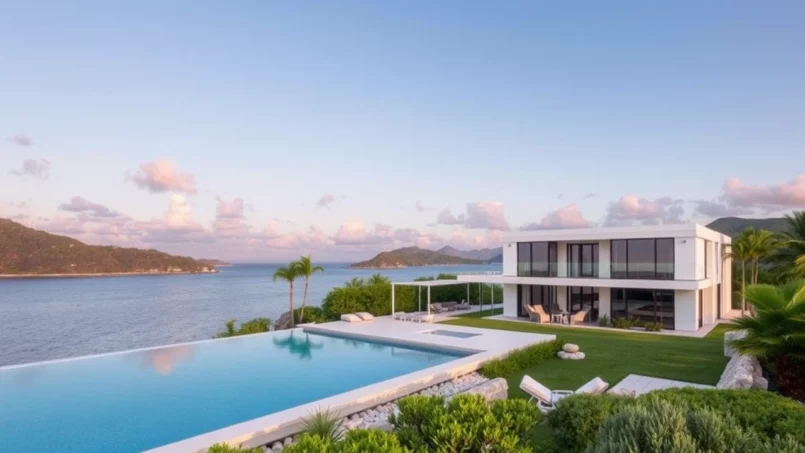
Long reserved for a select few, the real estate market in Saint Barthélemy is now one of the most expensive and closed markets in the world. After a decade of spectacular growth, marked by the shocks of Irma and then Covid, the island is entering a new phase: the excesses of the post-pandemic boom are fading, without calling into question a solid valuation trajectory driven by land scarcity, ultra-luxury tourism, and a unique tax framework.
The market is rebalancing across its segments, with sales timelines lengthening for the ultra-high-end. Resale supply for properties built after 2017 is increasing, while regulatory pressures and social tensions over housing are intensifying. This micro-market blends rental yield calculations, moderate speculation, and very long-term wealth preservation strategies.
A market shifting from frenzy to accepted stability
For several years, Saint Barthélemy lived through a veritable buying frenzy. After Hurricane Irma in 2017, the island surprised with its speed of reconstruction, reassuring investors. Prices, initially corrected by about 22% between 2017 and 2018, quickly rebounded, reaching about 30% above their pre-Irma levels by 2019.
Over ten years, the price per square meter has increased by approximately 70% in Saint Barthélemy.
However, from mid-December 2022, the market moved out of its “frenzied boom” phase and into what professionals describe as a new equilibrium. The wave of sharp price increases is over, transactions have temporarily become rarer, and sales timelines have lengthened, especially for the most expensive properties. But the underlying trend hasn’t reversed: demand structurally exceeds supply, and projections now point to long-term annual value growth of between 8 and 10%, rather than the double-digit surges seen after Irma and during Covid.
Proven resilience in the face of crises
This repositioning should not overshadow the island’s capacity to weather economic storms. During the 2008 financial crisis, prices did not fall. After Irma, the rebound was lightning fast. During the 2020 pandemic shock, while many destinations floundered, Saint Barthélemy set transaction records. Prices per square meter, already among the highest in the world, continued to rise.
The Monaco real estate market withstands crises due to its confined territory (21-25 km²), which mechanically limits supply. Its status as an overseas collectivity grants it significant fiscal and urban planning autonomy. It also benefits from a protective legal framework (French and European law) and an ultra-wealthy international clientele, largely insensitive to interest rates or classic economic cycles.
Market segments moving at different paces
While people often speak of “the” Saint Barthélemy market, the reality is more nuanced. Not all segments are evolving at the same pace, and the current stabilization phase highlights marked differences depending on price ranges.
Ultra-luxury: More time, slight adjustments
Villas and estates above 10 million euros, and even up to 50–60 million for the most spectacular properties, are the first to show signs of relative slowdown. Where a villa over 10 million would find a buyer in about twelve months not long ago, it now often takes nearly two years to close a sale. In this segment, price adjustments on the order of 12 to 20% are observed for properties lingering on the market.
For properties between 5 and 10 million euros, sales timelines are lengthening and negotiation is more pronounced, without signs of a market reversal. This segment remains illiquid, with a global but very limited pool of potential buyers, making most transactions discreet, even confidential.
Core market: Family villas and properties between 2.5 and 5 million
Conversely, the segment between 2.5 and 5 million euros appears much more fluid. The median sales time stabilizes around four months, reflecting a healthier balance between still-limited supply and solid demand, mainly from European and North American buyers seeking a second home with 3 or 4 bedrooms, a pool, and a sea view.
This core market includes some of the island’s “typical” family villas, priced in single-digit millions of euros – often in the middle or upper end of the range depending on location. In these price ranges, upward pressure on values is less spectacular than during the post-Covid boom, but progress remains steady. Experts also anticipate annual appreciation on the order of 8 to 10% in the coming years.
Relative entry-level: Studios, small apartments, and properties under 2.5 million
Below 2.5 million euros, the situation is paradoxical. On one hand, the island saw an influx of new properties for sale in this segment in 2022, pushing the average marketing time from about 4.5 to 11 months. On the other, prices remain stratospheric by international standards: a simple studio or one-bedroom condo revolves around 1 to 2 million euros, and a 56 m² two-room apartment in Gustavia was offered off-plan for over 3.1 million.
This “entry-level” is therefore entirely relative, even for very wealthy buyers. It mainly illustrates the strong market segmentation between properties accessible to the international ultra-rich on one side, and a chronic shortage of truly affordable housing for workers and permanent residents on the other.
Luxury real estate market analysis
Overview of values and surface areas
To measure the extent of price levels reached, a quick look at the selling price ranges is enough.
| Property Type / Segment | Typical Price Level (approx.) |
|---|---|
| Studio / 1-bedroom condo | €1 to 2 M |
| 2-bedroom apartment (e.g., Gustavia, 56 m²) | ≈ €3.15 M off-plan |
| 3–4 bedroom family villa | Single-digit millions of euros (mid/high range) |
| Luxury villas in prime sectors | €15,000 to 25,000/m² (and more) |
| Mainstream high-end market | €20,000 to 30,000/m², sometimes beyond |
| Grand prestige estates | €15 to 60 M |
| Iconic record (Rockefeller estate) | ≈ €135 M (April 2023) |
In this context, it is not surprising that observers now compare Saint Barthélemy to Monaco, Capri, or Saint-Tropez rather than to other Caribbean islands.
Transactions: More volatile volume than it seems
Recent volume trends highlight another specificity: in such a small market, a few exceptional sales can change the entire complexion of a year.
In 2021, 113 transactions were recorded, for a total amount exceeding 500 million euros. In 2022, the number of sales fell to 95, then to 70 in 2023. Yet the total amount remained close to the 2021 peaks, largely thanks to the sale of the mythical Rockefeller estate in Colombier, at around 135 million euros, accounting for nearly 20% of the annual volume by itself.
In 2024, the number of transactions in the luxury real estate segment rose to 94, confirming renewed dynamism.
This apparent volatility does not call into question the overarching trend: as a whole, the market is described as robust, exclusive, and mature, with growth now more measured but firmly established.
Key figures on recent volumes
| Year / Period | Number of Transactions | Key Insight |
|---|---|---|
| 2021 | 113 | Total volume > €500 M |
| 2022 | 95 | Slowdown after post-Covid peak |
| 2023 | 70 | Fewer deeds, but volume preserved thanks to mega-sales |
| 2024 | 94 | Transaction rebound |
| 1st half of 2024–2025 season | n.a. | Volume doubled for some market leaders |
| 1st half of 2025 (Sibarth) | 3 sales ≥ €30 M | Ultra-prime segments still very active |
A rare supply that is opening up… slightly
The foundation of Saint Barthélemy’s real estate economic model is scarcity. The island is only about twenty square kilometers, slopes are sometimes steep, buildable zones are strictly regulated by the local urban plan, and the Collectivité blocks projects deemed too massive or aggressive for the landscape. Result: most of the time, demand far exceeds supply.
It is currently estimated that there are officially only around forty villas available for sale, plus about twenty “off-market” properties negotiated in complete discretion. Land plots are even rarer, with prices easily exceeding €1,000/m² for the few quality parcels.
The “End of Irma Cycle” effect
This structural lack of supply will, however, be partially mitigated by a phenomenon very specific to the current cycle. The wave of reconstructions and new constructions following Hurricane Irma produced a significant stock of new houses between 2017 and 2018. However, the Collectivité tightened real estate capital gains taxation as early as May 2017: taxation increased from 20% to 35% for the first eight years of ownership, before reverting to the more standard French regime.
A large portion of villas built or purchased after Hurricane Irma reach their tax maturity around 2024–2025, making them suddenly more interesting to resell. Consequently, the stock of houses built after 2017, particularly those with two or three bedrooms and a sea view, is starting to reappear on the market.
In 2018, nearly 90% of villas offered were new; by the end of 2020, they represented only 35% of the supply, and about 20% of transactions today. The resale movement of recent properties should therefore help feed the market in the coming years, without being enough to fill the structural supply deficit.
Public policy: Curbing speculation, preserving the living environment
Faced with real estate pressure and an acute housing crisis for residents and seasonal workers, the Collectivité of Saint Barthélemy has tightened its policy. In addition to strengthening taxation on quick sales, it has suspended the issuance of new building permits for major luxury projects, with a dual objective: slowing down economic development deemed too rapid, and focusing efforts on housing for inhabitants.
New measures aimed at regulating construction and preserving coastal areas in the face of environmental challenges.
Authorities now limit the construction of giant villas and impose footprints better integrated into the landscape.
Strengthened environmental impact studies are now mandatory for new projects.
Consideration of tightening regulations in coastal zones in the face of rising sea level risks.
Permits remain possible on some seafronts, but with a clear orientation toward preservation.
The spirit of the new rules clearly leans toward preserving beaches and the coastline.
This political choice has a direct effect on the market: by curbing new, very high-end supply, it maintains scarcity in the already most expensive segment, while encouraging owners to renovate and bring existing properties back to market, whether for sale or long-term rental.
A unique tax framework, tailored for ultra-high net worth individuals
Saint Barthélemy also attracts for what it does not tax. On the island, there is no annual property tax, no local real estate wealth tax, and no income tax for individuals fiscally domiciled on the island for at least five years. Rents received locally are not taxed by the Collectivité.
Upon purchase, transaction fees (transfer duties, notary fees, and ancillary costs) represent approximately 6 to 7% of the price. Upon resale, for a non-resident, France applies a 35% tax on capital gains if the holding period is less than eight years. Beyond this period, the regime reverts to standard French law, with progressive exemptions.
For long-term residents, the rules are more lenient: after five years of tax residence on the island, there is no longer any local tax on capital gains, income, or wealth, under certain conditions. This combination of monetary stability (euro), absence of recurring taxes, and local political control makes it a highly sought-after wealth preservation tool for international fortunes, more than a playground for investors seeking high cash flow.
Who buys and who owns in Saint Barthélemy?
The profile of owners reflects this wealth preservation logic. About 30% of villas belong to local residents, 40% to French from the mainland, and 25% to Americans. In terms of recent buyers, Europeans (European Union and United Kingdom) represent about 55%, Americans 35%, and the remaining 10% are spread among other very wealthy nationalities.
In 2023, Saint Barthélemy welcomed approximately 292,000 visitors, a 10% annual increase, with a majority coming from North America.
In the Airbnb-type seasonal rental market, the clientele is also overwhelmingly international: 86% foreign visitors, including over 60% US nationals and nearly 15% French. Half belong to post-2000 generations, proof that the island’s appeal is renewing itself among young ultra-wealthy individuals.
Seasonal rentals: A pillar of the economic model
Behind the “second home” facade, a large portion of villas actually operate as true micro-hotel businesses. There are approximately 1,000 villas available for rent on the island, with 650 clearly positioned in the luxury segment and managed by some 70 specialized agencies. The remaining 300, more modest, often go through Airbnb or are offered directly by their owners.
Among the highest rents in the Caribbean
Rental incomes are dizzying: ultra-high-end villas regularly rent for between $20,000 and $50,000 per week in high season, with some exceeding $80,000. During New Year’s week, iconic properties directly on the seafront can reach or exceed $100,000 weekly. A five-bedroom villa in Saint-Jean is thus listed at €75,000 per week in peak season.
The top 10% of highest-performing properties on Airbnb generate over $23,000 in monthly revenue.
Even more modest apartments hold their own: a well-located condo can generate €3,000 to €6,000 per week, while medium-sized houses typically rent for between €8,000 and €50,000 per week, depending on season, view, and included services.
A highly structured and professionalized market
Unlike other destinations, seasonal rentals are heavily regulated. An authorization regime exists, and hosts are subject to the tourist tax. Most owners entrust their property to a local agency that handles not only marketing but also management: maintenance, concierge, daily housekeeping, transfers, private chefs, drivers, babysitters, yacht rentals, event organization…
On Airbnb-type platforms, the vast majority of listings are for entire homes.
Yield: Modest in percentage, powerful in absolute value
As a percentage of purchase price, gross yields are rather around 2 to 4%, which seems low compared to other emerging markets. But these percentages apply to values of several million euros: a 3% annual yield on a €10 million villa still represents €300,000 in gross rents, often enough to cover maintenance, staff, insurance, management fees, and periodic renovation work.
For buyers primarily motivated by capital preservation and personal use, this ability to have the tourist market shoulder part of the holding costs is a compelling argument.
Flagship neighborhoods: A highly segmented geography
The renown of Saint Barthélemy also rests on the diversity of its micro-markets, each with its own ambiance, codes, and price levels.
Gustavia, the capital, concentrates the marina, luxury boutiques (Louis Vuitton, Hermès, Cartier), gourmet restaurants, nightlife, and apartments with direct views of the harbor. Built density is highest here, and the scarcity of space explains the exceptional prices for rare buildable plots or penthouses with terraces.
The Saint-Jean neighborhood, with its iconic bay, the Eden Rock hotel, and Nikki Beach club, offers a chic beachfront atmosphere much in demand. It is particularly sought after for its beach-proximate villas, within walking distance of restaurants and shops. It also features high-end seasonal rental references, like villa BOM.
Pointe Milou embodies the dream of a villa suspended over the ocean, with 180° sunsets. This ultra-exclusive residential enclave lines up spectacular properties like Danse des Étoiles or Villa Caramba, whose prices and rents reflect the quality of the view and level of privacy.
Flamands stands out for its long beach and luxury establishments like Cheval Blanc (LVMH), offering high-end hotels, beachfront villas, and hillside houses. The neighborhoods of Gouverneur, Saline, and Colombier emphasize exclusivity with sparsely built beaches, sometimes pedestrian or maritime access, open views, and prestigious estates, like the former Rockefeller property in Colombier, reaching exceptional valuations.
Lorient, Vitet, Toiny, Grand and Petit Cul-de-Sac play a different tune: more village-like atmosphere, surf spots, intimate hotels like Le Barthélemy, contemporary villas on the heights, lagoons suitable for kitesurfing. Marigot, Anse des Cayes, Grand Fond, or Corossol complete the picture, each with its own balance between authenticity, sea view, and development of new properties.
Post-Irma architecture: Between sustainable luxury and hurricane standards
The passage of Irma profoundly transformed the island’s architecture. Reconstructions were done according to rigorous hurricane standards: reinforced structures, resistant materials, redesigned roofs, strengthened anchors. This constraint paradoxically served as a catalyst for a new generation of villas where “sustainable luxury” is no longer a marketing slogan but a set of specifications.
New constructions now integrate sustainable equipment like solar panels, rainwater recovery systems, high-performance glazing, and enhanced insulation. Their orientation is optimized for natural ventilation, reducing the need for air conditioning. The urban planning code also mandates the installation of traditional cisterns, often carved into rock, to compensate for pressure on desalinated water production, which reaches about 4,000 m³ per day and proves insufficient during high season.
Sustainability, a new value criterion
At the pinnacle of the international market, studies show that wealthy buyers are willing to pay more for eco-responsible housing: non-toxic materials, optimized energy consumption, advanced home automation, etc. In Saint Barthélemy, this trend translates into the growing success of villas combining contemporary design, European standards, and concrete environmental features.
For an investor, these characteristics are not just an image argument: a better-insulated house, equipped with solar panels and water recovery systems, reduces its energy costs, preserves the island’s limited resources, and avoids heavy medium-term work. On the scale of a multi-million euro asset, the difference in operating costs over ten or fifteen years becomes significant.
This real estate golden age, however, has a downside. The soaring prices do not spare residents’ daily lives: astronomical long-term rents, scarcity of standard leases in favor of tourist rentals, sharply rising cost of living in restaurants and supermarkets, difficulty for employees, seasonal workers, and even some self-employed individuals to find decent housing.
Local authorities warn of a risk of depopulation and uprooting of inhabitants, necessitating actions to rebalance the situation. Considered measures, such as suspending major building permits, reorienting supply toward housing for residents, and strengthening coastal regulations, aim to jointly address social and environmental challenges.
For now, these tensions have not dampened demand from the ultra-wealthy, but they clearly condition future urban planning policy directions and, in the long run, the shape that real estate growth will take on the island.
Investing in Saint Barthélemy today: For whom, for what, how?
Given price levels and the tax structure, Saint Barthélemy is not a market for opportunistic investors. It is aimed at buyers who already have substantial assets, seeking above all to:
– secure a portion of their assets in a highly resilient euro market;
– personally enjoy a second home in an ultra-privileged destination;
– cover part of the costs thanks to very high-level rental income.
A regulated but clear purchasing process
The legal framework is that of the French Civil Code, adapted to the local context. Transactions take place under the supervision of a notary, who ensures title checks, registers the sale in the French land registry, and secures the signing. Most purchases are made in full ownership; there is no residency requirement to acquire a property.
The classic process includes: search via an agency, receiving an offer, signing a preliminary contract (compromis) or promise to sell, paying a deposit of about 10%, an instruction period of 60 to 90 days, then signing the authentic deed and paying the balance. Ancillary fees (notary and transfer duties) typically amount to 6–8% of the purchase price.
For non-residents, obtaining local financing is possible but limited; many opt for a loan from their country of residence, or simply for an all-cash purchase.
A long, even very long holding horizon
The tightening of capital gains tax in the first decade of ownership and the low liquidity of the ultra-luxury segment make rapid rotation strategies irrelevant. Professionals instead consider that Saint Barthélemy lends itself to a horizon of 10, 15, or 20 years, or even to a family succession logic.
In the long term, an annual growth rate of 8 to 10%, coupled with rental income covering current expenses, makes it a powerful tool for capital appreciation and protection. However, this investment carries major risks: very high concentration of risk in a micro-territory and significant exposure to climatic hazards.
An island that wants to remain rare, expensive… and livable
The Saint Barthélemy real estate market is thus at a turning point. On one hand, all the fundamentals that made its success remain in place: land scarcity, unique tourist appeal, protective legislation, advantageous taxation for residents, abundant international clientele, resilience to crises. On the other, the Collectivité is trying to curb the excesses of a system that has become almost too successful, at the risk of sacrificing the territory’s soul.
Recent signals indicate an evolution toward a slower, more selective growth model: lengthening sales timelines in the very high-end, price stabilization, return of post-Hurricane Irma villas to the market, and regulatory tightening. The island remains a highly sought-after destination for the ultra-wealthy, while paying increased attention to its environment and inhabitants.
For investors capable of supporting entry tickets of several million euros, the message is clear: Saint Barthélemy is not the place to look for the best gross yield, but one of the rare places where luxury, stability, favorable taxation, and absolute scarcity combine, in a wealth preservation perspective that few markets can offer today with such a degree of historical certainty.
Disclaimer: The information provided on this website is for informational purposes only and does not constitute financial, legal, or professional advice. We encourage you to consult qualified experts before making any investment, real estate, or expatriation decisions. Although we strive to maintain up-to-date and accurate information, we do not guarantee the completeness, accuracy, or timeliness of the proposed content. As investment and expatriation involve risks, we disclaim any liability for potential losses or damages arising from the use of this site. Your use of this site confirms your acceptance of these terms and your understanding of the associated risks.

Cyril Jarnias is an independent expert in international wealth management with over 20 years of experience. As an expatriate himself, he is dedicated to helping individuals and business leaders build, protect, and pass on their wealth with complete peace of mind.
On his website, cyriljarnias.com, he shares his expertise on international real estate, offshore company formation, and expatriation.
Thanks to his expertise, he offers sound advice to optimize his clients' wealth management. Cyril Jarnias is also recognized for his appearances in many prestigious media outlets such as BFM Business, les Français de l’étranger, Le Figaro, Les Echos, and Mieux vivre votre argent, where he shares his knowledge and know-how in wealth management.





