
 Published on and written by Cyril Jarnias
Buying a house or apartment with your feet in the water is no longer just a postcard dream. The German coastline, whether on the Baltic Sea or the North Sea, offers a very specific real estate market, attractive for a vacation home, a secondary residence, or a tourist rental investment. But it is also a constrained market, exposed to climate change, regulations on short-term rentals, and specific tax rules.
This guide provides a complete process for acquiring a property on the German coast. It integrates the latest market data, price per square meter, the specific legal framework, considerations related to climate change, and the particularities of financing.
Understanding the German Coasts: Baltic Sea and North Sea
The first step before discussing price and financing is to understand what we are talking about when referring to the German “seaside.” The country does not have the image of a classic beach destination, and yet its coastline is very diverse and, in some segments, extremely sought-after.
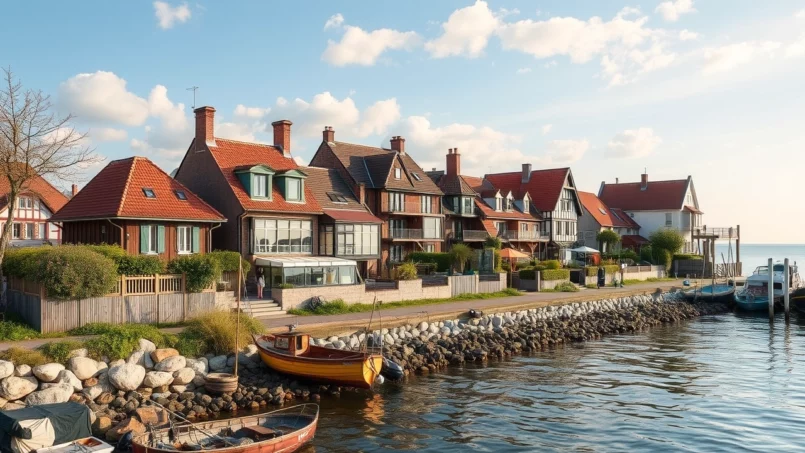
The Baltic Sea, often presented as the ideal region for fulfilling the dream of a seaside house, offers a great variety of coastal landscapes. It stretches from Flensburg in the northwest to Usedom near the Polish border. There are natural coves, long white sandy beaches, narrow peninsulas like Fischland-Darß-Zingst, and numerous islands with distinct profiles, such as Rügen, Usedom, and Fehmarn.
The North Sea offers a very different atmosphere, marked by the Wadden Sea, a UNESCO World Heritage site, the large tides, polders, and famous islands like Sylt, Norderney, or Juist. These landscapes and ecosystems make it a major tourist destination, but also a zone with high exposure to storms and sea level rise.
The climate of the German Baltic Sea varies significantly: cold in the north, temperate maritime in the southwest, and continental in the east. These differences directly impact the length of the beach season, the severity of winter, and opportunities for seasonal rentals.
A house in the “front row” facing the sea, whether on the Baltic or North Sea, is perceived as an exceptional asset, both a refuge for peaceful getaways and a rare legacy asset. The scarcity of land, especially on the islands, makes it a very specific product where supply is limited and demand is structurally strong.
Price Overview on the German Coasts
Buying by the sea in Germany is not just about choosing a landscape; it’s entering a market segment with price levels and dynamics that vary greatly depending on whether you are on a highly sought-after island or the mainland.
North Sea: Expensive Islands, More Accessible Mainland
On the North Sea side, the gaps between the islands and the mainland coast are spectacular. Data for single-family homes in the first quarter of 2024 illustrates these contrasts very well.
Here is an overview of average prices per square meter:
| Area (North Sea) | Type | Average Price Q1 2024 (€/m²) | Annual Change |
|---|---|---|---|
| North Frisian Islands (incl. Sylt) | Islands | 11,704 | -9 % |
| Sylt (detail within North Islands) | Island | 14,424 | -6 % |
| East Frisian Islands (Norderney, Juist…) | Islands | 8,833 | +2.4 % |
| Nordfriesland (mainland) | Mainland Coast | ≈ 2,340 | +8.9 % |
| Wittmund (mainland) | Mainland Coast | 2,203 | +7.4 % |
| Friesland (mainland) | Mainland Coast | 2,095 | -5.9 % |
| Aurich (mainland) | Mainland Coast | 2,069 | -6.5 % |
| Cuxhaven (district) | Mainland Coast | 1,968 | n.a. |
| Dithmarschen (district) | Mainland Coast | 1,958 | n.a. |
| Wilhelmshaven (city) | Urban Coast | 1,926 | n.a. |
| Emden (city) | Urban Coast | 1,913 | n.a. |
| Bremerhaven (city) | Urban Coast | 1,910 | n.a. |
| Wesermarsch (district) | Mainland Coast | 1,872 | Lowest |
We immediately see that Sylt is in a different category, with average prices around €14,400/m², despite a recent correction. The other islands remain very expensive on a German scale, while mainland districts (Nordfriesland, Cuxhaven, Dithmarschen, etc.) remain much more affordable, often around €2,000/m².
The price of a house near the beaches on the mainland can be three to four times lower than a villa on the island of Sylt.
Baltic Sea: Islands, Peninsulas, and Major Port Cities
On the Baltic Sea side, the market is a little less extreme than on Sylt, but remains tight for premium locations. The latest data show a slight correction movement after several years of increase, with a recent stabilization, however.
Some price benchmarks per square meter for houses in the first quarter of 2024:
| Area (Baltic Sea) | Type | Average Price Q1 2024 (€/m²) | Annual Change |
|---|---|---|---|
| Rostock (city) | Urban Coastal | 3,864 | n.a. |
| Fischland-Darß-Zingst (peninsula) | Seaside | 3,835 | +7.2 % |
| Usedom (island) | Island | 3,813 | -9.3 % |
| Rügen (island) | Island | 3,629 | +1.3 % |
| Fehmarn (island) | Island | 3,540 | -4.7 % |
| Flensburg (city) | Urban Coastal | 2,885 | n.a. |
| Kiel (city) | Urban Coastal | 3,111 | n.a. |
| Lübeck (city) | Urban Coastal | 3,216 | n.a. |
| Ostholstein (mainland) | Mainland Coast | 3,387 | n.a. |
| Plön (district) | Mainland Coast/Lakes | 3,213 | n.a. |
| Rendsburg-Eckernförde (district) | Mainland Coast | 2,698 | n.a. |
| Schleswig-Flensburg (district) | Mainland Coast | 2,494 | n.a. |
| Nordwestmecklenburg (district) | Mainland Coast | 2,468 | n.a. |
| Rostock (district, excluding city) | Mainland Coast | 2,336 | n.a. |
| Vorpommern-Rügen (mainland) | Mainland Coast | 2,683 | n.a. |
| Vorpommern-Greifswald (mainland) | Mainland Coast | 1,739 | -8.1 % |
We notice that some highly touristic peninsulas like Fischland-Darß-Zingst show marked price increases (+7.2 %), while Usedom is undergoing a pronounced correction (-9.3 %). The city of Rostock stands out as the most expensive urban market on the Baltic coast, while more remote districts like Vorpommern-Greifswald remain below €1,800/m².
Most of the buildable land on the Baltic islands is already built up. The scarcity of available land creates an imbalance between supply and demand, which sustains a high price level for existing houses, especially in the front row.
Engel & Völkers
The Ultra-Premium Segment: Exceptional Villas
In the best front-row locations facing the sea, with an unobstructed view, direct beach access, and high-end features, prices soar. On the Baltic Sea, the most exceptional properties can reach up to €6 million. These are often thatched-roof villas on Rügen or in sought-after areas like Zingst, or large estates directly on waterways like the Peenestrom on Usedom.
These properties are rare, highly sought-after, and the market is essentially private, via large networks like Engel & Völkers, which also emphasize their ability to provide a free market valuation of an existing property.
What Types of Properties Are Found by the Sea?
The German coastal real estate landscape has its architectural specificities. Some types are emblematic of the Baltic or North Sea and can influence maintenance costs, heritage value, and rental appeal.
On the Baltic Sea, houses with thatched roofs dominate certain areas, especially on the island of Rügen or around Damp. These traditional, extremely photogenic houses have strong tourist appeal but also involve specific maintenance constraints and sometimes architectural preservation rules.
Discover the features and advantages of bungalows on the Baltic Sea coast, an interesting option for a first vacation real estate investment.
Found all along the Baltic coast, often within dedicated vacation developments.
They offer limited living space, optimized for seaside stays.
Their maintenance costs are generally lower, making them a good entry point for a first seaside purchase.
Finally, there are more contemporary residences, especially in port cities (Kiel, Lübeck, Rostock, Flensburg), where waterfront or marina apartments can combine views of the water with proximity to all urban services.
This diversity of products means it is essential to clarify, from the outset, your priorities: traditional charm versus modern comfort, a single-family house more exposed to wind and spray, or an apartment in a condominium with “Hausgeld” fees, etc.
The German Market as a Whole: Context to Know
Before focusing on the seaside, it is useful to situate these purchases within the overall dynamics of the German real estate market.
After a long phase of price increases starting in 2010, driven by very low interest rates, urbanization, and investor appetite, Germany experienced a correction starting in 2022. Nominal prices fell by about 4% in 2022 and then 7% in 2023, before stabilizing and then rising moderately again in 2024–2025, with annual increases around 3–4%.
France is facing a chronic housing shortage. To meet demand by 2030, about 320,000 new homes would be needed each year. However, housing starts and building permits have been falling sharply since 2022. In 2024, only 216,000 permits were issued, the lowest level since 2010. Forecasts indicate a further contraction in deliveries for 2025–2026.
This combination of supply deficit, moderate price recovery, and mortgage rates returning to a “normal” range of 3–4% creates an environment where a well-located property, especially on an attractive coast, has a good chance of maintaining or even increasing its value in the long term.
For the coasts, the touristic dimension must be added: the demand for seasonal rentals in Germany is described as booming, with a growing preference of travelers for vacation rentals over hotels. Coastal regions, easily accessible from major cities, are particularly well placed to capture this demand.
Climate Change: A Risk to Factor in for the Seaside
Buying a house by the sea in Germany also means accepting exposure to the effects of climate change. This dimension must be integrated from the selection and negotiation phase.
Projections for the coming decades forecast rising temperatures, more intense heavy rainfall events, and a risk of more severe storms, particularly in northern and coastal regions. On the North Sea coast, sea levels have already risen by about 20 cm in a century. If greenhouse gas emissions remain high, some studies estimate that the rise in the German Bight could reach 1.20 meters by 2100.
The consequences for seaside properties are multiple: risks of marine flooding during storms, coastal erosion, waterlogged soils in winter, rising water tables making drainage more delicate. Models show that between approximately 5,500 and more than 600,000 people in northern Germany could be affected by flooding related to sea level rise, depending on whether the dikes hold or not.
This context explains the enormous effort placed on coastal protection in Germany. The country developed a “Strategy for Adaptation to Climate Change” as early as 2008, supplemented by an action plan in 2011. On the coasts, management has long relied on “hard” measures (dikes, levees), but a paradigm shift is underway towards a “living with water” approach rather than “defending at all costs.” This includes more “soft” solutions like restoring marsh areas, controlled opening of dikes to encourage sediment deposition, and creating buffer zones.
Estimated cumulative amounts, in billions of euros, that long-term coastal protection spending could reach.
For a buyer, this information translates into very concrete questions to ask:
– What is the elevation of the house relative to sea level?
– Is the property behind a dike? When was it built, and what work is planned?
– What is the flood risk zone indicated by local maps?
– What is the soil type (sensitive to subsidence, erosion)?
– What storm flood insurance is available, at what cost?
In some regions, storms that statistically occurred only every 350 years could happen every 5 to 10 years by the end of the century. For a long-term investment, it is therefore prudent to favor properties slightly set back from the water’s edge, on higher ground, even if the view is slightly less spectacular.
Legal Framework: Foreigners, Seaside, and Seasonal Rental
From a property ownership perspective, Germany is very open. There are no nationality restrictions: a citizen of the EU or a third country can freely buy a house by the sea, whether they are a resident or not. However, the acquisition does not confer any right of residence or citizenship; the “immigration” and “real estate” aspects are completely separate.
The purchase itself must obligatorily go through a notary. The notary acts as a neutral public official, drafts the deed, reads it aloud, verifies that everyone’s rights are respected, and handles registration in the land register (Grundbuch). From signing, it usually takes between 8 and 16 weeks for the property transfer to be definitively registered. A preliminary entry (Vormerkung), however, protects the buyer from the moment of signing.
For a seaside property intended for seasonal rental, the most sensitive aspect concerns its use, not ownership. In Germany, the framework is defined by the ‘BauNVO’ ordinance, which categorizes zones (residential, mixed, commercial, etc.) and specifies the activities permitted in each.
Vacation apartments (Ferienwohnungen) are explicitly defined as accommodations made available repeatedly, on a short-term basis (daily or weekly), to transient guests. They are generally classified as “non-disruptive commercial businesses” and are, in principle, permitted in mixed-use or downtown zones, but more restrictively in purely residential zones. In the latter, they are only tolerated if they remain a minority and do not alter the residential character of the neighborhood.
Para-hotel accommodations (boarding houses, serviced apartments) fall more under hospitality and are subject to regulations applicable to lodging establishments.
In tight housing markets like Berlin, Munich, Hamburg, or Frankfurt, ordinances (Zweckentfremdungsverbot) strictly regulate tourist rentals. They aim to preserve the stock of permanent housing by imposing, depending on the case, a specific permit, limiting the annual duration of rentals on platforms like Airbnb, or outright banning the short-term rental of an entire apartment.
Penalties can be severe: in Munich, for example, the fine can reach €500,000 in case of infringement. Authorities can order the cessation of illegal use, or even more radical measures in case of repeat offenses.
For a seaside buyer, this means systematically checking: the property’s status, local regulations, erosion risks, water quality, beach access, and environmental protection zones.
– The type of zone (residential, mixed, downtown) and what the local plan allows.
– Whether or not there is a Zweckentfremdungsverbot in the municipality.
– Whether converting into a vacation apartment requires a change of use permit.
– The conditions and limits imposed (number of days, obligation of primary residence, etc.).
In some seaside resorts, the situation is more flexible, especially when the local economy heavily depends on tourism. But this is not automatic, and it is prudent to consult the local urban planning office before basing a business plan on Airbnb rental income.
Real Costs of a Seaside Purchase
Beyond the sale price, all ancillary costs, often significant, must be factored in to avoid unpleasant surprises. The “Kaufnebenkosten” in Germany are high and, importantly, rarely financeable by the loan: they must therefore be covered by savings.
The main cost items are as follows:
The maximum rate of the real estate transfer tax (Grunderwerbsteuer) in Germany, applicable in several federal states like Schleswig-Holstein.
In practice, additional costs frequently range between 10% and 12% of the listed price. For a €500,000 apartment on the Baltic, the closing costs in Berlin alone were, for example, estimated at over €51,000 (transfer tax, notary, agent).
Maintenance costs by the sea should also not be underestimated: salt and wind accelerate the wear of facades, roofs, and joinery. A budget of about 1% of the property’s value per year for maintenance (€4,000 per year for a €400,000 house) is a good starting point, to be adjusted upwards if the property is very exposed.
Financing a Seaside House: Banks, Down Payment, and Rates
The German banking system is vast and competitive, with over 1,600 banks and savings banks. Mortgage loans are offered by network banks, public savings banks, cooperative banks, and Bausparkassen (specialized mortgage lending companies).
The most common tool is the standard annuity loan (Annuitätendarlehen), with constant monthly payments. Fixed rates are the norm, with fixed periods ranging from 5 to 20 years, sometimes more. In 2025, average mortgage rates overall are between 3.5% and 4.5%, depending on the term, the borrower’s profile, and the loan-to-value ratio.
The broad outlines of lending policy are as follows:
Banks generally finance 50% to 80% of the property’s value. Financing up to 90-100% is possible, especially for residents, but at higher rates. For non-residents without local income, it rarely exceeds 60%. It is recommended to put down at least 20% of the price in equity, ideally also covering the ancillary costs. Monthly payments should not exceed 35-40% of the household’s net income.
For a foreign investor, additional documentation is required: proof of stable income, sometimes a residence permit, a solid credit history. Some specialized players (brokers like Interhyp, PerFinEx, Hypofriend, or advisors like RG Immo Consult) are accustomed to assisting non-residents and comparing offers from several dozen or hundreds of banks.
For a seaside real estate purchase requiring modernization work, it is possible to use subsidized loans from KfW, the German public development bank. These financing programs are accessible for projects meeting strict energy efficiency or renovation criteria. A notable advantage is that they can also cover part of the project’s ancillary costs, thus facilitating the realization of improvement works.
Finally, in the case of new construction on coastal land, funding is released in stages as the construction progresses. Banks then charge interest on the portion already disbursed and, beyond a certain duration, “availability” interest on amounts not yet used. Cash flow management is more complex, especially since you often have to continue paying rent until the house is delivered.
Practical Steps: From Search to Signing
Buying a property by the sea in Germany follows the same major steps as anywhere in the country, but a few points deserve special emphasis.
First, it is crucial to clarify your overall budget: target purchase price, monthly repayment capacity, renovation budget, and ancillary costs (transfer tax, notary, agent, etc.). A pre-approval of financing from a bank or broker, in the form of a creditworthiness certificate, significantly strengthens your position with sellers, especially in coastal markets where demand remains strong.
The search for a property, especially a vacation home, can be done through several channels: major online portals (such as Immobilienscout24, Immonet, or Immowelt), local real estate agencies (like specialized networks Engel & Völkers or VON POLL IMMOBILIEN), or by using virtual tours, an increasingly common practice for this market segment.
During visits, the buyer must be particularly attentive to:
During inspection, check the condition of the roof and facades (damage from salt, moisture, wind), possible presence of damp or mold (especially in the basement), the type, age, and compliance of the heating system (risk of fines for old boilers), the quality of windows and doors (glazing, corrosion of fittings), and risks of land erosion or flooding (traces, local history).
An independent inspection by an architect or engineer can avoid discovering after purchase structural problems, insulation issues, or compliance problems, especially for old houses, typical of coastal villages or islands.
On the legal side, a full review of the documents is essential: extract from the land register (check for easements, rights of way, private dikes, etc.), energy certificate, condominium meeting minutes for an apartment, and especially, for a vacation rental project, written confirmation from the town hall on the compliance of the intended use with the local zoning plan.
Investing for Rental: Potential and Constraints
One of the main arguments in favor of a seaside house in Germany is the possibility of renting it out as a furnished tourist rental to offset the investment. On this point, the underlying trend rather favors the investor: vacation rentals are booming, and in a context of climate warming, the temperate coastal regions of Northern Europe could see their beach season extended by several weeks, even up to two additional months by the end of the century. Some projections mention an increase of 25–30% in the number of tourists due to warmer and longer summers.
But this potential comes with constraints:
– Regulatory, with the already mentioned Zweckentfremdungsverbote, short-term rental permits, or even quotas.
– Tax-related, since rental income is taxed at the progressive scale (14–45%), with the solidarity surcharge, even for non-residents, above certain thresholds.
– Technical, with heavy wear and tear due to vacationers, frequent cleaning, and the marine environment.
A non-resident investor must keep rigorous accounts and annually declare their rental income in Germany. It is strongly advised to rely on a tax advisor experienced with foreign property owners. Many expenses (loan interest, maintenance, insurance, management fees) are deductible from income, allowing for tax optimization.
The gross yield for long-term rentals in major German cities is generally between 3% and 4%, higher in some eastern cities. For vacation rentals, the gross yield can be higher, but with more volatility, vacancy off-season, and a more changing regulatory framework. On a highly sought-after coast with limited housing supply, a good, well-managed location can nevertheless be a solid medium-term investment.
Aging, Energy, and Renovation: A Strategic Trio
Finally, a last aspect not to overlook for a seaside purchase concerns energy quality and adaptation to aging or future resale. New constructions generally benefit from better insulation, modern heating systems, and equipment close to “barrier-free” standards (elevators, door widths, etc.). This translates into lower operating costs and often a higher resale value, but at an entry price 10–20% higher than comparable older houses.
Older buildings, especially on the coast, may require heavy work (roofing, electrical, heating, insulation) that is crucial to ensure the comfort and durability of the building in the face of wind, moisture, and future weather.
The advantage for the buyer is that many works aimed at improving energy performance can benefit from subsidies or low-interest loans via KfW. This could be, for example, installing a heat pump, insulating the attic, or replacing outdated windows. These programs are particularly interesting in markets like the Baltic or North Sea, where the climate is changing, but you want to keep operating costs reasonable, especially for year-round rentals.
Conclusion: How to Approach a Seaside Purchase in Germany Serenely
Buying a property by the sea in Germany, whether on the dunes of the North Sea or the more sheltered beaches of the Baltic, requires reconciling dream and pragmatism. The key elements to keep in mind are clear.
From a market perspective, highly touristic islands and peninsulas show high prices but remain supported by land scarcity and tourist demand. The mainland, a few kilometers from the beaches, offers much more accessible alternatives, sometimes at less than a third of the price of prestigious islands.
Climate change and sea level rise require a thorough analysis of the location, coastal protections, topography, and insurance. Although the federal government and states are investing heavily to protect inhabited areas, the risk persists and must be integrated into long-term calculations.
On the financing side, the German banking system remains attractive for strong borrowers, with rates now in a historically “normal” range and a wide array of products. Non-residents can obtain loans, provided they bring sufficient capital and present a very complete file.
To be profitable, a rental investment by the sea (long-term or vacation) requires mastering the local rules on short-term rentals, tax obligations, and travelers’ expectations regarding quality, durability, and services.
In summary, to approach a seaside purchase in Germany serenely, it is essential to combine:
– A fine analysis of the micro-location (prices, climate risks, local rules).
– A robust financial setup, including all ancillary costs and a buffer for works.
– A meticulous legal verification of the intended use (residence, seasonal rental, mixed).
– And, above all, a long-term vision, both in terms of legacy and climate, for the intended holding period.
With this structured approach, the house or apartment by the sea will not just be a beautiful view; it will become an asset coherent with your goals, inscribed in a solid market and a regulatory framework you truly master.
Disclaimer: The information provided on this website is for informational purposes only and does not constitute financial, legal, or professional advice. We encourage you to consult qualified experts before making any investment, real estate, or expatriation decisions. Although we strive to maintain up-to-date and accurate information, we do not guarantee the completeness, accuracy, or timeliness of the proposed content. As investment and expatriation involve risks, we disclaim any liability for potential losses or damages arising from the use of this site. Your use of this site confirms your acceptance of these terms and your understanding of the associated risks.

Cyril Jarnias is an independent expert in international wealth management with over 20 years of experience. As an expatriate himself, he is dedicated to helping individuals and business leaders build, protect, and pass on their wealth with complete peace of mind.
On his website, cyriljarnias.com, he shares his expertise on international real estate, offshore company formation, and expatriation.
Thanks to his expertise, he offers sound advice to optimize his clients' wealth management. Cyril Jarnias is also recognized for his appearances in many prestigious media outlets such as BFM Business, les Français de l’étranger, Le Figaro, Les Echos, and Mieux vivre votre argent, where he shares his knowledge and know-how in wealth management.





