
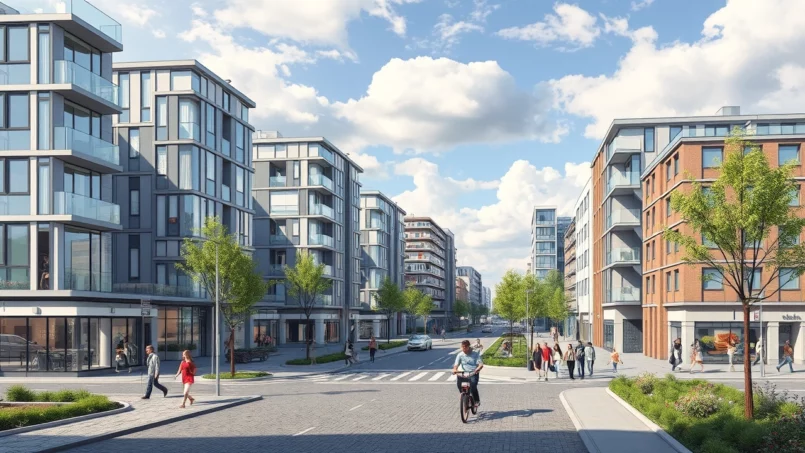
 Published on and written by Cyril Jarnias
As the housing crisis, climate disruption, and digital transition collide, German cities are transforming at high speed. Behind the sometimes dizzying figures of federal programs, thousands of concrete construction sites are reshaping neighborhoods, mobility, and even building methods. From Munich to Berlin, from the Ruhr to Stuttgart and Frankfurt, Germany’s next major urban development projects follow a clear logic: densifying without sprawling, greening territories marked by industry, and digitizing services to create genuine “smart cities,” without abandoning the goal of affordable housing.
The transformation of German cities relies on a precise legislative and financial framework, including the limitation of land consumption, the rehabilitation of industrial brownfields, the acceleration of building permits, and a national plan to promote cycling. These measures apply beyond major metropolises and are illustrated by concrete projects.
A national framework pushing to densify and recycle land
Before diving into the major neighborhoods under construction, it’s important to recall that German urban policy is based on a key principle: “inner development before outer development” (Innen- vor Außenentwicklung). In other words, priority is given to development within the already urbanized fabric, rather than new subdivisions on agricultural or natural land.
Target for reducing land consumption for urbanization and transport, set at 30 hectares per day.
Within this framework, the concept of brownfield (« Brachfläche ») is central, even though it lacks a strict legal definition. Contaminated sites (« Altlasten ») – old landfills, obsolete factories with polluted soil – are mapped and assessed. Estimates mention approximately 315,000 sites suspected of contamination in Germany, and nearly 165,000 hectares offering densification potential via brownfields and infill sites.
This strategy is particularly deployed in the Ruhr and in North Rhine–Westphalia, where the conversion of mining and steelmaking territories has become a laboratory for the post-industrial city.
Ruhr, North Rhine–Westphalia: The city built on brownfields
The Ruhr region, the historical heart of coal and steel, now concentrates a large share of the most emblematic urban conversion projects. The state of North Rhine–Westphalia, Germany’s most populous, has set itself the goal of limiting consumption of undeveloped land to 5 hectares per day, even stricter than the federal target.
To achieve this, the regional government relies on a set of measures specifically targeting former mining and industrial sites.
Conversion programs and funds for former coal regions
The “5-Standorte Programm” (5-site program) supports the transformation of five key areas: Duisburg, Gelsenkirchen, Herne, Hamm, and the district of Unna. Until 2038, this program can mobilize up to 662 million euros via the Coal Regions Investment Act (Kohleregioneninvestitionsgesetz). It is managed by a dedicated project office within Business Metropole Ruhr, with two governance bodies: a strategic council and a structural strengthening council.
The JTF program mobilizes about 90 million euros to repurpose polluted sites in the northern Ruhr (Bottrop, Dorsten, Gladbeck, Marl) into hubs for innovative industries by 2030, combining sustainable development, new mobility, energy systems, and innovation.
The economic effects are beginning to show: in the call center sector alone, brownfield reuse has created 4,000 jobs in two years in the Rhine-Ruhr region. More broadly, a recent study indicates that 40% of new logistics projects in Germany are now on brownfields, and that these operations show up to 15–20% higher tenant retention rates and 10–15% lower financing costs compared to greenfield projects.
Reinvented industrial landscapes: Emscher, bike paths, and green logistics
Beyond the numbers, several projects show how these territories are physically transforming.
As part of the Emscher Landscape Park, the “Allee des Wandels” (Alley of Change) illustrates the conversion of industrial infrastructure. This initiative transformed a former mining railway into a 10-kilometer cycle path, thereby contributing to the creation of an interconnected network of parks and green corridors within vast post-industrial areas.
In the logistics sector, major groups are also betting on brownfields. In Bischweier, Panattoni is developing a logistics complex of about 130,000 m² for Mercedes-Benz on a former particleboard site. In Mülheim an der Ruhr, developer CTP plans a 160,000 m² business park on the site of a former rolling mill. In Bitburg, Frasers Group plans to establish a 100,000 m² distribution center on the former airport.
National figures confirm the scale of this movement: in 2024, approximately 1.9 million m² of new warehouses were built on brownfields in Germany, and projections suggest up to 5.4 million m² more in 2025–2026. The Duisburg/Niederrhein region is a pioneer, with 90% of its new logistics projects built on converted sites.
In parallel, Germany has committed 57 billion euros to green infrastructure nationwide, a significant portion of which is materializing precisely in these territories: ecological restoration (“Rewilding the Ruhr”), the EU-supported “Green Infrastructure Ruhr” strategy, or targeted actions like the “Green Implementation Action” program which allocated 2.2 million euros to create green spaces in disadvantaged neighborhoods.
Munich: The “German Bay Area” under land pressure
If the Ruhr illustrates the recycled city, Munich is the typical example of a city under pressure. The country’s third-largest city, headquarters to giants like Allianz, BMW, or Siemens, the Bavarian capital shows sustained economic growth (3% employment growth in 2017, unemployment around 4.3%, the lowest among major German cities). Result: an explosion in housing demand.
The figures are unequivocal. Munich’s population is expected to reach 1.8 million inhabitants by 2030. The city revised its construction target to 8,500 new housing units per year between 2017 and 2021, including 2,000 at moderate or subsidized prices. Yet, even at this pace, Deutsche Bank Research speaks of a “deficit of several tens of thousands of housing units.” Between 2011 and 2015, only 36,000 units were built; 7,400 in 2016, below target.
The pressure on prices is proportional to land scarcity. In a city where land can represent up to 60% of the total price of a property, the market has literally skyrocketed:
| Munich Real Estate Indicator | Indicative Value |
|---|---|
| Average market growth (2009–2017) | Apartment prices x2 |
| Average price new apartment (2016, 80 m²) | 600,000 € |
| Average new price (€/m²) | ~7,500 € |
| Average existing price (€/m²) | ~5,600 € |
| Average market rent (2016, €/m²) | 18 € |
| Rent increase (2015) | +7.4 % |
| Vacancy rate (2015) | 0.2 % |
For low- and middle-income households, the situation is critical: it is common for low-income households to spend 40% or more of their income on rent. In this context, the city and the state have deployed a whole arsenal of programs and urban projects.
Freiham: A “mega-neighborhood” for 25,000 residents
Among new developments, Freiham, to the west of the city, is often presented as “the largest urban development project in Europe”. On about 350 hectares, the municipality ultimately plans to house more than 25,000 people and create commercial space for 7,500 jobs.
Approximately 11,000 housing units are currently under construction in Munich, with municipal companies playing a key role.
The first completed block illustrates the approach: a complex of 125 fully subsidized housing units, designed by Felix+Jonas Architekten under the EOF (income-oriented subsidy) scheme. The neighborhood offers a range from studios to five-room apartments, with 5% of units wheelchair accessible. It includes three buildings (a six-story “point” tower, two four- and six-story linear blocks), as well as a two-story children’s house, an asset management building, and a neighborhood meeting place.
The project’s architecture optimizes living quality while meeting environmental constraints. To combat noise on the Aubinger Allee side, box windows and recessed loggias are used. On façades exposed to traffic, glazed sliding loggias are installed. Bay windows complement these features. Furthermore, an underground parking garage is planned to avoid cluttering public space with cars.
Fürstenried West: Densifying a large 1970s housing estate
Another major project is Fürstenried West, a large housing estate built in the 1970s that already houses 1,505 rental units for about 3,000 residents. The goal is twofold: increase housing supply and modernize the neighborhood without sprawling.
The project plans the creation of about 620 additional housing units, with one-third as subsidized social housing, the rest in the mid-price segment. Twelve new buildings will be built along Forst-Kasten-Allee, Appenzellerstrasse and Bellinzonastrasse. Nine existing buildings will be raised by up to two floors, and two will receive lateral extensions.
For construction, the choice fell on hybrid wood-concrete modular systems, faster to assemble and emitting less CO₂. New buildings will aim for KfW 40 or KfW 55 energy efficiency standards, while existing buildings and their extensions will be renovated to KfW 85 level.
The project includes a futuristic mobility concept “FÜRstenried West Mobil” offering car-sharing and electric cargo bike sharing, bookable via the “MOQO” app. A new neighborhood center, the living heart of the area, will house an EDEKA supermarket, a café, a meeting space, and a mobility center.
An assertive municipal policy, but facing limits
To contain price increases, Munich has developed several tools: the “Wohnen in München VI” program allocates 870 million euros (2017–2021) to the production of affordable and subsidized housing, plus 250 million to support the two municipal housing companies. The “München Modell” scheme sets rules for the distribution between subsidized and free-market housing, with land sold at a fixed price below market rate, depending on buyers’ income.
Other programs, like “Wohnen für Alle” (3,000 targeted social housing units, half built by private developers via 135 million in public loans), or the “LaSie” project for densifying already urbanized spaces, illustrate this will to mobilize every available plot.
Beyond the city itself, the Munich Regional Planning Association includes the capital and 150 neighboring municipalities. A “Regional Alliance for Housing Construction and Infrastructure” attempts to coordinate population intake and mobility. But resistance from some suburban municipalities with a strong CSU majority, who see the arrival of new residents as a risk of political shift, hampers housing production at the metropolitan scale.
Berlin: Housing, carbon sobriety, and smart city
The German capital, long perceived as “cheap,” is now also under strong housing pressure. An emblematic project shows how Berlin is trying to combine densification, affordability, and climate neutrality.
Alt-Britz: Laboratory for circular construction
At Alt-Britz 107/107A, in the Neukölln district, the public housing company STADT UND LAND is realizing an experimental project: two five-story buildings totaling 36 rental apartments, 18 of which are barrier-free and 6 subsidized. A major feature: the buildings combine two construction techniques – clay bricks and timber-clay – in a “living laboratory” logic.
The objective is ambitious: reduce CO₂ emissions by at least 50% compared to conventional construction methods, while exploring low-tech strategies and frugal resource use. The project is scientifically monitored by the Technical University of Braunschweig, the Technical University of Berlin, and the University of Stuttgart. Monitoring covers planning, construction, and the first years of operation, tracking quality of life, energy consumption, and environmental footprint.
Supported by the Berlin Senate and the DBU, this project, associated with architects like ZRS Architekten and Bruno Fioretti Marquez, illustrates a major trend in future Berlin developments: producing affordable rental housing by experimenting with circular construction solutions with a very low carbon footprint.
Berlin Senate and German Federal Environmental Foundation (DBU)
Berlin-Tegel and new climate-neutral neighborhoods
In the capital’s northwest, the former Tegel airport is set to host the Schumacher-Quartier, a carbon-neutral neighborhood built in wood, with over 5,000 housing units on 46 hectares. Construction is scheduled to start from 2026 for phased delivery until the mid-2030s. The idea is to make this neighborhood a model of low-carbon urban planning, while providing a significant housing supply in a very tight market.
Further east, in Pankow, the KOKONI ONE project plans 84 housing units on a 23,000 m² site, with a target delivery in 2024. In Weißensee, the WIR neighborhood (207 housing units on 12,400 m²) was delivered in 2020. These diverse-scale operations are part of a broader movement of densification and conversion of existing sites, often accompanied by renewable energy programs or “tenant power” initiatives.
Smart city, data, and innovative mobility
Berlin is also a pioneer in “Smart City” development. The EUREF campus, near Südkreuz station, is a concentrated example: on 5.5 hectares, about 100 companies and institutions (2,000 people) work on sustainable energy, autonomous mobility, and digital networking. Solutions tested include wireless charging of electric buses via a plate under the road, or “EasyMile” autonomous shuttles. Data collection tools like the “Modalyzer” app are used to visualize cycling flows to adjust infrastructure.
The federal government has committed 820 million euros to support 73 smart city projects.
However, digitalization must not overshadow social challenges. The debate around affordable housing remains one of the most sensitive in Berlin, between reclaiming public control of energy networks, rent regulations, and citizen mobilization around tenants’ rights.
Stuttgart: City-center, innovative districts, and mixed-use neighborhoods
Stuttgart, capital of Baden-Württemberg, is often associated with the automobile (Bosch, Daimler/Mercedes-Benz, Porsche), but the city is trying to reinvent itself around sustainability and urban innovation.
NeckarPark and CANNION: A new piece of green, tertiary city
In Bad Cannstatt, a large project called Stadtquartier NeckarPark aims to transform a 22-hectare area into a mixed-use neighborhood with 850 housing units, offices, and sports and leisure facilities. A flagship element is the “CANNION” complex, composed of three buildings around an animated inner courtyard. In total, nearly 23,785 m² are offered for lease: 13,977 m² of offices, 672 m² for restaurants, a 194-room hotel over 6,875 m², and 2,052 m² for a premium fitness center.
The building integrates advanced solutions for sustainability and responsible mobility, limiting individual car use.
Approximately 30% of the surface area is covered with greened facades, representing 1.4 km of planters.
The building achieves 30% energy self-sufficiency through solar power.
Holds the Wired Score Platinum certification for connectivity and pre-certification DGNB Gold for sustainability.
Parking for 115 vehicles, 24 of which are equipped with charging stations.
300 bicycle parking spaces and direct access to the subway (lines U11, U19) and S-Bahn.
The neighborhood also utilizes wastewater heat, integrated into its energy concept, foreshadowing similar projects in other German cities.
Green Innovation Park: A low-carbon business park south of Stuttgart
South of Stuttgart, immediately adjacent to the A81, the Green Innovation Park illustrates another facet of future urban development: creating low-carbon business parks on abandoned industrial sites. On 85,000 m², the former brickworks is being converted into an “industrial zone of the future,” driven by the Sülzle family. The first phase (“Campus 1”) envisions four buildings offering about 650 workspaces, co-working areas, a company restaurant, a daycare center, an apart-hotel, and conference rooms, largely in hybrid timber construction.
The site will be self-sufficient through its own carbon-neutral energy system. It will also integrate a data center, illustrating the convergence between industry, digital technology, and the goal of climate neutrality.
Stuttgart 21, sustainable mobility, and IBA’27
More broadly, the Stuttgart metropolitan region (179 municipalities, 2.7 million inhabitants) is rethinking its infrastructure with the “Stuttgart 21” project: transforming the terminal station into a through station, freeing up railway land for future urban neighborhoods (including the Rosensteinquartier, announced for 7,500 housing units on 85 hectares, with a start no earlier than 2026). The region also pilots sustainable mobility programs (15 million euros) covering car-sharing, e-mobility, charging infrastructure, autonomous vehicles, bike-sharing, and smart payment systems for public transport.
Stuttgart and its region are also the setting for the International Building Exhibition IBA’27, which questions the productive city of tomorrow. A project like the “Productive City Region” in Winnenden (30,000 inhabitants) breaks the traditional separation between housing, industry, commerce, and leisure. The plans, signed by agency Jott, envision rooftop gardens, workshops within blocks, greenhouses between buildings – all indicators of the type of neighborhoods that will emerge by the end of the decade.
Frankfurt: Green belt, mixed neighborhoods, and sponge city
Frankfurt am Main, a major European financial center, is simultaneously developing a very green urban strategy. The city already has a “GrünGürtel” (green belt) of about 8,000 hectares, an urban forest of 3,866 hectares, and a network of 550 km of regional park trails, expected to exceed 1,250 km.
Green Metropolis and major green infrastructure projects
Among ongoing projects is “Frankfurt Bridges” (Frankfurter Brücken), which aims to create about 1,000,000 m² of additional green space by weaving corridors between neighborhoods. The partial burial of the A661 highway (a 1,300 m covering between Bornheim and Seckbach) is intended to connect Günthersburgpark to Huthpark and transform a road barrier into a linear park, simultaneously improving air quality and reducing noise.
The development of the “Frankfurt Westside” campus on the former Griesheim industrial site (73 ha) is a major operation. Designed by AS+P and pre-certified DGNB gold or platinum, it aims to create a mixed-use neighborhood integrating urban logistics, productive activities, and green spaces, with priority given to sustainable mobility.
Hafenpark, neighborhood district, and sponge city
On the banks of the Main, between the Honsell and Deutschherrn bridges, Hafenpark illustrates the care given to public spaces: 40,000 m² of recreational space, skatepark, sports fields, relaxation areas, for a budget of about 8 million euros. Designed by landscape agency sinai, it was largely co-created with residents through online consultation.
Number of housing units planned in the new ‘District of Neighborhoods’ in Frankfurt.
The concept of “sponge city” is very present: soil de-sealing, reuse of treated rainwater and wastewater for irrigation, greened roofs and façades. To manage these green infrastructures, the city relies on digital technologies: humidity, temperature, nutrient sensors, water-saving underground irrigation systems, even water-retaining “fueling concrete” columns.
Freiburg, Vauban, and the rise of climate-positive neighborhoods
When speaking of future projects, some already existing neighborhoods clearly serve as a compass for upcoming operations. Vauban, in Freiburg-im-Breisgau, is one such reference.
Created on a former French barracks squatted in the 1990s, this neighborhood of 5,000 inhabitants (600 jobs) has become a laboratory for the sustainable city: 70% of residents live car-free, streets are designed primarily for pedestrians and bicycles, parking is on the neighborhood fringe, everything is within walking distance of a tram stop. Energy and heat are produced by a wood chip cogeneration plant connected to a district heating network.
This is the number of tons of CO₂ avoided annually thanks to the project’s high energy standards.
These results feed into national research programs on the “green city of the future” and “climate-resilient urban renovation,” funded by the Federal Ministry for the Environment or the Ministry of Research. Many cities – Munich, Stuttgart, Heidelberg, Mannheim, or Weimar – draw inspiration from these models for their new development zones: passive or positive energy neighborhoods, district heating networks powered by biomass or solar thermal, locally treated graywater systems, etc.
Accelerating construction: The “Bau-Turbo” and Building Type E
Faced with a housing crisis no longer limited to metropolises (in 2024, only 172,100 housing units were permitted in Germany, nearly 20% less than in 2023, far from the 400,000 annual units set by a never-achieved federal target), the German government has brought out heavy legislative artillery.
Two pieces of legislation will strongly influence future urban projects.
The “Bau-Turbo”: Relaxing rules to build faster
Adopted in fall 2025, the law to accelerate residential construction (“Bau-Turbo”) introduces a new article (section 246e) into the Federal Building Code which allows, until the end of 2030, extensive exemptions from planning rules for housing projects.
Authorities can deviate from zoning plans and certain land use rules, under conditions: municipal agreement, project dedicated to creating or converting housing (e.g., offices to housing), compatibility with the public interest and the neighborhood, and absence of significant environmental impacts.
This experimental clause is intended to facilitate inner densification (buildings larger than existing plans allow, use of unplanned but already urbanized spaces, development in immediate extension of towns in outer zones, etc.). The government estimates between 18,000 and 74,000 annual applications, up to a quarter of construction projects, with potential savings of 2.5 billion euros per year for companies, citizens, and municipalities.
Municipalities, however, retain a veto right and can condition their approval (for example, on the creation of social housing or covering infrastructure costs). The state will evaluate the mechanism before 2030 to decide on its possible permanent adoption.
Building Type E: Relaxing standards to reduce costs
Another major change: the law on “Gebäudetyp E” (Building Type E), which came into force in early 2025. It creates a new category of residential buildings allowed to deviate from many DIN standards or technical rules, as long as safety, health, and functionality are guaranteed.
Possible relaxations include the use of non-standardized materials, slightly lower ceilings, simplified energy or acoustic performance requirements, and a reduced number of sanitary facilities while respecting hygiene standards. These measures aim to shorten approval and construction times, lower costs by 10–15%, and stimulate innovation in the sector.
Safeguards exist: any Type E project must be accompanied by an expert report attesting to its safety. Criticism is nevertheless voiced, especially among some architects, about the risks of lower quality or social segregation. Pilot projects are underway in Berlin, Hamburg, and Munich; if successful, the scheme could be expanded to other building types (student residences, schools, social facilities).
These reforms add to the land mobilization law (Baulandmobilisierungsgesetz) of 2021, which strengthened municipalities’ preemption rights on undeveloped plots, and the ramping up of digitalization of building permits.
A massive budgetary effort for housing and the city
These regulatory reforms would be ineffective without substantial financial support. And Germany has engaged unprecedented resources.
The Federal Ministry for Housing, Urban Development and Building sees its budget increase from 6.7 billion euros (2024) to 7.4 billion (2025) then 7.6 billion (2026). The envelope dedicated to social housing reaches 3.5 billion euros in 2025, then 4 billion in 2026, 5 billion in 2027, and 5.5 billion in 2028 and 2029, totaling 23.5 billion from 2025–2029.
This is the amount, in euros, that funding for urban development policy (“Städtebauförderung”) will reach in 2029, following a progressive increase from 2025.
A Special Fund for Infrastructure and Climate Neutrality of 500 billion euros complements this framework. Of this amount, 300 billion are reserved for federal investments, 100 billion for the Climate and Transformation Fund, and 100 billion for investments by states and municipalities. For the year 2026 alone, 58.9 billion euros from this fund are mobilized, including 21.3 billion for transport, 6 billion for hospitals, 8.5 billion for digitalization, 2.1 billion for energy infrastructure, 1 billion for research and development, and 0.5 billion for housing construction.
Table illustrating the main financial envelopes related to urban development and housing.
Envelope dedicated to financing and building social housing.
Envelope for neighborhood rehabilitation and infrastructure modernization.
Envelope for schools, daycare centers, and other collective facilities.
Envelope for transport infrastructure and sustainable mobility solutions.
Envelope for building energy performance and renewable energies.
Envelope for parks, public squares, and pedestrian zones.
| Domain | Amount (indicative year) |
|---|---|
| Social housing (2025–2029) | 23.5 bn € |
| Urban development programs (2026) | 1 bn € |
| Special fund infrastructure & climate | 500 bn € (multi-year) |
| Aid for urban energy renovation (2025–2026) | 75 M€ / year |
| Research “neutral & efficient building” (2026) | 15 M€ |
| Federal Transport Infrastructure Plan 2030 | 269.6 bn € |
In parallel, the federal state supports targeted programs: “climate-compatible new construction” (1.1 billion euros per year in 2025–2026), “climate-compatible construction in the affordable segment” (650 million per year), assistance for family homeownership (250 million per year), conversion of offices to housing (“Commercial to Residential”, 60 million in 2025, 360 million in 2026) or the “Young buys old” program to renovate the existing stock (350 million in 2025 and 2026).
Against the backdrop of energy crisis and transition, these public efforts also seek to make climate goals and housing production compatible, in a country where over 60% of the existing building stock will need renovation in the coming decade to meet European objectives.
Soft mobility and bike paths: The city of tomorrow is also made by bicycle
The German urban transformation is not just about construction cranes. It also involves a quieter but equally structuring revolution: that of the bicycle.
The National Cycling Plan 3.0 (Nationaler Radverkehrsplan 3.0) aims to make Germany a “cycling nation” by 2030. The objectives are clear: double the kilometers cycled compared to 2017, increase the number of trips from 120 to 180 per person per year, and the average distance from 3.7 to 6 km. Nationally, this would mean going from 112 million to 224 million kilometers cycled per day. In parallel, the government aims for a 40% reduction in cycling fatalities by 2030 compared to 2019, in the spirit of “Vision Zero”.
This is the amount in euros per inhabitant per year invested by Berlin for cycling over the period 2020-2023.
The “Radschnellwege” (cycle highways) symbolize this shift. In the Ruhr, the RS1 axis is to stretch 100 km from Hamm to Duisburg; 11 km are already open, on a dedicated 4 to 5 m wide lane, built with high-quality asphalt, with few intersections and almost no traffic lights. The route partly follows an old railway line and runs alongside the A40 highway. It is estimated that 1.8 million people live within 2 km of this axis, and initial feedback mentions commutes shortened by 30 to 40%. Other cities – Berlin, Munich, Hamburg, Frankfurt, Nuremberg – are developing their own network of rapid axes.
This is the total number of cumulative signatures gathered by the citizen movement ‘Radentscheid’ to push German municipalities to accelerate cycling development.
These new cycling infrastructures directly influence upcoming urban projects: new neighborhoods increasingly align with the principle of “everything by bike”, with a dense network, secure parking, dedicated streets, and last-mile logistics services via cargo bikes or tram-freight (“LastMileTram” tested in some cities).
Smart cities: Digital technology as the backbone of new neighborhoods
Finally, a last common thread connects many of Germany’s future major urban projects: the digitalization of urban services, buildings, and networks. The German smart cities market is growing strongly: according to a study by eco – Association of the Internet Industry – and Arthur D. Little, it is expected to grow from 38.5 billion euros (2021) to 84.7 billion (2026), an average annual growth of 17.1%.
In 2017, mobility, physical security, and building automation represented 59% of the digital technology market.
Major neighborhood projects increasingly integrate these digital building blocks: smart grids, real-time energy management, connected buildings, sensors for rainwater or green space management, e-mobility, citizen participation platforms. Experiments like wireless bus charging in Berlin, autonomous shuttles at the EUREF campus, low-carbon data centers at the Green Innovation Park, or district heating systems utilizing data center heat recovery show the direction being taken.
The federal government supports the transition via a national plan, European funding (Horizon 2020), and laws on administrative digitalization. In 2024, 98% of German cities had adopted the concept, with Munich at 50% development. Berlin, Cologne, and Hamburg serve as model cities.
Towards a denser, greener, and more digital German city
The upcoming urban development projects in Germany all illustrate, each in their own way, the same equation: responding to massive housing demand while limiting sprawl, reducing greenhouse gas emissions, and making cities more resilient.
In practice, this means:
Germany is implementing an integrated approach to develop sustainable cities, including: the systematic conversion of industrial and mining brownfields (Ruhr, Frankfurt); the densification and renovation of existing large housing estates (Munich-Fürstenried West); the creation of new high-performance environmental neighborhoods (Freiham, Vauban, Schumacher-Quartier, NeckarPark); a relaxed legal framework (Bau-Turbo, Building Type E) with massive funding for social housing and renovation; a reorientation of mobility towards walking, cycling, and public transport; and a cross-sector digitalization of infrastructure in a smart city logic.
A major challenge remains: reconciling these ambitions with housing affordability. Because behind the impressive investment figures and appealing images of wooden architecture or green roofs, Germany remains a country where about 80% of housing is rented, where prices in some metropolises have skyrocketed, and where construction targets have not been met in recent years.
It is precisely in the ongoing projects – whether an experimental clay building in Berlin-Neukölln, a mixed productive neighborhood in Winnenden, a brand-new cycle highway in the Ruhr, or a carbon-neutral innovation park near Stuttgart – that the ability of German cities to invent an urban model that is more just, more sober, and more intelligent is being tested. The coming years will tell whether the alliance between densification, greening, and digitalization is enough to meet this triple challenge.
Disclaimer: The information provided on this website is for informational purposes only and does not constitute financial, legal, or professional advice. We encourage you to consult qualified experts before making any investment, real estate, or expatriation decisions. Although we strive to maintain up-to-date and accurate information, we do not guarantee the completeness, accuracy, or timeliness of the proposed content. As investment and expatriation involve risks, we disclaim any liability for potential losses or damages arising from the use of this site. Your use of this site confirms your acceptance of these terms and your understanding of the associated risks.

Cyril Jarnias is an independent expert in international wealth management with over 20 years of experience. As an expatriate himself, he is dedicated to helping individuals and business leaders build, protect, and pass on their wealth with complete peace of mind.
On his website, cyriljarnias.com, he shares his expertise on international real estate, offshore company formation, and expatriation.
Thanks to his expertise, he offers sound advice to optimize his clients' wealth management. Cyril Jarnias is also recognized for his appearances in many prestigious media outlets such as BFM Business, les Français de l’étranger, Le Figaro, Les Echos, and Mieux vivre votre argent, where he shares his knowledge and know-how in wealth management.





