
 Published on and written by Cyril Jarnias
For about fifty years, the Maldives has been a dream destination for travelers in search of turquoise lagoons and private islands. But behind the postcard-perfect image, the archipelago is transforming into a major international real estate market, where overwater villas, entire islands, and residences stamped by luxury brands trade for anything from a few million to over a hundred million dollars.
This market now attracts developers, family offices, and ultra-high-net-worth individuals, who see it as a haven, a prestige product, and a high-yield asset. However, it is specific and demanding due to the legal framework (land remains state-owned) and extreme land pressure.
A Tiny Archipelago, a Gigantic Market
The Maldives, a small Indian Ocean nation comprising some 1,190 to 1,192 coral islands grouped into 26 atolls, is both the flattest and one of Asia’s smallest countries by land area. This physical scarcity is at the heart of the country’s real estate positioning: land supply is mechanically limited, while international demand for ultra-luxury seaside experiences continues to grow.
Tourism, including its indirect effects, accounts for up to 70% of the Maldives’ GDP.
The government is leveraging this dynamic to diversify its economy as part of the Vision 2040 strategy, which focuses on, among other things, high-end real estate, foreign investment, and large integrated projects (floating cities, “sustainable townships,” special economic zones). In this context, the Maldives’ luxury property market is described as stable, expanding, and driven by a marked upward trend, with an average annual appreciation of around 6 to 8%, or even 8 to 10% for the premier segment in recent years.
A Very Specific Legal Framework for Foreigners
To understand the nature of the market, one must first grasp a key rule: the Maldives Constitution prohibits full ownership (freehold) of land by foreigners. Land is reserved for citizens. International investors therefore cannot “buy” a piece of an island as they would a plot in Dubai or Paris.
The Logic of Long-Term Leases
The primary mechanism for non-Maldivians to access property is through long-term emphyteutic leases, typically ranging from 50 to 99 years. This is referred to as leasehold rather than freehold. In practice, this means the investor acquires rights of use, construction, and development for a period long enough to structure a hotel project, a residential program, or a second home.
In resort projects and integrated residential developments, a common model involves the state initially leasing an entire island or lagoon to an operator or developer via a master lease. This operator can then subdivide and market the property by granting subleases or selling individual units as strata titles to private individuals.
Strata Title, Branded Residences, and Integrated Tourism
Recent reforms have introduced laws on sectional ownership (strata title), allowing for the first time the sale of individual units under a master lease: villas, apartments, penthouses, or branded residences within resorts like Soneva, Aman, Baccarat, or Mandarin Oriental.
At the same time, a model called “Integrated Tourism” paves the way for mixed-use projects combining hotels, residential villas, retail, marinas, and even schools or clinics. Within these complexes, some residential plots can be marketed to foreign buyers for the duration of the master lease.
This activity is governed by several major legislative texts: the Land Act, the Foreign Investment Act (particularly its recent version, Act No. 11/2024), and the Tourism Act. It is also subject to foreign direct investment policies that specify sectors open, restricted, or closed to foreign capital.
Residence by Investment: An Additional Asset
Another key development: the launch, in partnership with Henley & Partners, of a residence-by-investment program. This scheme, operational based on the provided legal texts, offers five-year renewable residence permits to investors who allocate a minimum amount to eligible assets, including properties in approved developments.
Thresholds vary by program:
| Program / Scheme | Indicative Investment Threshold | Main Benefits |
|---|---|---|
| Investor Visa (official program) | 5 to 10 M USD | Renewable 5-year residence, includes family |
| Special Resident Visa linked to real estate | Minimum 250,000 USD in an approved project | Renewable 5-year residence for investor and dependents |
| Standard Business Investment | Starting from 250,000 USD depending on sector | 100% company ownership possible, tax benefits |
This is not a citizenship-by-investment program: to be naturalized, one must reside continuously for twelve years, and dual citizenship is not recognized. But for the ultra-wealthy seeking a foothold in the Indian Ocean and enhanced mobility solutions, these visas provide an additional argument to take a closer look at the market.
Property Types: From Urban Apartments to Private Islands
The luxury property market in the Maldives covers a surprisingly wide spectrum, despite the country’s small size. Broadly speaking, several major asset families can be distinguished.
High-End Apartments in Malé and Hulhumalé
The economic heart of the country is the capital Malé and its urban extension, Hulhumalé. Density is extreme, and prices reflect the scarcity of urban land. In the most sought-after neighborhoods, the average price per square meter for a luxury apartment reaches about 171,000 MVR/m², or around 11,000 USD/m². More broadly, values range between 5,000 and 10,000 USD/m², with much higher peaks for the rarest properties.
The starting price of a 2+1 bedroom apartment in the Maldives for local residents, approximately 195,000 USD.
Beachfront Villas and Overwater Villas
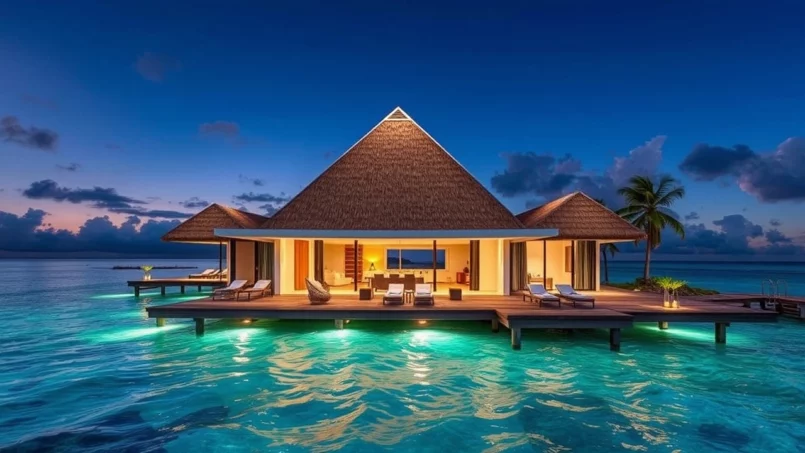
The absolute icon of the Maldivian market remains the private villa, either set on the beach or built on stilts over the lagoon. These properties—whether purely residential or part of hotel programs—concentrate the bulk of international capital.
In the atolls near Malé (North Malé, South Malé, Kaafu), beach villas typically trade between $1.5 and $4 million, for areas spanning several hundred square meters. “Premium” standard overwater villas fall within a range of $1.2 to $3.5 million, depending on the atoll and the managing brand.
A few examples illustrate the price range at the top end:
| Project / Resort | Property Type | Approximate Area | Indicative Price (USD) |
|---|---|---|---|
| Soneva Jani (Noonu Atoll) | 1-Bedroom Villa | ~4,424 sq ft | 5,225,000 |
| Soneva Jani | 2-Bedroom Water Retreat | ~5,597 sq ft | 7,700,000 |
| Soneva Jani | 4-Bedroom Beach Villa | ~19,246 sq ft | 9,000,000 |
| Soneva Fushi (Baa Atoll) | 9-Bedroom Residence | ~32,808 sq ft | 15,000,000 |
| Baccarat Residences (South Malé) | 2-Bedroom Villa | 285 m² | 4,940,000 |
| Baccarat Residences (South Malé) | 4-Bedroom Villa | 744 m² | 12,220,000 |
| Baccarat Residences (South Malé) | 7-Bedroom Mansion on Private Island | — | 42,000,000 |
As we see, some private villas easily exceed $10 to $15 million, especially when brand, size, and location converge.
Private Islands and Mega-Projects
At the top of the pyramid are private islands and large multi-island projects. In several atolls (Noonu, Raa, Baa, Ari, Lhaviyani…), virgin islets or turnkey resorts are offered for sale under 50 to 99-year leases.
A five-star resort with 114 villas, spanning over 43 hectares, is listed for over 105 million euros.
But the new generation of projects goes even further, exemplified by Zamani Islands, developed by Atoll Estates: eight islands grouped across about 70 hectares, three integrated resorts, the country’s first superyacht marina with 120 berths, 4 to 8-bedroom residences, and private estates starting at $25 million, not to mention a northern islet offered for $150 million. Another example: the private mansions signed Baccarat, some reaching $42 to $42.5 million for 7 to 10 bedrooms.
Who Buys What, Where, and Why?
The profile of buyers reflects the country’s tourist clientele, but with a clear overrepresentation of Western and Asian wealth.
An Ultra-Wealthy and Highly International Clientele
Available data indicates that in 2025, approximately 50% of luxury property buyers in the Maldives are European (French, Swiss, British, German), 30% are Asian (mainly India, China, Singapore), and 20% are North American and Middle Eastern. UAE developers play a major role: over $3 billion in investments are planned through 2030, and some observers anticipate that Emirati groups will eventually hold the largest real estate portfolio in the country.
Primary motivations combine the search for an ultra-confidential private haven, the acquisition of a prestigious second home, wealth diversification into hard currencies, and holding a product that generates high rental income. The clientele is primarily composed of Ultra-High-Net-Worth Individuals (UHNWIs) or family structures, sometimes supplemented by institutional investors specializing in luxury hospitality.
Rental Yields and Capital Appreciation: An Attractive Pair
The Maldives offers yields rarely seen in other beachfront markets. In cities (Malé and close suburbs), apartments can show gross yields of 6 to 7%. But it is especially the villas and integrated resorts that attract capital: gross rental yields are frequently between 8 and 12%, and can climb to 12-15% for well-positioned villas or branded residences managed by a hotel operator.
This is the average annual capital appreciation expected in the coming years, with a premium for projects labeled “green luxury.”
A simulation based on available data provides an idea: a $2 million beach villa, rented on average for $1,200 per night with an annual occupancy rate of 65%, generates roughly $285,000 in gross revenue. Subtracting 30% for operational costs and 2.5% for maintenance (about $50,000), net income is around $175,000, yielding a net return close to 8.75% on equity. If partial financing is used (when available), the cash-on-cash return can exceed 10%.
Geographical Distribution of Opportunities
Not all atolls present the same risk-return profile or positioning:
| Region / Atoll | Luxury Market Profile | Indicative Price Range (excluding whole islands) |
|---|---|---|
| Malé / Greater Malé | Urban market, land scarcity | 5,000 – 10,000 USD/m² (apartments) |
| North Malé Atoll | Established resorts, airport proximity | Beach villas $1.5 – 4 M, overwater villas $1.8 – 3.5 M |
| South Malé Atoll | New branded projects, good access | Overwater villas $1.2 – 2.8 M, residences $0.8 – 1.8 M |
| Baa Atoll (UNESCO) | Eco-luxury, protected biosphere | Branded villas $1.5 – 3.2 M, leased islands $8 – 25 M |
| Noonu Atoll | Ultra-high-end resorts, XXL villas | Villas $3 – 9 M, private island around $45 M |
| Lhaviyani Atoll | Emerging destination | Overwater residences $0.9 – 2.2 M |
| Addu Atoll / Gan | South, potential airport infrastructure | Investment villas $0.5 – 1.5 M |
To this are added more specific markets: islands like Fuvahmulah (eco-tourism), Maafushi (guesthouse segment but potential rental yield), or major urbanization projects like Hulhumalé Phase II.
The Growing Weight of Branded Residences
One of the clearest trends in the Maldives’ luxury property market is the explosion of branded residences. It’s no longer just about staying at a Four Seasons, Aman, or Mandarin Oriental hotel, but about owning one’s own villa within these worlds.
From Soneva to Baccarat: Continuous Upscaling
Soneva paved the way, particularly at Soneva Fushi (Baa Atoll) and Soneva Jani (Noonu Atoll), by allowing foreigners to become leasehold owners of villas ranging from 1 to 9 bedrooms, with private pools, giant slides into the lagoon, butler services “Mr. or Ms. Friday,” and access to the resort’s restaurants and activities. Some units exceed 30,000 sq ft and $15 million.
New brands are further strengthening this segment:
Discover a selection of exceptional real estate projects in the Maldives, combining prestigious architecture, island privacy, and luxury hotel services.
16 private residences of 5 to 10 bedrooms, each located on its own islet, designed by the renowned firm Kerry Hill Architects.
Spanning five islands in the South Malé Atoll, this project includes over 50 hotel villas and 53 private residences, with mansions up to 10 bedrooms.
190 units (villas, overwater bungalows, apartments with pools) resulting from a collaboration between a Dubai developer and the fashion house, starting at approximately $2.3 million.
Mandarin Oriental, Waldorf Astoria, Bulgari, Joali, and Six Senses are also developing hybrid projects blending private residences and luxury hotel services.
Branded residences sell for significantly more than comparable unbranded products; observed premiums often range from 20 to 40%. In return, they offer turnkey rental programs, with yields generally between 6% and 15% per year, as well as perks (complimentary nights within the network, discounts at restaurants and spas, global concierge).
“Green Luxury”: When Sustainability Becomes a Pricing Argument
The Maldives are on the front lines of climate change. Average altitude: 1.5 meters above sea level. Maximum natural height: 2.4 meters. The most pessimistic projections suggest possible uninhabitability of the archipelago by 2100 in case of rapid sea-level rise. 80% of the land surface would be threatened by a one-meter rise.
In this context, the rise of real estate investment might seem paradoxical. But it also aligns with a transition towards a more sustainable tourism, driven as much by environmental imperatives as by traveler expectations.
From Climate Constraint to Green Value
The authorities have set a carbon neutrality target for 2030 and are pushing developers to adopt high environmental standards: solar panels, water treatment plants, sustainable local materials, smart energy management, gradual ban on single-use plastics.
The most committed resorts, like Soneva Fushi or Six Senses Laamu, combine several actions: solar power generation, water recycling, optimized desalination, waste upcycling, coral restoration programs, and guest involvement through workshops, coral sponsorship, or co-financed donations.
Investors are taking notice. Available data indicates that: Market trends are constantly evolving and require particular attention to maximize investment returns.
Demand for eco-responsible stays has grown by approximately 28% over the last five years.
In other words, “green luxury” is no longer a niche for activists, but a new norm expected by a growing segment of the very wealthy clientele, willing to pay a premium for an experience that is both ultra-comfortable and less guilt-inducing.
A Surprisingly Favorable Tax Framework
Beyond rental yields, taxation plays a key role in the appeal of the Maldives’ luxury property market. For private investors, the country stands out for the absence of many taxes that weigh heavily in other jurisdictions.
No Income Tax, No Wealth Tax
Residents and non-residents are not subject to personal income tax. There is no wealth tax, no inheritance tax, and no recurring property tax. Furthermore, capital gains realized individually on real estate are not subject to a specific tax according to available sources.
However, several indirect taxes apply:
The rate of the Goods and Services Tax (GST) applied to real estate transactions and rental income.
For companies, the base regime provides for a tax of 15% on profits exceeding 500,000 MVR (approximately $32,500), and 0% below that. Certain banking or specific activities may face higher rates (up to 25%).
Overall transaction costs – legal fees, taxes, registration fees – are estimated in a range of 8 to 12% of the acquisition price for a foreign buyer.
Buying a luxury property in the Maldives does not resemble a standard transaction in London or Paris. The process systematically involves the state, either through the Ministry of Tourism (for islands and resorts), or via other agencies for urban projects and designated investment zones.
Generally, the steps are as follows:
The acquisition of a property in the Maldives by a foreigner follows a structured process. It begins with a reservation and a thorough review of legal and financial documents. Government approval is then required to verify the project’s compliance. The transaction is formalized by a contract detailing all rights and obligations. Finally, registration and payment, often staged for new projects, conclude the process.
In practice, over 70% of international buyers pay in cash, due to limited access to local credit. A few major Maldivian banks (Bank of Maldives, Maldives Islamic Bank) can finance certain projects, but most foreigners seek financing in their home country or rely on payment plans offered by developers.
Due to the complexity of local real estate law (long-term leases, influence of Islamic law on inheritance rules, strict transparency requirements on ultimate beneficial owners), it is highly recommended to be assisted by a specialized local law firm.
Risks and Limitations of an Exceptional Market
The picture might seem idyllic: high yields, steady capital appreciation, light taxation, paradisiacal climate, and exceptional living environment. But the Maldives’ luxury property market also presents structural risks that any serious investor must consider.
An Uncertain Climate Horizon
The most discussed risk is obviously that of rising sea levels and extreme weather events. The 2016 mass bleaching episode, which destroyed about 60% of coral reefs, was a reminder of the ecosystem’s fragility. With nearly all tourism infrastructure located within 100 meters of the coastline, exposure to storms, erosion, and flooding is maximal.
New development projects in the Maldives incorporate advanced engineering solutions to address sea-level rise, such as raising land by 2 to 2.5 meters, building seawalls, floating structures, and restoring mangroves as natural barriers. A notable example is the development of a floating city off Malé, designed to accommodate about 20,000 residents, illustrating this adaptation strategy. However, the long-term effectiveness of these measures will depend on the global climate trajectory.
Dependence on Global Tourism and Political Decisions
The Maldivian real estate market is closely tied to the health of international tourism and political stability. The abrupt border closure in 2020 caused arrivals to plummet by over 67%, a stark reminder of the country’s vulnerability to pandemics, geopolitical crises, or global recessions.
The residual value of a leasehold asset can be affected as the lease term approaches (50 or 99 years) without a clear renewal clause. Furthermore, the resale market, narrower than in major metropolises, can make liquidity for certain assets more challenging.
Finally, even if the country is generally described as politically stable, international observers have raised concerns about judicial independence and regulatory predictability, particularly regarding fiscal and land reforms.
Towards an Increasingly Selective Market
Based on the available information, the luxury property market in the Maldives appears as an exceptional territory, reserved for a clientele capable of absorbing a high entry ticket (often several million dollars) and accepting specific risks in exchange for a unique yield/lifestyle combination.
For these investors, the assets are hard to match: extreme land scarcity, an iconic global destination, rental yields far superior to other beachfront markets, steady capital appreciation, a light tax environment, and the ability to combine personal use with hotel operations.
The luxury real estate market in the Maldives is evolving towards a demand centered on projects combining ultra-luxury, economic performance, and managed ecological impact, in response to the growing awareness of the archipelago’s environmental vulnerability. These projects are likely to concentrate the majority of future demand and capital appreciation.
In the Maldives, the true real estate luxury will no longer be just owning an overwater villa above a perfect lagoon; it will be owning it on an island that has managed to remain livable, protected, and desirable in a rapidly changing world. For now, investors seem ready to bet that this balance is possible – and many are doing so, check for several million dollars in hand.
Disclaimer: The information provided on this website is for informational purposes only and does not constitute financial, legal, or professional advice. We encourage you to consult qualified experts before making any investment, real estate, or expatriation decisions. Although we strive to maintain up-to-date and accurate information, we do not guarantee the completeness, accuracy, or timeliness of the proposed content. As investment and expatriation involve risks, we disclaim any liability for potential losses or damages arising from the use of this site. Your use of this site confirms your acceptance of these terms and your understanding of the associated risks.

Cyril Jarnias is an independent expert in international wealth management with over 20 years of experience. As an expatriate himself, he is dedicated to helping individuals and business leaders build, protect, and pass on their wealth with complete peace of mind.
On his website, cyriljarnias.com, he shares his expertise on international real estate, offshore company formation, and expatriation.
Thanks to his expertise, he offers sound advice to optimize his clients' wealth management. Cyril Jarnias is also recognized for his appearances in many prestigious media outlets such as BFM Business, les Français de l’étranger, Le Figaro, Les Echos, and Mieux vivre votre argent, where he shares his knowledge and know-how in wealth management.





