
 Published on and written by Cyril Jarnias
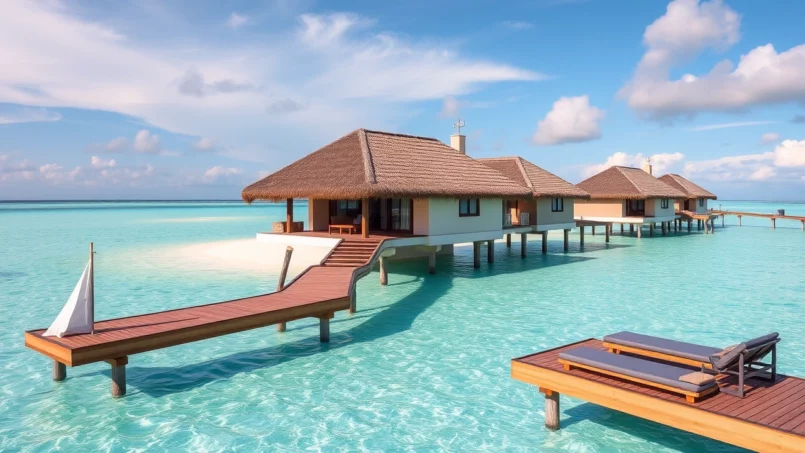
Buying an overwater villa or an apartment in an integrated resort in the Maldives is no longer reserved for cash buyers only. The country remains very focused on cash transactions, but the range of financing options—local, Islamic, international, or directly through developers—has become significantly more structured in recent years. Understanding these mechanisms is essential, especially since property rules, interest rates, and the legal framework are very specific to this archipelago.
To invest in the Maldives, foreigners can finance leasehold villas, branded residences, or units in integrated resorts. This article details the financing solutions available for these types of properties.
Understanding the Maldivian framework before considering financing
Before opening a credit file, you need to grasp two fundamental realities: in the Maldives, the ownership structure differs from most markets, and the market is closely tied to high-end tourism.
Foreigners cannot own land outright. The Constitution reserves land ownership for Maldivian citizens. Non-residents acquire rights through long-term leases, typically 50 to 99 years, on islands or plots designated for tourism projects. These leases allow you to build, operate, and rent the property, and even resell the leasehold rights, but never own the land itself.
The real estate market accessible to foreigners in the Maldives is mainly limited to resort villas, branded residences, beach villas, and apartments within tourist complexes. This framework is defined by the Foreign Investment Act of 2010 and the 2019 regulation on the “Integrated Tourism” model, which allows mixed-use developments in tourist zones. Buyer rights are tied to the developer’s main lease, a crucial factor to consider for any financing.
This context directly influences the credit supply: local banks mainly lend to residents and well-established businesses, while foreigners rely more on international banks, solutions in their home country, or payment plans offered by developers.
Overview of available financing options
Real estate financing in the Maldives rests on several pillars: traditional bank credit (local or international), Islamic financing, developer payment plans, bridge loans or refinancing in the home country, not to mention cash transactions, which remain predominant.
Local bank credit: a narrow door for foreigners
The Maldives has a banking system that is still modest but growing. The Bank of Maldives (BML) is the dominant player, alongside a few other commercial institutions and a limited number of international bank branches.
For Maldivian residents, BML, HDFC, and other players offer a range of home financing products: “Home Purchase Financing,” construction loans, refinancing, Islamic products based on Diminishing Musharaka, etc. The parameters are relatively clear: down payments of 20 to 30%, terms of up to 20 years, a requirement that the monthly payment does not exceed 50% of net income, a mortgage on the property, and sometimes recourse to other assets as additional collateral.
For a foreign investor looking to finance a resort villa, access to these products is very limited. Mortgage loans in local currency for non-residents are rare and generally reserved for structures already present locally (local company, tourism joint venture, guest house operator). Banks then require significant operational presence, additional guarantees beyond the property itself, and a solid financial track record.
However, for tourism development projects held through Maldivian companies, BML or other institutions can provide “real estate” or “project finance” credit lines. Here again, the main lease, tourism permits, environmental approvals, and the value of the leasehold come into the collateral equation.
International banks and expatriate mortgages
Given the difficulty of accessing local financing, many investors turn to banks based in Singapore, Hong Kong, or the Middle East. Some of these institutions offer “expatriate mortgages” for properties located in the Maldives, especially when they involve units in resorts managed by major hotel brands.
Common practices in project management include the Agile method, which favors iterative development and client collaboration, and the Waterfall method, which follows a linear and rigid sequence of phases. These approaches illustrate different ways of organizing work to achieve set goals.
– Loan-to-value (LTV) ratio: generally capped at 70% of the purchase price.
– Interest rate: often between 4% and 6% for the best profiles, significantly more competitive than mortgage rates in rufiyaa, which hover around 10–12% for a standard home.
– Term: frequently 10 to 15 years, sometimes up to 20 years depending on the bank’s policy and the client’s profile.
– Requirements: verifiable income, good credit score, compatible debt service ratio, and often pledging other assets (primary residence, securities portfolio).
These institutions examine the quality of the Maldivian project (branded residence, hotel operator, soundness of the main lease) and may require additional due diligence reports. The legal structure (ownership via a company or directly) and the borrower’s tax residence also influence the decision.
Financing in the home country: often a more flexible strategy
Many buyers finance their Maldivian investment without borrowing locally. Instead, they use credit leverage in their country of residence: refinancing their primary residence, a credit line backed by a securities portfolio, a multi-property mortgage, etc. The terms are often more attractive than those offered in a small market like the Maldives.
For example, an investor can take out a mortgage on their home in a low-rate country, then use the funds to pay cash for a resort villa. This is one reason why over 70% of international buyers in the Maldives remain “cash” buyers, even if they are indirectly indebted in their home jurisdiction.
Developer payment plans and financing
For a foreigner, the most accessible solution often remains direct financing by the developer. Major projects—for example, luxury residences like Coral Residences or complexes signed by major international brands—regularly offer structured payment schedules spanning several years.
Typical features of these plans include:
– Initial down payment: generally between 30% and 50% of the property price. Some examples mention thresholds starting at 30%.
– Plan duration: over 3 to 5 years for the balance, rarely longer.
– Rate: often fixed, between 5% and 8%. One case mentions a rate of 5.2% tied to a certain occupancy level.
– Payment schedule: indexed to construction milestones—foundations, structure, lock-up, handover, then a post-delivery period.
A concrete example helps visualize the financial impact:
– Villa price: $1.2 million.
– Initial down payment (30%): $360,000.
– Option 1 – conventional bank loan at 5% over 10 years: monthly payment around $5,900, total interest approximately $348,000 over the term.
– Option 2 – developer plan at 5.5% over 5 years, aligned with construction milestones: payments of about 20% at each major stage (foundations, structure, lock-up, handover), then 20% spread over the 12 months following key handover. Actual monthly cash outflows are higher during the construction phase (averaging $22,000 per month) then decrease after handover (about $10,000 per month), coinciding with the ramp-up of rental income.
This type of arrangement particularly interests investors who count on rental flows from the resort’s opening. Developers, for their part, highlight the simplicity of the process (less paperwork than a bank), speed of setup (programs finalized in a few weeks), and a “turnkey” experience covering construction supervision, guarantees, and post-delivery management.
Islamic financing and Shariah-compliant solutions
The Maldives has developed a significant offering of Islamic financial products for both individuals and businesses. The Bank of Maldives has an Islamic window, HDFC operates through its “AMNA” platform, and the Maldives Islamic Bank offers products like “Ujaalaa Hiyaa” for housing or financing dedicated to guest houses and real estate development.
Islamic finance is based on fundamental principles: the prohibition of interest (riba), the sharing of risks and profits between parties, and the use of specific contracts such as Diminishing Musharaka, Ijara, Wakalah, or Kafalah.
A few product examples:
– Home construction financing based on Diminishing Musharaka, to build or renovate up to approximately 2 million rufiyaa without additional collateral.
– Home purchase financing (apartment, flat, row house) anywhere in the country, a Shariah alternative to conventional mortgage loans.
– Investment property financing for developing income-generating assets (guest houses, rental buildings).
– “BML Islamic Guest House” financing to invest in or expand a guest house business, starting from 50,000 MVR, without additional collateral.
– Islamic Green Financing intended to finance green technologies (renewable energy, energy efficiency solutions).
Typical conditions include: system requirements, technical specifications, resource availability, time constraints, estimated costs.
– Minimum down payment around 20% of the property price, which can be in cash, through pledging pension funds, or by accounting for payments already made to the developer.
– Maximum term often 20 years (240 months).
– Annual profit rate in a range of 9–11% for some products in rufiyaa.
– Obligation that total debt burden (including new financing) does not exceed 50% of confirmed gross income.
– Full payment of Takaful (Islamic insurance) for the entire financing term before disbursement.
These products primarily target Maldivian clients. A foreign investor setting up a local structure with recurring income (e.g., a guest house or small rental residence) could theoretically be interested, subject to eligibility criteria.
Interest rates: where do the Maldives stand?
The question of rates is central in a market where the local currency, the rufiyaa (MVR), is officially pegged to the dollar (approximately 15.42 MVR to 1 USD) and financial resources remain limited.
Available data shows that: current trends indicate a significant increase in global temperatures.
In 2024, the general lending interest rate for private sector loans stood at around 11.55%, close to the historic peak of 11.68% reached in 2023.
Compared to standards in major financial centers, these rates are high. They reflect the small size of the market, the cost of capital, and perceived risk. This is what makes offshore credit (4–6%) or developer plans (5–8%) particularly attractive for foreign buyers.
The table below summarizes the main orders of magnitude mentioned in the data:
| Type of financing | Currency | Indicative rate | Typical term |
|---|---|---|---|
| Local home mortgage (Maldivian banks) | MVR | 10–12% | Up to 20 years |
| Local home mortgage (Maldivian banks) | USD | 8–10% | Up to 20 years |
| Average lending rate (all private loans, 2024) | MVR | 11.55% | Variable |
| 20-year fixed mortgage (observed average) | MVR | 12.40% (8–15% range) | 20 years |
| Expatriate mortgage via international bank | USD | 4–6% | 10–15 years (sometimes more) |
| Developer financing plan | USD | 5–8% (e.g., 5.2%) | 3–5 years |
| Residential Islamic product (profit rate) | MVR | 9–11% | Up to 20 years |
For a foreign investor, the challenge is often to take advantage of the lowest rates (international banks, credit in the home country) while respecting the local legal structure based on leasehold and tourism regulations.
Eligibility conditions: income, age, down payment, and guarantees
The various lenders—local, Islamic, international, or developers—converge on a number of criteria, even if the exact thresholds vary.
Personal and professional situation
The main conditions observed are as follows:
To obtain a loan, financial institutions evaluate several key criteria. The borrower’s age is generally between 18 and 60 at the time of application. Over 60, certain specific conditions apply, such as requiring a younger co-borrower or proof that repayment will come from income generated by the financed project. The required professional seniority is at least 24 months of full-time employment for certain specific products, while others require 12 months of documented income, including 6 with the current employer. Accepted income includes salaries, recurring rental income, and business profits, with particular attention paid to their stability and traceability. Finally, the debt level is strictly limited to 50% of income (net or gross depending on the institution) for the debt-to-income ratio; beyond this threshold, financing is rarely granted.
Personal down payment and investment capacity
The requirements for equity are high by Maldives standards:
– Minimum down payment of 20% for certain Islamic products, with profit rate adjustments if the down payment increases to 30, 40, or 50% (the higher the down payment, the lower the profit rate).
– Margins of 20 to 25% on project costs for standard homes (construction, apartment purchase).
– In the context of real estate development projects, some banks require the client to invest 30% of the total project cost, with the bank financing the remaining 70%.
For foreign investors wishing to acquire a resort villa, developers or international banks generally require a higher personal down payment, representing between 30% and 50% of the purchase price. This down payment can consist of cash, refinancing of other real estate assets, or investment products.
Guarantees and collateral
Collateral arrangements vary:
– Mortgage on the financed property: standard, including on leasehold rights in a resort.
– Value coverage: for certain products, the value of the property given as collateral must reach 150% of the amount borrowed.
– Insurance (Takaful or traditional policy): required to cover risk over the loan term.
– Other guarantees: in several cases, banks require additional assets (other properties, vessels, etc.) to secure their claims, especially for companies or large-scale projects.
Developers, for their part, are generally less strict on traditional guarantees, since they retain control over the property until full payment and can include repossession clauses in case of default.
Files and documents to prepare
Whether it is local, Islamic, or international financing, documentation is a frequent stumbling block for foreigners. Maldivian institutions and major international lenders require detailed, verified evidence:
List of supporting documents needed to prepare a credit application, categorized by type.
Valid national ID card or passport (often with at least 6 months validity remaining). Birth and marriage certificates where applicable.
Pay slips for the last 6 to 12 months, letter from employer confirming position, seniority, and compensation, bank statements showing salary credits.
Title deeds for properties generating rent, lease agreements, bank statements showing receipts.
Audited financial statements, business bank statements, business licenses, company articles of association, and board resolutions authorizing the borrowing.
Transfer receipts, account statements, documentation on the source of funds, information on any pension fund used as collateral.
Reservation contract, promise of sale, final sales and purchase agreement (SPA), reservation form, developer quote, approved plans, building permit, engineering report.
Institutions may additionally require a police certificate, bank reference letters, or tax attestations, depending on the client’s profile and the source of funds.
Summary of the main categories of documents most often requested to facilitate your procedures.
Official documents proving your identity and nationality, such as a passport or national ID card.
Recent attestations proving your address, such as an electricity bill or rent receipt.
Bank statements, tax returns, or pay slips attesting to your resources.
Employment contracts, employer attestations, or Kbis extracts for professionals.
Family record book, civil status certificates (birth, marriage), or divorce decrees.
Title deeds, registration certificates, or insurance policies.
| Category | Examples of documents requested |
|---|---|
| Identity | Passport, ID card, birth certificate, marriage certificate |
| Salaried income | Pay slips (6–12 months), employer letter, employment contract |
| Rental income | Title deeds, leases, bank statements showing rent |
| Business income | Audited balance sheets and income statements, bank statements, licenses |
| Down payment / equity | Bank statements, proof of transfers, pension fund details |
| Real estate | SPA, reservation contract, plans, permits, resort’s main lease |
| Compliance and KYC | Bank references, tax attestations, sometimes police record extract |
For a foreign investor, anticipating this document work upstream can greatly reduce approval times, which can otherwise stretch over several months.
Market specifics: yield, taxation, and cash flow
Obtaining financing only makes sense if the project itself is financially viable. The Maldivian market relies heavily on high-end tourism: about 28% of GDP comes directly from this sector, and up to 70% if indirect effects are included. This dynamic supports prices and rental income, but also creates constraints.
Rental income and yield
In well-positioned resorts, overwater or beachfront villas can command very high nightly rates, often between $800 and $2,500 in the luxury segment. Occupancy rates of 80 to 90% are not uncommon in the best establishments. Rental yield data shows, depending on the segment, gross yields of around 5 to 7% for very high-end villas, and 7 to 10% for more urban or domestic-market-oriented developments. In some peripheral markets, gross rental yields can be even higher.
At the same time, capital appreciation has gone through several cycles:
– 4–5% per year approximately between 2010 and 2015.
– 6–8% per year between 2016 and 2020, driven by the rise of branded residences.
– 3–5% per year between 2020 and 2022, a period of volatility linked to the pandemic.
– 8–10% per year since 2023, stimulated by integrated projects and the focus on sustainability.
The real estate market is made attractive by the combination of rental yield and property appreciation. This dynamic is explained by limited supply, due to the restricted number of islands, strict regulation, and rising construction costs, which also makes it very selective.
Local taxation on purchase and ownership
Any financing strategy must incorporate the Maldivian tax layer, even though the country applies neither personal income tax nor capital gains tax per se.
The main levies are:
– Goods & Services Tax (GST): 6% of the purchase price for real estate, and 6% on rental income. A 12% bracket may apply to certain tourism services.
– Tourism Land Rent Tax: a land rent tax for tourism leases, generally $8 to $10 per square meter per year, typically included in the management fees paid by owners to resort operators.
– Business Profit Tax: 15% on profits of certain structures operating locally (mainly for companies). An investor who is an individual indirectly exposed via a company should coordinate with a tax advisor.
– Green Tax: $6 per night per tourist, collected from guests by the operator and remitted to the state.
– Withholding tax: 10% on certain cross-border payments (management fees, royalties paid to non-residents), subject to tax treaties.
In the Maldives, there is no dedicated capital gains tax on real estate. However, gains may be subject to Business Profit Tax in some cases, particularly through a corporate structure or an activity akin to local commerce. A preliminary analysis of the investment structure is therefore essential.
Tax obligations in the home country
For a US or Canadian investor, for example, the Maldivian investment does not remain in a “tax void”:
– In the United States, Maldivian rental income must be reported to the IRS and is taxable, with the possibility of a foreign tax credit for taxes paid in the Maldives. Property sales trigger capital gains taxation. Maldivian bank accounts exceeding $10,000 trigger reporting obligations (FBAR, FATCA).
– In Canada, rental income received abroad must also be declared, with a possible foreign tax credit. Properties located outside the country and exceeding CAD 100,000 must be reported (Form T1135). Half of any capital gain realized on a resale is taxable at the marginal rate.
The absence of comprehensive tax treaties between Canada or the United States and the Maldives can create risks of double taxation if the investment is poorly structured. Again, specialized tax advice is essential when using debt to purchase.
Purchase and financing process: from scouting to handover
Once the broad outlines of financing are drawn up, the acquisition sequence generally follows a fairly standardized outline, adapted to the particularities of leasehold and resorts.
The process revolves around several main steps.
1. Property search and preselection
Most villas or resort residences in the Maldives are marketed directly by developers or through luxury platforms such as Christie’s International Real Estate, Sotheby’s International Realty, Knight Frank, or specialized networks like International Property Alerts. High-end property shows (Luxury Property Show, International Property & Investment Expo) and private events like the “Maldives Property Expo – Bangkok” are also marketing channels.
The type of property accessible to foreigners includes:
Overview of the main investment opportunities in Maldivian real estate, from overwater villas to secondary islands.
Overwater villas located in sought-after atolls like North Malé, offering an iconic luxury experience.
Accommodations integrated into mixed resorts, combining comfort and access to hotel services.
Property titles within large developments or sustainable concepts like floating projects.
Plots or hotel suites with entry prices 15 to 30% lower than historical zones.
2. Negotiation, reservation, and preliminary agreements
Once the property is targeted, a Reservation Agreement is signed and a deposit is made (often between $10,000 and $50,000). This deposit secures the property for an exclusivity period of 14 to 30 days, allowing time for due diligence and arranging financing.
If the transaction proceeds, the deposit is applied to the purchase price. If the buyer withdraws without a legitimate reason beyond certain milestones, they may lose all or part of this amount.
3. Due diligence: legal, technical, financial
This phase is crucial, especially in a market with many specificities. It involves:
Before investing in a beachfront property, three checks are crucial. Legal verification must confirm the compliance of the main lease, sublease rights, the legality of the acquisition scheme for foreigners (strata-title), the validity of tourism and environmental permits, and the absence of major disputes. Technical analysis must focus on the adaptation of materials to the marine environment, protection measures against erosion and sea-level rise, the quality of infrastructure (water, electricity, waste), and rely on coastal engineering reports. Finally, financial verification must assess the developer’s solidity and track record, analyze rental performance data (occupancy rates, average rates) if available, examine the structure of management fees, and study cash flow projections.
In parallel, the buyer finalizes their financing structure (offshore bank, developer plan, refinancing in the home country) and provides lenders with the necessary documents.
4. Signing the sale contract and setting up financing
If due diligence is satisfactory, a complete Sales & Purchase Agreement (SPA) is signed. The first major payment typically occurs at this stage, often 20 to 30% of the price for off-plan purchases, or more for completed properties.
Financing is then activated:
– For a bank loan, the bank issues its final offer after validating the property’s value, the rights related to the lease, and the property documents.
– For a developer plan, the payment schedule detailing the construction milestones and timeline is annexed to the SPA.
5. Construction, intermediate deliveries, and stage payments
For an off-plan property, payments are spread in 3 to 5 installments, each tied to a stage verified by an independent expert: foundations, shell, lock-up, finishes, handover. It is highly recommended to require that these milestones be certified by a third party, and to arrange escrow mechanisms or bank guarantees to protect the deposits.
6. Handover, registration, and post-purchase
The handover concludes with:
This is the percentage of the balance remaining to be paid upon final inspection of the property, before registration of ownership.
Afterwards, the owner must complete some administrative steps: finalize rental management contracts, take out appropriate insurance policies, open bank accounts to receive rent, and comply with tax obligations (registration with the Maldivian administration if applicable, GST declarations on rental income, etc.). Most resorts, however, handle most of these obligations on behalf of individual owners.
Strategies to optimize your financing
In an environment where access to credit is selective, a few strategies can help maximize your chances of obtaining financing and improve the return profile:
To finance a real estate purchase abroad, several strategies can be combined. It is recommended to mix different sources of financing (e.g., 40% cash, a local mortgage, and a developer plan spread over five years) to negotiate better terms. Align loan repayment with your income, for example by using a developer plan whose payments correspond to construction and the first years of rental, allowing rents to contribute to debt service. For investors whose currency is not the dollar, using currency hedging products, such as forward contracts, allows you to lock in a rate and secure the real cost of the investment. Finally, consider including rental guarantee programs offered by some resorts, which ensure a minimum income for a few years and provide valuable visibility for planning repayment.
The table below illustrates, in a simplified manner, how the same purchase can be financed under three different configurations:
| Financing scenario | Initial down payment | Debt / plan | Average rate | Initial cash flow effort | Risk profile |
|---|---|---|---|---|---|
| International bank loan alone | 30% | 70% over 10 years | ~5% | Moderate, regular | Rate risk, collateral requirements |
| Developer plan alone (5 years) | 30–40% | 60–70% over 5 years | 5–8% | High at start, decreasing | Less paperwork, project risk |
| Home country credit + down payment + reduced plan | 40–50% | 50–60% (mix) | Often lower | Staggered, flexible | Multi-jurisdictional complexity |
Conclusion: prepare your file like a business project
Obtaining real estate financing in the Maldives is anything but automatic, especially for a non-resident. But by approaching the transaction as a business project—with a rental business plan, cash flow projections, regulatory and environmental risk analysis, and thoughtful tax structuring—the investor can convince international banks, specialized local institutions, or developers to back them.
The success of a leasehold investment in the Maldives rests on four essential pillars: a deep understanding of the local legal framework, choosing a financing structure suited to your profile (cash, local or offshore debt, developer plan, Islamic or conventional), rigorous anticipation of required administrative documents, and precise calculation of net profitability after taxes and expenses for sound debt management. In a context of limited land, stable tourism demand, and evolving regulation, this meticulous preparation is what distinguishes a high-performing investment from a mere aesthetic opportunity.
Disclaimer: The information provided on this website is for informational purposes only and does not constitute financial, legal, or professional advice. We encourage you to consult qualified experts before making any investment, real estate, or expatriation decisions. Although we strive to maintain up-to-date and accurate information, we do not guarantee the completeness, accuracy, or timeliness of the proposed content. As investment and expatriation involve risks, we disclaim any liability for potential losses or damages arising from the use of this site. Your use of this site confirms your acceptance of these terms and your understanding of the associated risks.

Cyril Jarnias is an independent expert in international wealth management with over 20 years of experience. As an expatriate himself, he is dedicated to helping individuals and business leaders build, protect, and pass on their wealth with complete peace of mind.
On his website, cyriljarnias.com, he shares his expertise on international real estate, offshore company formation, and expatriation.
Thanks to his expertise, he offers sound advice to optimize his clients' wealth management. Cyril Jarnias is also recognized for his appearances in many prestigious media outlets such as BFM Business, les Français de l’étranger, Le Figaro, Les Echos, and Mieux vivre votre argent, where he shares his knowledge and know-how in wealth management.





