
 Published on and written by Cyril Jarnias
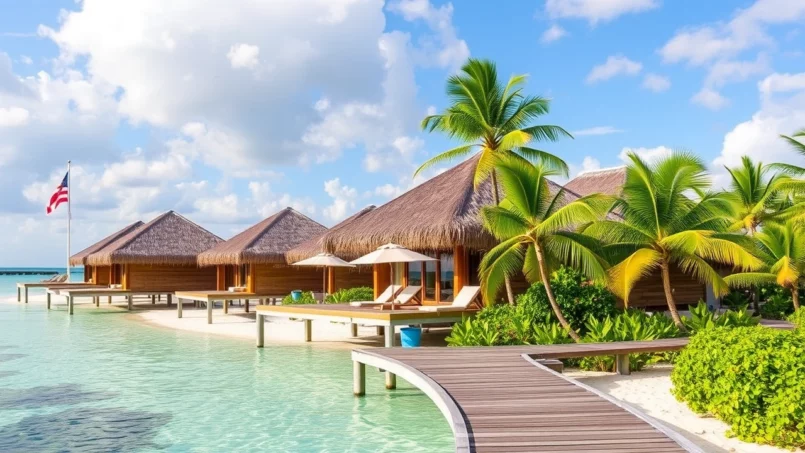
In the Maldives, real estate is as much a dream as it is thought-provoking. Between overwater villas costing several million dollars, highly profitable urban apartments around Malé, and new investment-linked residency programs, the archipelago has become a unique destination for expatriate investors. But the legal framework is strict, leases are temporary, and climate-related challenges are ever-present.
This guide details key aspects for expatriates: specific ownership rules, types of properties accessible, potential yields, applicable taxation, visa conditions, risks to consider, and best due diligence practices to follow.
Understanding the Economic and Real Estate Context
The Maldives is an archipelago of 1,192 coral islands in the Indian Ocean, organized into 26 to 27 atolls depending on classification. The country is home to between 523,000 and 600,000 inhabitants, with a very high concentration in the Greater Malé region, the administrative, economic, and demographic heart.
The economy relies heavily on tourism, which directly generates about 28% of GDP and up to 70% if indirect effects are included. In 2024, over 2 million visitors were recorded, most staying in high-end complexes. GDP is around $5.7 billion, with growth expected between 5.2% and 7% per year until 2027.
This is the Maldives’ total land area (km²), explaining land scarcity and high real estate prices.
Performance data shows long-term price increases, with more or less dynamic phases.
| Period | Average Annual Price Increase |
|---|---|
| 2010 – 2015 | 4 to 5% |
| 2016 – 2020 | 6 to 8% |
| 2020 – 2022 | 3 to 5% |
| Since 2023 | 8 to 10% |
Adding to this context are two structuring elements for an expatriate investor: a stable currency (the rufiyaa is pegged to the dollar at around 15.42 MVR to 1 USD) and a decidedly pro-investment government policy, driven by the “Vision 2040” strategy which aims to diversify the economy through real estate, Islamic financial services, technology, and renewable energy.
What Foreigners Can (and Cannot) Buy
The starting point, often confusing for an expatriate, is constitutional: in the Maldives, freehold land ownership is reserved for Maldivian citizens. In practice, this means a foreigner cannot own the land itself, except in very rare exceptions under specific regimes in Special Economic Zones.
For non-nationals, the central tool is the long-term lease, or leasehold. One does not buy “the land,” but a usage right for a set period, typically between 50 and 99 years. Upon expiration, the land and structures revert to the state (or the primary lessor), unless renegotiated, which is never guaranteed.
The applicable legal framework mixes national land law, tourism law, and specific foreign investment rules. Key texts notably include these different areas.
| Text / Legal Framework | Main Role for Foreign Investor |
|---|---|
| Constitution | Reserves freehold land ownership for Maldivian citizens |
| Land Act (2002, revised 2015) | Governs land allocation, sale, transfer, and leasing |
| Tourism Act (2/99, multiple amendments) | Governs resort islands, tourism leases, sub-leases |
| Foreign Investment Act / Maldives Investment Act | General framework for foreign investment and investment agreements |
| Special Economic Zones Act (2014) | Derogatory regime for very large projects (taxation, duration, etc.) |
| Integrated Tourism Model (2019) | Authorizes mixed projects with a residential component for foreigners |
Concretely, an expatriate can invest in different types of assets, but always within a framework delimited by the state and tourism authorities:
– overwater or beachfront villas within resorts or branded residences
– apartments or condos in integrated tourist complexes
– urban apartments in Greater Malé, primarily in Hulhumalé
– villas or rooms in “managed residences” or aparthotel programs
– sub-lease rights within a resort island (via a strata-title or co-ownership structure)
Conversely, buying an individual house on a local island for purely residential use, as one might do in many countries, is generally not possible for a foreigner. Expected investments must contribute to the economy, notably through tourism.
Main Real Estate Investment Models
Within this framework, several structures have developed over time, adapted to different expatriate investor profiles.
Resort Lease (Master Lease) and Sub-Leases
First level: major operators (hotel chains, funds, developers) obtain a long-term lease from the state for an entire island or lagoon. This “master lease” often runs for 50 years, sometimes up to 99 years, with an annual rent payable to the state (tourism land rent, typically $8 to $10 per m² per year for the leased area).
Based on this, the operator builds a resort and can either:
– operate the entire property themselves
– grant sub-leases for villas or apartments to individual buyers (a system similar to co-ownership under a lease, via a strata-lease title)
The expatriate who buys a villa under this scheme becomes the holder of a leasehold right for the unit until the end of the master lease. They can sometimes use the property for a few weeks per year; the rest of the time it is rented to tourists through the resort, with revenue sharing.
Branded Residences and Integrated Apartments
Many projects combine hotel and residences: examples include Baccarat Hotel & Residences, Zamani Islands, Aman Residences, or programs like Samana Ocean Views by Elie Saab.
Rental real estate investment in France attracts expatriates for several reasons: market stability, potential tax advantages like the non-professional furnished rental regime (LMNP), and the possibility of preparing for a return home by building assets. For example, an expatriate in Asia can buy a studio in Paris to rent it out, benefiting from supplemental income in euros and a property that can serve as housing upon their return.
– reassuring international brand
– turnkey rental management
– very high construction and service standards
– possibility of integrating an investment-linked residency program (special resident visa for a purchase of at least $250,000 in an approved project)
The gross yields announced for these products generally range between 5% and 9% depending on the type: typically 5 to 7% for ultra-luxury overwater villas, 6 to 8% for integrated resort residences, and up to 7 to 9% for well-located tourist apartments.
Joint Ventures and Local Companies
For more ambitious projects (hotel development, acquisition of an island lease, project in a special economic zone, or sustainable township), it is common to use a Maldivian company majority-owned by foreigners (up to 95%) and at least 5% by a local partner.
This investment scheme, more complex and costly, often requires a minimum investment starting from $1 million for a hotel project, $100 million for some special economic zones, and $500 million for a “sustainable township.” In return, it offers increased control for the professional investor or family office.
Urban Investment in Greater Malé
For an expatriate seeking a more “classic” approach, the rapid urbanization of Greater Malé offers another path. Malé is one of the densest capitals in the world: over 250,000 inhabitants on about 8 km², exorbitant rents (over $1,000/month for a simple room), and sale prices often between $5,000 and $10,000 per m².
The real development zone, however, is Hulhumalé, an artificial island and planned extension of the capital, connected by bridge to the airport and Malé. Here you can find:
– modern apartments ranging from $250,000 to $900,000 depending on size and location
– strong rental demand, driven by the middle class, tourism workers, and expatriates
– announced gross yields between 7% and 10%
Available data indicates precise yields in certain sub-sectors of Hulhumalé, as shown in the following table.
| Area of Hulhumalé | Estimated Average Gross Yield |
|---|---|
| Center | 8.23% |
| Periphery | 8.08% |
| Overall Price-to-Rent Ratio | ~12 |
For an expatriate seeking regular cash flow rather than an ultra-luxury villa, this urban segment can prove more accessible and more liquid.
Where to Invest: Focus on Key Atolls and Areas
The archipelago offers very different realities depending on the atoll. Not all have the same clientele, price levels, or appreciation prospects.
Greater Malé: Malé, Hulhumalé and Surroundings
Greater Malé concentrates almost half the national population, most services, jobs, infrastructure, and air connections. It is the economic heart, but also a saturated rental market, especially for residential property.
Prices in Malé itself:
– are generally between 5,000 and 10,000 USD/m²
– can significantly exceed these levels for the best locations (waterfront, proximity to business centers)
Hulhumalé, a new city designed with a ‘livability’ index developed with the UNDP, offers a structured environment, new real estate programs, and attractive rental yields.
Many projects offer rental yields above 8%.
Example programs: Savya Stars or The Marina Residence.
Housing (studios or 1-bedroom) available from around $250,000 to $300,000.
Historical Tourist Atolls
The atolls close to Malé remain the beating heart of luxury resort tourism:
– Kaafu Atoll (North and South Malé): historical zone, proximity to the airport, density of resorts. The price of a high-end overwater villa can exceed $3.5 million.
– Ari (notably South Ari): renowned for year-round whale sharks, mix of mid-range and luxury resorts.
– Baa Atoll: a UNESCO Biosphere Reserve, prime ecotourism location. Resorts here often boast occupancy rates above 80% and attract a wealthy clientele sensitive to environmental issues.
– Noonu Atoll: home to Soneva Jani, a symbol of ultra-luxury. Overwater villas can sell starting from $3 million, up to over $10 million.
Emerging Atolls with High Appreciation Potential
Other more remote atolls represent medium-term appreciation bets, driven by new domestic airports or incentive policies:
| Atoll | Characteristics and Indicative Prices | Estimated Yield or Potential |
|---|---|---|
| Raa | Relatively close to Malé, 49-year leases, VAT incentives | Yields 5–7%, approx. $900/ft² |
| Shaviyani | Preserved reefs, new domestic airport | Projected growth up to 30%/3 years |
| Lhaviyani | 50 min by seaplane, villas < $1,500/ft² | Yields 8–9% |
| Addu | Southern region, international airport, bridges between islands | Villas $500,000 to $1.5M |
For an expatriate, these emerging atolls are well-suited for capital gain strategies combined with moderate rental yield, notably via residences integrated into resorts.
Local Tourist Islands
Another developing segment is on inhabited islands open to tourism: Maafushi (budget), Thulusdhoo (surf / digital nomads), Dhigurah (diving and nature), and many other islands in Addu and other atolls.
The maximum monthly rent for a long-term lease in the dominant accommodation on these islands, such as guesthouses and small hotels (USD).
Prices, Yields, and Return Scenarios
On paper, Maldivian real estate combines price appreciation and high rental yields, especially compared to mature markets in Europe or North America.
Available benchmarks provide the following orders of magnitude.
| Property Type / Location | Typical Gross Rental Yield |
|---|---|
| Branded overwater villas (premium segment) | 5 – 7% |
| Beachfront villas | 4 – 6% |
| Integrated resort residences | 6 – 8% |
| Apartments in resorts | 7 – 9% |
| Urban apartments (Greater Malé / Hulhumalé) | 7 – 10% |
| Well-located guesthouses | 8 – 12% |
In parallel, five-year price appreciation projections suggest:
– 6 to 8% per year for premium branded properties
– 5 to 7% for North and South Malé atolls
– 7 to 9% for Baa Atoll
– 8 to 10% for emerging atolls like Lhaviyani, Raa
– 4 to 6% for urban apartments in Greater Malé
Several studies and project examples (like Coral Residences) mention price increases of 15% before delivery and then annualized returns of 8 to 10% over the decade following commissioning.
Studies and real estate project examples (e.g., Coral Residences)
However, one must distinguish between gross yield and net yield: in an aggressive marine environment, with staff to house and pay, significant operating costs, and a share of revenue returned to the operator, the margin shrinks. Operating expenses can absorb 25 to 35% of revenue, and it is prudent to reserve 2 to 3% of the property’s value annually for major maintenance.
Ultimately, many analyses converge on a “realistic” net yield between 4% and 6% for quality island villas, and more for good urban apartments or highly efficient guesthouses.
Tax Framework: An Attractive Yet Technical Environment
One of the great strengths of the Maldives is its perception as a light-tax jurisdiction for individuals: no personal income tax, no wealth tax, no specific inheritance tax, and no capital gains tax on real estate as known in many countries.
In practice, this idyllic picture must be nuanced by several layers of indirect or corporate taxation.
Key Taxes and Fees for a Foreign Investor
For an expatriate investing via a company or in a tourism scheme, the main levies are as follows.
| Type of Tax / Charge | Rate or Indicative Range |
|---|---|
| GST on real estate purchase (non-tourism) | 6% of acquisition price |
| GST tourism sector (tourist services) | 16% (increase to 17% planned) |
| “Green Tax” | $6 to $12 / tourist night (depending on accommodation type) |
| Tourism Land Rent (master lease) | $8 – $10 /m²/year (for resort islands) |
| Corporate Profit Tax | 0% up to 500,000 MVR, then 15% beyond |
| Corporate Tax for banks | 25% |
| Withholding tax for non-residents | 10% on certain payments (rents, royalties, etc.) |
| Lease/Transaction registration fees | Approx. 0.1 – 0.2% + fixed costs ($1,000 – $3,000) |
For foreigners, total transaction costs (duties, lawyers, notaries, agencies, registration, exchange) generally amount to around 8 to 12% of the purchase price. Added to this is the fact that most tourist rental income goes through the operating structure (resort, operator), which often keeps 40 to 60% of gross revenue for management, marketing, and services.
While there is no specific capital gains tax, profits generated via a Maldivian company may be subject to corporate profit tax at a rate of 15% beyond a threshold of 500,000 MVR (Maldivian Rufiyaa). It is highly recommended to consult a local tax expert to optimize the investment structure.
Visas and Investment-Linked Residency: The Added Advantage
Maldivian real estate is not just a simple financial transaction. Since 2021, and then with the launch of a more ambitious program in 2025 in partnership with Henley & Partners, the archipelago also uses property as a lever for investor residency.
Several schemes coexist:
– Special Resident Visa: accessible for purchasing a property worth at least $250,000 in an approved project. The visa is valid for 5 years, renewable as long as the property is held, and can include close family.
– Investor Visa: for an investment of at least $250,000 in a company registered in the Maldives, with a visa for up to 5 years renewable.
– Premium programs: with thresholds between $5 and $10 million, combining real estate investments and business projects, clearly targeting an ultra-high-net-worth clientele.
These visas do not lead to permanent residency or citizenship. Naturalization remains possible only after 12 years of continuous residence, conditional on being Muslim, speaking Dhivehi, and accepting exclusivity of Maldivian citizenship for new naturalized citizens.
For an expatriate, the immediate interest is primarily practical and fiscal:
– easier setup as a resident, without strict minimum presence requirements
– possible family reunification (spouse, children, sometimes parents and grandparents)
– easier access to the local banking system and certain services
– possibility to base residency on an income-producing real estate asset
Financing: Why Cash Dominates
Access to local credit remains very limited for foreigners. Maldivian banks, dominated by the Bank of Maldives (BML), favor residents and citizens, and interest rates are high: long-term mortgage rates frequently exceed 12% per annum.
The minimum down payment required for Islamic real estate financing products, which have profit rates of 9-11%.
Faced with this, over 70% of international buyers pay in cash. Otherwise, expatriate investors often prefer:
– refinancing real estate assets in their home country
– lines of credit (home equity, Lombard loans)
– installment payment plans offered by developers (30 to 50% down payment, 5 to 8% interest over 3 to 5 years)
Before opting for a leveraged structure, it is crucial to factor the cost of debt into the net yield projection: an investment offering a 5 to 6% net yield will not easily support financing at 10 or 12%.
Specific Risks: Climate, Politics, Lease Market
Investing in the Maldives means accepting a combination of risks rarely found together elsewhere.
Climate and Environmental Vulnerability
The country is the flattest in the world: average altitude 1.5 meters, highest natural point at 2.4 meters. Nearly 80% of the islands are less than one meter above current sea level. Sea-level rise projections (0.5 to 0.9 meters by 2100) suggest scenarios where a large part of the archipelago could become uninhabitable or threatened.
The coral reefs, which constitute the major tourist asset, are themselves vulnerable: about 60% are estimated to have already experienced significant bleaching episodes. Add to this seasonal storms (notably in May and October) and the risk of tsunamis, like the one in 2004.
The government devotes a massive share of its budget to adaptation (up to half of the state budget by some estimates), develops floating city or artificial island projects, and increasingly imposes sustainability standards on new developments (at least 60% renewable energy for “sustainable townships,” strict waste management, coastal protections, etc.).
For an investor, it is essential to integrate a very thorough technical analysis during due diligence.
– site elevation and topography
– protections against erosion and swell
– adopted construction standards (materials, anchors, marine protection)
– the project’s concrete sustainability commitments
Perishable Nature of Leases
A 50 or 99-year lease is an asset that depreciates mechanically as years pass. The resale value 20 years from the lease end will have nothing in common with that of a “fresh” lease with 95 years remaining.
In practice, this translates to:
– a non-linear value curve, with accelerated erosion in the final decades of the lease
– a strong dependence on the ability to renegotiate a renewal with the state or lessor at expiry, which is never guaranteed
– a narrower base of potential buyers for maturing leases
Before investing, it is essential to know the remaining term of the master lease, any renewal clauses, the state’s historical policy on renewal, and the market’s perception of this type of asset.
Political and Regulatory Risk
The Maldives has experienced several episodes of political tension, and its judicial system is sometimes criticized by international observers for a lack of independence. In a country where the state remains the landowner, the legal security of long-term leases depends largely on the stability of institutions.
In parallel, the regulatory framework evolves: strengthened transparency obligations on beneficial owners, new laws on currency conversion, reform of tourism taxation, adjustments to investor visa conditions…
This requires constant legal and tax monitoring, as well as reliance on a trusted local firm accustomed to navigating these changes.
Narrow Resale Market
The Maldivian real estate market, especially for ultra-luxury overwater villas or very high-end residences, remains narrow. Demand is international, but the number of potential buyers is limited. Resale periods can extend from 6 to 12 months, sometimes longer.
For an expatriate, it is better to consider this investment as a long-term position (10 years and more), combining rental yield and potential capital gain, rather than a highly liquid asset.
Due Diligence: What an Expatriate Must Absolutely Check
The scale of the stakes demands due diligence that is far more rigorous than for buying an apartment in a major Western city. Several areas must be covered systematically.
Legal Checks
First, clarify the ownership structure:
– who is the holder of the master lease for the island or land?
– what is the exact lease term and its remaining duration?
– what are the sub-lessor’s (the developer or resort) rights to assign sub-leases?
– is the project properly registered with the Ministry of Tourism and land authorities?
It is essential to have:
– the master lease agreement (or at least a detailed extract)
– the draft sale and sub-lease agreement
– tourism and environmental permits (EIA validated by the Environmental Protection Agency)
– the bylaws of the strata-title or co-ownership regime into which the property falls
A Maldivian lawyer specializing in real estate must imperatively analyze the documents, verify the absence of mortgages or encumbrances, and ensure compliance with the operator’s obligations to the state (master lease rents, taxes, etc.). Any default at this level can indeed impact the validity and security of the sub-leases.
Economic and Financial Analysis
Financially, one must: prioritize savings, reduce debt, and invest wisely.
– compare the price per m² or square foot with recent transactions in comparable projects (same atoll, same segment)
– analyze the operator’s yield projections: occupancy rate assumptions, daily rate levels, revenue split between owner and manager
– factor in costs: management fees (often 40–60% of revenue), structural maintenance, repair reserves, taxation (GST on income, environmental taxes), marketing costs (OTA, marketing)
In the case of an off-plan purchase, one must additionally evaluate:
– the developer’s financial strength
– their delivery track record (for example, projects like Coral Residences have shown pre-delivery price increases of around 15% in six months, but such performance is not transferable everywhere)
– the payment schedule and completion guarantees
Physical and Environmental Inspection
An independent technical inspection is recommended, even for a new property:
The essential elements to verify to ensure the durability and safety of an overwater villa in a marine environment.
Quality of piles and marine structures designed to support the villa over water.
Resistance to wind and salt spray, ensured by quality materials and anti-corrosion protections.
Water, electricity, and wastewater treatment systems adapted to an isolated environment.
Elevation relative to sea level and protective devices like dikes, rock armor, and breakwaters.
For large projects, coastal engineering reports and environmental impact assessments provide valuable insights into the site’s resilience to erosion and storms.
Tax and Exchange Compliance
Finally, it is advisable to verify how the following will be collected and remitted:
– GST on tourist rentals
– Green Tax on stays
– specific fees and taxes (tourism land rent, possible withholding taxes on payments abroad)
And to ensure with one’s bank and advisors that flows (capital inflow for purchase, outflow of dividends or rents) are compatible with exchange rules and reporting obligations in one’s country of tax residence.
For Which Expatriate Profile Does Maldivian Real Estate Make Sense?
In light of all these elements, real estate in the Maldives is clearly not a “mass-market” product. It appeals to several broad categories of expatriate investors.
First, high-income and high-net-worth individuals seeking:
– diversification into an ultra-premium tourism market
– an iconic second home (overwater villa, branded residence)
– resident status via a special visa, without full-time relocation
Next, tourism and hospitality entrepreneurs ready to:
– develop guesthouses, lodges, or small hotels on local islands
– take on the operational dimension (team management, marketing, yield management)
– benefit from potentially high gross yields in still unstructured segments
Finally, institutional or semi-institutional investors, who can deploy tickets starting from $1 million, or much more, into:
– resort, marina, private island projects
– joint ventures in special economic zones or sustainable townships
– integrated programs combining real estate, renewable energy, and services
For an individual expatriate with a more modest budget but sensitive to yields, urban apartments in Hulhumalé or certain approved residential programs in Greater Malé often represent the best compromise between:
– entry ticket ($250,000 to $500,000)
– structural rental demand
– more readable legal framework
– possibility of investment-linked resident visa
Conclusion: Tropical Dream or Rational Strategy?
Investing in the Maldives is no small matter. The paradisiacal setting must not hide fundamental realities: an atypical legal framework (absence of freehold ownership), an uncertain climate horizon, massive dependence on international tourism, and a narrow secondary market.
For a disciplined expatriate, ready to:
– work with an experienced Maldivian lawyer
– accept the perishable nature of a long-term lease
– integrate environmental and regulatory risks
– and not overexpose their assets to a single island market
Maldivian real estate can nevertheless play a very specific role in an overall strategy:
This investment combines rental yield with the advantage of a personal residence. It offers exposure to the sustained growth of the luxury tourism sector, particularly dynamic in Asia and the Middle East.
The real challenge lies in transforming a lagoon villa dream into an investment decision based on numbers, contracts, and a lucid understanding of the risks. In this context, the key is not so much finding “the most beautiful” property but selecting “the best structured” one: a well-documented project, backed by a solid operator, with a clear lease duration, manageable taxation, and a genuine long-term exit strategy.
Disclaimer: The information provided on this website is for informational purposes only and does not constitute financial, legal, or professional advice. We encourage you to consult qualified experts before making any investment, real estate, or expatriation decisions. Although we strive to maintain up-to-date and accurate information, we do not guarantee the completeness, accuracy, or timeliness of the proposed content. As investment and expatriation involve risks, we disclaim any liability for potential losses or damages arising from the use of this site. Your use of this site confirms your acceptance of these terms and your understanding of the associated risks.

Cyril Jarnias is an independent expert in international wealth management with over 20 years of experience. As an expatriate himself, he is dedicated to helping individuals and business leaders build, protect, and pass on their wealth with complete peace of mind.
On his website, cyriljarnias.com, he shares his expertise on international real estate, offshore company formation, and expatriation.
Thanks to his expertise, he offers sound advice to optimize his clients' wealth management. Cyril Jarnias is also recognized for his appearances in many prestigious media outlets such as BFM Business, les Français de l’étranger, Le Figaro, Les Echos, and Mieux vivre votre argent, where he shares his knowledge and know-how in wealth management.





