
 Published on and written by Cyril Jarnias
Getting around the Czech Republic without a car is not only possible, it’s often the simplest, most economical, and most comfortable solution. The country has a dense network of trains, regional buses, and integrated urban transport, with a level of service that surprises many visitors. Prague, in particular, is regularly cited among the European capitals with the best-functioning public transportation.
This practical guide compiles all the essential information for using public transportation in the country. It focuses in detail on Prague and its integrated PID system, while providing concrete points of reference for traveling in other Czech regions.
Understanding the Logic of Czech Public Transport
Before buying a ticket or looking for a subway, it’s useful to understand the general philosophy of the system. The Czech Republic has opted for a highly structured network, supported by regional organizing authorities and strong integration between modes.
The main rail lines are dominated by České dráhy, the national railway company, complemented by private operators like RegioJet or Leo Express. On the road side, many coach companies coexist, while cities generally manage their own urban networks (tram, trolleybus, bus).
To combat the fragmentation of transport, the Czech Republic has set up fifteen regional integrated transport systems. Each covers a specific geographic area, such as Prague and Central Bohemia, South Moravia with Brno, or the regions of Plzeň, Ostrava, and Liberec. Within these networks, a single ticket allows the use of different modes (regional buses, trams, local trains) under a common fare structure, thus facilitating intermodal travel on a local scale.
In Prague and the surrounding central region, this system is called Prague Integrated Transport (PID). It is organized by the ROPID agency, operated in Prague mainly by the DPP company, and extends up to 20–40 kilometers around the capital via suburban bus lines and commuter trains.
The main idea is simple: rather than adding up tickets, you combine zones and a period of validity. As long as your ticket is still valid in time and zones, you can board, get off, and change modes infinitely.
Prague: A Dense, Integrated… and Accessible Urban Network
Most travelers start their discovery of the country in Prague. This is also where the functioning of public transport is the most advanced, with a tight grid, high frequencies, a common fare system, and a very progressive accessibility policy.
Subway: The Backbone of Travel
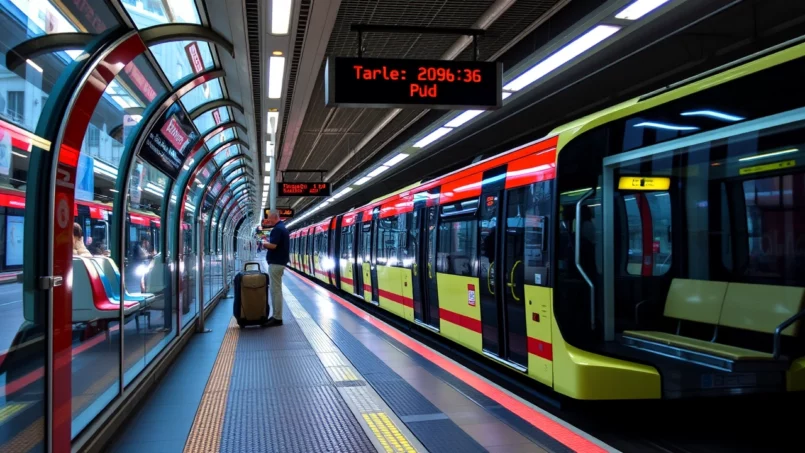
The subway is the fastest way to cross the city. It is operated by DPP and structured around three lines clearly identified by colors:
| Line | Color | Main Terminals (examples) | Notes |
|---|---|---|---|
| A | Green | Depo Hostivař – Nemocnice Motol | Crosses the center via Můstek and Muzeum |
| B | Yellow | Černý Most – Zličín | Serves residential neighborhoods and commercial areas |
| C | Red | Letňany – Háje | Direct connection to the main train station |
In total, the network has 61 stations. The system is one of the most used in Europe, with nearly 600 million passengers per year, placing it among the five busiest subways on the continent. A project for a fourth line (D) is in preparation, which will further strengthen the subway’s role in the coming years.
The three interchanges between lines are at Můstek (A–B), Muzeum (A–C), and Florenc (B–C). However, be careful for some trips with a wheelchair: the Můstek station, although important for transfers, is not accessible to people with reduced mobility, unlike Muzeum and Florenc, which do have step-free solutions.
Subway Accessibility: A Priority Project
DPP has set accessibility as a long-term strategic objective. The company invests tens of millions of Czech korunas every year to adapt stations and equipment. Out of the 61 stations, 48 are currently classified as “barrier-free” in the Czech sense of the term, meaning they can be used independently by people in wheelchairs, parents with strollers, and, more broadly, anyone with reduced mobility.
In 45 stations, access is via passenger elevators, sometimes in cascades when the depth is significant. Three stations (Nové Butovice, Smíchovské nádraží, Strašnická) complement this offer with inclined platforms mounted on the stairs. These devices theoretically allow the passage of a wheelchair, but they remain more prone to breakdowns and vandalism and often require staff initiative.
All platforms are equipped with tactile strips and deep grooves to guide blind or visually impaired people, and the elevator cabins have buttons in braille as well as an audio system connecting passengers to the station agent.
DPP collaborates with wheelchair user associations and the SONS organization for visually impaired people. This consultation allows prioritizing work and defining the most useful transformations, station by station. Several recent projects have been co-financed by the European Union through the “Prague – Competitiveness” program, confirming that accessibility is considered a strategic investment.
Some older stations, built before 1990 with no preparation for elevators, still remain partially or totally inaccessible. An upgrade schedule is underway: for example, construction of a cascade of two elevators at Flora is set to begin in fall 2025, while feasibility studies are underway for Českomoravská, Hradčanská, Křižíkova, or Náměstí Republiky.
It is also important to know that the accessibility of a station depends on all its equipment. Where a single elevator serves a platform, one breakdown is enough to make access impossible. Conversely, stations with two parallel devices offer better resilience. To avoid bad surprises, DPP has set up an SMS information system to check the operation of elevators and platforms in real time.
Boarding Trains: Steps, Ramps, and Level Differences
Even with an elevator in perfect condition, there remains one last potential obstacle: the horizontal gap and the height difference between the platform and the train. On lines A and B, 81‑71M type trainsets, inherited from the Soviet era, are still running. They have been modernized but their vertical behavior varies depending on load or wear. This can make boarding trickier for a wheelchair, especially on low platforms.
To limit this problem, DPP has equipped all stations on lines A and B with access ramps, systematically positioned at the first door of the first car. A wheelchair user benefits from positioning themselves precisely at this spot on the platform. Only one reported exception: one of the two platforms at the Zličín terminus, where the equipment is still missing.
On line C, the situation is more favorable: the newer M1 type trainsets have an automatic adjustment system upon stopping, which corrects the height to match that of the platform, providing much flatter and more consistent access.
Trams: A Tight Network, Day and Night
If the subway is king underground, on the surface, it’s the trams that set the tempo. Prague operates a particularly dense network, with 21 daytime lines and 9 night lines, covering nearly 88.5 miles of track, or more than 140 kilometers.
Trams run from 5 a.m. to midnight, with a frequency of 5 to 10 minutes. Wait times are often reduced in the city center where several lines overlap. LED screens show the waiting time in real time and indicate with a pictogram if the tram is accessible (low floor).
The rolling stock is very heterogeneous: about one third of the 931 trams are modern Škoda models with low floors, introduced from 2005 onward. They are recognizable at a glance by the wheelchair symbol at the front and their contemporary silhouette. Inside, a manual ramp deploys at the door closest to the driver, on request: simply signal to the driver, who lowers the ramp for boarding and alighting.
The other two thirds of the fleet still consist mainly of T3 high-floor trainsets from the 1960s, which require climbing several steps. Many are gradually being renovated with a central low-floor section and a ramp, creating hybrid vehicles that are easier to access. Despite this progressive modernization, part of the service therefore remains less convenient for wheelchairs or strollers, even though the stops themselves are, overall, properly equipped (raised sidewalks, beveled curbs).
At night, between about 12:30 a.m. and 4:30 a.m., a specific network of night trams takes over, with an adapted grid and organized connections. The lines are numbered in the 90–99 series. The principle remains the same: identical fares, same ticket type, but more spaced frequencies (generally every 30 minutes, sometimes 20 minutes on weekend nights) and a mandatory stop at certain central stops that act as interchange hubs.
Urban and Suburban Buses: Completing the Grid
Buses play a somewhat different role in Prague. In the city center, their presence is limited; they mainly take over in the outlying neighborhoods, connecting housing estates, industrial zones, or surrounding villages to subway or tram stations.
The city operates over a hundred daytime lines, numbered in different ranges depending on whether they are purely urban or suburban lines. The majority of urban buses are low-floor, equipped with a folding ramp at the central door. As with trams, it’s the driver who deploys it on request. Many services are accessible, which has greatly contributed to making bus use natural for wheelchair users and parents with strollers.
Some buses provide strategic connections, particularly to the airport and outlying towns. Other lines play a beltway role, allowing one to avoid a systematic trip through the city center and thus save time.
At night, the service transforms to adopt a simpler structure, with a network of lines numbered in the 900s (901–915). These night buses run every 30 to 60 minutes depending on the line and complement the night trams, including for reaching Václav Havel Airport, via lines 907 and 910 for example.
Connections to the Airport: Buses and Airport Express
Václav Havel Airport Prague is fully accessible to wheelchairs and well connected to the urban network.
Several regular bus lines provide the connection to the subway:
| Line | Type | Main Route | Average Time | Fare |
|---|---|---|---|---|
| 59 | Trolleybus | Airport – Nádraží Veleslavín (A) | 15–20 min | Standard PID fare |
| 100 | Bus | Airport – Zličín (B) | ~18 min | Standard PID fare |
| 907/910 | Night Bus | Airport – Prague center (night) | ~45 min | Standard PID fare |
Alongside these lines integrated into the PID system, a specific service, the Airport Express (AE), connects Terminal 1 directly to the main train station (Praha hlavní nádraží). This express bus runs continuously during the day, about every 30 minutes, and takes roughly 40 minutes to reach the center. Its peculiarity: it is not priced like other PID lines, but as a dedicated service for rail travelers. The ticket costs significantly more than a standard urban ticket and is purchased from the driver or at information centers linked to the railways.
For a controlled budget, buses 59 or 100 combined with the subway remain the most interesting option. For a loaded or rushed traveler who wants to get off directly at the main station, the AE can, on the other hand, represent a good compromise.
Funicular, Ferries, Tourist Lines: Smart Supplements
The territory of Prague is not flat, and some reliefs are used for tourism. The Petřín funicular thus connects, from the Malá Strana district (Újezd Street), the wooded slopes up to the top of the hill, with an intermediate stop at Nebozízek. This little cable car is an integral part of the network, but with a fare peculiarity: it is included in the 24- or 72-hour passes, as well as in subscriptions, but requires a specific ticket if you only have a simple 30- or 90-minute ticket.
On the Vltava, several ferries (lines P1, P2, P3, P5, P6, P7) allow crossing from one bank to the other without detour. They use the same ticket system as the rest of the network. In parallel, some private tourist services, like the “Prague Venice” cruises, offer crossings with their own pricing.
Finally, certain historical tram lines, like routes 41 and 42, run on weekends and public holidays from April to mid-November with vintage vehicles. They require a specific, more expensive ticket, while another retro line, 23, accepts ordinary PID tickets.
Fares, Discounts, and Ticket Purchases: How to Pay the Right Price
The question of fares is often the one that worries the most before arrival. In the Czech Republic, two logics coexist: a national logic of mandatory discounts (for children, students, seniors, persons with disabilities) and local fare systems specific to each urban or integrated network. In Prague, these two layers overlap.
Tickets in Prague: Duration Rather Than Distance
Within the capital, the basic tickets are time-limited passes, valid on all PID modes (subway, tram, bus, S-trains within the city, ferries, funicular under conditions). They are not limited in the number of transfers, but in time.
For adults without a specific discount, the standard formats are, for example:
| Ticket Type | Validity Period | Example Indicative Price* | Notes |
|---|---|---|---|
| Short Stay | 30 minutes | Approx. 30–39 CZK | Bus, tram, subway, unlimited transfers within the allotted time |
| Long Stay | 90 minutes | Approx. 40–50 CZK | Ideal for crossing the city or combining bus+tram+subway |
| Day Pass | 24 hours | Approx. 120–150 CZK | Includes the Petřín funicular |
| 3-Day Pass | 72 hours | Approx. 330–350 CZK | Very cost-effective for an urban stay |
*The exact amounts vary depending on whether you buy via the app, on paper, or by SMS, and on the effective date of new fares. However, they remain within this order of magnitude.
Subscriptions (30 days, 90 days, 365 days) are particularly attractive for residents or long-term visitors. An annual pass for Prague costs on the order of a few thousand korunas (around 3,650 CZK for a registered pass), a very competitive price if divided by 12.
For paper tickets purchased from a machine or shop, validation in a yellow stamping machine is required upon first use. A single validation is sufficient for the validity period, but forgetting to validate renders the ticket invalid. For electronic tickets in the PID Lítačka app, activation triggers a countdown (usually two minutes) before the validity begins, requiring anticipation before accessing the transport.
National Discounts: Half Price for Children, Students, and Seniors
Beyond Prague, the country applies a strong national policy to support travel for the young and the elderly. A key measure established a 50% discount on base fares for trains and buses for:
– children and adolescents aged 6 to 15,
– pupils and students aged 15 to 26,
– seniors aged 65 and over.
This discount applies across the entire country, on railway lines as well as coaches, regardless of the operator (České dráhy, RegioJet, Leo Express, GW Train Regio, Arriva, etc.). For international connections, the discount only concerns the portion traveled in the Czech Republic.
It only applies in second class (or equivalent with private operators) and excludes certain special or tourist services. However, it works every day of the year, without limitation to school trips.
In Prague, this national policy combines with the PID system specific to the capital. The result: certain categories travel for free in the city, regardless of the mode of transport (excluding Airport Express). This applies to:
– children under 6 years old anywhere in the country, as long as they are accompanied by a person over 10;
– children aged 6 to 10, who travel for free within the city of Prague;
– young people aged 10 to 15, who also benefit from free travel in the Prague zone subject to being able to prove their age;
– seniors aged 65 and over, who no longer pay in Prague (including for the Petřín funicular, but excluding the AE line).
Between 60 and 65 years old, seniors benefit from reduced fares (half-price tickets or specific subscriptions), but not free travel. Students aged 18 to 26 can also obtain discounts on subscriptions, provided they are in full-time initial education at a Czech institution.
Persons with disabilities holding a ZTP or ZTP/P card enjoy a particularly favorable regime: a mandatory 75% discount on tickets throughout the country and complete free travel in Prague for them, their attendant, and their guide dog if applicable.
Where and How to Buy Tickets
The range of sales points is deliberately broad to avoid any excuse for traveling without a ticket. You can find tickets:
– in the automatic vending machines at subway stations and many tram or bus stops;
– at the counters and PID network information centers (present at the main station, several major stations, and directly at the airport);
– in some newspaper kiosks and tobacco shops (trafika);
– directly from the drivers, on suburban buses, for basic tickets;
– in modern trams, buses, and trolleybuses, via contactless terminals inside the vehicles;
– on trains operated by České dráhy and other carriers, provided you explicitly request a PID ticket when traveling within the integrated network perimeter.
The newest machines and terminals accept contactless payments (debit card, Visa, Mastercard) and, often, coins. Some vending machines at major hubs (main station, airport) also accept Czech banknotes. The onboard terminals work exclusively with bank cards.
Tickets purchased from drivers, at railway counters, or on electronic terminals are generally pre-validated and do not require stamping. On the other hand, tickets obtained from a shop, kiosk, or via an automatic vending machine must be stamped (validated) in a yellow validator before the start of the journey.
The PID Lítačka App: The Digital Swiss Army Knife
For those traveling with a smartphone, the PID Lítačka app has become the central tool. Developed for the City of Prague by the company Operátor ICT, it combines three main functions: ticket purchase, route search, and real-time information.
The app allows you to: manage your tasks, track your goals, and organize your schedule.
– buy short-term tickets (from 15 minutes to 72 hours) as well as monthly, quarterly, or annual subscriptions;
– store multiple tickets, activate them when needed, or even transfer them to another user by email;
– check at a glance the next departures at a stop, vehicle positions, disruptions on a line;
– plan routes combining subway, tram, bus, train, funicular, and ferries, optionally with a filter to prioritize low-floor vehicles;
– also manage parking in paid zones of the capital, for those arriving by car.
Purchases are made by bank card, Google Pay, or Apple Pay. The app applies the same pricing as physical tickets, sometimes with slight savings, and even offers automatic capping: once the sum of your small ticket purchases during the day reaches the price of a 24-hour pass, the app converts your tickets into an equivalent daily pass, so you never pay more than a day pass.
The only real constraint is activation: an “immediate” ticket only becomes valid one to two minutes after pressing the button. This deliberate desynchronization aims to avoid fraud consisting of buying a ticket only when one sees a ticket inspector.
Traveling by Train: The National Backbone
On a country scale, the train is the great backbone of intercity travel. With nearly 9,500 kilometers of tracks, the Czech Republic has one of the densest railway networks in the world relative to its area. The lines serve medium-sized towns, boroughs, and industrial hubs, while also providing connections to neighboring countries (Germany, Austria, Poland, Slovakia, Hungary, Switzerland, etc.).
České dráhy: A Giant in Modernization
České dráhy (ČD) – literally “Czech Railways” – is the historic operator. Founded in 1993 after the split of Czechoslovakia, it claims a railway heritage dating back to 1827 and its first horse-drawn tracks. Today it operates about 6,500 trains per day, or nearly 2.5 million passenger trains per year, and transports around 180 million passengers in a full year.
The group has launched a vast modernization program, called “Strategy 2030“, which includes the acquisition of dozens of new trainsets. Among the flagship models are:
– the RegioPanter and RegioFox units for regional services;
– Vectron locomotives;
– ComfortJet trainsets, designed with Siemens and Škoda, capable of reaching 143 mph (230 km/h).
These trains complement or replace older equipment, such as Pendolino (up to 100 mph / 160 km/h) or some classic trainsets. They also aim to raise the Czech offer to international standards, which earned ČD an international distinction (“Global Recognition Award”) in 2024 for its contribution to rail development.
České dráhy (ČD)
For the traveler, this translates into long-distance trains equipped with free Wi‑Fi, power outlets, a dining or bistro car, bicycle compartments, and dedicated spaces for wheelchairs.
Train Categories, Classes, and Onboard Services
The system distinguishes several train categories, from local service to international express:
| Category | Code | Type of Service |
|---|---|---|
| Osobní | Os | Local/stopping train, stops at all stations |
| Spěšný | Sp | Regional semi-fast train |
| Rychlík | R | “Fast” train connecting medium-sized towns |
| Expres | Ex | Classic express |
| InterCity | IC | High-standard fast train |
| EuroCity | EC | Quality international connections |
| SuperCity | SC | Pendolino high-speed |
| Railjet | RJ | Fast international trainsets (ČD/ÖBB) |
| ComfortJet | – | Latest generation ČD high speed |
The major national connections (Prague–Brno, Prague–Ostrava, Prague–Plzeň, Prague–Olomouc) are often served by R, Ex, IC, EC, RJ, or SC, with competitive travel times: about 2 h 30 for Prague–Brno, 3 h 15 to 3 h 40 for Prague–Ostrava, 1 h 30 for Prague–Plzeň.
Most trains offer at least two classes:
– Second class (2nd): 2+2 seating, free Wi‑Fi on many lines, power outlets, air conditioning;
– First class (1st): wider seats in 2+1 layout, increased space and quiet, sometimes additional services (newspapers, water, snack) on Railjet, Pendolino, or ComfortJet.
Reserved spaces and station assistance are available. To use mobile ramps to bridge the gap between the platform and the train, it is mandatory to signal your need at least 24 hours in advance to the ČD customer service.
Buying Train Tickets: Online, at the Station, or via App
Rail tickets can be booked through several channels:
– the České dráhy website, which offers national and international tickets, advance-purchase discounts, discount cards (In Karta), and a loyalty points program (ČD Points);
– the official mobile app “Můj vlak” (“My Train”), which combines schedules, ticket purchase, real-time information, and onboard services;
– the counters and vending machines at major stations (Prague hlavní nádraží, Brno, Ostrava, Olomouc, Plzeň, etc.);
– intermediaries like Omio or Rail Ninja, rather aimed at foreign travelers.
Prices are calculated mainly by distance, with surcharges depending on the train category and class chosen. There are very many discounts available: round-trip tickets, youth cards (In Karta with 25, 50, or 100% discount), group tickets, weekend offers, SONE+ (family day ticket for travel on regional trains), bike tickets, etc.
The national 50% discount for children, students, and seniors applies on trains, but only in second class. On some higher-category trains (like the SuperCity Pendolino), seat reservation may be mandatory and chargeable.
Main Stations: Accessibility and Connections
The major Czech stations have undergone a real upgrade. Prague’s main station (Praha hlavní nádraží) is emblematic: created in 1871, it has been deeply renovated to offer:
– elevators and escalators to all platforms;
– step-free paths to line C of the subway and to tram/bus stops;
– moving walkways, information counters, shops, and services (dining, luggage lockers, car rental, etc.);
– an assistance service for wheelchair boarding via ramps, ideally reserved the day before.
The other major hubs (Brno hlavní nádraží, Ostrava hlavní nádraží, Olomouc hlavní nádraží, Plzeň hlavní nádraží) have also been modernized with common features: elevators, level access, adapted toilets, clear connections with urban networks (tram, trolleybus, bus).
For a foreign traveler, English is widely spoken at the main counters, which facilitates ticket purchases or information requests.
Other Cities: Trams, Trolleybuses, and Modern Buses
If Prague concentrates attention, other major Czech cities also offer good-quality urban networks, often equipped with trams or trolleybuses.
In Brno, Olomouc, and Ostrava, for example, the majority of trams and buses are low-floor. Drivers are supposed to assist with ramp deployment when requested. Ostrava, via its DPO company, has even generalized dematerialized tickets: you pay for your trip directly with your contactless bank card or an ODISka card, with paper tickets reserved for a few tourist products.
The city is modernizing its network of trams, trolleybuses, and buses with card payment onboard and SMS tickets for Czech numbers. Multi-day tourist offers are available. Since 2020, the region uses at least partially low-floor buses on regional lines, and the accessibility of train stations and platforms improves each year.
Everywhere, the trend is towards mode integration: regional systems coordinate schedules and fares between buses and trains, to limit duplication and ensure fairly coherent connections, even in rural areas.
Accessibility at the National Level: Arrival by Plane, Train, Bus, or Car
For a traveler with reduced mobility, accessibility is not just about the city. Arriving in the country, whether by plane, rail, road, or by one’s own means, also relies on a set of arrangements.
Prague Airport (Václav Havel) is fully accessible with elevators, adapted toilets, and trained staff. Buses 59 and 100 to the subway are low-floor with ramps. In other cities (Brno, Karlovy Vary, Ostrava, Pardubice, Kunovice), the infrastructure is modernized but the offer of flights and urban transport remains more limited.
By train, the key is anticipation: signaling your needs to České dráhy at least 24 hours before departure. The major stations in Prague, Brno, Ostrava, or Olomouc have been reconfigured with elevators, ramps, and wheelchair assistance. On small lines or in the countryside, platform upgrades are progressive: you may sometimes benefit from a mobile ramp, sometimes not.
For long-distance coach travel, accessibility varies. Although some bus stations are poorly equipped, operators like RegioJet or FlixBus sometimes have vehicles equipped with lift platforms. It is therefore recommended to contact the company directly before each trip to check access conditions.
Finally, for those who choose to rent a car, the country has a very dense highway network and service stations. The majority of stations and rest areas along the main roads are equipped with accessible toilets. Highways are tolled via an electronic vignette for light vehicles, with several possible durations (1 day, 10 days, one month, one year).
Practical Tips for Using Czech Transport Well
Beyond the rules, a few local habits and tips help in experiencing Czech public transport serenely.
In the subway and on escalators, stand on the right and pass on the left. In trams and buses, always let passengers get off before boarding, as doors close quickly after the audible signal. During rush hours (6:30-8:30 a.m. and 4-6 p.m.), some lines are very crowded, but the high frequencies usually allow waiting for the next vehicle if you are in a wheelchair or heavily laden.
Ticket inspectors do not wear a full uniform, but must present an official photo ID card. In case of a check, it is essential to have a valid and correctly validated ticket (or activated for digital tickets). Otherwise, the fine can climb to several hundred korunas, although an immediate on-the-spot payment often allows a discount.
In most vehicles, audio announcements and screens indicate the name of the next station at each stop. For travelers not fluent in the local language, it is enough to know or have written down the name of your destination station to orient yourself easily.
Finally, the indispensable tool for planning a trip anywhere in the country remains the website and app IDOS (Jízdné Řády), which aggregates schedules for trains, regional buses, urban transport, and sometimes even boats. By entering a starting point and a destination, you get possible combinations, with indication of connections, duration, and often, the approximate price.
In Summary: A Country Where Leaving the Car Behind is Not a Handicap
Between the density of the rail network, integrated regional systems, well-structured urban networks, and an increasingly ambitious accessibility policy, the Czech Republic offers a very favorable environment for public transport travel.
Prague has a high-performing network (accessible subway, trams, buses) and the PID Lítačka app for tickets. Outside the capital, cities like Brno, Ostrava, Plzeň, and Olomouc allow crossing the country without a car, with advantageous fares for children, students, seniors, and persons with disabilities.
For those who prepare their trip with a minimum of anticipation – particularly on the question of the specific accessibility of stations and equipment – Czech public transport is not just a practical means of travel: it becomes the guiding thread for a smooth, economical, and largely inclusive discovery of the country.
Disclaimer: The information provided on this website is for informational purposes only and does not constitute financial, legal, or professional advice. We encourage you to consult qualified experts before making any investment, real estate, or expatriation decisions. Although we strive to maintain up-to-date and accurate information, we do not guarantee the completeness, accuracy, or timeliness of the proposed content. As investment and expatriation involve risks, we disclaim any liability for potential losses or damages arising from the use of this site. Your use of this site confirms your acceptance of these terms and your understanding of the associated risks.

Cyril Jarnias is an independent expert in international wealth management with over 20 years of experience. As an expatriate himself, he is dedicated to helping individuals and business leaders build, protect, and pass on their wealth with complete peace of mind.
On his website, cyriljarnias.com, he shares his expertise on international real estate, offshore company formation, and expatriation.
Thanks to his expertise, he offers sound advice to optimize his clients' wealth management. Cyril Jarnias is also recognized for his appearances in many prestigious media outlets such as BFM Business, les Français de l’étranger, Le Figaro, Les Echos, and Mieux vivre votre argent, where he shares his knowledge and know-how in wealth management.





