
 Published on and written by Cyril Jarnias
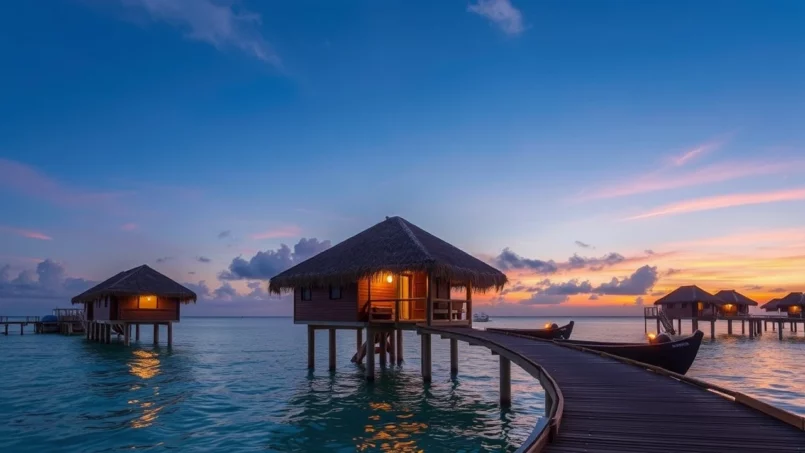
Moving from your home country to live in the Maldives often first brings to mind a postcard image: turquoise lagoons, white sand, an almost permanently blue sky. But behind this dream scenery lies a far more complex reality. Expatriation here rhymes with an ultra-fragile environment, high cost of living, strict religious and legal constraints, but also professional opportunities, a unique quality of life, and a profound human experience.
This article analyzes in detail the living conditions in the Maldives for expatriates, covering essential aspects such as climate, economy, job market, cost of living, legal framework, education, healthcare system, and environmental risks.
A Unique Living Environment: Tropical Paradise… Under High Climate Threat
Living in the Maldives means first and foremost inhabiting one of the world’s most atypical countries. The archipelago consists of about 1,192 coral islands grouped into 26 atolls, lying just above sea level in the Indian Ocean. No point in the territory exceeds 2.5 meters in altitude, and nearly 80% of the land area is less than one meter above sea level.
Climate: Constant Heat, High Humidity, and Monsoons
The climate is tropical monsoon. Temperatures hover around 31°C during the day and 23°C at night, with annual averages of about 30.4°C (max) and 25.7°C (min). Humidity levels range between 73% and 85%, meaning a near-permanent sultry heat. Sunshine is generous, but the weather is dictated by two main monsoons: the wetter southwest monsoon from May to November, and the drier northeast monsoon between January and March.
Average annual rainfall in millimeters in Kiribati, with regional variations ranging from 1,779 mm in the north to 2,277 mm on the southern atolls.
For an expatriate, this means a very stable climate in terms of temperature, but a hot, humid, and sometimes grueling atmosphere, especially for those who don’t tolerate heat well. The projected increase in the number of “hot” days and nights due to global warming suggests this oppressive heat sensation will only grow.
Existential Threat from Sea Level Rise
What especially distinguishes the Maldives from other tropical destinations is the extreme vulnerability to sea level rise. Projections mention a rise of between 0.5 and 1.10 meters by 2100. In this scenario, between 77% and potentially 100% of Maldivian territory could be submerged. In other words, the prospect of the physical disappearance of the country in the long term is not far-fetched, but a scenario taken very seriously, including by the local population and international organizations.
Faced with the threat of flooding due to climate change, which ranks the Maldives among the three most vulnerable nations, authorities are considering radical solutions like acquiring land abroad (India, Sri Lanka, Australia) to relocate the population, as well as projects for floating cities or elevated artificial islands.
For a prospective expatriate, this raises a fundamental question: am I ready to settle long-term in a country whose geophysical horizon is so uncertain, and whose economy must allocate more than half its budget to climate adaptation measures?
Coastal Erosion, Endangered Corals, and Pressure on Natural Resources
Images of pristine beaches hide a phenomenon of massive erosion. Nearly 97% of islands are experiencing shoreline retreat, and about 90% were already, in 2021, suffering from erosion considered “severe.” More than 60% of tourism infrastructure is estimated to have sustained damage related to these coastal dynamics and development practices (construction, land reclamation).
The New Caledonia archipelago, home to about 3% of the world’s coral reefs, experiences massive bleaching episodes. The 2016 episode affected nearly 60% of the reefs, with losses of up to 75% of corals in some areas. This degradation is mainly due to rising sea surface temperatures (by 0.11 to 0.15°C per decade) and ocean acidification. Scientists warn that global warming exceeding 2°C could lead to the disappearance of almost all shallow-water corals.
This degradation is not just an abstract ecological issue: it directly affects tourism (shrinking beaches, degraded dive sites) and fisheries, a sector that could see its catches almost completely collapse by the end of the century under a high-emissions scenario. For an expat, this impacts quality of life (beaches, snorkeling, diving) but also job stability in sea-related sectors.
Economy, Employment, and Salaries: Real Opportunities, Strong Dependencies
Economically, the Maldives presents a paradox: a high per capita income level relative to the region, but an extreme dependence on a few sectors and very concerning public debt.
A Model Based on Tourism and Fishing
The country is classified among Small Island Developing States (SIDS), and its prosperity relies mainly on two pillars: tourism and fisheries. Together, these two sectors generate nearly half of the GDP and employment. Tourism alone accounts for about 28% of GDP and over 60% of foreign exchange earnings, while fisheries remain an essential source of export revenue, despite a recent sharp decline in export volumes.
The per capita income is the highest in South Asia, which translates, for expatriates, into often attractive remuneration for qualified profiles, especially in high-end hospitality, construction, services, and certain specialized professions (doctors, engineers, teachers, environmental experts).
The capital Malé is the administrative, economic, and logistical heart of the Maldives, offering the most professional opportunities. However, it is also the most expensive and densely populated area. Rural atolls, with the exception of resort islands and a few regional hubs, are generally less well-equipped with infrastructure and offer fewer job prospects.
Job Market: Strong Foreign Presence, Growing Sectors
Nearly one-third of residents are expatriates, around 150,000 to 180,000 foreign workers according to estimates, mainly from South and East Asian countries (Sri Lanka, Bangladesh, India, China, Philippines…). In some sectors, foreign labor is overwhelming, particularly in hospitality, construction, and healthcare. In tourist resorts, only about one-third of the workforce is Maldivian.
For a qualified foreign professional, there are many growing sectors: tourism and hospitality (management, F&B, diving, wellness, marketing), construction (engineering, project management), healthcare (doctors, nurses, lab technicians), education (teachers, trainers), financial services, information technology, and also jobs related to the environment (marine biology, energy transition project management, conservation, eco-tourism).
Overview of average monthly net salaries by sector, expressed in Maldivian Rufiyaa (MVR).
Revolves around 14,700 MVR per month. Qualified expatriates can earn significantly higher remuneration.
IT: over 32,000 MVR. Management: about 31,500 MVR. Telecoms: over 26,000 MVR. Banking & Healthcare: 24,000 to 25,000 MVR.
Cap at around 13,000 MVR, making independent living difficult, especially in Malé or Hulhumalé.
A non-negligible advantage is the tax environment: no wealth tax, no capital gains tax, no inheritance tax, and a progressive but relatively moderate income tax, with tax brackets starting above 720,000 MVR annually (i.e., 60,000 MVR per month). De facto, a large number of expatriate employees remain below the highest thresholds. However, sending money abroad may be subject to specific taxes depending on banking arrangements.
Cost of Living: Paradise Comes at a Price
The Maldives is not a cheap destination for daily living, and the disconnect between average salary levels and the cost of expenses is one of the major stumbling blocks for expatriates.
Monthly budget estimates highlight several realities:
| Profile | Monthly budget excluding rent | Monthly budget with modest rent in Malé |
|---|---|---|
| Single person | 7,900 to 11,700 MVR (≈ 520 to 770 USD) | 22,000 to 25,000 MVR (≈ 1,450 to 1,640 USD) |
| Family of 4 | 22,200 to 39,400 MVR (≈ 1,460 to 2,590 USD) | 55,000 to 60,000 MVR (≈ 3,600 to 3,950 USD) |
Housing is a particularly heavy burden, often representing 30% to 50% of household budgets. In Malé, a simple one-bedroom apartment in the center often costs between 14,000 and 15,000 MVR per month, and a three-room apartment downtown far exceeds 26,000 MVR. In more peripheral areas or on islands like Hulhumalé, rents are slightly lower but remain high relative to the average salary.
Add to this food prices influenced by massive dependence on imports: more than 90% of the food consumed in the Maldives comes from outside, as the national arable land area does not exceed 28 km². Some staples remain cheap (rice, some local products), but dairy products, cheese, meat, imported fruits and vegetables, as well as international brand products, can be expensive and subject to supply disruptions.
The consequence for the expatriate: if the salary does not include a complete package (housing, food, transport to work, health insurance), life can quickly become financially strained. Figures also show that, on average, the net salary only covers 0.7 months of expenses for a typical individual, illustrating the structural gap between average local incomes and the cost of living in urbanized areas.
Choosing Your Island and Lifestyle: Malé, Hulhumalé, Local Islands, or Resort?
One of the most defining choices for an expatriate in the Maldives is the type of environment they wish to live in: a dense and bustling capital, a more spacious new artificial city, a relatively traditional local island, or a resort island almost hermetically sealed from the rest of the country.
Malé: Nerve Center, Expensive, and Stifling
Malé is the political and economic capital, but also one of the most densely populated cities in the world. Almost all administrative services, large companies, banks, and healthcare facilities are located here. For an expatriate working in services, finance, education, healthcare, or administration, it is often the mandatory landing point.
The trade-off is heavy: extreme density, heavy traffic, air pollution (average PM2.5 fine particle levels reach 19 μg/m3, four times the WHO recommendation), noise pollution, and scarcity of green space. Most residents live in apartments, and over 60% of households are tenants. Rents are the highest in the country, and real estate pressure keeps increasing, driven by internal migration and the influx of foreign workers.
For families, the neighborhood offers the advantage of a concentration of schools (including international institutions), hospitals, and shops. However, its urban environment can be perceived as oppressive and poorly suited for young children.
Hulhumalé and Urban Extensions: Modernity / Cost Compromise
Hulhumalé, an artificial island located near Malé and the international airport, was designed to relieve congestion in the capital. It features large residential projects, modern buildings, and more planned urbanism. Rents there are generally a bit lower than in the heart of Malé for often better housing quality, making it a popular choice for many expatriates.
It is also in these extension areas that real estate projects targeting foreign investors are developing, sometimes linked to residence-by-investment programs. However, purchase prices per square meter are far from low, and access to full ownership is highly regulated for non-nationals (use of long-term leases, specific investment structures).
Local Islands: Cultural Immersion, Religious Constraints
Living on an island inhabited by Maldivians (outside Malé) offers a much closer experience to local life: slower pace, tight-knit community, less concrete environment, daily contact with traditions (call to prayer, hedika, religious holidays). This is particularly suitable for expatriates working in local schools, regional health centers, or certain development projects.
In this region, social and religious rules are strict: modest dress required (shoulders and knees covered), total prohibition of alcohol and pork, and strict observance of Ramadan (no eating, drinking, or smoking in public during daylight). Western leisure activities are scarce. Health and education services are rudimentary, emergency medical evacuations are complex, and the job offer is limited.
Resort Islands: The “Golden Cage”
Most expatriates working in tourism live directly on resort islands, in staff areas separate from guest spaces. Contracts often include housing and meals, which drastically reduces personal expenses and allows saving a significant portion of the salary. Access to beaches, the lagoon, water sports equipment, and hotel facilities (sometimes at a discount) is a much-appreciated advantage.
But life on a private island is frequently experienced as a “golden cage.” Trips off the island are limited and depend on employer-provided shuttles or seaplanes. Workdays can be very long, the line between professional and private life becomes blurred, and social life is almost exclusively confined to colleagues. Over time, this feeling of isolation can weigh heavily.
Social, Religious, and Cultural Framework: Hospitality, Conservatism, and Culture Shocks
The Maldives is an almost entirely Sunni country, where Islam is the state religion and deeply structures collective life, especially on local islands.
A Warm People in a Conservative Society
Testimonies converge: Maldivians are often described as warm, proud of their country, hospitable, quick to invite foreigners to share tea and snacks during the afternoon hedika. It is not uncommon for expatriates to be “adopted” by a local family, which facilitates integration and offers an inside look at the country’s codes and values.
At the same time, society remains conservative. Implicit norms govern behavior, dress code, and the place of genders. On some islands, women—both local and foreign—complain of street harassment: comments, whistles, intimidation. Alcohol consumption, attire deemed indecent, or public displays of affection are prohibited on inhabited islands. The public practice of any religion other than Islam is forbidden there.
For a female expatriate, especially a single woman, it is necessary to accept certain sacrifices in public spaces, to exercise tact, and to adapt her way of interacting.
Religion, Rules of Life, and Calendar
The call to prayer marks the rhythm of the day, five times a day. Fridays, the holy day, also alter the country’s functioning: ferries stopped, administrations closed, social life refocused on the mosque and family.
The month of Ramadan profoundly transforms daily life: reduced work hours, restaurants closed during the day on local islands, prohibition of eating or drinking in the street. Non-Muslim expatriates are generally not penalized if they consume in private, but must avoid any ostentation.
Understanding and respecting these codes is a sine qua non condition for harmonious integration. Expats who arrive with the idea of “shaking up” the established order or campaigning for political or social change quickly hit a wall, with a real risk of tensions or even expulsion.
Culture Shock and Psychological Adaptation
Research on intercultural adaptation shows that the success of an expatriation largely depends on the ability to adjust to the host culture. In the Maldives, this process often follows a classic curve: “honeymoon” phase (euphoria faced with the paradise setting), then confrontation with difficulties (isolation, slow administration, religious rigidity, cost of living, hierarchical relationships), and finally, for those who stay, a phase of stabilization and ownership.
Several studies highlight the importance of cultural intelligence and intercultural preparation before departure. Specific research on female expatriates in the Maldives reveals that it is the combination of cultural intelligence and the spiritual dimension that most favors adaptation. Surprisingly, in this same study, emotional intelligence was not found to be statistically significant for this cohort.
Concretely, expats who succeed in the long term are often those who accept not trying to “change everything”, who learn a few phrases of Dhivehi, and who develop a mixed network (locals and foreigners) rather than remaining confined to an expatriate bubble.
Health, Water, Pollution: A More Fragile Reality Than It Appears
In tourist brochures, the Maldives appear as a healthy environment, without heavy industry, bathed in sea air. In practice, the health and environmental situation is more nuanced.
Healthcare System: Real Progress, Territorial Disparities
In thirty years, the country has profoundly transformed its healthcare system. There is at least one health center on every inhabited island, and significant investments have dramatically reduced infant and maternal mortality. A universal health insurance scheme (Aasandha) covers Maldivian citizens, and over 40% of the national budget is allocated to the social sector (including health), a regional record.
Legally employed expatriates benefit from mandatory employer-funded health insurance, covering consultations, emergencies, certain tests and medications, and sometimes overseas care for specific cases. It is highly recommended to take out supplementary international insurance, including especially medical evacuation to India, Sri Lanka, or Singapore in case of serious illness.
The most modern infrastructure is concentrated in Malé, with hospitals like Indira Gandhi Memorial (public) or ADK (private), and a few reference establishments in other atolls. On remote islands, healthcare provision is rudimentary and heavily dependent on expatriate doctors with high turnover. In an emergency, evacuation time and the availability of transport (boat, plane) can make the difference between a minor incident and a tragedy.
Health Risks: Heat, Vector-Borne Diseases, and Air Pollution
Health risks related to climate are well documented: more frequent heat waves, dehydration, heatstroke, but also a resurgence of vector-borne diseases like dengue or chikungunya. A seasonal shift in the dengue peak, now occurring earlier in the year, is already observed.
A one-degree increase in temperature leads to approximately a 5% increase in late miscarriages and premature births.
Contrary to the image of pure air, Malé suffers from notable pollution levels, linked notably to road traffic, diesel generators, and waste burning. It is estimated that about 160 premature deaths each year are attributable to air pollution in the country.
Water and Waste: A Daily Challenge
The Maldives is among the world’s poorest countries in freshwater. The majority of aquifers, very shallow (1 to 1.5 m), are now salinized or contaminated. In 2021, 97% of the country no longer had potable groundwater. Water supply therefore relies on rainwater collection and seawater desalination, especially on large islands like Malé.
Number of islands in the Maldives supplied by water tanker boats during the dry season.
Waste management is another sore point. For nearly thirty years, garbage from the capital and nearby atolls was simply piled and burned on Thilafushi island, nicknamed “Trash Island.” The country is one of the world’s largest producers of plastic waste per capita, and studies have revealed one of the highest densities of microplastics on the planet in Maldivian coastal waters. Open burning of waste is estimated to account for about 15% of national greenhouse gas emissions.
Modern incinerator and sorting center projects have indeed emerged, but increasing consumption and tourism make the problem structural. For the expatriate, this translates into the frequent sight (and smell) of waste, especially on local islands, far from the polished image of the brochures.
Housing, Daily Costs, and Schooling: Balancing Comfort, Budget, and Integration
Beyond the natural and cultural setting, the decision to expatriate to the Maldives also hinges on very prosaic questions: finding housing, feeding one’s family, schooling children.
Housing: Scarce, Expensive, Often Precarious for Foreigners
In Malé and the surrounding conurbation (Hulhumalé, Vilimale’), about 60% of households are tenants, and housing is mostly in the form of apartments. Demand is driven both by internal migration from rural islands to the capital and the continuous arrival of foreign workers.
For expatriates, the situation is tricky: little legal protection for tenants, risk of overcharging, and difficulty finding quality properties. In practice, most manage by going through their employer (company housing, lease negotiated by the company) or via informal expat networks (Facebook groups, targeted classifieds “for foreigners” in English-language newspapers). Security deposits can be high, and lease contracts often run for three years.
In the atolls, rental housing is marginal (about 5% of households), with the majority of inhabitants living in family homes. For an expatriate, it is therefore difficult to find a standard rental offer there, aside from a few guesthouses or rooms in private homes.
Cost of Goods and Services: Balancing Local and Imported
Regarding food, expatriates quickly learn the difference between what is local (more affordable) and what is imported and “Western” (often expensive and irregular). Milk, cheeses, imported meat, off-season fresh fruits, or major brand products can quickly strain the budget.
Neighborhood restaurants remain more accessible than high-end establishments, and statistics actually compare dining prices often much lower than in the UK or the USA. On the other hand, some supermarket products can be more expensive than in Europe.
Transport between islands represents a significant expense. Options are either economical but slow and infrequent (public ferries), or fast but very costly (speedboats, seaplanes), which restricts the mobility of expatriates living on remote islands.
Education: An Expanding International Offering
For expatriate families, the question of schools is crucial. The good news is that the supply of private and international institutions has increased significantly, especially in Malé. The language of instruction in the Maldivian system is largely English, which eases the transition for expat children. Several schools follow Cambridge programs (IGCSE, A-level), sometimes combined with approaches like the International Baccalaureate or pedagogies inspired by foreign systems (British, Finnish, etc.).
The table below gives an idea of tuition fees in some private institutions for primary and secondary levels.
| Level | International School (order of magnitude) | Annual or Monthly Cost |
|---|---|---|
| Kindergarten / Preschool | Private nurseries / kindergartens | ≈ 2,500 MVR per month per child |
| Primary (Grades 1–5) | Private Cambridge-type schools | 4,000 to 5,000 MVR per month (or equivalent annual) |
| Middle / High School | IGCSE / A-level programs | From a few thousand to over 50,000 MVR per year depending on level |
These rates remain high for a local budget but can be comparable to other Asian countries for international schools. The major issue remains availability: popular schools have waiting lists, and some institutions prioritize children of certain nationalities or employees of large companies.
Legal Framework, Visas, and Working Conditions: Advantage to Those Coming with a Solid Employer
Expatriating to the Maldives without a hosting structure is practically impossible. The immigration system is designed so that the initiative comes first from the local employer.
Visas and Work Permits: Mandatory Route Through the Company
All foreigners theoretically receive a free 30-day tourist visa on arrival (excluding Israeli nationals, not admitted), provided they present a passport, return ticket, accommodation booking, or sufficient means. This visa is strictly incompatible with any paid activity.
To work, one needs a work permit (Work Permit or Employment Approval) issued by the relevant ministry, then a work visa formalized by immigration services. The procedures are entirely handled by the employer via dedicated online platforms. Without a sponsor, no worker status is possible.
The legal procedure for hiring a foreign worker in the Maldives includes several mandatory steps: job offer, quota opening, obtaining an “entry pass,” medical visit with screenings, subscription to local health insurance, and finalization of the work visa. Any breach, such as undeclared work or visa overstay, exposes one to severe sanctions, including fines and expulsion from the territory.
Labor Relations: Between Opportunities and Tensions
While many expatriates report a good professional quality of life, particularly in well-managed high-end resorts, others describe more difficult experiences: management practices deemed authoritarian, verbal promises not kept, differences in treatment between locals and foreigners (hours, days off), or difficulties in getting international standards recognized (in education, for example).
Although a legal framework (labor codes, courts, authorities) exists, geographical isolation, dependence on the employer for housing, food, and the right of residence considerably reduce employees’ room for maneuver, especially the more modest ones.
Expatriates who are best equipped are those who, before signing, ask the right questions (housing, meals, transport, vacation days, early termination clauses, insurance) and insist that commitments appear in black and white in the contract, inquiring if possible with other foreigners who have worked for the same employer.
Environmental and Economic Risks: A Country on the Front Line
Beyond the individual aspect, it must be understood that expatriation to the Maldives takes place in a country under chronic stress, both environmental, economic, and social.
Sea Level Rise, Flooding, and Economic Costs
Projections show that periodic coastal flooding could, by 2050, damage up to 3.3% of the country’s assets during decadal events, with a potential annual cost equivalent to 0.7–1.1 billion dollars, representing up to 11% of GDP in the most pessimistic scenarios. Nearly half of all housing is located within 100 meters of the coast, as is a large portion of key infrastructure (power plants, fishing facilities, hotels).
The country’s public debt exceeds 120% of its GDP, partly due to massive investments in climate adaptation.
For an expatriate, this means living in a state where vulnerability is strongly integrated into daily life: recurrent discussions about sea level rise, monitoring of extreme weather events, coastal management works, and sometimes preventive evacuations. The 2004 tsunami episode remains very present in memories and is a brutal reminder of this archipelago’s fragility.
Dependence on Imports and External Shocks
The COVID-19 pandemic caused a contraction of more than 30% of GDP in 2020, essentially because tourist arrivals stopped. The Maldivian economy illustrates what it means to be almost totally dependent on one sector: when tourism catches a cold, the whole country sneezes.
For expatriates, dependence on food imports can lead to precarity due to fluctuations in international prices, risks of stockouts, and rising maritime transport costs. This translates concretely into sudden price increases, difficulties finding certain products, and occasional supply restrictions.
Conclusion: For Whom Does Expatriation to the Maldives Make Sense?
Expatriation to the Maldives is neither a fantasy of an overwater bungalow nor a bleak narrative of a disappearing state. It is a decision that requires facing a set of very contrasting realities.
The advantages are real:
– A sublime natural environment, with daily access to some of the world’s most spectacular lagoons and reefs, as long as they last.
– Strong professional opportunities for sought-after profiles, often with attractive packages in high-end tourism, healthcare, education, or engineering.
– A largely welcoming population, with strong hospitality and a sense of community.
– An intense intercultural experience that can profoundly enrich one’s worldview and career.
– Relatively advantageous personal taxation, especially for high incomes.
But the drawbacks and constraints are just as pronounced:
Life in the Maldives for foreign workers presents several major challenges: a high cost of living, particularly for housing and imported goods; a strict social and religious framework with prohibitions and codes of conduct; a risk of social isolation, especially on resort islands; health and environmental risks (heat, diseases, pollution); structural vulnerability to climate change and economic crises; and an administrative framework where the employer holds central power over residence and work.
In practice, expatriation to the Maldives primarily suits:
Expatriation to the Maldives mainly suits three profiles. Firstly, tourism and hospitality professionals willing to live on a resort, accepting an intense community life and a degree of isolation, in exchange for an exceptional setting and good savings potential. Secondly, qualified experts (doctors, engineers, teachers, managers) recruited by employers offering complete packages (housing, schooling, insurance) and a structured work environment. Thirdly, sea and environment enthusiasts (professional divers, marine biologists, climate resilience specialists) who see the archipelago as a unique, albeit fragile, living and research field.
For those primarily seeking a comfortable urban life, total lifestyle freedom, long-term political and environmental stability, or a country where one can improvise a project without a prior employer, the Maldives are likely to disappoint.
The true luxury of expatriation in the Maldives is not so much the postcard scenery but the lucidity with which one accepts its paradoxes: living by the ocean in one of the most beautiful and most vulnerable places on the planet, with all that implies in terms of constraints, responsibilities… and fragile beauty to defend on a daily basis.
Disclaimer: The information provided on this website is for informational purposes only and does not constitute financial, legal, or professional advice. We encourage you to consult qualified experts before making any investment, real estate, or expatriation decisions. Although we strive to maintain up-to-date and accurate information, we do not guarantee the completeness, accuracy, or timeliness of the proposed content. As investment and expatriation involve risks, we disclaim any liability for potential losses or damages arising from the use of this site. Your use of this site confirms your acceptance of these terms and your understanding of the associated risks.

Cyril Jarnias is an independent expert in international wealth management with over 20 years of experience. As an expatriate himself, he is dedicated to helping individuals and business leaders build, protect, and pass on their wealth with complete peace of mind.
On his website, cyriljarnias.com, he shares his expertise on international real estate, offshore company formation, and expatriation.
Thanks to his expertise, he offers sound advice to optimize his clients' wealth management. Cyril Jarnias is also recognized for his appearances in many prestigious media outlets such as BFM Business, les Français de l’étranger, Le Figaro, Les Echos, and Mieux vivre votre argent, where he shares his knowledge and know-how in wealth management.





