
 Published on and written by Cyril Jarnias
Moving to the Maldives with a pet is a very particular undertaking. Between the very strict import rules, the near-total ban on dogs, the tropical climate, and the still-limited veterinary services, it’s far from a “standard” European relocation. However, more and more expats are successfully living there with their cats or other small animals, provided they prepare the paperwork with absolute rigor.
Moving to the Maldives with your dog is possible, but requires rigorous preparation. This article summarizes the official regulations, common practices, and recent feedback to guide you. It helps you assess the feasibility of the trip and gives you the keys to organizing it while avoiding unpleasant surprises.
Dogs, Cats, and Other Animals: What’s Allowed… or Forbidden
Before thinking about plane tickets and suitcases, you need to understand the country’s general philosophy regarding pets. The Maldives is a Sunni Muslim state, with very protective biosecurity laws for the archipelago. This translates into radical choices.
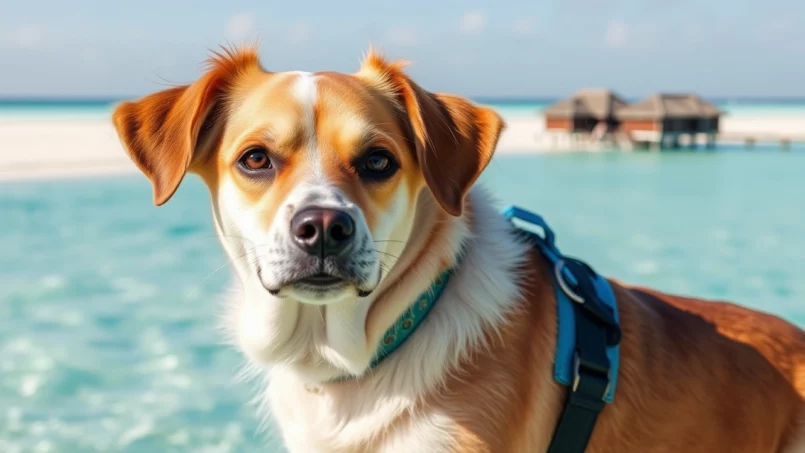
In the Maldives, the importation of all dogs, regardless of breed or size, is strictly prohibited. This rule applies for both short tourist stays and long-term expatriation. The only potential exceptions, subject to very strict government authorization granted on a case-by-case basis, concern certain service dogs (guide, police, or assistance dogs). In practice, it is impossible for a private individual to circumvent this ban for their pet dog.
For cats, the approach is more flexible but regulated. Domestic cats are accepted, including assistance animals, provided a set of health and administrative requirements are met. Certain hybrid cats with wild blood are a separate case: Savannah and Bengal cats are prohibited, unless documented proof is provided that they are at least five generations removed from their wild ancestors. Suffice it to say, the burden of proof is heavy.
Other pets – birds, reptiles, amphibians, rodents, rabbits, tropical fish, invertebrates – can, in theory, be imported, but each species is subject to specific rules. These animals are not subject to rabies vaccination requirements but must meet other health requirements, and sometimes international constraints related to protected species.
The table below summarizes the broad outlines of import possibilities.
| Type of Animal | Import Status in the Maldives | Main Conditions |
|---|---|---|
| Dogs (all breeds) | Prohibited | Rare exemptions possible for service dogs, with prior authorization |
| Domestic Cats | Permitted | Vaccines, health certificate, complete procedures in the country of origin |
| Savannah / Bengal Cats | Prohibited, except lineage ≥ 5 proven domestic generations | Detailed pedigree documents required |
| Pet Birds | Permitted under conditions | Health certificate, sometimes vaccines, possible CITES checks |
| Reptiles, amphibians, rodents, rabbits | Permitted under conditions | Veterinary certificate, sometimes specific permits, CITES verification |
| Tropical fish, invertebrates | Permitted under conditions | Possible permits and quarantine procedures |
For an expat, this first overview is essential: if you have a dog, you must immediately consider alternative solutions (long-term boarding, foster family, expatriation to another country). If you have a cat, expatriation remains feasible, but at the cost of meticulous preparation.
Understanding the Regulations: The “Pet Passport” Maldives Version
The Maldives does not recognize a single “pet passport” in the European administrative sense. When specialized websites talk about a “pet passport” for this destination, they are actually referring to a set of documents that, taken together, must satisfy the country’s requirements.
This dossier includes three mandatory pillars for a cat:
– Clear identification (ideally by microchip);
– Detailed proof of vaccination, notably against rabies;
– An international health certificate, issued in the country of origin and validated by the official veterinary authorities.
In addition, depending on the case, an import permit must be obtained from the Maldivian authorities, and possible CITES authorizations for protected species (parrots, turtles, certain reptiles, etc.).
Microchip: Mandatory or “Just” Essential?
The texts relating to cat importation to the Maldives are contradictory on one point: some official documents present the microchip as mandatory, others as simply “highly recommended.” In practice, the most recent procedures and serious relocation services consider micro-identification as a standard requirement.
The number of digits a microchip must have to comply with ISO 11784 or 11785 standards for cat identification.
Beyond regulatory compliance, the microchip is your best protection in case of loss during transit or on-site, especially in an archipelago where repatriating a “found” animal is not straightforward.
Vaccinations: Rabies, But Not Only
For a cat entering the Maldives, the rabies vaccination is non-negotiable. It must meet several cumulative conditions:
– Be administered between 30 days and 12 months before entry into the territory;
– Be recorded, signed, and stamped by the veterinarian on a vaccination certificate, an official health book, or a European passport;
– Be associated with clear identification of the animal (ideally, microchip number).
If it is a first vaccination or if the vaccine coverage was no longer valid, a waiting period is imposed after the injection (21 days or 30 days depending on the chosen protocol) before travel is possible. Boosters, if done on time, do not require this waiting period.
To import a cat to the Maldives, the authorities require vaccination protection against several common feline diseases. This includes viral rhinotracheitis, panleukopenia, feline leukemia, and sometimes calicivirus depending on the vaccine formulations used. Vaccines must be administered with approved products and strictly in accordance with the manufacturer’s protocol, including primary vaccination followed by necessary boosters.
All these injections must appear in the health book with the date, commercial name of the vaccine, lot number, and the veterinarian’s signature.
Rabies Serology Test: Optional, But Highly Recommended in Some Cases
Unlike many countries with moderate or high risk, the Maldives does not require a rabies antibody titer test as an entry condition for cats. The virus neutralization test (RNATT) is therefore not a regulatory obligation.
Nevertheless, specialized sources recommend this test for cats coming from countries classified as high-risk for rabies. It is then an additional precaution in case of inspection or rapid rule changes, and a reassuring element for some airlines.
Parasite Treatments: Recommended Before Departure
Maldivian authorities do not impose parasite treatment in the texts, but recommend preventive treatment against:
– Internal parasites (worms, notably Echinococcus multilocularis);
– External parasites (fleas, ticks).
Best practice is to ask your veterinarian to perform these treatments between 30 and 14 days before departure, then record the information (product, date, signature) on the health certificate. In a tropical country where mosquitoes, ticks, and parasites thrive, this is as much about protecting your animal as respecting biosecurity.
Import Permit and Health Certificate: The Administrative Part of the Journey
Administrative procedures vary according to sources, but a clear pattern emerges for expatriation with a cat.
Import Permit: Mandatory or Not?
On the question of the import permit, the texts are also contradictory. Some technical documents indicate that a pet cat entering with its owner does not need a permit, while others mention the obligation to obtain prior authorization via the government portal.
Disclaimer: The information provided on this website is for informational purposes only and does not constitute financial, legal, or professional advice. We encourage you to consult qualified experts before making any investment, real estate, or expatriation decisions. Although we strive to maintain up-to-date and accurate information, we do not guarantee the completeness, accuracy, or timeliness of the proposed content. As investment and expatriation involve risks, we disclaim any liability for potential losses or damages arising from the use of this site. Your use of this site confirms your acceptance of these terms and your understanding of the associated risks.

Cyril Jarnias is an independent expert in international wealth management with over 20 years of experience. As an expatriate himself, he is dedicated to helping individuals and business leaders build, protect, and pass on their wealth with complete peace of mind.
On his website, cyriljarnias.com, he shares his expertise on international real estate, offshore company formation, and expatriation.
Thanks to his expertise, he offers sound advice to optimize his clients' wealth management. Cyril Jarnias is also recognized for his appearances in many prestigious media outlets such as BFM Business, les Français de l’étranger, Le Figaro, Les Echos, and Mieux vivre votre argent, where he shares his knowledge and know-how in wealth management.





