
 Published on and written by Cyril Jarnias
Long perceived as a paradise reserved for wealthy tourists, the Maldives is also a complex real estate market, fractured between a saturated capital, rapidly expanding urban islands, and more peripheral atolls betting on tourism. Behind the postcard images, price disparities between cities are considerable, whether discussing rental, purchase, or even homeownership for the local population.
The Maldivian real estate market presents two distinct realities: a luxury sector for foreign investors and a local residential market, which is particularly tight for Maldivians in the Malé region.
Malé vs. the Rest of the Country: A Two-Tiered Market
Malé is the country’s economic and political heart. On less than two square kilometers, the capital concentrates more than a third of the population, with a density that exceeded 65,000 inhabitants per km² in 2015, one of the highest in the world. This demographic pressure directly impacts real estate prices and the market’s structure.
While the national average monthly rent was about 12,683 MVR in 2019, Malé is already above that at 13,494 MVR, roughly five times more than in the atolls (2,668 MVR). In just a few years, these rents have increased further, and the proportion of renting households has risen sharply.
A summary of the figures illustrates the gap well: the capital Malé, which concentrates a very large share of the national population, versus the rest of the country, composed of many small, scattered islands.
Overview of Average Rents (2019)
| Area | Average Monthly Rent (MVR) | Ratio Compared to Atolls |
|---|---|---|
| Malé | 13,494 | ≈ 5 times more |
| National Average | 12,683 | ≈ 4.75 times more |
| Atolls (excluding Malé) | 2,668 | Reference |
These numbers don’t tell the whole story. In Malé, about half of renting households were already paying more than 13,000 MVR per month in 2019, compared to 43% in 2016. For the poorest 10%, rent can absorb up to 68% of income, while the average for renting households is around 35%.
This high cost explains why a majority of residents simply cannot consider buying. Only 31% of Maldivian households have a sufficient annual income (at least 400,000 MVR) to hope for homeownership with a down payment. About 45% earn between 150,000 and 399,999 MVR per year, enough to pay an average rent but not to afford a purchase. The remaining 26%, below 150,000 MVR, cannot even afford the average rental market.
Malé: Rents, Price per Square Foot, and Rental Yields
The most recent available data for Malé show a residential market that remains tight and expensive, even compared to the average income.
The average net salary after tax is around 15,000 to 17,000 MVR per month, while the price-to-income ratio exceeds 9.7, placing homeownership far from the reality for most households. The burden of a standard mortgage can exceed 125% of the average monthly income, with an estimated mortgage interest rate over 20 years around 12 to 14%.
Key Indicators for the Residential Market in Malé
| Indicator | Indicative Value |
|---|---|
| Price-to-income ratio | 9.3 – 9.75 |
| Monthly loan payment as % of income | ≈ 126 – 132 % |
| Loan affordability index | 0.76 – 0.79 |
| Mortgage interest rate (20 years) | ≈ 12.4 – 14 % |
| Average net monthly salary | ≈ 15,000 – 17,250 MVR |
These figures are enough to show that, for an average household, buying an apartment in Malé requires either a massive down payment, public assistance, or a professional situation well above average.
Rental Levels in Malé
The range of apartment rents illustrates the pressure on housing. For a one-bedroom unit downtown, the average monthly rent is around 14,200–15,300 MVR, with common extremes between 10,000 and 20,000 MVR. In the outskirts, it drops to around 10,000–10,500 MVR, but with a range that can still go up to 16,000 MVR.
For families needing three bedrooms, the bill is even heavier.
Typical Monthly Rents in Malé (Apartments)
| Property Type | Location | Average Rent (MVR/month) | Common Range (MVR) |
|---|---|---|---|
| 1 Bedroom | City Center | 14,222 – 15,333 | 10,000 – 20,000 |
| 1 Bedroom | Outskirts | ≈ 10,000 – 10,556 | 9,000 – 16,000 |
| 3 Bedrooms | City Center | 25,375 – 27,250 | 20,000 – 35,000 (up to 38,000) |
| 3 Bedrooms | Outskirts | ≈ 21,375 – 22,750 | 18,000 – 30,000 |
For a household earning about 16,000 MVR per month, renting a simple two- or three-bedroom apartment downtown therefore often means dedicating almost all income, especially since utilities (electricity, water, internet) can easily add more than 2,000 to 3,000 MVR monthly.
Purchase Price per Square Foot in Malé
The gap between rents and sale prices is evident in the price-to-rent ratios. Downtown, the average price to buy an apartment is around 3,500 to 4,000 MVR per square foot, with a range from about 2,500 MVR to over 7,700 MVR for the most sought-after units. In the outskirts, average prices drop to around 1,500 to 2,700 MVR per square foot, with extremes from 700–800 to 3,500 MVR.
Apartment Purchase Prices in Malé
| Location | Average Price per ft² (MVR) | Range (MVR/ft²) |
|---|---|---|
| City Center | ≈ 3,500 – 4,030 | ≈ 2,500 – 7,700 |
| Outskirts | ≈ 1,535 – 2,720 | ≈ 715 – 3,500 |
Converted to euros, these levels place Malé in a fairly wide range: on average, around €3,000 per m² for the capital, with peaks exceeding €5,000/m² in the most central or ocean-facing neighborhoods, while some outlying areas can go below €2,000/m².
The average price per m² of a house in prime areas of the Maldives, equivalent to about €11,000.
Rental Yields in Malé
Despite these high prices, the gross yields reported remain attractive for an investor, at least on paper. Recent data indicate gross yields of around 7 to 8.2% downtown and around 8% in the outskirts for apartments. Price-to-rent ratios are around 12 to 13, meaning an investor theoretically recoups their outlay in about twelve years of gross rent, not counting expenses or taxes.
In reality, the cost of financing – with mortgage rates around 12 to 14% – drastically reduces the appeal of bank leverage for local buyers. Hence the importance of prior savings or public schemes.
Hulhumalé: A (Slightly) More Affordable Alternative?
Faced with Malé’s saturation, authorities launched the creation of Hulhumalé in the late 1990s, an artificial island intended to provide additional, better-planned housing. The first development phase began in 1997, the first 280 housing units were occupied in 2004, and the population already exceeded 40,000 inhabitants by 2016. Hulhumalé is now at the heart of the Greater Malé urban development strategy.
The city is developing according to a mixed model, combining the dense urbanity of Malé and the characteristics of a beach resort. Its real estate offering is diverse, including social housing, private mid-to-high-end residences, and many projects for the middle and upper classes. This area is a privileged space for private developers and, for certain market segments, for foreign investors, thanks to specific legal frameworks.
Cost of living comparisons show that Hulhumalé remains slightly cheaper overall than the national average: about 5% less across all expenses, with housing rents and costs nearly 3% below the country’s average. This doesn’t mean prices are low, but that they remain slightly below those of Malé while offering a more spacious environment.
Cost of Living and Housing in Hulhumalé
| Indicator | Difference vs. Maldives Average |
|---|---|
| Overall cost of living | ≈ –5 % |
| Housing (rent + utilities) | ≈ –3 % |
| Food | ≈ –6 % |
| Leisure / Sports | ≈ –10 % |
In absolute terms, rents in Hulhumalé remain high. A one-bedroom apartment downtown can cost around 20,000 MVR per month, a level higher than that of a small apartment in central Malé in some data series. Outside the center, a one-bedroom is around 12,000 MVR, with a common range of 9,000 to 15,000 MVR. For a three-bedroom, levels range from 35,000 to 45,000 MVR monthly depending on location.
Typical Monthly Rents in Hulhumalé
| Property Type | Location | Average Rent (MVR/month) | Range (MVR) |
|---|---|---|---|
| 1 Bedroom | City Center | ≈ 20,000 | – |
| 1 Bedroom | Outskirts | ≈ 12,000 | 9,000 – 15,000 |
| 3 Bedrooms | City Center | ≈ 45,000 | – |
| 3 Bedrooms | Outskirts | ≈ 35,000 | – |
For an average wage earner, these rents remain just as difficult to bear as those in Malé, especially since the median net salary in Hulhumalé is lower than in the capital, around 9,978 MVR per month according to some estimates. The cost of credit is even slightly higher there (about 13.9–14% over 20 years), further increasing the cost of homeownership.
The purchase price of apartments in central Hulhumalé can exceed 7,600 MVR per square foot.
Greater Malé: A Single Basin, Different Dynamics
The so-called Greater Malé region includes Malé, Hulhumalé, and Villimalé. It concentrates most job opportunities, services (healthcare, higher education, administration), and consequently, housing demand. Internal migration from the atolls to this area is massive, driven by the search for work, quality healthcare, and schooling.
To understand how real estate prices are structured, one must consider the entire basin.
In this Greater Malé, market studies estimate the equilibrium price for renting varies by housing size:
– below 10,000 MVR for a one-bedroom;
– between less than 10,000 and 15,000 MVR for a two-bedroom;
– between 10,000 and 15,000 MVR for a three-bedroom.
More than one-fifth of monthly rents in Malé fall within the 15,000 to 20,000 MVR range.
Greater Malé is thus marked by a strong concentration of rents in a range that remains very high relative to the income of the majority of the population, fueling overcrowding and degraded housing conditions.
In 2019, 74% of households in Malé were renting, compared to 60% in 2014.
Hulhumalé presents an intermediate profile: about 61.8% of surveyed people lived in rental accommodation, 29.2% in their own homes, and 9% in social housing. The Greater Malé region is thus structurally a rental market more than an ownership one, with all the social implications that entails.
Addu City: A More Affordable Market, But in Transition
At the other end of the archipelago, Addu City tells another facet of the Maldivian real estate story. Located just south of the Equator, this community groups six inhabited islands – Feydhoo, Maradhoo, Maradhoo-Feydhoo, Hithadhoo, Hulhudhoo, and Meedhoo – with a population of about 33,000, nearly 10% of the national population.
Historically, Addu played a strategic role, hosting a British base on Gan during World War II. Today, the city is positioning itself as a regional transport and tourism hub for the south of the country, with an international airport (Gan International Airport), sea and road links, and the prospect of new tourism developments.
Unlike Greater Malé, the Addu atoll experiences lower rental pressure and more affordable land and construction costs. Tourist accommodations, such as guesthouses or lodges in Meedhoo or Hithadhoo, are offered at rates well below the luxury standards of the northern atolls. For instance, a lodge in Meedhoo can be rented for about 176 Canadian dollars per night for several rooms, indicating much lower initial investment costs than for a similar project near Malé.
Above all, the political will to develop tourism in Addu will gradually transform real estate demand. The President has approved the creation of 4,000 new tourist beds, through the lease of 96 plots located in five specially planned tourist zones. The current capacity is only 1,378 beds, suggesting a more than doubling in the medium term.
Five new tourist zones (Dhigihera, Venbolhafishi, Hadhdhoo, Mulimathi, Maafishi) offer standardized plots of 2,400 to 10,000 square feet, with a maximum height of four floors or 14 meters. These lands are primarily intended for hotel or guesthouse construction, combining operational and investment real estate.
Even if the sale prices of these plots are not detailed in the corpus, the simple contrast in hospitality pricing levels and the fact that Addu is presented as a more affordable destination leave little doubt: real estate investment there is, for now, significantly cheaper than in Malé or the luxury atolls of the north (Noonu, Baa, etc.), but with potential for catch-up if tourism and international connections strengthen.
Between the Local Market and the Luxury Market: Two Parallel Universes
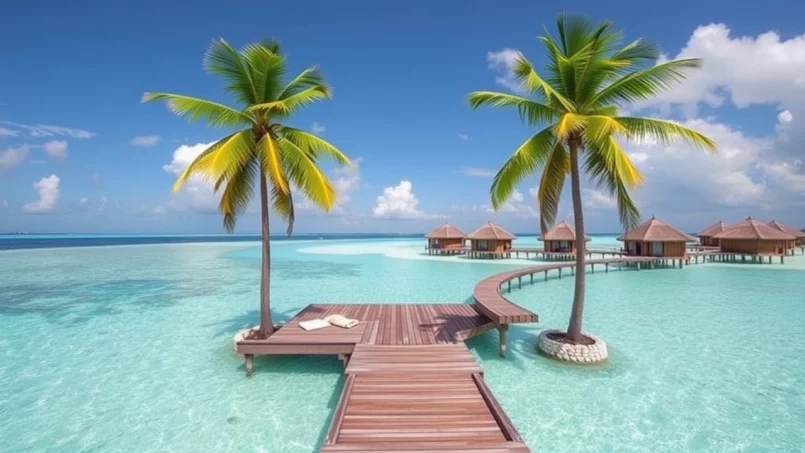
Comparing real estate prices between cities in the Maldives cannot be limited to the residential markets of Malé, Hulhumalé, or Addu City. A large part of the country’s real estate value is played out on another field: that of luxury villas, residences integrated into resorts, and at the top, private islands entirely leased or developed for the ultra-wealthy.
In these segments, geography is no longer read in terms of “cities” but of atolls: North Malé Atoll, South Malé Atoll, Baa Atoll, Lhaviyani Atoll, Noonu Atoll, Addu Atoll, etc. Price gaps between atolls are as marked as those separating Malé from populated local atolls.
Geographical description of the Maldives
In Greater Malé, urban apartments trade between $250,000 and $900,000, with a price per square meter on the order of $3,000 to $5,000. At the other end of the spectrum, branded villas in premium atolls (Baa, North Malé, Noonu) can reach $8,000 to $12,000 per m², or more for some highly exclusive developments.
Synthetic Price Comparison by Area (Investor Market)
| Area / Product Type | Price Range | Indicative Price per m² (USD) |
|---|---|---|
| Urban Apartments – Greater Malé | 250,000 – 900,000 USD | 3,000 – 5,000 |
| Beachfront Villas – North Malé Atoll | 1.5 – 4 M USD | 7,000 – 9,000 |
| Overwater Villas – North Malé Atoll | 1.8 – 3.5 M USD | 9,000 – 12,000 |
| Branded Villas – Baa Atoll | 1.5 – 3.2 M USD | 8,000 – 11,000 |
| Overwater Residences – Lhaviyani | 0.9 – 2.2 M USD | 6,500 – 9,000 |
| Investment Villas – Addu Atoll | 0.5 – 1.5 M USD | 4,500 – 7,000 |
For a foreign investor, cities in the administrative sense ultimately matter less than location in a reputed atoll, distance from Malé International Airport, affiliation with a hotel brand, and ease of access by seaplane or speedboat.
Comparison of the main strengths influencing the value and appeal of three major atolls in the Maldives.
Proximity to Velana International Airport, developed infrastructure, presence of international brands (Four Seasons, Ritz-Carlton), high marketing visibility, and high tourist occupancy rates.
Benefits from the same strengths as North and South Malé, with the added status of a UNESCO Biosphere Reserve, adding a highly valued environmental dimension.
Conversely, atolls like Addu, Raa, or Dhaalu position themselves as emerging markets, with entry prices generally 15 to 30% lower than already “mature” areas, but with perceived stronger appreciation potential over five to ten years.
Yields, Occupancy Rates, and Differences Between Cities
In terms of profitability, the gaps between segments are just as significant as the gaps in prices.
In the urban residential sector (Malé, Hulhumalé), gross yields are high on paper, around 6 to 7% for apartments, even 7 to 10% for some projects. But these figures must be qualified by the cost of local financing, indirect taxation (VAT on rents, for example), condominium fees, and potential vacancy.
It’s the number of annual tourist arrivals that supports an occupancy rate above 70% for resorts in the Maldives.
Location plays a crucial role here. The profitability of an urban apartment in Malé will depend on the domestic market (civil servants, private sector employees, long-term expatriates), while an overwater villa in a luxury atoll primarily targets a high-income global clientele.
Public Policies and Market Distortions
Price differences between cities in the Maldives are explained as much by geography and land scarcity as by public policies. Faced with the housing crisis in Greater Malé, the state has become the country’s main developer and landlord.
Through the Housing Development Corporation (HDC) and Fahi Dhiriulhun Corporation (FDC), the government has launched large-scale social and affordable housing programs, particularly in Hulhumalé (“Buy-Sell,” “Hiyaa,” etc. programs). More than 13,000 units have been financed, mainly through international loans that have brought the guaranteed debt of the housing sector to over $600 million by early 2024. Housing-related debt service is set to peak around $129 million in 2025.
Public interventions have increased housing volume but have created major problems: poor targeting of beneficiaries, design and maintenance flaws, subsidies harming the private sector, and informal resale or subletting of subsidized housing at market prices. Furthermore, these programs record a high rate of “non-performing” contracts and generate insufficient revenue to cover their costs, such as the Hiyaa program which shows negative cash flows of about 600 million MVR per year.
For households, these policies have partially slowed rent increases in some segments, but without solving the structural tension created by the exodus to Malé and Hulhumalé. In atolls like Addu, where demographic pressure is lower and ownership more widespread, real estate markets remain more “natural,” guided by the gradual growth of tourism and local activities rather than massive public programs.
Why Do Prices Vary So Much From One City to Another?
Several factors combine to create these disparities between cities and regions.
Foreigners cannot own land freehold in the Maldives. They only have access to leaseholds of 50 to 99 years, primarily in tourism projects and luxury residences. Residential land on inhabited islands is largely reserved for Maldivian citizens. This distinction creates two separate markets: a local market, very tight in Greater Malé, and an international investment market, with prices in dollars or euros, attracting a global clientele.
Second, the concentration of jobs and services. Malé and Hulhumalé concentrate administrations, the best schools, hospitals, and corporate headquarters. This fuels structural demand that pushes rents upward, with no equivalent in more remote cities like Addu City.
Real estate prices in the Maldives vary strongly depending on the area’s tourism development. Near Malé (North Malé, South Malé, Baa atolls), the high concentration of luxury resorts justifies very high per m² prices for overwater villas. In regions like Addu, where tourism is emerging, prices remain lower. Their future evolution will depend directly on the success of expansion plans: increase in hotel supply, infrastructure improvements, and better air connectivity.
Finally, environmental risks and climate resilience are beginning to influence valuations. Properties better protected against coastal erosion and sea-level rise, or designed to high ecological standards (solar panels, water treatment, etc.), sell and rent for more, particularly in the luxury segment.
What Future for Real Estate Prices in Major Maldivian Cities?
Available projections anticipate an average increase in real estate values of about 5% per year if current trends continue. Historically, Maldivian real estate has shown:
– 4 to 5% annual increase between 2010 and 2015,
– 6 to 8% between 2016 and 2020,
– 3 to 5% between 2020 and 2022, a more volatile period,
– then an acceleration around 8 to 10% since 2023, driven by tourism recovery and foreign investment.
The progression of the Maldivian real estate market will not be uniform. In Greater Malé, price increases may be moderate (4 to 6% per year), constrained by public policies and limited household purchasing power. Conversely, in emerging urban or tourist atolls like Addu, Lhaviyani, Raa, and Dhaalu, scenarios foresee stronger annual growth, of 8 to 10%, driven by new projects, infrastructure improvements, and a catch-up effect relative to more mature areas.
The key question, for Maldivians as well as foreign investors, will be one of sustainability. On one hand, rental yields, tourism dynamism, and land scarcity argue for continued price increases, especially in the high-end segment. On the other, social constraints (affordable housing, overcrowding, inequalities in homeownership access) and environmental constraints (climate risk, coastal protection costs) exert pressure to rethink the model.
The example of the Maldivian real estate market illustrates a highly contrasted landscape. In Malé and Hulhumalé, prices are high and life is difficult for modest households. Addu City and other atoll cities remain relatively affordable but are in full transition. Finally, on resort islands, the price per square meter reaches peaks, disconnected from local residential reality.
For anyone interested in this market, whether to understand the social issues of housing or to measure investment potential, the first step remains to clearly distinguish these three universes and to observe how they influence each other in an archipelago that lacks land but does not lack real estate ambitions.
Disclaimer: The information provided on this website is for informational purposes only and does not constitute financial, legal, or professional advice. We encourage you to consult qualified experts before making any investment, real estate, or expatriation decisions. Although we strive to maintain up-to-date and accurate information, we do not guarantee the completeness, accuracy, or timeliness of the proposed content. As investment and expatriation involve risks, we disclaim any liability for potential losses or damages arising from the use of this site. Your use of this site confirms your acceptance of these terms and your understanding of the associated risks.

Cyril Jarnias is an independent expert in international wealth management with over 20 years of experience. As an expatriate himself, he is dedicated to helping individuals and business leaders build, protect, and pass on their wealth with complete peace of mind.
On his website, cyriljarnias.com, he shares his expertise on international real estate, offshore company formation, and expatriation.
Thanks to his expertise, he offers sound advice to optimize his clients' wealth management. Cyril Jarnias is also recognized for his appearances in many prestigious media outlets such as BFM Business, les Français de l’étranger, Le Figaro, Les Echos, and Mieux vivre votre argent, where he shares his knowledge and know-how in wealth management.





