
 Published on and written by Cyril Jarnias
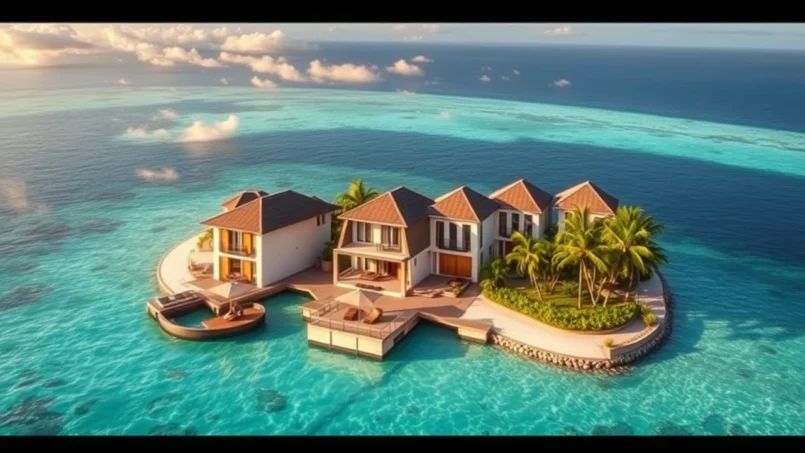
When looking at a postcard of the Maldives, one mainly sees overwater bungalows, turquoise lagoons, and white sand beaches. But behind this paradise image lies a powerful economic engine: tourism, which, in just a few decades, has completely reshaped the archipelago’s real estate market, down to the way people live, build, and invest.
In the Maldives, the real estate market is entirely tied to the tourism sector. The health and value of real estate directly depend on tourism performance.
A country where tourism dictates the pace of real estate
The Maldives is an archipelago of over 1,100 coral islands spread across 26 atolls. Only about 1% of its 90,000 km² territory consists of land. In this ultra-fragile setting, tourism became the main engine of the economy starting in the 1970s.
The tourism sector directly represents between a quarter and nearly 30% of GDP, and up to 70% if all indirect impacts are included. Alone, it contributes to more than 70% of exports and generates nearly 70% of the state’s tax revenue through taxes, fees, and specific levies.
The number of tourists who visited the country in 2024, exceeding pre-pandemic levels.
As long as flights are full and hotel complexes maintain occupancy rates above 70%, the demand for land, villas, and new infrastructure remains strong. Conversely, the slightest shock to tourism immediately affects construction, lease values, and the prospects of real estate projects.
The “one island, one resort” model and its real estate effects
One of the most distinctive features of Maldivian tourism is the “one island, one resort” concept. In practice, an entire island is leased to an operator who builds a private hotel complex on it, often positioned in the high-end or ultra-luxury segment.
This economic or regulatory model has several consequences for the real estate sector. It can influence prices, demand, types of construction, or land-use planning policies, depending on its specific characteristics.
– it boosts the value of islands and lagoons put under concession, which have become high-yield tourism assets;
– it concentrates investment on tourism real estate products (overwater bungalows, beach villas, marinas, integrated residences) rather than on conventional residential property;
– it creates a strong boundary between the tourist and local worlds, with most resort islands being separate from inhabited islands.
Between 2009 and 2022, the supply of resorts grew at a rate of approximately 5% per year. In 2019, over two-thirds of resorts were rated 5-star and nearly a third 4-star. Behind each island-hotel, dozens of luxury villas, suites, and facilities are added to the real estate stock dedicated to visitors.
A price surge driven by tourism demand
The rise of tourism doesn’t just add hotel beds. It mechanically pushes real estate prices upward, particularly in the most connected and touristic areas.
Malé and the capital region: a market under pressure
Approximately 42% of the Maldivian population lives in the capital Malé, on just 9.3 km², making it one of the most densely populated cities in the world. The economic pull of tourism – direct or indirect jobs, services, administration – intensifies human concentration around Malé and its artificial extension, Hulhumalé.
The consequence is twofold: chronic housing shortage and soaring prices.
Available data shows levels rarely seen in a developing economy: in Malé, the price per square meter generally ranges between $5,000 and $10,000, with averages around $11,000 in the most sought-after neighborhoods. Some reports mention over MVR 171,000 per square meter, equivalent to over $11,000, for upscale apartments.
The real estate pressure leads to very high rents, making property ownership inaccessible for 80% of residents in Greater Malé. A one-bedroom apartment costs around MVR 8,000 per month, while the majority of households have monthly incomes between MVR 3,000 and MVR 6,500. As a result, 72% of households are renters, often sharing accommodations or living in overcrowded conditions, with an average household size of six people.
The paradox is striking: one of the most expensive real estate markets in the Indian Ocean overlays a local population often unable to afford decent housing without public assistance or family arrangements.
Simultaneously, in the segment driven by international clientele, prices directly reflect the perceived value of a Maldives stay.
The country clearly positions itself as a high-end destination. The average spending per visitor is significantly higher than in many competing destinations, and the wealthiest travelers spend over $1,500 per day, well beyond the average of around $450.
This ability to pay is reflected in tourism real estate: investors and buyers of this type of property generally have higher purchasing power, which can influence market dynamics, prices, and investment strategies in this specific sector.
| Area / Product | Indicative Price Range |
|---|---|
| Overwater Villa – North Malé Atoll | Approx. $1.8 to $3.5 million USD |
| Overwater Villa – South Malé | Approx. $1.2 to $2.8 million USD |
| Branded Villa – Baa Atoll | Approx. $1.5 to $3.2 million USD |
| Waterfront Villa – Noonu | Approx. $3 to $9 million USD |
| Private Island Lease – Baa Atoll | Approx. $8 to $25 million USD (leasehold right) |
| Private Island – Noonu (example) | Approx. $45 million USD (reported value) |
| Urban Apartment – Greater Malé | Approx. $250,000 to $900,000 USD |
International brand residences – Aman, Baccarat, Soneva, Samana / Elie Saab, etc. – add another layer: affiliation with a prestigious brand allows for a premium of 20 to 40% on prices. Some properties trade between $1 and $50 million for exceptional villas or estates.
An appreciation dynamic fueled by tourism
Over the long term, the Maldivian real estate market has shown steady appreciation, well correlated with the rise of tourism.
A history of annual changes gives an idea of this trajectory:
| Period | Estimated Average Annual Appreciation |
|---|---|
| 2010 – 2015 | Approx. 4 to 5% |
| 2016 – 2020 | Approx. 6 to 8% |
| 2020 – 2022 | Approx. 3 to 5% (Covid period) |
| 2023 – to date | Approx. 8 to 10% |
Five-year projections, in a scenario of continued tourism growth, forecast further 5 to 10% annual increases depending on the atolls and property types, with peaks expected in emerging areas.
In a country where land is scarce, where demand for stays remains strong, and where new supply is constrained by high construction costs and environmental regulations, the real estate market benefits from a favorable structural imbalance that supports valuations.
The rules of the game: real estate dominated by tourism leases
In the Maldives, the Constitution reserves full land ownership rights solely for citizens. Foreigners – individuals or companies – cannot buy land as freehold. All their real estate exposure must therefore be through leasehold.
A legal framework designed to attract tourism capital
The main form of tenure for foreign investors is long-term leasehold, often ranging from 50 to 99 years. These leases are granted by the state, registered, and most often involve entire islands intended to be transformed into resorts, marinas, integrated complexes, or tourism residences.
Several laws structure this framework:
– the Foreign Investment Law, which allows up to 100% foreign ownership in most sectors, especially tourism;
– the Land Act and the Tourism Act, which define the conditions for leasing islands and lagoons;
– the so-called Integrated Tourism model, which since 2019 has allowed combining hotel accommodation, residences, commerce, and leisure in a single development;
– the Special Economic Zones (SEZ) regimes, which offer enhanced incentives (reduced taxation, regulatory easing) for certain major projects.
For residences integrated into resorts, a specific regime allows foreigners to acquire a property with hotel management services.
Allows foreigners to acquire, for the duration of the master lease, a villa or apartment within a resort complex.
The acquisition comes with a usufruct title for the property, valid for the lease duration.
Hotel rental management is provided when the owner is not occupying their property.
Investment-based residency and real estate-linked visas
The rise of luxury tourism and the desire to diversify the economy have pushed the government to launch investment-based residency programs linked to real estate.
An investment residency program, established with a specialized firm, allows obtaining a five-year renewable residence permit in exchange for an investment starting at $250,000 in approved projects. Other regimes provide investor visas with thresholds that can go up to $5 to $10 million for large-scale projects, often related to high-end hospitality or integrated developments.
For developers, the minimum investment threshold in hospitality and resorts is frequently set at around one million dollars, while major “sustainable townships” projects integrating tourism, residential, healthcare, education, and renewable energy require at least $500 million to benefit from preferential tax regimes.
Taxation calibrated for tourism and real estate
On the tax side, the Maldives displays attractive characteristics for international investors, while deriving a large part of its revenue from the tourism sector.
Notable features include:
– a flat-rate profit tax of 15% on annual profits exceeding MVR 500,000;
– no specific capital gains tax on real estate, although some arrangements may be captured by the profit tax;
– a Goods and Services Tax (GST) of 6% applicable to real estate transactions and rental income;
– a higher Tourism Goods and Services Tax (TGST) on tourism services;
– a Green Tax of $6 per person per night, levied on tourist stays;
– concession rents (tourism land rent) that can reach $8 to $10 per square meter per year for resort islands.
A future specific transfer duty for integrated townships is also planned, ranging from 1% on the first transaction to 4% on the third, without affecting other tourism taxes.
Overall, the message is clear: the door is wide open to capital destined for tourism and associated real estate, provided they accept the leasehold framework and increasing environmental obligations.
Tourism and rental yields: real estate as an investment product
If prices are high, it’s also because real estate in the Maldives has become, to a large extent, a yield product linked to international tourism.
Occupancy rates that support income
Luxury resorts display average annual occupancy rates above 75%, and beyond 80% in the high season. The country has won the title of “World’s Leading Destination” several years in a row, strengthening its appeal to high-end clientele.
These occupancy rates, combined with rising daily rates – average prices for luxury resorts have increased by approximately 25% since 2019 – create a massive revenue stream: tourism revenues already exceed $3 billion in some years and could surpass the $5 billion mark by 2025.
For owners of villas or residences within these complexes, net rental yields are often higher than in other vacation markets.
The estimated order of magnitude is as follows:
| Property Type | Estimated Net Rental Yield |
|---|---|
| Premium Brand Overwater Villa | Approx. 5 to 7% |
| Waterfront Villa | Approx. 4 to 6% |
| Integrated Residence (resort + services) | Approx. 6 to 8% |
| Urban Apartments (Greater Malé) | Approx. 7 to 10% |
| Guesthouses on Inhabited Islands | Approx. 8 to 12% |
| Well-Placed Properties in Resorts | Up to 12 to 15% |
Some projects go further by offering contractual guarantees, for example a 7% guaranteed yield for ten years for certain units, or “rental pool” models with a 50/50 split of net profits between the operator and the owner.
A highly liquid market for tourism assets
Despite the small size of the country, the resort and hotel market is considered one of the most liquid in the world for this type of asset. Hotel sales amounting to approximately $2 billion have been recorded over the last decade.
Over 70% of international buyers operate in cash, which speeds up transactions and supports valuations. The presence of major international brands reassures investors, who see them as standardized products backed by long-term management contracts.
Institutional or wealthy investors
A highly internationalized investor demand
Buyers of tourism-related real estate are mostly foreigners, with an approximate distribution where Europeans represent half of the buyers, Asians about 30%, and North Americans and Middle Easterners the remaining 20%. In the Maldives, this international demand is overlaid with the growing appetite of regional conglomerates, notably from the United Arab Emirates, which are said to have committed over $3 billion in investments in the archipelago by 2030.
This diversity of profiles – investment funds, hotel developers, high-net-worth individuals seeking a prestige residence or a climate refuge – fuels a virtuous circle for the high-end real estate market, as long as tourism remains flourishing.
When tourism also disrupts the housing of residents
If one only looks at yield and price figures, the picture seems idyllic. But the impact of tourism on Maldivian real estate is not limited to the luxury segment: it also deeply reconfigures the housing of Maldivians themselves.
A housing crisis in the Malé region
While multi-million dollar villas rise from the water on private islands, a large part of the population struggles to find proper housing in the capital region.
The monthly incomes of most Maldivians are far from what is required to purchase even a modest property. The price of a “cheap” residential unit is often around MVR 2.2 million, with a 20% down payment that is difficult to access due to low savings capacity. For a large part of households, even with multiple earners, it is impossible to handle the mortgage payments.
The result is a massive dependence on private rental, fueled by:
– limited land supply in Malé;
– competition between residential uses and tourism or commercial projects;
– the general rise in construction costs, made more expensive by the insularity and imports.
The number of additional housing units the Maldivian government needs to provide by 2028 to meet national needs.
Tourism, internal migration, and urbanization
Tourism also contributes to accelerating internal population movements. The growth of resorts, regional airports, and related services creates employment hubs that attract working-age men especially towards tourist areas or the Malé region. Demographic data shows the country could approach one million inhabitants by 2054, with up to 64% of Maldivians concentrated in the capital according to some scenarios.
The less tourism-integrated atolls are partially drained of their active population, leading to:
Less developed islands are experiencing an increase in female-headed households, increased demand for urban housing for internal migrant workers, and growing pressure on urban infrastructure (water, sanitation, transport, schools, healthcare).
In this context, tourism acts as a magnet that distorts the geography of settlement, and therefore real estate needs, much faster than planning can keep up.
The paradox of tourism migrant workers
Another indirect effect: the heavy reliance on foreign workers in tourism and construction. According to the 2022 census, expatriates represent more than 60% of the total workforce, with a strong concentration in resorts.
A significant part of this staff lives in temporary housing, sometimes in precarious conditions on hotel islands or in outlying neighborhoods. The tourism boom therefore creates a need for worker accommodation, often on the margins of the conventional residential market, without always triggering real investment in decent and sustainable housing for these populations.
Here again, we see this imbalance: the real estate value captured by investors and tourism operators coexists with a social reality marked by cramped, precarious, or overcrowded living conditions for some of those who keep the industry running.
Tourism, climate, and real estate value: a risky bet
Any serious discussion about real estate and tourism in the Maldives cannot ignore the climate issue. The country is one of the most vulnerable in the world to sea level rise, coastal erosion, and coral bleaching.
Threatened natural heritage, thus weakened tourism assets
The very assets that make the Maldives’ tourism fame – coral reefs, beaches, lagoons – are directly exposed to the effects of warming. Massive bleaching episodes have already destroyed a significant portion of the reefs, with up to 75% of corals lost during an episode in 2016. These reefs play a triple role: tourist attraction, protective barrier against waves, and sand provider for beaches.
Projections of sea level rise – 0.5 to 0.9 meters by 2100 – pose a structural risk to the entire seaside real estate stock… that is, almost the entire country, since 80% of the emerged land area is less than one meter above sea level. About 47% of housing units are located within 100 meters of the shoreline.
Percentage of the country’s total assets that could be damaged by decadal floods by 2050 according to the World Bank.
For tourism real estate, this already translates into rising insurance premiums (on the order of 15 to 20% per year for some resorts) and the obligation to invest in costly protective structures or innovative adaptation solutions.
Major reclamation projects and floating cities
Facing this threat, the Maldivian state allocates more than half of its budget to climate adaptation, with needs estimated between $2 and $4 billion just for sea level rise and flooding.
One of the structural responses has been the construction of artificial or enlarged islands through reclamation, like Hulhumalé, nicknamed the “City of Hope“. This 4 km² island has been raised to about 2 meters above sea level – nearly double the average height of other islands – to provide housing, urban infrastructure, and real estate investment opportunities (hotels, shopping malls, schools, hospitals), while improving resilience to flooding.
The number of inhabitants the Maldives’ future floating city, inspired by coral reefs, is designed to accommodate.
These projects represent both a vital response to demographic pressure and the climate threat, and a new playground for tourism-linked real estate (urban hotels, floating residences, marinas…). They place tourism back at the center of adaptation financing: it is because the Maldives remain attractive to travelers and investors that these infrastructures can be envisioned.
But adaptation is not without controversy. Reclamation operations, seawalls, ports, and new regional airports can degrade reefs and marine habitats, thereby weakening the natural coastal protection and the beauty of the sites.
Some practices, like sand extraction or the massive transplantation of trees from inhabited islands to resorts, have been criticized for their effects on local communities (loss of resources, natural barriers, landscapes).
Tourism also exerts climate pressure upstream: multiplication of flights, airport development, transfers by seaplane or speedboats. Yet, paradoxically, the very survival of the real estate assets created to host these flows depends on the country’s – and the world’s – ability to limit warming.
Towards new models: integration, sustainability, and community tourism
Aware of the limits of the “one island, one resort” model, Maldivian authorities are now attempting to steer tourism and real estate development towards more diversified formats.
“Sustainable townships”: when the city becomes a tourism product
Under the Vision 2040 strategy, the government promotes the creation of large “sustainable townships“: integrated neighborhoods or towns combining hotels, permanent residences, clinics, schools, commerce, leisure spaces, and renewable energy infrastructure.
The stated objective is multiple:
– reduce dependence on short-stay, purely beach-focused tourism;
– attract long-stay residents, families, remote workers, students, medical tourism patients;
– create less seasonal and more resilient living hubs, capable of functioning even in the event of a shock to conventional tourist flows;
– offer new housing spaces for Maldivians, potentially better integrated with services.
Income tax rate applied to investors in these townships for the first ten years.
In real estate terms, they represent a paradigm shift: moving from the isolated island-hotel to the city-destination, where tourism is no longer the sole master of usage. But here again, it is the tourist appeal – and the promise of making these places desirable for wealthy visitors – that makes the financial equation possible.
Community tourism: more locally anchored real estate
At the other end of the spectrum, another movement is trying to rebalance tourism’s benefits for local communities. Since the guesthouse sector opened on inhabited islands, a growing share of visitors (over one-fifth) choose to stay in family-run guesthouses or small hotels on islands like Maafushi, Dhigurah, or Thulusdhoo.
Tourism in the Maldives encourages the construction and renovation of small accommodations, cafes, restaurants, shops, and nautical services owned by locals. These real estate properties, though modest in size, serve less as financial assets and more as tools to diversify Maldivian families’ incomes.
Initiatives like the Horsburgh Atoll (Baa Atoll) tourism alliance, structured as a cooperative, show that a locally managed destination model is possible, with mechanisms for voluntary visitor contributions to fund beach cleaning, reef restoration, or mangrove protection. Here too, the construction of small tourism infrastructure – rooms, jetties, visitor centers – becomes an act that is simultaneously real estate, economic, and environmental.
Comparing these approaches with the island-resort model, a major difference emerges: in community tourism, real estate remains in the hands of residents, even though land prices can also rise and pressure on space intensify.
An increasingly tight macroeconomic equation
Finally, a last angle connects tourism, real estate, and vulnerability: that of public finances. The Maldives displays a very high level of debt, around 123% of GDP, with projections potentially going even higher in the medium term. A large part of this debt is linked to massive investments in tourism and transport infrastructure – airports, bridges, ports, roads, artificial islands.
In such a context, the value of tourism real estate plays an implicit role as collateral: as long as resorts, villas, and luxury residences attract buyers and visitors, foreign currency flows and tax revenues can continue to finance debt servicing and new adaptation projects.
Dependence on tourism and debt makes the economy vulnerable. A prolonged shock to tourist arrivals (health crisis, geopolitical instability, global recession) or a major climate event could trigger a dual crisis.
– degrade the value of certain real estate assets (drop in occupancy, physical damage, rising insurance costs);
– reduce the state’s budgetary room for maneuver;
– delay necessary investments to protect or relocate essential infrastructure, both tourism and residential.
To continue attracting capital, the Maldives is therefore betting on structural reforms (modernizing the investment framework, public-private partnerships, developing carbon markets, climate guarantee platform with the World Bank) and on strengthening resilience standards for tourism construction.
Conclusion: a real estate market at full speed, but on a tightrope
Tourism has transformed the Maldives into one of the most unique real estate markets on the planet. Both a showcase for beachfront luxury and a laboratory for climate adaptation, the archipelago concentrates global trends: the upscaling of tourism, the financialization of real estate, the quest for prestige residences, tensions over local housing, urban and ecological experiments.
The positive impacts are evident: a dynamic construction sector, high yields for well-positioned projects, steady appreciation of assets, and an investment capacity in infrastructure that few small island states can claim.
Tourism, though vital for certain economies, generates major issues: it exacerbates inequalities in access to housing, creates dangerous economic dependency, increases vulnerability to climate change, puts pressure on marine and coastal ecosystems, and can add to public debt.
In the final analysis, the impact of tourism on the Maldivian real estate market lies as much in what it creates as in what it forces us to rethink. The challenge of the coming years will be to transform this energy – these flows of visitors, this capital, these construction sites – into a more balanced real estate fabric, capable of providing decent housing for Maldivians, remaining desirable for travelers, and surviving sea level rise.
Only under this condition can the postcards of the Maldives continue to show overwater villas… without their economic, social, and ecological foundations crumbling under the waves.
Disclaimer: The information provided on this website is for informational purposes only and does not constitute financial, legal, or professional advice. We encourage you to consult qualified experts before making any investment, real estate, or expatriation decisions. Although we strive to maintain up-to-date and accurate information, we do not guarantee the completeness, accuracy, or timeliness of the proposed content. As investment and expatriation involve risks, we disclaim any liability for potential losses or damages arising from the use of this site. Your use of this site confirms your acceptance of these terms and your understanding of the associated risks.

Cyril Jarnias is an independent expert in international wealth management with over 20 years of experience. As an expatriate himself, he is dedicated to helping individuals and business leaders build, protect, and pass on their wealth with complete peace of mind.
On his website, cyriljarnias.com, he shares his expertise on international real estate, offshore company formation, and expatriation.
Thanks to his expertise, he offers sound advice to optimize his clients' wealth management. Cyril Jarnias is also recognized for his appearances in many prestigious media outlets such as BFM Business, les Français de l’étranger, Le Figaro, Les Echos, and Mieux vivre votre argent, where he shares his knowledge and know-how in wealth management.





