
 Published on and written by Cyril Jarnias
As Bali breaks new tourist records, the villa real estate market is no longer limited to the beaches of Canggu or Seminyak. Ubud and the Balinese highlands are attracting a new generation of foreign investors, seeking solid returns but also stability, nature, and meaning. Between complex land regulations, new environmental constraints, and a still-strong appetite for wellness retreats, the playing field is promising—provided you don’t venture in blind.
This structured guide uses recent data from the Balinese market and the Indonesian legal framework to explain how to invest in real estate in Ubud and the Balinese highlands while complying with regulations.
Why Ubud and the Balinese Highlands Attract Investors
Ubud is now one of the most unique and resilient markets in Bali. Unlike purely coastal areas, demand here relies less on short-stay beach tourism and more on three complementary pillars: wellness, extended stays, and semi-permanent residence.
Wellness-, spirituality-, and nature-oriented visitors tend to stay longer and prefer quiet areas. Ubud precisely captures this audience, with an annual occupancy rate regularly exceeding 75% for well-positioned villas, even rising above 80% in some sectors like Pejeng or Tampaksiring. These travelers also accept higher nightly rates for a “sanctuary” environment, supporting yields.
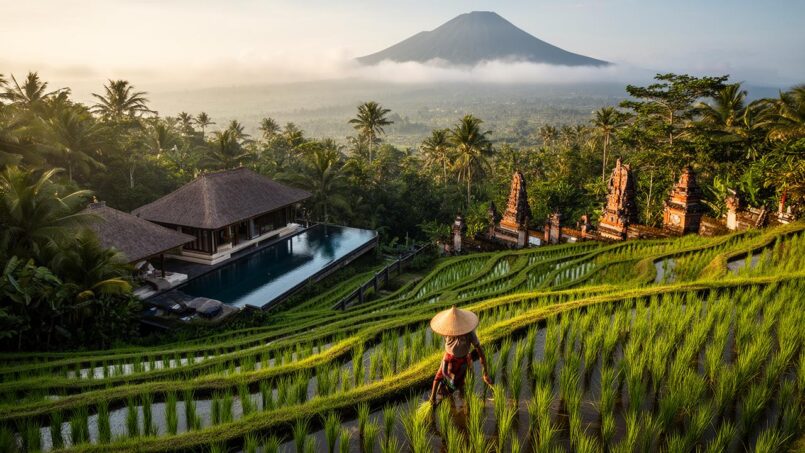
The highlands around Ubud—Sayan, Pejeng, Tampaksiring, Tegallalang, or the rural areas to the north—extend this model with more available land, spectacular rice terrace or jungle landscapes, and lower building density. This setting attracts digital nomads on 1- to 3-year leases, yoga or detox retreats, and expat families seeking peace and space.
In this context, Ubud is often described as a “defensive” market within Bali: price growth is solid (roughly +30% between 2022 and 2026), but less explosive than some ultra-trendy southern spots, while rental yields show remarkable stability. For a foreign investor looking for a yield/security combination rather than a speculative bet, this is a rare mix.
Understanding the Numbers: Prices, Rents, Returns
To get oriented, you first need to situate Ubud relative to other Balinese hubs, both in prices and rental performance.
In terms of transaction values, the Balinese market overall shows a median price near 4.7 billion rupiah (approximately 258,000 USD), with an average price of around 33 million IDR/m². Ubud sits well below the prime areas of the south coast, while remaining above the still-emerging western regions.
For leasehold villas, Ubud and its surroundings offer a particularly accessible entry point for two-bedroom units, the star product of the Balinese market. For 25-year leases, observed ranges are as follows:
| Segment | Location | Type / Size | Price Range (USD) | Notes |
|---|---|---|---|---|
| 2BR leasehold villa | Ubud & surroundings | Jungle / rice terraces | 120,000 – 220,000 | Typical 25-year lease |
| 3BR leasehold villa | Ubud & surroundings | Nature view | 200,000 – 380,000 | Ideal for retreats and families |
| Wellness retreat multi-unit | Ubud | Land ≥ 2,000 m² | 400,000 – 900,000 | “Boutique resort” products |
The contrast with more mature southern areas is stark: in Canggu/Berawa, a simple 2-bedroom villa on a 25-year leasehold on 200–300 m² trades between 220,000 and 350,000 USD, and the million-dollar mark is common for premium properties. In Uluwatu and Seminyak, premium villas can climb to 1.2 million dollars, and cliff-top properties exceed 5 million.
Land prices for freehold around Ubud increase by 200 dollars per square meter as you get closer to the center.
| Zone | Type of Right | Price per “Are” (100 m²) | Market Profile |
|---|---|---|---|
| Tampaksiring / Tegallalang | Freehold | 250 – 500 M IDR | High potential, still affordable |
| Pejeng / Sayan | Freehold | 600 – 900 M IDR | Strong interest for jungle-view villas |
| Ubud center (prime) | Freehold | 1.5 – 2.5 Billion IDR | Rare, highly sought, limited supply |
Where Ubud really stands out is in the rental performance of well-managed villas. For a 2-bedroom leasehold in sought-after micro-areas like Penestanan or the Bisma area, data converges:
Summary of the main financial ratios for a furnished rental investment, based on market data.
Between 210 and 240 USD, with a benchmark peak at 220 USD.
Realistic occupancy rate of 70% per year with professional management.
Annual gross revenue between 45,000 and 65,000 USD.
Net yield after management fees and operating costs, generally between 9% and 12%.
We can summarize a typical setup for this asset profile:
| Parameter | 2BR Ubud (Penestanan / Bisma) | Realistic 2026 Assumption |
|---|---|---|
| Initial investment | 200,000 – 250,000 USD (25 yr leasehold) | Excluding transaction costs |
| Average rate | ~220 USD / night | Adjusted by season |
| Occupancy rate | ~70% | With a good manager |
| Annual gross income | 45,000 – 65,000 USD | Based on positioning and design |
| Operating costs | 13,000 – 16,000 USD | Utilities, maintenance, staff |
| OTA fees | 15 – 17% of revenue | Booking, Airbnb, etc. |
| Property management | 18 – 22% of revenue | Full service management |
| Net income | ~20,000 – 24,000 USD | After all fees |
| Net yield | 9 – 12% | Before home country taxes |
Across Bali, well-operated villas in good micro-locations deliver an average 7–12% net yield, with some 18–20% for exceptional products in Canggu or Uluwatu. Ubud sits at the high end of this range in terms of stability, though not in terms of speculative peaks.
Who This Market Serves: Digital Nomads, Retreats, and Long Stays
The shift in the Balinese market since the pandemic is clear: demand is gradually moving from short stays toward long-term formats, supported by the rise of remote work and specific visas such as the e-visa for remote workers (E33G) or the “Second Home” visa valid for up to 10 years.
Digital nomads represent about 20% of long-term rental demand in Bali. They seek furnished villas with reliable internet, workspace, and 1- to 3-year contracts. Their favorite neighborhoods are Ubud, Pererenan, and Canggu, with Ubud favored by those escaping the beach crowds.
Wellness– and spirituality-oriented visitors, meanwhile, often stay for several weeks or even months. Ubud concentrates yoga retreats, meditation centers, detox complexes, creating structural demand for villas or small resorts that can accommodate groups, with shared spaces (shala, pool, dining areas) and spectacular natural views.
This clientele translates into several strong trends for an investor:
Prioritize 2- to 3-bedroom villas with a home-office space, which are in high demand. Invest in eco-certifications to charge 20 to 30% more and achieve occupancy rates over 20% above average. In Ubud, reduced seasonality ensures stable income year-round.
For a foreigner considering alternating personal use and rental (a “lifestyle + yield” model), this is a particularly comfortable framework: the probability of filling unused weeks remains high, as long as the product is well-positioned and properly managed.
The Rules of the Game for Foreigners: What You Can Own… and What Is Forbidden
One of the major specificities of the Balinese market is legal: foreigners simply cannot hold freehold land ownership (Hak Milik) in their own name. This is a principle rooted in the 1960 Agrarian Law, reinforced in recent years, and now associated with criminal penalties via a new regional regulation.
To invest in Ubud or the Balinese highlands while staying legal, several structures are possible, each with its advantages, constraints, and entry tickets.
Leasehold (Hak Sewa): The Simplest and Most Common
The leasehold, or lease right (Hak Sewa), is the most common route for an individual investor. It is a long-term rental contract entered into with the Indonesian landowner (usually a Hak Milik holder).
The most frequent characteristics are as follows:
– Initial term of 25 to 30 years for villas operated as short-term rentals.
– Possibility of extension, often via one or two additional options of 20 to 25 years, making it possible to reach 50–75 years total.
– Payment of the lease premium in one lump sum at the signing of the notarial deed.
– Right to use the land and buildings for the entire lease term, with freedom to operate for tourism if zoning permits.
– Reversion of the property to the local owner upon lease expiration, unless an extension agreement is reached.
The leasehold offers several advantages for a foreigner:
– No minimum capital required by law.
– No need to create a company or find a local partner.
– Relatively simple documentation, in the form of a notarized lease contract.
– Generally lighter taxation than freehold.
– Location often in legal tourist zones (Pink or mixed), ideal for short-term rentals.
On the downside, a lease that is nearing expiration gradually loses resale value, especially once past the 20-year remaining mark. Therefore, you must incorporate extension terms (price, indexation, or fixed amount) into the negotiation from the start.
Hak Pakai: A Registered Right of Use in the Foreigner’s Name
For foreigners holding a residence permit in Indonesia (KITAS or KITAP), the law allows direct ownership of a registered right of use, the Hak Pakai, on a residential property. This right, stronger than a simple lease, is recorded in the land registry and can have a total duration approaching 80 years (initial 30 years, extended by 20 years, then renewable by 30 years).
The minimum price of a single-family home in Bali to register a Hak Pakai in your name is 5 billion IDR.
The Hak Pakai is the preferred solution for budgets that are already quite substantial, often exceeding 300,000 USD in attractive sectors of Ubud or its surroundings, and for profiles who plan to reside several months a year in Indonesia.
PT PMA: The Investment Company That Holds the Land
For more ambitious projects — villa portfolios, wellness resorts, long-term property holdings — the flagship structure is the PT PMA (foreign capital company). This vehicle can hold a building right (Hak Guna Bangunan, HGB) or a Hak Pakai, with a total duration comparable to an individual Hak Pakai (up to 80 years).
The framework has been relaxed at the national level: most sectors are now open to 100% foreign capital, including real estate via a PT PMA dedicated to tourist accommodation or rental. But the entry ticket is strictly regulated:
– Total minimum investment of 10 billion IDR per activity and per site (the price of land and buildings counts toward this).
– Minimum paid-up capital of 2.5 billion IDR to be deposited in the company.
– Need for a real economic activity, with tax filings, operating licenses, etc.
For a wellness retreat project of several villas on over 2,000 m² in Ubud, this route is essential. It allows securing land ownership, and developing, operating, and reselling the asset with a long-term vision.
What Is Now Forbidden: “Nominees”
For years, many foreign investors used “nominees”: a trusted Indonesian, appearing as the Hak Milik owner of the plot, would sign a series of powers of attorney and agreements behind the scenes to guarantee use and resale for the foreigner’s benefit. Legally, this arrangement has been null since 1960, but the practice persisted, with de facto tolerance and considerable risks.
Balinese authorities have decided to end this head-on. A new regional regulation adopted in 2026 explicitly prohibits these nominee arrangements and adds, for the first time, a criminal component. Not only is the underlying contract void, but both parties (foreigner and “nominee”), as well as intermediaries, can be prosecuted.
For a serious investor in Ubud or the highlands, the conclusion is unambiguous: better to walk away from a deal, even a very attractive one, than to face total loss of the asset and criminal prosecution. The only sustainable paths are leasehold, Hak Pakai, or PT PMA.
Zoning and Landscape Protection: A Major Issue in the Highlands
In Ubud and the mountain areas, the issue of zoning is even more critical than on the coast. Official spatial planning maps divide each hectare into several categories (tourism, residential, agricultural, conservation, mixed), with strict rules on what can be built, operated, and rented.
The main categories to know are as follows:
| Color (Common Scheme) | Primary Use | Specifics for Ubud and Highlands |
|---|---|---|
| Pink (Tourism) | Hotels, resorts, tourist villas, restaurants | Selected tourist corridors around Ubud, essential for legal short-term rentals |
| Yellow (Residential) | Homes, private villas | Tourist rental limited, possible if rezoning or permits obtained |
| Green (Agricultural) | Rice fields, plantations | Residential or tourist construction generally prohibited, strong protection in Ubud and highlands |
| Dark Green / Brown (Conservation) | Sacred sites, forests, rivers | Nearly total ban on construction, risk of demolition if violated |
| Orange (Mixed) | Residential + commercial | Road axes, shophouses, cafes, small residences |
In and around Ubud, a very large portion of the rice fields and mountain landscapes is classified as green or conservation zone. The goal is twofold: preserve the traditional irrigation system (subak) and protect sacred sites, temples, and sensitive natural areas (rivers, gorges, forests).
This translates into several concrete consequences for an investor.
– Buying land or a villa illegally built on a green zone exposes you to sanctions ranging from demolition to heavy fines.
– The provincial government has announced a zero-tolerance policy on converting productive agricultural land into tourist accommodations, precisely after recent floods and landslides.
– New setback rules impose minimum distances from rivers (up to 50 m for unprotected banks and 100 m in tidal zones), beaches (100 m from the high tide line), and temples (exclusion perimeters varying by temple type).
In Ubud and the highlands, plots with idyllic panoramas are legally unbuildable. Although illegal constructions were tolerated in the past, new regulations and public pressure now strengthen controls.
Conversely, this zoning discipline acts as a powerful value driver for already compliant assets: villas and resorts with full permits in tourist or permitted residential zones benefit from a “legality premium,” rent for more, resell better, and will suffer less from future regulatory tightening.
Ubud: A Defensive Market in an Overheating Bali
At the Bali level, indicators point to a market in a phase of high activity, sometimes bordering on overheating. International arrivals have exceeded pre-Covid levels, with nearly 7 million foreign visitors and double-digit growth in recent years. Villas are among the big winners of this recovery, with demand surging over 20% in 2024, driven particularly by Australians, Indians, and CIS market travelers.
The stock of villas in some corridors is estimated to be 20 to 30% above pre-Covid levels, leading to growing tensions on the island.
– Risks of overdevelopment in certain areas (Canggu, Bukit, etc.).
– Legally “gray” real estate projects, without clear zoning or tourist permits.
– Pressure on rice fields and natural landscapes, with soaring rents for locals.
The Indonesian government and Balinese authorities have responded, notably with a proposed two-year moratorium on new tourist accommodation construction in several regencies (Badung, Gianyar, Denpasar, Tabanan), and by strengthening controls on undeclared accommodations.
In this turbulent context, Ubud plays a special role. The market has seen significant price increases (roughly +30% between 2022 and 2026), but without the volatility of some beach areas. Demand is supported by a more stable foundation: retreats, wellness stays, digital nomads, semi-permanent families.
Ubud real estate market analysis
Growth prospects thus combine:
– Land appreciation, particularly in peripheral areas like Tampaksiring or Tegallalang, where annual increases of 15–20% have been observed since 2022.
– Sustainable net rental yields, in the 8–12% range, or even higher for eco-designed projects.
– Potential benefit from the “scarcity shock” linked to the tightening of moratoriums and construction bans on productive land, which will limit the emergence of new direct competitors.
For a foreign investor, Ubud and its highlands therefore constitute a sort of refuge within a very dynamic Bali, but one subject to increasingly strong tensions between mass tourism and island protection.
Specific Risks: Legal, Environmental, Market
The attractiveness of returns should not obscure the risks, especially since some are unique to Bali and take on a particular dimension in Ubud.
On the legal front, the combination of a complex legal framework and still very informal practices can trap poorly advised investors. Common pitfalls are numerous: poorly registered land titles, double certificates, leases signed by unauthorized heirs, lack of PBG (building permit) or SLF (certificate of compliance), missing tourist licenses for villas operated on Airbnb, or recourse to nominees now criminally penalized.
In the Balinese highlands, risks of landslides, bank erosion, flash floods, and seismic effects must be anticipated when choosing land. Authorities require impact studies (AMDAL) or commitments (UKL-UPL, SPPL) for water, waste, and nuisance management.
Finally, on a purely economic level, even a market reputed to be defensive like Ubud can see its performance fluctuate. A temporary oversupply of generic villas (e.g., 4–6 bedrooms with no strong identity) or poor property management can cause yields and occupancy rates to drop. Conversely, carefully designed villas—soothing design, unobstructed views, clear storytelling (wellness, disconnection, creativity)—maintain their rates and occupancy much better.
The key for a foreign investor will therefore be to approach Ubud and its highlands not as a lawless El Dorado, but as a mature market where quality of design, legal compliance, and operational management now trump the simple “location, location, location.”
Balinese real estate market observer
Investment Strategies Adapted to Ubud and the Highlands
Faced with this regulatory and economic landscape, several strategies emerge for a foreigner wishing to invest specifically in this part of Bali.
A first approach is to target mid-sized villas, on leasehold, positioned in micro-markets with strong landscape content (rice terrace or jungle view, reasonable proximity to the center). Penestanan, Sayan, Pejeng, or the outskirts of Tampaksiring offer this type of combination: still accessible land, strong visual environment, access to the wellness clientele, and the possibility of renting both nightly and monthly. In this case, the strategic priority will be to secure legality (zoning, PBG, tourist license if applicable) and entrust operations to an experienced manager capable of maintaining an occupancy rate close to 70% and sustained nightly rates.
For large projects (≥ 2,000 m²) with several autonomous units, the PT PMA structure is essential to acquire a lasting building right, structure the business (licenses, staff, taxation), and allow for resale. Ubud and the highlands already offer locally-oriented wellness demand.
A third approach, more wealth-oriented, is to aim for direct ownership via Hak Pakai for a residential property intended primarily for personal use, with a secondary rental component. In Ubud, this strategy appeals to expatriates or couples wishing to spend several months a year there, while covering part of the costs through seasonal rentals when the villa is vacant. However, the minimum price threshold for a Hak Pakai on a house (5 billion IDR) directs this type of project toward mid-to-upper range properties.
Before any signing, rigorous legal and technical due diligence is essential. This includes verifying the land title with the BPN, consulting official zoning maps, examining existing permits, discussing with the local desa adat to confirm customary acceptance of the project, and engaging a notary/PPAT and an independent lawyer not associated with the seller.
Toward a New Cycle: Ubud, a Pivot Between Return and Sustainability
All signs indicate that Bali is entering a new cycle: one of tighter regulation, focused on environmental protection and the fight against opaque structures, even as foreign investment flows continue to seek double-digit returns, particularly on villas.
Demand for retreats and long stays in Ubud remains strong, driven by favorable visas and telecommuting. However, preserving iconic landscapes (rice terraces, valleys, temples) imposes increasing restrictions on new developments.
For a pragmatic foreign investor, this means two things. First, the window to enter this market under good legal conditions is gradually closing, as moratoriums and bans on converting productive land expand. Second, already compliant assets—especially villas and projects in tourist or authorized residential zones, with full permits and a clean track record—should benefit from growing scarcity, supporting both their rental yields and resale value.
The competitive advantage lies in mastering the entire chain: choosing the legal structure (leasehold, Hak Pakai, PT PMA), selecting the land or villa, validating zoning, respecting cultural and environmental constraints, and professional rental management for a discerning audience.
Ubud and the Balinese highlands will then remain, for years to come, one of the rare segments of Bali capable of reconciling return, durability, and meaning—provided you enter with a reliable legal compass rather than promises of shortcuts.
A wealth project or a question? Contact us now to speak with a wealth management expert.
Disclaimer: The information provided on this website is for informational purposes only and does not constitute financial, legal, or professional advice. We encourage you to consult qualified experts before making any investment, real estate, or expatriation decisions. Although we strive to maintain up-to-date and accurate information, we do not guarantee the completeness, accuracy, or timeliness of the proposed content. As investment and expatriation involve risks, we disclaim any liability for potential losses or damages arising from the use of this site. Your use of this site confirms your acceptance of these terms and your understanding of the associated risks.

Cyril Jarnias is an independent expert in international wealth management with over 20 years of experience. As an expatriate himself, he is dedicated to helping individuals and business leaders build, protect, and pass on their wealth with complete peace of mind.
On his website, cyriljarnias.com, he shares his expertise on international real estate, offshore company formation, and expatriation.
Thanks to his expertise, he offers sound advice to optimize his clients' wealth management. Cyril Jarnias is also recognized for his appearances in many prestigious media outlets such as BFM Business, les Français de l’étranger, Le Figaro, Les Echos, and Mieux vivre votre argent, where he shares his knowledge and know-how in wealth management.





