
 Published on and written by Cyril Jarnias
wp:paragraph –>
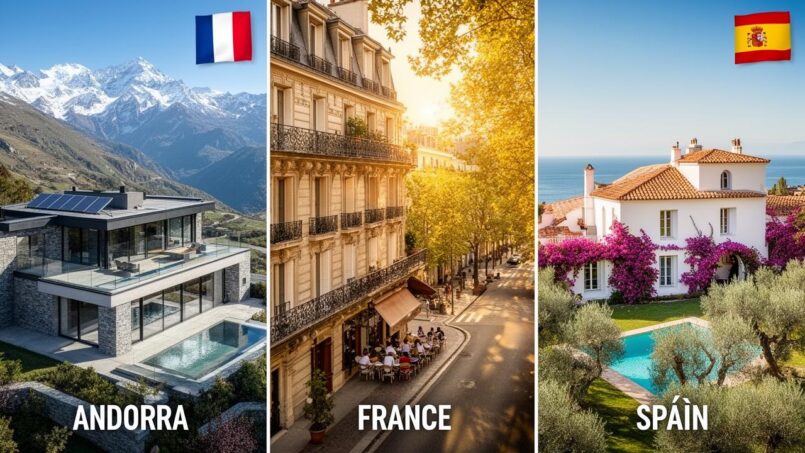
The same dilemma has been recurring among European investors for months: with rising interest rates, easing inflation, and tighter regulations, should they buy in France, move to the Spanish coast… or cross the border to take advantage of Andorra’s regime? In 2026, these three markets have never been more different in terms of taxation, yield, political risk, and price outlook.
The real estate challenge is no longer just about chasing the sun: you now have to balance rental cash flow, legal security, overall taxation, and residency constraints. Andorra remains very attractive tax-wise but heavily regulated, France offers stability and average yields with high tax pressure, while Spain is a compromise between cost per square meter, yield, and increasingly strict regulations, especially for short-term rentals.
Three radically different tax systems
Even before discussing prices or yields, taxation weighs heavily on net profitability. In this area, Andorra plays a different tune, poles apart from France and Spain.
Andorra: the tax haven… under tight regulation
In Andorra, the maximum income tax rate is set at 10%, with an allowance of €24,000 in annual income, then 5% between €24,001 and €40,000, and 10% above that. Corporate income tax is also capped at 10%, with special regimes that can go as low as 2%, or even 0% for certain holding companies. Most importantly, the country has no wealth tax, no inheritance tax between parents and children, and no gift tax.
The local VAT (IGI) is 4.5%, the lowest standard rate in Europe, far below the 20% in France or 21% in Spain. There is no national property tax, only a municipal tax called “Foc i lloc,” calculated per square meter and generally very modest: around €0.75/m² on average, resulting in an annual bill of €100 to €1,000 for most properties.
The minimum tax rate on rental income for an Andorran resident is 0.4%.
Another major factor for investors in securities: gains on stocks, fund shares, crypto assets, or financial instruments are simply not taxed in Andorra, whereas France applies a 30% flat tax and Spain imposes a sliding scale that can go up to 30% for very large capital gains on savings income.
France: decent yield, heavy tax burden
France remains marked by heavy taxation on wealth and rental income. Income tax can go up to 45%, plus 17.2% in social contributions. The real estate wealth tax (IFI) applies to net assets exceeding €1.3 million, with a progressive scale from 0.5% to 1.5%.
Real estate capital gains can be taxed at up to 45% plus social contributions, with total exemption after 22 years for income tax and 30 years for social contributions. Transfer taxes range from 5% to 6% of the purchase price, excluding notary fees.
Add to that local taxation: property tax (rising in many municipalities), possible surcharges on second homes in “stressed” areas that can go up to +60%, and an increasingly hostile environment for multiple property owners.
Spain: intermediate taxation but a complex system
In Spain, income and wealth taxation is generally heavier than in Andorra, but in practice it is often better perceived than the French system due to lower prices per square meter and higher rental yields.
The marginal income tax rate can reach 47% to 48% depending on brackets and regions.
Real estate capital gains follow a progressive scale for residents (19% to 30% depending on the gain level), while non-residents are subject to a rate of around 19% (with nuances depending on the source). A 3% withholding on the sale price is systematically collected by the buyer from the non-resident seller, then reconciled through the capital gains declaration.
Regarding transfer taxes, a purchase in the resale market typically incurs 7% to 10% transfer tax (ITP), depending on the region. For new builds, you need to account for 10% VAT plus notary and registration fees, bringing the total entry cost to around 10–12%.
Comparative summary of main property taxes
To visualize the contrast among the three countries, a comparative table is in order.
| Key element | Andorra | France | Spain |
|---|---|---|---|
| Standard VAT / IGI | 4.5% | 20% | 21% |
| Income tax (max) | 10% | 45% (+ 17.2% social contributions) | 47–48% (depending on region) |
| Real estate wealth tax | None | IFI from €1.3M | Wealth tax (threshold approx. €700,000) |
| Transfer tax (resale) | 4% | 5–6% (excluding fees) | 7–10% depending on region |
| Tax on real estate capital gains | 0–15% (0% after 10 years for residents) | Up to ~36% or more for large gains | 19–30% depending on status and amount |
| National property tax | None | Yes | Yes (IBI, based on cadastral value) |
| Typical annual local tax | Foc i lloc ≈ €0.75/m² | Property tax + possible surcharges | IBI 0.4–1.3% of cadastral value |
| Inheritance / gift tax | 0% (direct line) | Yes | Yes (highly dependent on region) |
For a wealth investor, these tax differences can represent, over a period of 10 to 20 years, the difference between a neutral investment and an asset generating several additional points of net annual yield.
Price per square meter: advantage to Spain, Andorra under pressure
Once the tax framework is established, the central question remains: how much do you pay per square meter, and how are prices behaving?
Andorra: a small market at record levels
The Andorran market is narrow but under strong pressure. At the end of 2025, the average price of apartments reached €4,547.3/m², an increase of 8.2% year-on-year and nearly double the €2,369.2/m² in 2020. In the first quarter of 2026, the average price of flats hovered around €4,415.9/m², up 3% year-on-year despite an early slowdown.
When broadening to all built properties (apartments, single-family homes, buildings), the average jumps to €4,661.7/m² in the first quarter of 2026, an increase of 11% compared to a year earlier. On the real market, asking prices remain even higher: in January 2026, listings for homes for sale showed an average price of €5,609/m², compared to €5,136/m² in March 2025.
Over €4,000/m² is common for properties in Andorra, with peaks at €11,000/m² in Escaldes‑Engordany.
Listing data by property type show the following levels: property types.
| Property type (Andorra) | Median listing price (€/m²) |
|---|---|
| Chalets | 4,368.12 |
| Duplex / Townhouses | 4,821.29 |
| Apartments | 4,557.41 |
| Land | 824.48 |
Professionals consider that below €3,500/m² for a chalet or duplex, and under €3,750/m² for an apartment, you start entering “opportunity” zones — often because renovations are needed, or because the property is in a secondary location.
France: high prices in major cities, corrections underway
In France, the landscape is more heterogeneous but the major trends are clear: after a post-Covid surge, the market has entered a phase of soft correction. Between 2024 and 2025, prices for existing homes are estimated to have fallen by about 4.5% on a national average, with 2026 forecasts ranging from −0.2% to +0.8% depending on the region. A majority of notaries (58%) expect further declines, while 40% bet on stability.
Major cities remain expensive: Paris intra-muros still shows €8,500 to €12,000/m² in central neighborhoods, Lyon hovers around €4,800/m², Bordeaux €4,600/m², Nice €4,650/m². Other dynamic cities like Toulouse or Nantes range between €3,400 and €4,500/m².
The added value of these markets comes less from rapid price increases than from legal security, market depth, infrastructure, and repositioning opportunities such as co-living, furnished rentals, or coliving, despite increased state regulation on rentals, especially for energy-inefficient homes and tourist rentals.
Spain: more square meters for the same budget
On the Spanish side, the picture is very clear for the investor seeking sun and profitability: prices per square meter remain much lower than on the French coast. According to Q1 2026 comparisons, the average price on Spanish coastlines is around €2,800/m², compared to €4,600/m² on the French coasts, meaning about 40% more surface area for the same budget.
On prime segments, Savills and Knight Frank report increases of 3% to 5% in 2025 on the Spanish coasts, with the trend continuing in 2026, especially in Mallorca and the Costa del Sol. Supply is particularly constrained in the ultra-high-end segment, especially in the €6–10 million range in Mallorca.
Second homes remain a pillar of the Spanish market: approximately 14.6% of the housing stock is classified as second homes, with some provinces exceeding 30%. Spanish households thus own twice as many second homes as the French.
Rental yields: Spain leads, France in the middle, Andorra segmented
For an investor, the gross rental yield (and especially net yield) is a decisive criterion. Here again, the three countries offer different profiles.
Yields in France: 3–5% depending on the city, with a strong micro-local effect
Studies from 2024–2025 converge: the average gross rental yield in France is around 4.1–4.7%, with peaks above 5% in some secondary cities, and conversely yields below 3.5% in Paris. The best ratios are found in studios and small apartments in cities like Toulouse, Marseille, Montpellier, Lille, Grenoble, Nantes, or Rennes, where gross yields can reach 5.2–5.8%.
Ancillary expenses (non-recoverable charges, property tax, renovations, management, insurance, energy renovation requirements) often absorb 20% to 35% of rents, bringing net yields down to around 3% on average. In very tight zones, the rise in interest rates has compressed profitability: many projects are now flat or slightly negative in cash flow.
Yields in Spain: 5.2–7.8% on well-targeted coasts
In Spain, Q1 2026 comparisons show gross yields of 5.2% to 7.8% on sought-after coastal areas. The combination of lower acquisition prices and rents supported by tourism and residential demand makes it possible to obtain, at equivalent location quality, 1 to 2 percentage points more gross yield than in France.
In highly stressed tourist areas like Barcelona, Palma, parts of the Costa Brava, or the Balearic Islands, tourist rental licenses are limited or not renewed. This favors long-term rentals, which are more regulated but more predictable.
Yields in Andorra: very high rents, extremely tight market
The Andorran rental market is unique: chronic housing shortage, combined with strong immigration and an influx of high earners, drives rents upward. In 2025, one study reported average rents of about €1,450 for a one-bedroom, €2,100 for a two-bedroom, €2,600 for a three-bedroom, and €4,300 for a large apartment. At the end of 2024, market data showed average apartment rents around €2,833 per month and €20.89/m², with houses renting for an average of €5,133 per month (€17.69/m²).
The gross rental yield reaches about 4.8% for a property bought at €5,500/m² and rented at €22/m².
However, one must take into account that, for investors becoming passive residents, the primary residence used to meet stay criteria cannot generally be rented out, which limits purely rental strategies on this specific segment.
Rental regulations: Andorran freedom, French oversight, Spanish crackdown
Taxation isn’t everything. Local laws can turn a good spreadsheet into a regulatory nightmare, especially for short-term rentals. On this front, the gap between the three countries has widened significantly.
Andorra: a rental market moving toward liberalization
In Andorra, 2026 marks a turning point: more than 3,000 old leases signed before 2019, which benefited from forced extensions, are no longer being renewed. Landlords can finally adjust rents to market levels, sometimes with increases of up to 40% to reach current prices.
The government has clearly stated that 2026 would be the year of gradual lease liberalization to avoid labor market rigidity caused by a lack of residential mobility. The social downside is heavy: many middle-class households are being pushed toward border towns in Spain (La Seu d’Urgell) or France, exacerbating the sense of a housing crisis. The country has launched a housing fund to finance about 300 affordable apartments by the end of 2025, but supply remains far below demand.
For the investor, this liberalization means a potential for revaluation of existing rents, but also a political risk to monitor if social tension translates into new restrictive measures.
France: widespread regulation and crackdown on low-performance homes
In France, successive reforms have profoundly transformed the rental landscape. Major cities have rent controls, short-term rentals are capped (120 days for a primary residence in Paris, even stricter restrictions for second homes), and the most energy-intensive homes are being gradually banned from being re-let.
Tax incentive programs (Pinel, LMNP, etc.) offer interesting tax offsets, but at the cost of heavy constraints on rents, holding periods, and property types. The investor today must be a shrewd strategist to obtain a net yield more than 2 percentage points above the cost of capital, which remains the selection criterion for many professionals.
Spain: major overhaul of short-term rentals
Spain is experiencing in 2026 the biggest overhaul of its tourist rental market since the arrival of platforms like Airbnb. Several levels have moved almost simultaneously.
Since Organic Law 1/2025, any apartment in a homeowners association must obtain a favorable vote from a majority of three-fifths of owners to be rented short-term. Without this agreement, the activity can be immediately banned. Additionally, the association can increase the charges for the affected units by up to 20% to offset wear and tear.
Meanwhile, a single national registry for short-term rentals was established by decree at the end of 2024, requiring registration of all homes rented for less than 30 days, with platforms obliged to verify the registration number under threat of heavy fines. This registry was partially struck down by the Supreme Court in May 2026 for exceeding state authority, which lightens one administrative layer, but leaves intact the central requirement: holding a valid regional tourist license where the autonomous community requires it.
In Catalonia, the number of tourist apartments is limited to 10 per 100 inhabitants, with licenses valid for five years. Barcelona plans to gradually eliminate the 10,000 licenses starting in 2028. Valencia caps tourist homes at 2% of the residential stock per district. In Palma and Mallorca, so-called “stressed” areas impose a rent increase cap of 3% per year and a reference index.
Result: between July and November 2025, the number of beds available in tourist homes in the 25 largest Spanish cities fell by 4.1% compared to the previous year, i.e., nearly 16,000 fewer beds, and more than 100,000 listings are estimated to have been removed between 2025 and early 2026.
For the investor, this regulatory offensive means that a property already equipped with a solid tourist permit becomes rare and expensive, while new short-term projects are significantly riskier. Long-term rentals are once again becoming the most solid foundation in many Spanish cities.
Acquisition costs: Andorra is no longer cheap for foreigners
Beyond ongoing taxation, the entry ticket (registration fees, foreign investment tax, notary and agency fees) weighs on the purchasing strategy, especially over a short or medium horizon.
Andorra: Omnibus 2 significantly increases costs for foreign buyers
Omnibus 2, adopted in January 2026, has profoundly changed the economics of foreign real estate investments in Andorra. For a non-resident or a resident of less than three years, the purchase of a first property now incurs a specific tax of 6% of the price (previously 3%), and 10% from the second property onward (previously 5%). On top of that, the property transfer tax (ITP) of 4% applies.
For an €800,000 apartment purchased as a first property by a foreigner, the tax bill would look like this:
| Item | Amount (€) | Comment |
|---|---|---|
| Transfer tax ITP (4%) | 32,000 | Paid before notarial deed |
| Foreign investment tax (6%) | 48,000 | IEI 1st foreign property |
| Total acquisition taxes | 80,000 | i.e., 10% of price excluding notary |
To this, you must add notary fees (0.5–1%), agency fees (5–10%), and, for an investor seeking passive residency, a minimum total investment of €1 million plus a non-refundable contribution to the Andorran financial authority of €50,000 for the main applicant (€12,000 per dependent), as well as approximately €18,000 in due diligence fees and €3,000 for permit issuance.
Although Andorra retains an advantageous tax system over the long term, the entry has become expensive for foreigners. This encourages long-term holding strategies and rigorous property selection.
France: high transfer tax, but no specific surtax for foreigners
In France, buying a resale property incurs transfer taxes of about 5–6%, plus notary fees. There is currently no specific national surtax on purchases by non-residents (even though many municipalities heavily tax second homes). Over five years, a study comparing all costs (taxes, property tax) estimates that the total burden can represent more than 8% of the price in some cases.
Spain: 10% on average, with regional nuances
In Spain, entry into the resale market typically costs 7–10% in transfer tax (ITP) depending on the region, plus 1–1.5% in notary and registration fees. For new builds, the standard combo is: 10% VAT, plus notary and registry fees. In Madrid, for example, ITP is 6% in certain configurations, and notary fees are around 1.5% of the price.
The total entry cost exceeds 10% of the price, similar to the Andorran case post-Omnibus 2, but without the €1 million investment requirement and the non-refundable contribution for passive residency.
Markets and dynamics: Andorran scarcity, French stabilization, Spanish rebound
The question remains: where is the probability of a good 10-year performance the highest?
Andorra: scarcity, sustained demand, and early normalization
In Andorra, the data reveal a rare and expensive market, with a high transaction volume in 2025 (2,175 sales, +35.3% year-on-year, for a volume of €1.4 billion), followed by signs of slowdown in 2026: apartment sales in Q1 fell from 438 to 398 units (−9.1%), and total transactions from 511 to 492 (−3.7%). Prices continue to rise, but more slowly.
Professionals speak of a phase of “containment” of prices, with a decline in activity and a gradual adjustment that, according to the president of AGIA, typically takes 4 to 5 quarters. However, the fundamentals remain very supportive: immigration, a relatively strong European economy, a dynamic labor market, land scarcity, and a rise in sustainable real estate projects. According to experts, the best opportunities are to be found in:
– truly rare prime residential properties;
– development projects ready to execute;
– long-term holding strategies on ultra-constrained locations;
– locally sourced deals with controlled execution.
The housing crisis, the increase in the household effort rate (13.9% of the population spent more than 40% of their income on housing in 2019), and the end of lease extensions create a risk of social tension and a return to stricter regulatory measures.
France: cautious market, moderate yields but robust visibility
In France, the market is entering a phase of cautious calm. Lending rates around 3.3–3.5% over 20 years, after a peak above 4% in 2023, allow for some recovery, but demand is constrained by political uncertainty and declining purchasing power.
Prices corrected by about 4.5% between 2024 and 2025, and should stabilize or move slightly in 2026. Institutional players anticipate rent increases of around 5% for residential, supporting medium-term rental profitability despite growing regulatory constraints.
The best strategies remain focused on:
– dynamic provincial cities with strong population growth (Toulouse, Nantes, Rennes, Strasbourg, Grenoble…);
– small units in city centers (studios, one-bedroom/two-bedroom);
– multi-unit buildings and family homes in the suburbs (4–5% gross yield).
Prime assets in Paris or the French Riviera retain their prestige but offer modest yields, little aligned with the cost of capital, reserving them for very long-term wealth strategies.
Spain: residential rebound and foreign anchor
In Spain, foreign demand accounts for about 14% of national transactions, and over 30% in several coastal and island provinces. British, German, and French buyers remain the main purchasers, although the French share has slightly declined (around 5.1% of foreign acquisitions in 2025 compared to nearly 9% at its peak).
According to Knight Frank, Southern Europe, and especially Spain, is experiencing the strongest rebound in the residential market. On coastal areas, prices increased by 3% to 5% in 2025, and this rise is expected to continue in 2026, supported by climate, construction costs, and tourist appeal.
The main paradigm shift comes from the complete elimination of the Golden Visa for real estate (abolished in early 2025): buying a property, even an expensive one, no longer grants easier access to residency. Residency candidates must go through non-lucrative (rentier), digital nomad, or entrepreneur visas, requiring an effective presence of at least 183 days per year — and therefore full subjection to Spanish taxation.
For the investor who wishes to remain a non-tax resident, Spain remains viable as a pure investment market, but the “passport through property” effect is buried.
Which country for which investor profile in 2026?
Given these three very different landscapes, the choice cannot be generic. It depends closely on the profile, objectives, and horizon of the investor.
Andorra: for high earners seeking a European tax hub
Andorra is primarily aimed at:
– entrepreneurs, traders, crypto or securities investors who can work remotely and want to drastically optimize their tax on financial income;
– wealthy families who want to reduce their wealth tax to zero and secure a transfer with no inheritance tax;
– investors willing to commit at least €1 million, bear a significant entry tax on real estate, and accept a minimum presence of 90 days per year.
Andorran real estate, in this context, plays the role of both residency support and investment asset. Over a 10-year horizon, a well-located purchase below peak prices, on a structurally scarce market, has good chances of preserving its value or even continuing to appreciate, especially since capital gains are eventually exempt for residents. But the investor must contend with:
The market features already very high prices, a social risk linked to the housing crisis, rapid regulatory changes like Omnibus 2, and lower liquidity than in the larger neighboring markets.
For a purely rental investor with no intention of settling, the increase in the foreign investment tax (6–10%) reduces the relative appeal of this market compared to Spain.
France: for prudent wealth diversification
France remains a relevant market for savers who: are looking for investment opportunities in a stable economic environment.
– want to secure part of their wealth in a country with very strong legal security;
– prefer moderate but relatively predictable returns (3–5% gross);
– use specific tax regimes (LMNP, Pinel, etc.) to optimize their taxation;
– have a long-term, more wealth-oriented than speculative vision.
Main risks are:
– the continued increase in tax pressure (property tax, IFI, surcharges);
– the rise of environmental constraints (renovation of energy-inefficient homes);
– the multiplication of local regulations on furnished tourist rentals.
Focus on growing mid-sized cities and neighborhoods with a good price-to-rent ratio. Explore niche segments like coliving, managed residences, or managed real estate in ski resorts and coastal areas outside saturated zones.
Spain: for yield and sunny residence at a reasonable cost
Spain appears as the best compromise for:
– investors seeking a good price/m² ratio – yield – quality of life;
– those who accept a certain regulatory complexity on tourist rentals, in exchange for gross yields of 5% to 7% in good locations;
– households wanting to move to the sun in the medium term via a rentier, digital nomad, or worker visa, assuming the tax constraints of effective residency.
Spain is generally more welcoming for second-home residents than France, despite a sometimes hostile political discourse toward foreign buyers. Attempts to heavily tax non-residents (e.g., a proposed 100% surtax on certain acquisitions by non-Europeans) have so far remained at the rhetorical stage.
The real challenge for the investor is to: maximize yield while minimizing associated risks.
– clearly distinguish between long-term and short-term rentals depending on the city;
– carefully check the regulatory status of any property already operated as a tourist rental (regional license, homeowners association position, urban planning compliance);
– include tax costs (ITP, IBI, capital gains tax) in the net yield projection.
Conclusion: balancing overall taxation, yield, and freedom of use
In 2026, the question “Andorra vs France vs Spain” has no single answer. Each market follows distinct logics.
Andorra is the most powerful option for those banking on overall tax optimization and wealth protection, with a high entry ticket and investment constraints. France is a defensive diversification market, offering legal security and infrastructure despite heavy taxation. Spain offers the best cost per m², rental yield, and sunshine, but requires vigilance on short-term rental regulations and clear tax arbitration.
For a diversified investor, the most robust solution is probably not to choose a single country, but to combine:
Deploy a diversified approach to optimize taxation, security, and rental performance.
A potential residential and financial base in Andorra to optimize overall taxation.
One or more assets in France in stable secondary markets, for legal security and market depth.
Properties with good yields in Spain, carefully selected according to the regulatory framework, to boost rental performance.
In 2026, real estate is no longer a simple brick and mortar investment: it is a balancing act between taxation, regulation, demography, and geopolitics. Those who accept to enter this complexity, with numbers in hand, can still build highly performing portfolios across these three markets — provided they do not apply yesterday’s strategies to today’s rules.
A wealth project or a question? Contact us now to speak with a wealth management expert.
Disclaimer: The information provided on this website is for informational purposes only and does not constitute financial, legal, or professional advice. We encourage you to consult qualified experts before making any investment, real estate, or expatriation decisions. Although we strive to maintain up-to-date and accurate information, we do not guarantee the completeness, accuracy, or timeliness of the proposed content. As investment and expatriation involve risks, we disclaim any liability for potential losses or damages arising from the use of this site. Your use of this site confirms your acceptance of these terms and your understanding of the associated risks.

Cyril Jarnias is an independent expert in international wealth management with over 20 years of experience. As an expatriate himself, he is dedicated to helping individuals and business leaders build, protect, and pass on their wealth with complete peace of mind.
On his website, cyriljarnias.com, he shares his expertise on international real estate, offshore company formation, and expatriation.
Thanks to his expertise, he offers sound advice to optimize his clients' wealth management. Cyril Jarnias is also recognized for his appearances in many prestigious media outlets such as BFM Business, les Français de l’étranger, Le Figaro, Les Echos, and Mieux vivre votre argent, where he shares his knowledge and know-how in wealth management.





