
 Published on and written by Cyril Jarnias
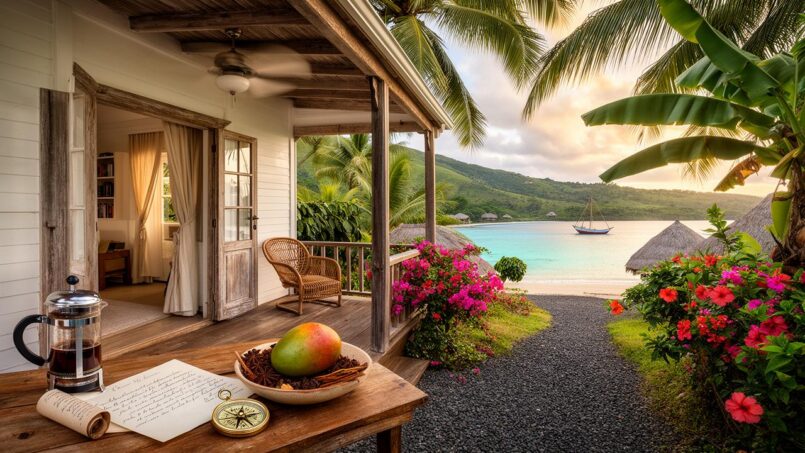
Setting up on the island of Principe means choosing a slow-paced life, amid lush nature, far from the hustle and bustle of Europe. This small island in the Gulf of Guinea, belonging to São Tomé and Príncipe, attracts a handful of travelers and expatriates primarily seeking tranquility, a stable climate, and an almost timeless atmosphere. For a French person, it is both a tropical paradise and a logistical challenge that requires careful preparation.
This guide compiles essential information on climate, cost of living, housing, long-stay formalities, health, safety, as well as internet, work, and daily life, offering a realistic perspective for those considering settling on Principe Island beyond a simple tourist stay.
An “Eternal Summer” Climate: What It Means Day to Day
Principe lies almost on the equator, in an area classified as a tropical rainforest climate (Köppen Af type). Concretely, this means: constant heat, very high humidity, frequent rain, dense and green vegetation year-round. For those escaping the European winter, it’s a major asset; for those who struggle with heavy, muggy air, it can quickly become trying.
Temperatures remain remarkably stable. Over the year, the island averages around 25 to 28 °C, with very little difference between day and night. In Santo António, the small “capital” of the island, long-term data give an annual average close to 24.8 °C. Overall, values fluctuate between 23 and 30 °C. There is neither extreme heat nor noticeable coolness: nights are almost as warm as days, often with only 1 to 2 degrees difference.
Stable Heat, but Seasonal Nuances
Even though variations are small, there are slightly warmer periods and slightly “cooler” ones:
From January to April, the average atmospheric temperature is about 27.5 °C.
In practice, you won’t experience season changes like in Europe: no winter, no autumn. You live in a kind of perpetual humid summer, with differences mainly related to rain and wind rather than temperature.
Humidity and Rain: Living in a Tropical Greenhouse
The other major characteristic is humidity. Available data indicate an average humidity around 80 to 83% over the year. Even in slightly drier months, the air remains very humid; some readings show e.g., 73% average in March, and up to 86% in September.
In the Santo António area, average annual rainfall reaches about 2,000 mm, more than double that of mainland France. In the south of the island, on the heights, totals rise to 4,000 mm, creating a super-humid environment inland, while the better-ventilated coasts are slightly less watered.
Over the year, it rains a large part of the time: statistics show about 220 days of significant rainfall (≥1 mm), i.e., more than 60% of days. Even in July–August, the driest period, there are still 14 to 15 rainy days per month on average.
For a future resident, it’s important to understand that rain is everywhere and present almost all the time in Principe’s landscape. These are often tropical downpours, more or less intense but mostly brief: a hard shower, then the sun returns. In the wettest months, these showers can turn into real torrents, with over 100 mm in a few hours.
The Seasons: “Gravana,” “Chuva,” and Mini Dry Season
Officially, the country experiences two main seasons:
– the rainy season (Chuva or Green Season), from October to May;
– the dry season (Gravana), from June to September.
On Principe, Gravana is shorter, from mid-June to mid-September, with less rain, slightly lower temperatures and humidity, but often cloudy skies; it’s a ‘dry’ season by comparison, without permanent blue skies.
Within the long rainy season, a “mini dry season called ‘Gravaninha'” typically appears between January and February: rain temporarily decreases, temperatures drop very slightly. Many residents consider January–February one of the best times of the year: a bit more sun, a bit less mugginess, while retaining the lush vegetation.
In daily life, life on Principe is mostly dictated by showers, cloud cover, and clear spells. You plan your week less by seasons than by weather windows within the day.
Cost of Living: How Much to Budget for Living on Principe Island?
Before leaving everything for a tropical island, you need to face the numbers. Available data for São Tomé and Príncipe and for Principe paint a fairly clear picture: for a French person with European income, the cost of living remains reasonable, but isolation, the small market size, and dependence on imports inflate certain expenses, especially if you want “European comfort” on such a remote island.
Overall figures for the archipelago show that the cost of living is about 58% lower than New York’s, with an index around 42 (NYC = 100). Rents are much lower than in Western Europe: often 50 to 70% less than in cities like Lisbon, London, or Paris, but this mainly concerns the main island and the capital.
For Principe, there are dedicated ranges in dollars that give a more concrete idea.
Typical Monthly Budget on Principe Island
Aggregated data for Principe propose three living standards for an expatriate:
| Profile | Standard of Living | Monthly Budget incl. Rent | Monthly Budget excl. Rent |
|---|---|---|---|
| Single | Basic/frugal | ~$655 (minimum) | ~$505 |
| Single | Medium (comfortable standard) | ~$1,487 (average) | ~$1,137 |
| Single | Comfort / “luxury” | ~$2,955 | ~$2,305 |
| Couple | Basic/frugal | ~$1,001.50 | ~$851.50 |
| Couple | Medium (comfortable standard) | ~$2,261.60 | ~$1,911.60 |
| Couple | Comfort / “luxury” | ~$4,512 | ~$3,862 |
| Family of 4 | Basic/frugal | ~$1,447 | ~$1,252 |
| Family of 4 | Medium (comfortable standard) | ~$3,262.60 | ~$2,807.60 |
| Family of 4 | Comfort / “luxury” | ~$6,482 | ~$5,637 |
Converted to euros (at an exchange rate close to 1:1 for order of magnitude), a single French person can therefore consider:
Three living standards according to allocated budget
About €650–700 per month. Living like a local, few leisure activities, consuming almost exclusively local products.
About €1,400–1,600 per month. Comfortable standard of living with a balance between needs and leisure.
About €2,800–3,000 per month. High-end housing, frequent outings, many imported products.
Rents and Housing: What the Market Reveals
Detailed rental figures pertain more to the main island, but give a good benchmark for the region. In São Tomé, for example:
| Type of Housing (São Tomé) | Average Monthly Rent (EUR) | Range (EUR) |
|---|---|---|
| 1 bedroom in city center | ~€233–255 | €100–300 |
| 1 bedroom outside center | ~€163–174 | €90–200 |
| 3 bedrooms in city center | ~€505–575 | €367–750 |
| 3 bedrooms outside center | ~€395–450 | €285–600 |
On Principe, the rental supply is much more limited, especially if you’re looking for something of “European standard.” The island is small, most homes are modest, and the few really comfortable properties are often linked to tourism projects or transient expatriates (hotels, NGOs, companies).
The average price per square meter on Principe Island is between $2,000 and $3,500, higher than in São Tomé.
For a French person wishing to buy a small house on Principe, one concrete example mentions a property around €35,000: furnished house, connected to the electricity grid, with a 1,000-liter rainwater tank, access to community water, and planted land (banana, papaya, pineapple trees). This illustrates a market where one can still find human-scale properties, but in a very specific legal and administrative context (land concessions rather than full land ownership).
When buying, ancillary costs add up quickly: transfer taxes (8%), stamp duties, notary, registration, lawyer fees, and possible agency commission. In total, you should budget about 15 to 20% in fees on top of the property price.
Everyday Expenses: Food, Outings, Services
For daily prices, most consolidated data cover all of São Tomé and Príncipe. They remain relevant for order of magnitude, but keep in mind that on Principe, isolation can make some imported products even more expensive.
The amount in euros serves as a reference to illustrate key data in the article.
| Item or Service (São Tomé & Príncipe) | Approximate Average Price |
|---|---|
| Simple meal at a local restaurant | €25 (recorded data) |
| 3-course meal for 2 people | ~€34 |
| Local beer (draft) | ~€1.5–2 |
| Cappuccino | ~€2–2.25 |
| Mid-range bottle of wine | ~€8 |
| Bottle of water (0.33 L) at a cafe | ~€0.87–1.0 |
| 1 liter of milk | ~€5.1 |
| 500 g white bread | ~€1.1 |
| 500 g rice | ~€0.75 |
| 12 eggs | ~€3.9 |
Two trends immediately stand out: restaurant meals can seem expensive relative to local income, but remain affordable for Europeans; basic local food (rice, bread, some agricultural products) is relatively cheap, while imported dairy products, cheeses, or wine are much more costly.
For services:
– a fixed internet subscription (when available) is around €60–70 per month;
– a mobile plan with voice and data can be around €20–25;
– utilities (electricity, water, garbage for an 85 m²) are in the €200–240 per month range.
For a French person receiving a pension or salary from abroad, the country offers a very favorable cost of living / quality of life ratio, provided you accept infrastructure limitations and the low diversity of supply on such a small island.
Housing and Real Estate: Specifics of Principe Island
The real estate market in São Tomé and Príncipe is still fairly unstructured and relatively opaque, with many transactions done directly, outside public databases. Principe, smaller and more isolated than São Tomé, functions even more on the basis of networks, local contacts, and targeted projects (tourism, NGOs, specific investments).
For a French person wishing to settle long-term, several points deserve to be considered well in advance.
Limited Supply, Rather “Premium” Segment
Available analyses show that Principe has a reduced real estate supply, but positioned more in premium segments, mainly linked to high-end tourism. You’ll find:
The real estate sector on Príncipe is divided into three main categories
A few villas or houses by the sea, sometimes intended for short-term rentals
Concession land for hotel or eco-tourism projects
More modest homes in and around Santo António
The most attractive coastal areas of the archipelago (which serve as market benchmarks) are located in northern São Tomé, but Principe retains an image of a “still untouched” pearl, favorable for luxury and ecotourism projects. For purchases, the higher per-square-meter prices on the island reflect this scarcity and positioning.
Ownership, Concessions, and Fees
Foreigners can buy various types of built properties (houses, apartments, commercial premises). For land, the system is more complex: it often involves long-term concessions rather than full land ownership, especially for large tourism or agricultural projects.
Ancillary costs of a real estate purchase (transfer taxes, notary, registration, lawyer, agency) amount to 15 to 20% of the property price. This additional cost, to be factored into any settlement project, often makes renting more reasonable in the first few years.
Reasonable Strategy for a French Person
For a French person discovering Principe Island, a prudent approach consists of:
– first renting a home in Santo António or a nearby village, to test the lifestyle, weather, the reality of internet access and services;
– then building a local network (landlords, agents, NGOs, shopkeepers) to spot opportunities;
– only considering a purchase after a good understanding of the terrain, local legislation, and ideally with the help of a lawyer familiar with local law.
In any case, it is strongly recommended to physically visit any property before signing: photos can hide very concrete problems (low water pressure, structural humidity, roofs in poor condition, difficult access, almost non-existent mobile network coverage).
Health and Healthcare System: What a French Resident Should Know
The healthcare system of São Tomé and Príncipe remains far from European standards. The country has a universal public structure for its citizens, supplemented by a few private clinics mostly concentrated on the main island. On Principe, the offering is much more limited.
Hospitals and Facilities on Principe Island
Principe Island is mainly served by Principe Hospital, located in Santo António. It is the reference facility for the island’s inhabitants. It offers:
– general medicine services;
– emergency care;
– pediatric care;
– some basic obstetrics and surgery.
Laboratory and radiology services there are basic. Other sources mention a “Príncipe Island Medical Center” with about 70 beds and activities in general surgery and dermatology, designed to provide access to care in rural areas of the island. In any case, capacity remains modest, the technical platform is limited, and one should not expect advanced specialties (interventional cardiology, oncology, neurosurgery, etc.).
For any serious problem, a medical evacuation is generally necessary, to Libreville, Lisbon, or a better-equipped country.
Organization of the National Health System
At the country level:
– the Ministry of Health runs a public system aimed at providing free basic care to citizens;
– public coverage does not cover all costs (medications, tests, certain procedures remain the patient’s responsibility), except for children under 5 and pregnant women;
– foreigners do not benefit from free care: they must pay for their care, often in cash, and do not benefit from public coverage mechanisms.
Better-equipped hospitals (diagnosis, specialized surgery) are on São Tomé Island, notably Ayres de Menezes Hospital, the main public facility, and a few private clinics in the city. Again, quality remains far below French standards, even if basic services are provided.
Health Insurance and Evacuation: A Must
For a French person settling on Principe Island, international health insurance with a medical evacuation option is not a luxury but a necessity. Recommendations from assessments of the local system are very clear:
For São Tomé, plan for solid international coverage from specialized insurers, as most facilities require cash payment even for emergencies, and medications are not always available, including in local pharmacies.
Estimates of annual premiums for comprehensive international insurance fall in a fairly wide range, but orders of magnitude are around a few thousand dollars per year. This is a significant expense item to include from the outset of your settlement project.
Public Health: Malaria, Other Risks
On the health front, an interesting piece of information concerns malaria: recent data show a markedly improved situation, with a reduced number of cases on Principe (a few cases reported over a quarter) thanks to active control programs. The national target is elimination by 2027. This does not negate the need for caution (mosquito protection, medical consultation if fever occurs), but shows a less risky environment than other tropical areas of Africa.
Other tropical diseases may circulate, and the usual recommendations apply: up-to-date vaccinations, including for yellow fever depending on itineraries (especially if transiting through risk countries), basic food hygiene, and precautions with water.
Safety: A Very Calm Island, but Not Entirely Risk-Free
For a French person accustomed to traveling, São Tomé and Príncipe stands out as an exceptionally safe destination compared to other countries in the region. International indices and official assessments converge.
Organizations like the U.S. State Department or the Overseas Security Advisory Council classify the country at a low threat level for crime and terrorism. Data from an “organized crime” index for Africa give the country last place (54th out of 54) with a very low crime score. For an expatriate, this translates to a very peaceful atmosphere.
Crime: Mostly Opportunity Thefts
In practice:
Even though violent crimes remain rare, including against foreigners, incidents mainly involve theft of items left unattended (phones, bags on the beach, objects visible in a car). Burglaries and snatch thefts exist, especially in the capital, but they are much less frequent than in many large African cities.
Compiled indicators on personal safety give very low “scores” for fear of theft, burglary, or assault, and very high scores for feelings of safety when walking alone day or night. On paper and in testimonials, Principe and São Tomé are among the calmest African destinations.
Basic caution is still in order, especially in certain contexts:
Avoid leaving valuables unattended on the beach or on a terrace, do not walk alone at night in isolated areas, and do not display expensive jewelry or large sums of cash.
On Principe, the rare incidents recorded sometimes mention thefts from hotel rooms, in a context of gradual tourism growth, but this remains marginal.
Other Safety Aspects
Politically, the country has experienced occasional tensions (attempted coup in the past), but the situation remains generally stable. Major risks are more related to the environment (poor roads, weather) than to violence.
On Principe in particular, traffic is limited by the sparse road network. A few kilometers of improved roads exist, but when heavy rain hits, some sections become difficult or even impassable. For a resident, this can impact daily travel, access to certain villages or beaches, and the delivery of goods.
Internet, Connectivity, and Remote Work: Can You Telework from Principe Island?
In the imagination of digital nomads, living on Principe Island would be like a postcard: laptop set up facing an empty beach, powerful Wi-Fi, smooth video calls. The reality, for now, is much more nuanced.
Current Internet Situation on Principe
At the country level, São Tomé and Príncipe has made significant progress thanks to connection to the ACE submarine cable, which multiplied international bandwidth. However, connectivity scores remain low globally, with a global resilient internet index around 29/100 and a very low position in international rankings.
Across the country:
– typical mobile download speeds are around 15–23 Mbps, sufficient for video calls or standard streaming, but with latency peaks and slowdowns;
– fixed offerings (ADSL or fiber) are often between 3 and 12 Mbps for the general public, with little deployment outside the capital.
On Principe Island in particular, the data is clear: access is “much more limited” than on São Tomé. 3G network is present in Santo António, but as soon as you move inland or to some isolated beaches, the signal becomes irregular or even non-existent (2G, EDGE, or no network). The country itself acknowledges that Principe is still “offline” in many areas of the island.
Connectivity analysis of Principe
In practice, Principe is not currently a relevant choice for someone who absolutely needs a stable and fast connection, full-time, for intensive remote work. Basic uses (emails, messaging, a few video calls) are still possible in Santo António, but it is essential to test the connection in a given home before committing to a long-term lease.
Outlook: A Submarine Cable Announced
The good news is that a submarine cable project dedicated to Principe is in preparation, financed notably by the World Bank for an amount of about 21 million euros. The goal is to connect the island to the main network and offer much better internet quality. According to statements from the president of the regional government, commissioning could occur around 2025 (the timeline remains uncertain, as the negotiation phase is still ongoing in available sources).
4,000 computers are already planned for students in the island’s school system to support digital education.
For a French person planning to settle long-term, this means the situation could improve significantly in the medium term, but in the short term, you should plan as if the connection remains unreliable.
Practical Recommendations
For a resident working partially remotely:
– prioritize a home in Santo António, where 3G signal is most stable;
– subscribe to a local SIM card (CST or Unitel STP) and test coverage on site;
– consider a Plan B (two operators, possibly a 4G router) to handle outages;
– plan fairly flexible working hours, taking into account possible speed drops in the evening.
“Light” remote work (emails, writing, project management) can be considered with these precautions. However, for very demanding needs (long daily video calls, large transfers, real-time work with international teams), Principe remains a risky bet today.
Formalities, Visas, and Long-Stay for French Nationals
For French nationals, entry formalities for São Tomé and Príncipe are relatively simple for a short stay, but become much more regulated as soon as you plan to settle long-term.
Short Stay (Less than 15 Days)
French citizens benefit from a visa exemption for stays of 15 days or less. You need:
– a passport valid at least six months beyond the return date;
– proof of return or onward ticket;
– proof of accommodation reservation.
This exemption applies to all EU nationals within the same duration limit.
Longer Stays and Settlement
For more than 15 days, a visa is required. Several categories exist (tourist, temporary, residence…), with varying durations and conditions. In practice, for someone considering living on Principe Island, the central question quickly becomes that of residence status or work permit.
Here are some general points to keep in mind.
– most basic tourist visas allow 30 days on site and can, in some cases, be extended;
– a long-term residence project requires entering a heavier administrative framework (residence visa, work permit, etc.);
– there is currently no specific visa for “digital nomads” or foreign retirees.
Procedures are done either through representations (consulates, e-visa online) or on site for renewals, in contact with immigration services.
For a French person planning to reside continuously, a good strategy is to:
– inquire with the competent French embassy (in Libreville) and São Toméan authorities;
– come first as a visitor, within the legal framework, to assess whether life on the island truly meets expectations;
– only embark on a long-term settlement process after this test phase and with local legal advice.
Work and Income: On Site or Remote?
The local job market in São Tomé and Príncipe is very narrow. The country is small, the economy limited, formal employment rates low. Available data indicate an employment rate around 21% for those over 15, with official unemployment close to 12%, and a large part of the working population concentrated in agriculture and the informal economy.
For a French person, three main options emerge.
Working Remotely for a Foreign Employer
This is the most realistic path for many expatriates: keep an employer or activity based in Europe (remote employment, freelancing, online entrepreneurship) while residing on Principe. Many foreigners in the archipelago operate this way, which allows:
– benefiting from European-level income;
– not depending on the local job market;
– maintaining a comfortable standard of living.
As seen, the limit remains internet connection quality, making this option safer in São Tomé than Principe in the short term.
Finding a Local Job
Opportunities exist, but they are very targeted and often linked to international projects: luxury hotels, eco-tourism, NGOs, foundations (such as Fundação Príncipe), environmental or development projects funded by the World Bank, IFAD, or other donors.
Positions are occasionally posted for roles like: project manager, developer, data analyst, community manager.
– hotel manager or restaurant manager;
– environmental engineer, renewable energy specialist;
– project coordinator for NGOs specializing in biodiversity;
– teachers, doctors, or skilled technicians in deficit sectors.
These positions are typically fixed-term contracts, with salaries in euros and sometimes benefits like housing, plane tickets, or health insurance. They target experienced profiles, French- or Portuguese-speaking, and require strong integration into ongoing programs on the island.
For a French person, a local job of this type can be an excellent entry point, provided you match the profiles sought.
Living on Passive Income
For retirees or people with enough income to fund a cost of living of €1,500 to €2,000 per month, Principe can be a peaceful haven, provided you accept a simple daily life, limited public services, restricted access to healthcare, and a much smaller social life than in Europe.
The absence of a large French-speaking community (only about thirty French are registered in the entire country) means opening up to the local culture, the Portuguese language, and a more intimate social life.
Daily Life: Language, Community, Environment
The official language is Portuguese. French is the first foreign language taught in the country, and a dynamic Alliance Française exists in São Tomé (classes, media library, cultural activities). But on Principe in particular, the practice of French remains limited, even if you may meet São Toméans with some knowledge.
For a French person, speaking at least basic Portuguese is essential, if only for formalities, daily life, and neighborly relations. Without it, the risk is staying in a foreign bubble, which is hard to sustain on such a small island.
Principe Island is a natural sanctuary with tropical forest, preserved beaches, and exceptional biodiversity, classified as a UNESCO Biosphere Reserve. Actors like Fundação Príncipe and a mechanism of ‘environmental dividends’ reward residents adopting ecological behavior, demonstrating a strong commitment to sustainable development.
For a French resident, this translates to a very preserved living environment, but also to rules and expectations regarding environmental respect (waste, deforestation, hunting, etc.) that must be taken very seriously.
Principe, a Life Project: For Whom and Under What Conditions?
Living on Principe Island is not simply “moving to the beach”. It means accepting a radical change of pace and reference. Those who feel good there are generally:
– people seeking silence, nature, and a life far removed from urban codes;
– professionals in environment, hospitality, or development, integrated into local projects;
– people with stable external income (retirement, remote work, annuity), able to manage variable connectivity and limited infrastructure.
For a French person, this destination offers a stable climate, high safety, affordable cost of living, welcoming population, and exceptional ecological richness. Drawbacks include a fragile healthcare system, isolation, uncertain internet access, complex administrative procedures, and a very small French-speaking community.
Before taking the plunge, the best approach is to:
– visit the island several times, at different times of the year (rainy season, Gravana, Gravaninha);
– test a few weeks or months of life in “real” conditions (renting, local shopping, dealing with outages, adapting to humidity);
– draw up a precise financial plan, including a good margin for unforeseen events and international health insurance with evacuation.
If, after all this, Principe Island continues to call you, then you will have a solid foundation for considering a thoughtful, conscious, and sustainable settlement, in harmony with this unique and fragile territory.
A estate planning project or a question? Contact us now to speak with an asset management expert.
Disclaimer: The information provided on this website is for informational purposes only and does not constitute financial, legal, or professional advice. We encourage you to consult qualified experts before making any investment, real estate, or expatriation decisions. Although we strive to maintain up-to-date and accurate information, we do not guarantee the completeness, accuracy, or timeliness of the proposed content. As investment and expatriation involve risks, we disclaim any liability for potential losses or damages arising from the use of this site. Your use of this site confirms your acceptance of these terms and your understanding of the associated risks.

Cyril Jarnias is an independent expert in international wealth management with over 20 years of experience. As an expatriate himself, he is dedicated to helping individuals and business leaders build, protect, and pass on their wealth with complete peace of mind.
On his website, cyriljarnias.com, he shares his expertise on international real estate, offshore company formation, and expatriation.
Thanks to his expertise, he offers sound advice to optimize his clients' wealth management. Cyril Jarnias is also recognized for his appearances in many prestigious media outlets such as BFM Business, les Français de l’étranger, Le Figaro, Les Echos, and Mieux vivre votre argent, where he shares his knowledge and know-how in wealth management.





