
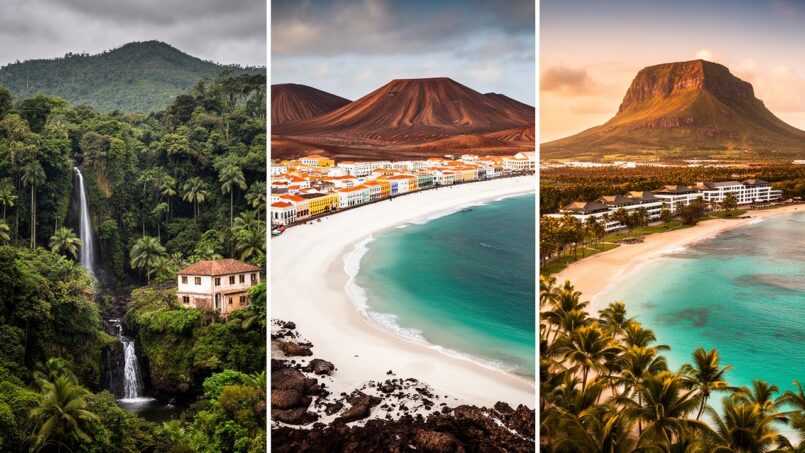
 Published on and written by Cyril Jarnias
Leaving Europe for a small island in the Atlantic or Indian Ocean is a dream for many expatriation candidates. But behind the postcards, not all paradises are created equal. São Tomé and Príncipe, Cape Verde, and Mauritius each have their own strengths, limits, and especially very different profiles for an expatriate employee, a retiree, an investor, or a digital nomad.
Cape Verde is launching an official program for teleworkers, Mauritius offers a nomad visa and favorable taxation, while São Tomé and Príncipe appeals with its preserved nature and off-the-radar lifestyle. The choice depends on your budget, profession, risk tolerance, and lifestyle.
Cost of Living: Three Islands, Three Budget Levels
One of the first filters for choosing an expatriation destination is the wallet. On this point, the comparison between São Tomé and Príncipe, Cape Verde, and Mauritius holds some surprises, especially when considering rents, local salaries, and spending habits.
Overall Cost Overview
Recent data shows that, overall, São Tomé and Príncipe is the most expensive of the three islands, especially for food and dining, even though local salaries are the lowest. Cape Verde falls in the middle, slightly more expensive than Mauritius on average, but with wide variations from one island to another. Mauritius, for its part, has a rather moderate cost of living relative to the quality of infrastructure and services.
A quick look at synthetic indices helps to get your bearings.
| Indicator | São Tomé and Príncipe | Cape Verde | Mauritius |
|---|---|---|---|
| Monthly cost of living (single person, excluding rent) | ≈ $719 | ≈ $847 | $753 |
| Monthly cost of living (family, excluding rent) | $2,239–$2,694 | n/a | $1,909–$2,152 |
| Cost of living index (NYC = 100) | 42.0 | n/a | n/a |
| Rank among most expensive countries (world) | 101st | n/a | 131st |
| Overall cost difference vs. Mauritius | +23.5% | +12% | baseline |
The figures clearly show that São Tomé and Príncipe is not the “ultra-cheap small island” some might imagine. For a comparable basket, this destination is on average 23.5% more expensive than Mauritius.
Local Salary vs. Cost of Living: Who Can Really Live Like a Local?
For an expatriate paid from abroad (telework, pension, or investment income), these differences are read differently than for someone looking for a local job.
The average salary in São Tomé and Príncipe covers only 0.3 months of standard expenses for a single person.
In Mauritius, the picture is less unbalanced, but the gap remains clear: the cost of living for a single person is estimated at $753 excluding rent, and the average net salary covers about 0.7 months of expenses. Cape Verde still sits in between: the average cost of living is around $847, or 12% more than Mauritius, but average salaries are higher than in São Tomé and Príncipe, around $400 per month.
In São Tomé and Príncipe, a foreign income of $700 to $1,000 per month allows a decent standard of living. In Mauritius, a budget of $500 to $1,000 per month (excluding rent) is realistic for a frugal digital nomad profile. In Cape Verde, the monthly bill is closer to Southern Europe, especially on touristy and connected islands.
Dining, Groceries, Transport: Where Do You Spend What?
Detailed comparisons clearly show that budget trade-offs vary from one island to another. Between São Tomé and Príncipe and Mauritius, the differences are sometimes dramatic.
| Expense Category | São Tomé and Príncipe vs. Mauritius |
|---|---|
| Restaurants | +130% (2.3x more expensive) |
| Groceries | +76.4% |
| Transport | +2.8% |
| Housing (rents) | –24.5% (cheaper) |
| Entertainment & sports | +23.5% |
| Clothing | –71.6% (much cheaper) |
In other words, someone living in São Tomé and Príncipe like a Western tourist—regular restaurant meals, consumption of imported goods—will see their bill skyrocket. Conversely, someone who adopts a more local lifestyle (markets, basic products, motorbike taxi travel) can keep their budget between $700 and $900 for a single person.
Cape Verde, for its part, generally falls above Mauritius for groceries, housing, and health costs, but below for some categories like clothing. Note that, according to comparisons, Mauritius would be approximately 14.2% cheaper than Cape Verde on the overall basket, even though the Indian Ocean island stands out for significantly higher childcare and private school fees.
Housing: Rents and Real Estate, Advantage São Tomé and Príncipe
On the housing front, São Tomé and Príncipe is unbeatable in terms of gross rents, even compared to Mauritius.
For major cities and capitals, here is the picture:
| Type of housing (monthly) | São Tomé and Príncipe (average) | São Tomé (capital) | Mauritius (capital) |
|---|---|---|---|
| 1-bedroom city center | ≈ £220–270 / ≈ €233–254 | €250 | €418 |
| 1-bedroom outside center | ≈ £150–180 / ≈ €163–174 | €180 | n/a |
| 3-bedroom city center | ≈ £437–575 / €505–575 | €437 | n/a |
| 3-bedroom outside center | ≈ £341–450 / €395–450 | €341 | n/a |
Even using the high estimates, rent remains well below what you find in Mauritius, where a simple one-bedroom apartment in downtown Port Louis is around €418 per month, with even higher rents in sought-after areas like Grand Baie or Flic en Flac.
On the other hand, real estate for purchase in São Tomé and Príncipe remains extremely informal and illiquid. Published average prices (around €1,633/m² in city center, €1,020/m² outside center) are difficult to interpret in a market where many transactions take place outside the modern cadastre, and where purchase by a foreigner requires patience, local advice, and tolerance for legal risk.
Mauritius, conversely, offers a more structured real estate market, with secure schemes for foreigners (dedicated schemes) and a range from affordable apartments to luxury villas, with high-end resorts starting around $200 per night for short-term rentals.
Cape Verde sits between these two extremes: property ownership is possible for foreigners, but quality, infrastructure, and connectivity vary enormously from one island to another.
Job Market and Expat Profiles: Getting a Job Locally or Staying Remote?
Another key criterion for choosing between São Tomé and Príncipe, Cape Verde, and Mauritius is whether you plan to work locally for an employer, start a business, or remain fully independent through international telework.
São Tomé and Príncipe: Few Jobs, Heavy Reliance on International
Economy of São Tomé and Príncipe remains very narrow: a GDP of about $547 million, agriculture (especially cocoa) accounting for 70 to 80% of exports, heavy reliance on international aid, and official unemployment around 14%, much higher among young people.
For an expatriate seeking a local contract, prospects are limited to a few targeted sectors:
– Energy and offshore oil (in partnership with major groups like TotalEnergies or Shell);
– Solar projects funded by major institutions (AfDB, IFC);
– High-end tourism and ecotourism;
– Fishing and seafood processing;
– Construction and infrastructure;
– NGOs, UN agencies, donors.
Published job openings mainly concern consultants, project managers, engineers, or specialists in UN programs, WFP, UNDP, UNICEF. These are highly skilled positions, often fixed-term, where the expatriate is assigned to develop local capacities.
For the rest, the country shows an average salary around $115 to $170 per month for many jobs, with a minimum in the civil service at $60 per month. Suffice to say that it is not realistic for an expatriate to live comfortably in São Tomé and Príncipe on a “standard local salary”.
On the other hand, for a teleworker paid in euros or dollars, the country can become very attractive, provided you can handle:
– Limited infrastructure (power outages, absence of specialized healthcare, illiquid real estate);
– Very informal rental market (word-of-mouth, flexible contracts);
– Small but tight-knit expat community (many Portuguese, development workers, oil professionals).
Cape Verde: Official Nomad Program and Africa–Europe Stepping Stone
Cape Verde plays a very different card: that of a relatively politically stable archipelago, connected by several international submarine cables, with a deliberate policy favoring teleworkers. The country has created a genuine “Remote Working Program” with a specific digital nomad visa, limited to certain passports (Europe, North America, CPLP, ECOWAS), and a 100% online procedure.
Possible pathways for expatriates
Facilitates access to the local job market through support mechanisms.
Offers integration programs, such as language courses and cultural activities.
Allows access to specific rights regarding residence and work.
– Remain an employee or freelancer for foreign clients via the 6-month Digital Nomad Visa, renewable once;
– Apply for a more classic residence visa (work, family, investment, retirement) leading to a residence permit that can lead to permanent residency after 5 years;
– Aim for citizenship in the long run if they accept the lengthy administrative process (continuous residence, Portuguese language test, proof of integration and financial means).
The local job market remains limited. The average salary is around $400 per month, and work visas are strictly conditional on an employer proving no local candidate is available. Cape Verde is therefore more suited to a telework or export-oriented entrepreneurship project than a traditional job search.
Mauritius: Business Hub, Investment, and Favorable Taxation
Mauritius has been attracting companies, investment funds, and wealthy individuals for years thanks to a rare combination: political stability, simple and competitive tax regime, good infrastructure, English–French bilingualism, and proximity to Africa, India, and Asia.
For an expatriate, the possibilities cover several profiles.
– Digital nomads and teleworkers, thanks to a specific 6- to 12-month visa for remote workers;
– Executives sent by international groups (finance, business services, IT, offshoring);
– Real estate investors or entrepreneurs using the island as a structuring platform through companies taxed at 15% on profits, with partially exempt regimes on certain foreign income;
– Retirees seeking a soft tax regime (no wealth tax, no capital gains tax, no inheritance tax).
The local job market, especially in services, finance, and new technologies, is significantly more developed than in São Tomé and Príncipe or Cape Verde. However, access to a work or residence permit requires meeting salary or investment thresholds and remains regulated.
Visas and Legal Frameworks: Who Really Wants You as an Expat?
Another decisive dimension in 2026 is immigration policy: who truly facilitates the settlement of foreign residents, nomads, or investors? And who remains reserved, or even closed?
Cape Verde: A Comprehensive Arsenal, from Short Stay to Passport
Cape Verde has set up a very wide range of tools, from short-stay visa exemption to permanent residence and naturalization, with the teleworker visa as a highlight.
For short stays, citizens of the EU, EFTA, CPLP, and ECOWAS, as well as most nationals of the United Kingdom, United States, Canada, or Australia, can enter without a visa for 30 days, provided they pre-register on the EASE portal and pay an airport security tax.
For teleworkers, the Digital Nomad Visa is designed for citizens of Europe, North America, CPLP, and ECOWAS. It allows:
First authorization of 6 months, renewable once (max 12 months). Application 100% online on the official portal. Required documents: proof of foreign income (€1,500/month for an individual, €2,700 for a family), telework certificates for non-Cape Verdean clients, health insurance, criminal record extract, and proof of accommodation.
Another particularity: this nomad visa must then be converted, on the ground, into a genuine residence permit with the administration (DGAE), with mandatory address registration at the town hall. From there, an expatriate who settles long-term can switch to a more classic residence permit, and aim for permanent residence (after 5 years) then nationality.
For professional projects, D residence visas, work permits, and naturalization procedures follow a fairly European logic: complete file, legalized and translated documents, processing times of 4 to 8 weeks for a residence permit, 5 years for permanent, Portuguese language requirement for citizenship. The country, overall, opens the door, but within a dense administrative framework.
Mauritius: Nomad Visa, Residence by Investment, and “Golden Visa”
Mauritius, for its part, particularly caters to high-income profiles, entrepreneurs, and affluent retirees. The country offers:
The country offers a nomad visa (DNV) of 6 to 12 months for teleworkers, residence schemes through real estate or professional investment with a flat income tax rate of 15%, no capital gains or inheritance taxes, and territorial taxation. A “Golden Visa Scheme” from $1 million offers long-term residence with taxation only on foreign income remitted to Mauritius, except for exceptions for local expenses via foreign cards or already taxed funds.
The Mauritian nomad visa is particularly appealing for a French-speaking or English-speaking teleworker: the island is bilingual, the nomad scene is booming, fiber internet can reach 100 to 200 Mbps, and long-term rents remain “reasonable” compared to Western standards.
For a life project of 5 years, 10 years or more, residence permits linked to investment or employment offer a clear legal and tax framework, provided you reach a certain level of income or capital.
São Tomé and Príncipe: Classic Work Visas, No Nomad Visa
In São Tomé and Príncipe, the path is much more traditional. There is no nomad visa or specific regime for teleworkers. Expatriates wishing to live there formally must go through:
– Temporary or permanent work visas, conditional on a local contract and a sponsoring employer;
– A classic residence procedure for those wanting to settle long-term, with a requirement of 5 years of continuous stay to qualify for permanent residency.
Most work visas require a complete file (passport, questionnaire, photos, employer letter, insurance, sometimes additional certificates like mental health statements or proof of assets). Processing times vary from 4 to 6 weeks, within an administrative apparatus with limited capacity.
For a digital nomad who simply wants to telework from São Tomé and Príncipe, the situation is therefore more like an extended tourist stay, potentially using back-and-forth trips. The absence of a formal framework may appeal to those who like gray areas, but it also creates long-term legal uncertainty.
Internet, Healthcare, Infrastructure: The Very Concrete Backdrop of Daily Life
You can accept higher rents or less favorable taxation when public services and infrastructure follow. In this area, Mauritius takes a clear lead, ahead of a rapidly catching up Cape Verde and a still lagging São Tomé and Príncipe.
Internet and Connectivity: Cape Verde and Mauritius Lead, São Tomé and Príncipe Lags Behind
For teleworkers, the issue of bandwidth is often decisive. Here again, the three islands play in different leagues.
Mauritius has a reliable internet network, with an average speed around 25 Mbps, but above all the availability of fiber between 100 and 200 Mbps in urban and modern residential areas. For a digital nomad, this connection quality is one of the island’s main arguments, even if some rankings still consider it “underdeveloped” in this regard compared to major tech capitals.
Cape Verde has invested heavily in its submarine cables and domestic fiber. Data shows:
– an average fixed speed between 17.8 and 50 Mbps depending on the source, with a median of 37 Mbps in 2024;
– in key hubs (Praia, Mindelo, Santa Maria), fiber offers between 50 and 300 Mbps, up to a theoretical 1 Gbps in some neighborhoods;
– internet penetration of 72 to 78% of the population, with a target of 90% in 2026;
– statistically high 4G coverage, even if actual penetration and quality vary.
Sal, São Vicente, and Santiago offer fiber, coworking spaces, and a remote community. Isolated islands suffer outages and slow speeds, sometimes requiring a Starlink kit.
São Tomé and Príncipe, on the other hand, does not appear as a digital hub. Internet access costs are relatively high (around £53 per month in some reports), quality remains uneven, and the archipelago offers neither structured coworking spaces in any number nor a government program for teleworkers. For a remote worker, this means accepting less reliable connectivity and few backup solutions.
Healthcare: Mauritius Well-Equipped, Cape Verde Acceptable, São Tomé and Príncipe Fragile
In terms of healthcare, the gaps widen even further.
Mauritius has a two-tiered healthcare system: a very developed public sector, free for all residents (including expatriates), and a private sector of high quality, but expensive. The island has five regional hospitals, two district hospitals, and several specialized facilities (ENT, psychiatry, ophthalmology, thoracic diseases).
Expats overwhelmingly prefer private clinics, like Darne Clinic or Apollo Bramwell, where you find Western standards, modern infrastructure, and specialists in many disciplines. The downside is the price: a general practitioner consultation in an office is around 500–600 rupees, a home visit 600–900, a specialist 800–900, an overnight hospital stay can range from 3,500 to 11,000 rupees. For childbirth, prices range from 45,000 to 60,000 rupees for a natural birth, 65,000 to 100,000 for a C-section.
The island has 15 insurers like Cigna or Allianz for expat coverage, and French nationals can enroll with the CFE. Réunion is malaria-free; recommended vaccines are limited to routine boosters (tetanus, diphtheria, MMR, hepatitis).
Cape Verde offers a generally acceptable level of care for an island African country, but detailed data ranks it slightly below Mauritius on health scores. A consultation costs about $24, compared to $23 in Mauritius according to some comparisons. Serious cases often require evacuation to Europe or a better-equipped country, and the country relies on a small network of hospitals and health centers, mainly concentrated in Praia and a few main islands.
São Tomé and Príncipe, finally, remains clearly fragile in terms of healthcare. Infrastructure is limited, and for any complex treatment, expatriates must consider a transfer to Lisbon, Accra, or another regional center. The public system suffers from a lack of advanced equipment, private hospitals are rare, and international health insurance becomes essential to cover potential medical evacuations. Living there in good health is entirely possible, but an expatriate must accept from the outset that for cancer, major surgery, or a serious accident, leaving the country will be necessary.
Safety: Peaceful Paradises, but Nuances Across Islands
All three destinations enjoy a relative safety image, much better than many continental African countries. But nuances matter.
Safety index in São Tomé and Príncipe is very high, around 83.
Cape Verde, on the other hand, presents a more mixed picture. Major Western countries generally classify the country at a “normal precautions” level, but with increased warnings for certain areas:
– Praia, the capital, is subject to heightened vigilance (muggings, burglaries, pickpocketing, nighttime assaults);
– Tourist islands like Sal and Boa Vista are seeing a rise in petty crime, especially in isolated beach areas after dark;
– Pickpockets and bag snatchers deliberately target people perceived as affluent, regardless of nationality.
Official statistics place the homicide rate around 7 per 100,000 inhabitants, within the African average but well above Europe. That said, violence specifically targeting foreigners remains rare, and crimes are mostly opportunistic.
Mauritius, finally, benefits from a largely positive reputation in terms of safety. Rankings deem it “very safe” for travelers and nomads, even if some indices point to a safety score around 60/100, lower than the postcard image might suggest. In practice, violent crime targeting expatriates is marginal; precautions are still advisable (avoid walking alone at night in certain neighborhoods, don’t leave valuables in plain sight), but the general environment is stable and reassuring.
Taxation and Real Cost of Expatriation: Mauritius Widens the Gap
The daily cost of living tells only part of the story. For an expatriate settling long-term, the host country’s taxation becomes decisive. In this area, Mauritius clearly plays in a different category.
Mauritius: 15% Tax, Zero Capital Gains and Inheritance Taxes
Mauritius offers a particularly appealing tax regime:
Mauritius applies a flat income tax rate of 15% for all, without progressive brackets, but with additional contributions beyond certain thresholds (Solidarity Levy, Fair Share Contribution). It does not tax capital gains, inheritances, gifts, or wealth. Residents are taxed only on Mauritian-source or remitted income (specific rules for Golden Visa holders). The country has over 45 double taxation treaties.
For an expatriate receiving foreign income (dividends, interest, telework salaries, capital gains), this regime allows for very efficient structuring of one’s situation. As long as the income remains abroad and is not remitted to Mauritius, it can in some cases escape Mauritian tax, while benefiting from possible tax credits to avoid double taxation.
The income thresholds triggering the Solidarity Levy (25% on the portion exceeding 3 million rupees, about $66,500) target very high incomes. For a senior executive or entrepreneur, the effective overall rate remains attractive compared to Western Europe.
Cape Verde and São Tomé and Príncipe: More Classic Frameworks, No Major Advantage
Neither Cape Verde nor São Tomé and Príncipe currently offer a tax regime as clear and advantageous as Mauritius. Both countries remain on more classic schemes, with tax brackets and charges that are not intended to make these islands major hubs for international tax planning.
For a digital nomad or a retiree, this does not mean these destinations are disqualified, but simply that they do not provide, fiscally, any special bonus. On the contrary, for someone aiming for wealth optimization or structuring an international activity, Mauritius clearly dominates the matchup.
Lifestyle, Community, Nomad Scenes: Where Will You Really Live Well?
Beyond the numbers, an expatriation also hinges on subjective criteria: atmosphere, language, culture, natural environment, size of the expat community, opportunities to socialize, school quality, etc.
São Tomé and Príncipe: Quiet Refuge, but Very Isolated
São Tomé and Príncipe attracts a very specific profile: people seeking an extremely calm pace of life, immersion in preserved nature, and a very relaxing safe environment. The local concept of “leve-leve” describes the mindset well: take your time, live with little, accept that not everything is Western-rationalized.
Major advantages:
– Exceptional daily security, little harassment, little theft;
– Very low housing costs, allowing you to rent large spaces at moderate prices;
– Natural beauty, virgin beaches, remarkable biodiversity, stable equatorial climate year-round.
Drawbacks:
– Geographic isolation, few flight connections, heavy reliance on imports;
– Fragile infrastructure (electricity, internet, healthcare);
– Real estate market illiquid and informal;
– Very small expat community, mainly composed of NGOs, Portuguese, and professionals from a few sectors.
For a frugal retiree or a teleworker ready to live in “light off-grid”, this is potentially a discreet paradise. For a family with school-age children, specific medical needs, or a strong cultural appetite, it can quickly become too limited.
Cape Verde: “No Stress” Atmosphere but Variable Realities Across Islands
Cape Verde also cultivates an image of island coolness, summed up in the famous slogan “No stress“. But behind this label, the reality is very heterogeneous from one island to another.
For a teleworker or expat, three islands stand out:
– Sal, with Santa Maria as a practical base, fiber widely available (50 to 200 Mbps), coworking spaces, beach atmosphere heavily geared toward tourism;
– São Vicente, with Mindelo, the cultural capital mixing cafés, music, small-scale urban life, and now good connectivity;
– Santiago, with Praia, the country’s largest city, administrative center, best services and most extensive fiber coverage, but also more urban security issues.
The nomad scene is emerging with coworking spaces and shared spaces offering fiber and generators, an advantage given frequent outages. The administration supports the teleworker program, attracting a growing flow of European, North American, and Lusophone remote workers.
The general atmosphere is more “African” than that of Mauritius: more socio-economic contrasts, a safety level requiring vigilance in large cities, a heavy administrative framework for anything beyond short stays, and still modest domestic economy. For an expatriate wanting to live at lower cost, take part in local life, and enjoy a laid-back vibe, Cape Verde offers a good compromise. For someone looking for the great comfort of a very developed ecosystem, it is not there yet.
Mauritius: “Chill” but Structured Island, Francophone Nomad Hub
Mauritius bets on an “Indian Ocean chill” atmosphere: tropical climate tempered by the ocean, multilingual population, cultural diversity, mix of beaches, mountains, and small towns.
The island is largely French-speaking and officially bilingual with English, making daily life and international business easier.
The nomad scene is growing rapidly, with clearly identified hotspots:
– Beau Bassin-Rose Hill, considered one of the best bases for nomads, with a nomad score of 69/100 (quality of life, moderate cost, safety);
– Flic en Flac, Grand Baie, Tamarin, Port-Louis, which concentrate much of the offering in coworking spaces, cafés, long-stay residences, and expat social life.
The island is however designed for cars: few truly “walkable” areas, limited public transport, distances that quickly require renting or buying a vehicle. Nightlife, outside resorts, is considered rather dull, especially for those seeking a vibrant party scene.
In return, the overall comfort—healthcare, schools, banks, internet connection, stable administration, air hubs—is clearly superior to that of Cape Verde or São Tomé and Príncipe. For a family, an entrepreneur, or a nomad wanting a rather “plug and play” environment, Mauritius checks many boxes.
So, Where to Expatriate in 2026?
By cross-referencing costs, infrastructure, safety, taxation, and lifestyle, the three destinations outline very distinct profiles.
São Tomé and Príncipe is primarily for:
– Those seeking a discreet refuge, extremely quiet and very safe;
– Nature lovers, ecotourism enthusiasts, or professionals from NGOs and international organizations on assignment;
– Teleworkers who prioritize tranquility and accept major compromises on infrastructure (healthcare, internet, logistics).
Cape Verde is more suited to:
This destination is for European or North American teleworkers looking for a mix of sun, Lusophone culture, and reasonable cost of living. It suits those who appreciate an official digital nomad program with a clear visa framework. However, you must be prepared to deal with mixed safety in capitals, power cuts, and variable service quality depending on the island.
Mauritius finally appears as the most “complete” choice for:
– French-speaking and English-speaking digital nomads who want a very comfortable setting, good connectivity, and a dedicated visa up to 12 months;
– Families and retirees seeking both a solid healthcare system, schools, favorable taxation, and a stable environment;
– Entrepreneurs and investors interested in a reliable tax and legal platform for their international activities.
Approximately $847 per month is needed for an average lifestyle in Cape Verde.
Ultimately, the choice will depend less on the most beautiful beach than on your risk tolerance, your healthcare needs, the nature of your income, and your appetite for isolation or, conversely, for a structured ecosystem. Between the peaceful “leve-leve” retirement in São Tomé and Príncipe, the Cape Verdean “no stress” provided you stick to the right neighborhoods, and the very organized “chill” of Mauritius, there is no one best island, but three radically different ways to reinvent your life in the sun.
An asset management project or a question? Contact us now to speak with a wealth management expert.
Disclaimer: The information provided on this website is for informational purposes only and does not constitute financial, legal, or professional advice. We encourage you to consult qualified experts before making any investment, real estate, or expatriation decisions. Although we strive to maintain up-to-date and accurate information, we do not guarantee the completeness, accuracy, or timeliness of the proposed content. As investment and expatriation involve risks, we disclaim any liability for potential losses or damages arising from the use of this site. Your use of this site confirms your acceptance of these terms and your understanding of the associated risks.

Cyril Jarnias is an independent expert in international wealth management with over 20 years of experience. As an expatriate himself, he is dedicated to helping individuals and business leaders build, protect, and pass on their wealth with complete peace of mind.
On his website, cyriljarnias.com, he shares his expertise on international real estate, offshore company formation, and expatriation.
Thanks to his expertise, he offers sound advice to optimize his clients' wealth management. Cyril Jarnias is also recognized for his appearances in many prestigious media outlets such as BFM Business, les Français de l’étranger, Le Figaro, Les Echos, and Mieux vivre votre argent, where he shares his knowledge and know-how in wealth management.





