
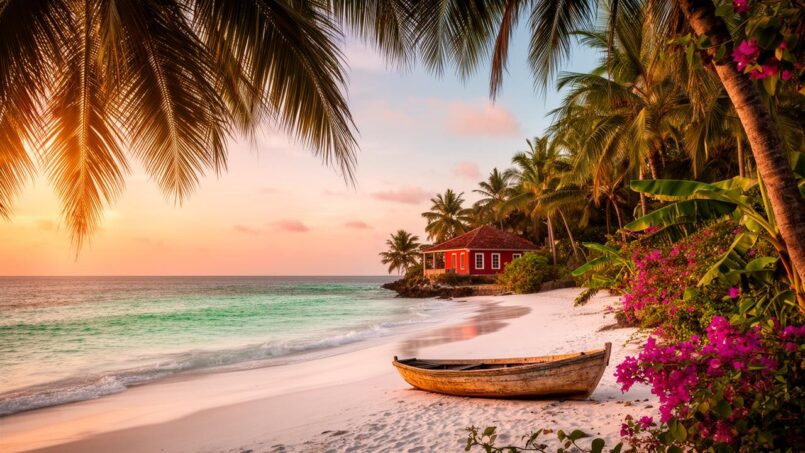
 Published on and written by Cyril Jarnias
Discreet archipelago in the Gulf of Guinea, São Tomé and Príncipe is starting to attract a new generation of expatriates, investors, and digital nomads seeking calm, nature, and lower living costs. Behind the postcard image, however, the country remains a niche market, with limited infrastructure, fragile healthcare, and an administrative environment that is still unclear.
This guide covers quality of life, cost of living, housing, safety, healthcare, education, work, real estate, visas, and the expat profile suited to the archipelago in 2026.
Understanding São Tomé and Príncipe Before You Go
São Tomé and Príncipe is a small island nation in Central Africa, with about 240,000 inhabitants, made up of two main islands. The general atmosphere is described as very tranquil, with a slow pace of life, a population known for its warmth, and a small but close-knit expat community.
The capital, São Tomé, is home to about 80,000 residents, accounting for nearly all of the country’s urban life.
The country remains a “frontier market” in many respects: a limited job market, rudimentary medical infrastructure, weak air connectivity, virtually no international school options, and administrative procedures that can be opaque. Expatriating here therefore requires a real project and a great deal of adaptability, not just a desire for tropical beaches.
Cost of Living: A Real Advantage… Under Certain Conditions
One of the major assets of São Tomé and Príncipe for an expat remains the level of daily expenses. Comparative studies place the cost of living at about 42% of New York’s level (index 42/100), meaning up to 50 to 70% less than Portugal, the UK, or the U.S. for a moderate lifestyle.
The figures available allow for distinguishing several profiles and comfort levels.
Realistic Monthly Budgets for Expats
Estimates converge around relatively consistent ranges, which vary depending on lifestyle and expectations for “Western” comfort.
Here is a summary of recommended monthly budgets (including rent):
| Expat Profile | Moderate Budget (USD) | Comfortable Budget (USD) | Estimate in Euros (ranges used in sources) |
|---|---|---|---|
| Single, local/frugal lifestyle | 700 – 900 | 840 – 1,680 | 750 – 950 € |
| Single, average expat lifestyle | 700 – 1,000 | ≈ 1,500 – 2,000* | ≈ 715 € average in São Tomé |
| Couple | 1,350 – 1,850 | ≈ 2,000 – 3,000* | — |
| Family of three | ≈ 2,600 | 3,000 – 4,000* | 1,700 – 2,700 € |
| Family of four, moderate expat standard | 2,500 – 3,500 | 3,500 – 4,500 | — |
| Family of four, “imported” comfort (car, imports, private schools) | 4,500 – 6,000+ | — | 1,500 – 3,000 € just for quality housing |
*Estimates derived from observed housing costs + daily living expenses.
One point emerges very clearly from the data: a single person can get by on around $700 to $900 per month by living “the São Tomé way” (local markets, motorcycle taxis, few imported products), while a lifestyle closer to Western standards quickly drives up the bill.
For families, the gaps are even more pronounced: a budget of $2,500 to $3,500 per month allows for a moderate expat standard of living, but switching to a lifestyle with many imported products, a private vehicle, and private schooling can push the bill to $4,500 to $6,000 monthly.
Housing: Cheap Locally, Costly in “Western Standard”
Housing is both one of the most financially attractive items and one of the most tricky, as the market is very informal and the “expat” supply is limited in quality.
National or São Tomé averages give order-of-magnitude estimates for simple housing
| Type of Accommodation (rental) | City Center (€/month) | Outside Center (€/month) |
|---|---|---|
| 1-bedroom apartment – average | 233 | 163 |
| 1-bedroom apartment – observed range | 100 – 300 | 90 – 200 |
| 3-bedroom apartment – average | 575 | 450 |
| 3-bedroom apartment – observed range | 400 – 750 | 300 – 600 |
In dollar equivalents, several sources also mention:
– About $200 per month for a 1-bedroom in central São Tomé.
– About $590 for a 3-bedroom in the center.
Compared to Western Europe or North America, these average rents are estimated to be 75 to 85% lower. This is one of the major sources of savings for expats.
But these figures mostly correspond to local standard housing. As soon as you look for a level of comfort and finish that’s more “international”, the picture changes:
– In São Tomé, “good quality” housing suited to Western standards often negotiates between €1,000 and €3,000 per month.
– For a family, it is advisable to budget €1,500 to €3,000 monthly for housing if you want to avoid major compromises on location, amenities, or construction quality.
– More affordable options (€450 to €850) exist, but they are mainly suitable for singles or couples willing to accept local standards, rarely satisfactory for families accustomed to Western comfort.
The other difficulty lies in how the market operates: most rentals are found through word of mouth, local contacts, Facebook groups, or recommendations. Structured agencies and real estate portals are marginal. Written contracts exist, but it is mainly trust relationships, thorough property inspections (water, electricity, safety, neighborhood), and oral arrangements that actually structure the agreement.
Where to Settle: Neighborhoods, Towns, and Islands
For an expat, not all places in the country are equal. The available data outlines distinct area profiles.
In São Tomé, the capital, several sectors stand out:
A developing sector focused on beaches, biodiversity, and ecotourism.
Production of cocoa, coffee, and other tropical crops for export.
An important activity for the local economy and food supply.
Sector including trade, banking, and public administration.
– Downtown São Tomé, especially around Ana Chaves Bay, remains the heart of activity. Here you’ll find government offices, banks, shops, restaurants, bars, and a waterfront popular with expats. Rents are higher, but access to services is significantly better.
– Somewhat outlying or suburban neighborhoods offer lower rents (around $100 to $200 for a local 1-bedroom), at the cost of a simpler environment and more frequent trips to the center.
– The Água Grande district, which encompasses the capital, is described as the most practical long-term option for most expats: better access to the central hospital, better Internet connections, private schools, a small foreign community, basic services.
– Guadalupe, quieter, is mentioned as a more peaceful residential area than some parts of the capital, sometimes appreciated by expats seeking tranquility.
For beach lovers, a few alternatives exist:
The east coast, especially around Santana, attracts those who love a beach lifestyle with resorts like Club Santana and residential projects, but options suitable for remote workers remain limited. Coastal areas to the north and south are mainly intended for tourism or hotel investment, without sufficient infrastructure for remote workers or families.
Finally, the island of Príncipe represents a special case:
– Classified as a UNESCO Biosphere Reserve, ultra-exclusive, with about 8,000 inhabitants and very little mass tourism, it mainly attracts ultra-luxury eco-tourism.
– For a residential expat, the offering boils down to a binary choice: ultra-luxe resorts billed at around €12,000 (or more) per month or basic guesthouses between €1,000 and €2,500. There is virtually no mid-range.
– In practice, Príncipe Island is only reasonable in specific professional contexts (contracts in high-end hospitality, conservation, NGOs, research), not as a standard base for remote work or family relocation.
Other Expenses to Budget For
The available data also indicates:
– Local fresh produce is affordable. Costs rise as soon as you consume many imported products (branded cereals, cheeses, luxury items, etc.).
– A meal at an inexpensive restaurant is sometimes valued at over €20 in some databases, suggesting that “Western-style” dining can be expensive relative to local wages.
– Utilities (electricity, water, garbage, etc.) for a medium apartment (85 m²) are estimated at around £176 or over $300 depending on the source, amounts that are high compared to local rents.
– Fixed Internet is expensive relative to local purchasing power: around £50 or about $100 per month for a connection, with inconsistent reliability.
Currency, Payments, and Daily Reality
The local currency is the Dobra (STN). It has been officially pegged to the euro since 2010, at around 1 euro for 24.5 dobras. This peg stabilizes budgets for European expats, even though in practice, the Dobra also trades at around 21.5–22 STN per US dollar.
This euro peg makes mental conversions easier, but the payment system remains largely cash-based:
Card payments are limited, and ATMs may be out of service or out of cash. It is strongly recommended to keep a stock of cash and not to rely on a single card or ATM.
Daily life unfolds in a very informal mode: direct negotiations, flexible hours, administrative slowness, importance of personal relationships. Those who appreciate the “laid-back” side and are willing to forgo ultra-reliable logistics often feel very comfortable here. Those who need a very well-oiled environment are likely to become frustrated quickly.
Work and Income: A Country for Remote Workers More Than Job Hunters
Studies agree on one point: the most realistic financial model for an expat in São Tomé and Príncipe is remote income. Local salaries are low, the formal job market is limited, and even skilled positions do not always allow for maintaining a Western lifestyle.
Local Salaries and the Job Market
A few key figures illustrate the gap:
– The local average net salary is around €460 per month, or according to other sources, on the order of $150 to $300.
– The average salary in the formal sector is estimated at 2,415,000 dobras (about $115) monthly, with a minimum around $60 to $100 depending on the position.
– Even local positions considered “high” rarely exceed $1,000 per month.
– Formal unemployment hovers around 12%, and only 21% of adults over 15 hold a formal job, according to World Bank data.
– Nearly 68% of the population lives below the poverty line.
Under these conditions, relying on a local salary to fund an expat lifestyle is rarely realistic. The sectors that employ most workers remain agriculture (cocoa, coffee, palm oil), services, fishing, some industrial activities, and the civil service.
Employment opportunities for foreigners are mainly in specific sectors.
– Tourism and hospitality (management, chefs, guides, hotel administrators, reservation agents).
– NGOs and international organizations (UN, UNDP, WFP, UNICEF, etc.), with positions for coordinators, analysts, program assistants, environmental engineers, climate specialists, etc.
– Energy and infrastructure sectors (solar projects, hydroelectric, network rehabilitation), often funded by the World Bank or other donors.
– Fisheries and the “blue economy,” with fleet modernization, aquaculture, seafood processing.
– More occasional technical roles in construction, engineering, education, or healthcare (teachers, doctors, engineers, etc.), often within a cooperation or specific project framework.
But these positions are generally:
– Rare,
– Very targeted,
– Tied to international projects or companies already established,
– And recruited through specific channels (UN agency websites, NGO networks, specialized firms).
For most expats living comfortably, the pattern is therefore: a salary, freelance income, pensions, or investment income received from abroad and spent locally.
Remote Work and Digital Nomads: Doable, but with Constraints
São Tomé and Príncipe is sometimes presented as an exotic destination for digital nomads. The facts call for a more nuanced view:
– There is no specific digital nomad visa.
– Internet quality is variable, expensive, and far from the standards of major remote work hubs.
– Power and network outages are a reality, even though recent improvements are mentioned.
– Coworking spaces are almost nonexistent, essentially concentrated in the capital, and remain rare.
– The country is considered “impractical” for professionals who depend on very fast and reliable connections.
On the other hand, for freelancers who accept a more flexible pace, can work asynchronously, and are able to set up backup solutions (4G hotspots, multiple operators, UPS units, even small supplementary solar systems), the archipelago can work, with the trade-off being a moderate cost of living and a very calm environment.
The implicit message from the data is clear: São Tomé and Príncipe is suited to flexible profiles, not to workers who need daily video conferences with teams in London or New York over a fiber connection.
Healthcare: A Weak Link to Be Anticipated
On the medical front, sources are unambiguous: the local healthcare system is very limited, and any serious expat must plan for international health insurance with medical evacuation. This is presented as a nearly non-negotiable condition for settling there.
Local Capabilities: Basic Care, but No Specialties
The archipelago has:
– 50 health facilities in total, including 6 health centers, 29 health posts, 13 community health posts, and 2 hospitals.
– The central hospital Ayres de Menezes in São Tomé is the country’s main facility, but its technical capabilities are described as rudimentary and it has very few specialists.
– The hospital on Príncipe, in Santo António, has very limited capacity, like all infrastructure on that island.
– A private medical center, such as Centro Médico Gnóstica in São Tomé, covers some care, including traumatology.
Recurring observations:
– Lack of qualified staff,
– Insufficient equipment,
– Coverage essentially focused on primary care,
– Need for evacuation abroad (often to Lisbon, sometimes to Gabon or home country) for serious illnesses, major surgeries, or many specialties.
European countries such as France stress: without insurance covering medical expenses and repatriation, access to care, even in life-threatening emergencies, can be compromised.
International Health Insurance: A Must
All recommendations converge:
Take out international health insurance that explicitly covers São Tomé and Príncipe, with emergency medical evacuation of at least $100,000 to $150,000, medical expense coverage capped at a minimum of $500,000 (ideally $1 million), direct billing to hospitals, coverage for the whole family including maternity, neonatal, and pediatric guarantees, and no geographic exclusions (especially for Príncipe).
Annual premiums for this type of coverage generally range from $3,000 to $8,000 depending on age, family composition, and scope of coverage, often around $250 to $600 per month. Compared to the level of risk, this is an expense that is hard to avoid.
Additionally, it is advisable:
– To consult a travel medicine doctor before departure to establish a suitable vaccination schedule.
– To prepare a comprehensive personal pharmacy (chronic medications, basic antibiotics, painkillers, antihistamines, antimalarial treatment, first aid supplies).
– To follow strict precautions regarding water (boiled or treated) and food (pasteurized or boiled milk, enhanced hygiene).
Safety and Crime: Generally Safe, but Not Without Risks
Safety data paints a rather favorable picture compared to other countries in the region, even though travel advisories shift depending on political and health contexts.
Key indicators:
The crime rate is very low (about 17.86/100), with a very low level of vandalism, theft, and violent crime. The Global Organized Crime Index ranks the country third in the world and first in Africa for low organized crime. Kidnappings and violent assaults are rare, and serious public crimes are almost nonexistent.
Risks mainly concern:
– Opportunistic theft (pickpocketing, bag snatching, theft on the beach, in markets, or near hotels).
– Burglaries and, more rarely, home invasions, sometimes armed.
– A few cases of theft from parked or moving vehicles.
– Some tourist scams in the capital, but significantly less developed than in other destinations.
Personal safety indices are indeed high:
– Walking alone during the day is rated as very safe.
– Walking alone at night is also considered relatively safe according to some sources, which is rare for the region.
U.S. authorities have raised their overall advisory to “Reconsider Travel” (Level 3) due to risks of sporadic instability, health, demonstrations, or political tensions that could disrupt transportation. Although crime is generally low, the situation can evolve and caution remains advisable.
In practice, advice remains standard:
– Avoid flashing jewelry, watches, or expensive devices.
– Limit cash on hand.
– Use a safe for sensitive documents.
– Stay cautious in isolated, poorly lit, or reputedly sensitive areas, especially at night.
– In case of attempted theft or carjacking, do not resist and prioritize physical safety.
For an expat, basic safety is therefore a rather positive point compared to other African countries, provided you act prudently.
Education and Schooling: The Real Achilles’ Heel for Families
If São Tomé and Príncipe may suit a couple or a single person, the situation is more delicate for families with children, especially from middle/high school onward.
Local Education System: Portuguese Model, Uneven Quality
The education system generally follows the Portuguese model inherited from colonization, with compulsory schooling limited to the first four years of primary school. Public education is entirely in Portuguese, the official language spoken by over 98% of the population, alongside local Creoles (Forro, Angolar, Principense).
A few key points:
– The enrollment rate has risen sharply, from 56% in 2008 to 93% in 2017.
– The quality of secondary education is very uneven.
– About 18% of poor families withdraw their children from school for financial reasons, despite its theoretical cost-free nature.
– Higher education is mainly provided by the University of São Tomé and Príncipe (USTP), which brings together several pre-existing institutions.
For an expat child, integration into the public system means total immersion in Portuguese. Children under 8 generally adapt within 6 to 12 months, while teenagers without a Portuguese foundation may face significant difficulties, affecting their results and academic continuity.
International Schools: A Very Limited Reality
This is one of the most sensitive points for families: truly international schools, in the usual expat sense (IB Diploma, recognized British or American curricula, instruction in English), simply do not exist in the country.
The reported facts are clear:
– No institution offers the International Baccalaureate (IB Diploma).
– No school teaches a structured British curriculum (GCSE/A-levels type).
– No American curriculum school is in place.
– Options mentioned as “international” actually remain tied to the Portuguese system, in Portuguese, possibly with a few hours of English or French.
The main private schools listed in São Tomé are:
The Escola Portuguesa de São Tomé e Príncipe – Centro de Ensino e da Língua Portuguesa is a public school integrated into the Portuguese network, following the Portuguese curriculum from primary to 12th grade and aiming to promote Portuguese language and culture. The Escola Internacional de São Tomé e Príncipe is a private school supervised by the APRENDE association, based on Portuguese programs for the 1st cycle (1st to 4th grade).
On Príncipe:
– The Escola Internacional de Santo António (EISA), a private international school, offers instruction mostly in English with a mix of international curricula, but remains a small structure, suitable for a limited number of families and mainly for younger children.
Other Portuguese private institutions, such as Colégio Lusíada São Tomé, welcome expat children, but always within a Lusophone framework.
Consequently:
– Families seeking a continuous Anglo-Saxon curriculum (IB, A-levels, AP, etc.) will have to turn to distance learning (British, American, Canadian, or Australian programs) or consider boarding schools abroad for secondary education.
– The most common option among long-term expats remains homeschooling or online schooling, requiring a very significant parental investment in time and organization.
For children under 8, immersion in Portuguese can work, provided language support is arranged and a certain break with the original school system is accepted. For middle and high school students, most experts advise against São Tomé and Príncipe, except for very specific projects and exceptional adaptability.
Real Estate and Investment: A Niche Market, Still Affordable
Beyond the rental housing question, some expats or investors are interested in buying property. Here again, São Tomé and Príncipe stands out as a very illiquid market, still little studied, but with potential, especially through tourism development.
Purchase Conditions for Foreigners
Notably, the country allows foreigners to buy real estate:
About 90% of land is state-owned, meaning purchases mainly involve construction rights or leases rather than outright ownership of vacant land.
The market is described as:
– Very illiquid,
– Poorly documented by official statistics,
– Historically dominated by Portuguese and European investors who have driven up prices on the most attractive coastal sites.
Prices and Prospects
The available data gives a glimpse of prices per square meter for different types of locations:
| Area | Average Price per m² (USD) | Profile |
|---|---|---|
| São Tomé (capital) | 1,200 – 2,000 | Administrative and business center |
| Northern coastal areas / near airport | 1,500 – 2,500 | Close to tourism projects, developing resorts |
| Príncipe Island | 2,000 – 3,500 | Ultra-luxury, very limited supply |
| Southern São Tomé | 800 – 1,500 | Less developed infrastructure |
| Interior / former plantations | 600 – 1,200 | Agricultural land, eco-tourism projects |
These levels remain much lower than those of European beach destinations or certain islands in the Indian Ocean or Caribbean. The country is still in a nascent market phase, with progressively more dynamic growth since 2016, slowed by the pandemic, then picking up again between 2023 and 2026, with estimated appreciation rates of 5 to 7% per year recently due to tourism investments.
Five-year value projections mention:
– 5 to 8% per year on premium coastal areas.
– 6 to 10% on Príncipe for ultra-luxury assets.
– 3 to 5% on urban residential.
– 2 to 4% on agricultural estates.
– 4 to 12% on development land depending on location.
The main driver remains the rise of tourism, which already accounts for about 11% of GDP and is considered a growth pillar by the government, with investments in airports, ports, and hospitality infrastructure.
Caution is needed, however: underdeveloped market, difficulty reselling, legal security that could be improved, need for very thorough due diligence and strong local advice.
Visas, Residence, and Citizenship: An Evolving Environment
For an expat, understanding the legal framework for entry and stay is essential. São Tomé and Príncipe has implemented a relatively practical e-visa system for short stays, but long-term stays require more procedures.
Short-Stay Entry
Many nationals (USA, Canada, European Union, etc.) benefit from visa exemption for short stays:
– Up to 15 days without a visa for certain nationalities, simply by presenting a valid passport (often required to be valid for at least six months after the intended return date).
– Beyond that, a tourist visa is required, generally valid for 30 days, extendable once for up to an additional 60 days.
– An e-visa service (eVisaST) has existed since 2012: you fill out an online form, upload a PDF (under 2 MB) containing a copy of your passport, ticket, and proof of accommodation or contact, then receive authorization by email within 3 to 7 days.
The tourist visa costs between $20 and $50. Conditions include proof of yellow fever vaccination, a return ticket, and proof of accommodation.
Long Stays and Residence
To settle long-term, you must go through a residence visa, which comes in several categories (salaried employment, self-employment, study, family reunification, research, volunteering, training, highly skilled profession, etc.).
The standard process:
The residence visa application is made at an embassy (one-year passport, application form, photos, financial documents, criminal record, accommodation, and purpose). Processing up to 30 days. Once on site, the temporary residence certificate (valid for 1 year, renewable, authorizing work/study) is obtained via SMF or e-Cidadão. After 5 years of continuous legal residence, permanent residence is possible subject to good integration (language, social contributions, economic/family ties).
Administrative fees for a temporary residence certificate are on the order of 5,000 to 10,000 dobras, about $220 to $450.
Nationals of ECCAS (Economic Community of Central African States) countries may benefit from simplified procedures.
Citizenship by Investment: A Shortcut for Some
More recently, São Tomé and Príncipe launched a structured citizenship by investment (CBI) program, governed by a 2025 decree law and managed by a dedicated unit (CIU) based in Dubai. It is a donation-only program, with no state-approved real estate component.
The main points:
This minimum amount is required from a single applicant for the non-refundable contribution to the National Transformation Fund, which finances renewable energy, education, and infrastructure projects.
Recent adjustments have been announced, however, including the suspension of applications from individuals already holding three or more citizenships and certain temporary restrictions on passports issued to adult children, pending new legislation.
This program is not directly a tool for expatriation to work in São Tomé and Príncipe, but rather a product for asset planning and international mobility, which may interest investors who also wish to settle locally.
Which Expat Profile Suits São Tomé and Príncipe?
The accumulated data paints a fairly specific destination profile.
The country may suit: people seeking a high quality of life, economic opportunities, and a secure environment.
This block is for Portuguese speakers or those willing to accept a Portuguese environment with little English, couples or singles with stable remote income seeking moderate costs and a calm tropical climate, professionals on mission for NGOs or projects paid from abroad, experienced real estate investors able to handle a niche tourism market, and healthy retirees aware of local medical limitations and prepared to plan for medical evacuations if needed.
Conversely, the country is decidedly less suited to:
Those requiring continuous international schooling (IB, A-levels, AP), people with complex medical needs (insufficient healthcare system, reliance on evacuations), expats looking for an English-speaking community and a cosmopolitan life, and candidates counting on a local job to maintain a Western standard of living.
Expatriating to São Tomé and Príncipe in 2026 therefore means choosing a very specific life project: a safe environment, welcoming people, a potentially very advantageous cost of living, and a promising real estate market, at the cost of significant trade-offs in terms of modern comfort, services, schooling, and healthcare. For the right profiles, well-prepared and clear-eyed, the archipelago can be a surprisingly pleasant base. For others, it remains a vacation destination, or a beautiful dream to keep as a screensaver rather than a move.
A wealth management project or a question? Contact us now to speak with a wealth management expert.
Disclaimer: The information provided on this website is for informational purposes only and does not constitute financial, legal, or professional advice. We encourage you to consult qualified experts before making any investment, real estate, or expatriation decisions. Although we strive to maintain up-to-date and accurate information, we do not guarantee the completeness, accuracy, or timeliness of the proposed content. As investment and expatriation involve risks, we disclaim any liability for potential losses or damages arising from the use of this site. Your use of this site confirms your acceptance of these terms and your understanding of the associated risks.

Cyril Jarnias is an independent expert in international wealth management with over 20 years of experience. As an expatriate himself, he is dedicated to helping individuals and business leaders build, protect, and pass on their wealth with complete peace of mind.
On his website, cyriljarnias.com, he shares his expertise on international real estate, offshore company formation, and expatriation.
Thanks to his expertise, he offers sound advice to optimize his clients' wealth management. Cyril Jarnias is also recognized for his appearances in many prestigious media outlets such as BFM Business, les Français de l’étranger, Le Figaro, Les Echos, and Mieux vivre votre argent, where he shares his knowledge and know-how in wealth management.





