
 Published on and written by Cyril Jarnias
Settling in Algeria, whether for work, to join a partner, or to launch a business venture, means entering a dense social and cultural universe—warm, but also highly codified. The country presents itself as a crossroads between the Mediterranean, the Arab world, Africa, and French heritage. Without a roadmap, an expatriate can quickly feel lost in the face of behaviors that, from the outside, sometimes seem contradictory: great human warmth but a very marked hierarchy, humor about delays but a cult of honor, generous hospitality but conservative social norms.
Mastering cultural differences is essential to avoid misunderstandings, build trusting relationships, and live your expatriation peacefully. This guide is based on research, sociological data, and field observations for an in-depth analysis.
A Warm, Hierarchical Society Deeply Marked by Islam
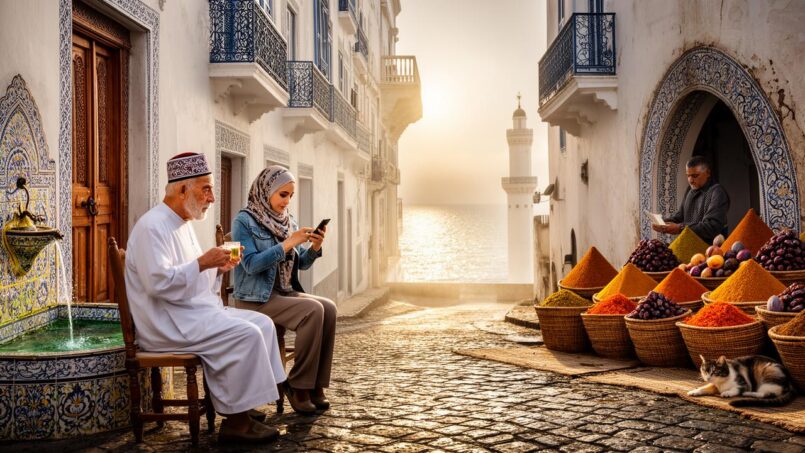
The first impression that foreigners often have is of a warm, generous people, quick to help, invite, and chat. The culture of hospitality is not a folkloric veneer, but a pillar of national identity. Offering tea, a meal, prolonging a conversation, opening one’s home to a visitor—all of this is almost a moral obligation. Refusing an invitation too quickly can be perceived as distance, even disrespect.
Behind the warmth lies a highly hierarchical society, where the patriarchal family is central, with marked respect for paternal authority and elders. In work and public life, age, title, and status are essential: important decisions rest with senior figures, and openly challenging a superior is very frowned upon.
Islam, the majority and official religion, permeates all social life. It is felt in the organization of time (prayers, Ramadan, religious holidays), in consumption (no pork, alcohol very limited), in daily ethics (the value of charity, the place of family, rules of modesty), and in the importance given to honor and reputation.
The weight of history, particularly 130 years of French colonization, the war of independence, and the violence of the 1990s, has also shaped a society that is both seeking modernity and deeply attached to its traditional benchmarks. The Arabization policies, the official promotion of Arab-Islamic identity, and more recently, the recognition of Amazigh languages and cultures, create a complex but coherent cultural landscape for those who understand its logic.
Cultural Analysis
The Relationship with Time: Between “Algerian Time,” Climate, and the Demands of Modern Life
For an expatriate from Northern Europe or North America, the perception of time is often the first culture shock in Algeria. In the local culture, time is not a rigid framework to be optimized at all costs, but an element negotiated with human relationships, weather conditions, and especially religious rhythms.
Research shows that in traditional societies, the past and present take precedence, while industrial societies value linear time oriented toward the future. Algeria lies between these two logics: the country officially operates on modern time (centrality of schedules, administrations, schools, businesses), but day-to-day life retains a more flexible relationship with time, sometimes called “Algerian time.”
It is common for appointments to start 10 to 30 minutes late without causing offense. Business hours or public service hours can be variable, with some administrations closing earlier than expected or shops suddenly shutting. Algerians joke about these discrepancies by speaking of “Algerian time,” with humor rather than fatalism.
This flexibility does not mean a lack of organization: it reflects a hierarchy of priorities where human relationships take precedence over strict punctuality. A meeting can run long because the discussion becomes important; a manager may interrupt a meeting to receive a relative; a family emergency can override a professional imperative.
The climate strongly influences the rhythm of activities, with activities concentrated in the morning and evening during summer heat. Added to this are schedules shaped by the five daily prayers and the month of Ramadan, a period when working hours are reduced and active life shifts toward nighttime.
For an expatriate, the key is to keep a dual reflex: arrive on time out of respect, while being mentally prepared to wait, to see an appointment shifted or extended. This psychological preparation helps reduce stress and avoid interpreting every delay as a lack of seriousness or consideration.
Official Time, Religious Time, Family Time
Several “layers” of time coexist and intertwine in daily life:
| Type of Time | Main Characteristics | Impact for the Expatriate |
|---|---|---|
| Official Time | Administrative hours, office hours, school, banks, companies | Need to check hours, especially before holidays and religious periods |
| Religious Time | Five daily prayers, Ramadan, holidays like Eid al-Fitr and Eid al-Adha | Adjusting appointments, respecting prayer and fasting times |
| Family Time | Evenings with family, visits, shared meals | Avoid scheduling late meetings, understand refusals of commitments at certain hours |
| Social Time | Cafés, prolonged discussions, spontaneous invitations | Anticipate that interactions last longer than expected, accept the central role of conversation |
A good practice is to always check opening hours before going somewhere, especially during Ramadan or major holidays, and to confirm appointments a day or two in advance.
Religion, Ramadan, and Holidays: Adjusting Your Daily Life
In Algeria, Islam is not just a private spiritual framework: it structures public space, the calendar, and part of social expectations. The expatriate is not required to practice, but is expected to respect the resulting codes.
The five prayers punctuate the day, visible or discreet depending on the context.
First prayer before sunrise, marks the start of the day.
Second prayer, often in the middle of the day, a break in activities.
Third prayer, in the afternoon, a moment of reflection.
Fourth prayer, at dusk, closes the active day.
Fifth prayer, in the evening, the last before night.
The month of Ramadan profoundly disrupts daily rhythms. Muslims fast from dawn to sunset: no food, drink, or smoking in public during the day. Working hours are reduced, economic activity slows during the day and explodes in the evening, streets come alive after breaking the fast, and iftar meals take on a very convivial and community dimension. Many shops open late and close very late at night.
There is no legal fine for an expatriate who eats or drinks in the street during Ramadan, but the implicit transgression is seen as a provocation.
Beyond Ramadan, several religious holidays (Eid al-Fitr, Eid al-Adha, Mawlid al-Nabi, Ashura) and national holidays (Independence Day, Revolution Day, Labor Day, Yennayer…) lead to widespread closures of businesses, public services, and shops, or reduced hours. Professional project planning must account for this, or risk hitting administrative “walls” without understanding why.
Family, Honor, and the Place of Women: Understanding the Social Logic
In Algerian society, the family is not merely an affective unit; it is the primary frame of reference that defines identity, obligations, and each person’s honor. Three generations living under the same roof is not uncommon, and even when children move out, ties to the parental home remain very close.
The individual is seen first and foremost as a member of a family group. Their behaviors reflect on the reputation of the entire clan. A shortcoming, public humiliation, or direct criticism can be experienced not as a temporary disagreement, but as an attack on honor. This logic of honor explains the sensitivity to “face-saving” in interactions: avoiding putting someone in a difficult spot in front of others, not forcing them to say “no” directly, and sidestepping a refusal with softened phrases (“it will be difficult,” “we’ll see”) are deeply ingrained reflexes.
The place of women is undergoing rapid and contrasting evolution. On the educational front, the numbers are impressive: female students are the majority at university, and are very present in legal, medical, and academic professions. Women reach positions of responsibility, join the judiciary, higher education, and administration. In large cities, you see women as executives, lawyers, business owners, police officers.
Social norms remain conservative, with a family code inspired by Islamic law that maintains legal inequalities despite reforms. The traditional model sees the man as the provider and head of the family, the woman as responsible for the home. Social mixing is regulated, romantic encounters are mediated by families, and public display of sexuality or homosexuality is poorly accepted or even punished.
For a female expatriate, this translates into ambivalent situations: on one hand real access to work and the city, on the other implicit expectations of modest dress, caution in interactions with men, and increased risk of remarks or harassment in some contexts, especially in rural or very conservative areas. For a male expatriate, misreading these codes (crude jokes, explicit flirting, inappropriate physical contact) can be heavily sanctioned socially.
The best approach is to observe the behaviors of Algerian women and men in the environment where you move, tactfully ask trusted colleagues, and adopt a cautious attitude at first, adjusting later as needed.
Hospitality, Invitations, and Meals: The Beating Heart of Sociability
Refusing tea, coffee, or a meal is rarely a neutral gesture in Algeria. Hospitality is a core value, rooted both in Berber heritage (the sacred duty of welcoming the traveler) and Islamic ethics (honoring one’s guest, practicing generosity). Opening one’s door, cooking abundantly, prolonging the evening—all this contributes to building bonds and trust.
Accepting a home invitation is an honor; bring a small gift (pastries, fruit, flowers) on a first visit, but avoid alcohol unless you are sure the family consumes it.
Once inside, certain codes should be known. Shoes are often removed at the entrance, especially in traditional homes. Greet the oldest people first, go around the room shaking everyone’s hand, sometimes cheek-kissing between people of the same sex. Men and women may be seated separately, especially in conservative families. Dishes are frequently placed in the center, to be shared: each person takes from the part of the dish in front of them, avoiding “traveling” across the communal plate.
Eating with the right hand is a cultural and religious norm, the left hand being reserved for impure uses. Although fork and spoon are acceptable, using the right hand for certain bites, especially couscous, eases integration.
It is common for the host to insist on serving guests, sometimes multiple times. Starting with a small portion helps avoid being overwhelmed. Leaving a little food on the plate is interpreted as a sign that you have been amply satisfied. Flatly refusing a dish or drink can be seen as rejection; it’s better to accept at least a small amount.
Some Practical Pointers for Sociability Around Meals
| Situation | Dominant Cultural Expectation |
|---|---|
| Home invitation | Accept if possible; arrive with a small gift (pastries, fruit, flowers) |
| Offers of tea or coffee | Accept, at least once; refusing systematically is frowned upon |
| Seating at table / in living room | Don’t sit before the host indicates; greet the oldest first |
| Way of eating | Prefer the right hand for picking up food, or utensils; avoid using the left alone |
| Quantity of food | Start modestly, accept seconds diplomatically, leave a little on the plate at the end |
This culture of hospitality, which may seem overwhelming to some foreigners, is actually a powerful lever for integration and understanding the country. Many misunderstandings dissolve over a plate of couscous or a glass of mint tea.
Languages, Communication, and Unspoken Rules: The Art of Reading Between the Lines
Algeria is officially bilingual (Arabic and Tamazight), but the linguistic reality is much more nuanced. In daily life, the vast majority of people speak a local Arabic dialect, Darija, a mix of Classical Arabic, Berber, French, and other influences (Ottoman, Spanish…). In some regions, Amazigh variants (Kabyle, Chaoui, Mozabite…) remain very present. French, although unofficial, dominates in administration, business, part of higher education, and the written media. English is growing, especially in international companies, tech, and among young people, but remains far behind French and Arabic.
For an expatriate, not mastering Arabic or French complicates daily and professional life. Although English and gestures suffice to get by, this maintains a communicative marginality. Learning a few basics of Arabic (greetings, polite phrases) and/or improving your French is a sign of respect and a very worthwhile investment.
Beyond language, the way of communicating is also specific. On technical or operational subjects, Algerians can be very direct. However, as soon as criticism, refusal, disagreement, or anything that could cause loss of face comes up, communication becomes noticeably more indirect. The word “no” is often avoided. In its place, you will hear phrases like “we’ll see,” “inshallah,” “it will be difficult,” which to an unwary expatriate may seem encouraging but sometimes actually mean a polite refusal.
No specific figure is highlighted in this article, which describes behavioral nuances in communication in Algeria, where for example a lack of response by email may reflect discomfort rather than contempt.
It is therefore crucial to:
– Summarize decisions at the end of a meeting, verbally then in writing;
– Ask gentle clarifying questions (“What would be the best next step?”, “What do you need to decide?”);
– Check whether validation from a higher hierarchical level is still needed.
In exchanges, the expatriate would do well to adopt a measured tone, avoid public confrontation and frontal criticism, especially in front of others. A negative remark is always better given one-on-one, in a factual and respectful manner.
Work, Hierarchy, and Negotiation: Why Patience Is a Key Skill
The Algerian professional world often reproduces and accentuates family hierarchical structures. Companies, whether public, family-owned, or multinational, are generally organized along clear lines: decision-making power is concentrated at the top of the pyramid, mid-level managers relay instructions, subordinates rarely openly challenge their superiors’ choices.
In meetings, it is impolite to be in a hurry and to avoid informal conversation (family, health, current events, football) before the main topic. The agenda may be vague, with people coming and going without causing offense. The expatriate should remain calm, observe, and gradually steer the discussion back to the initial topic.
Appointments are set in advance and ideally confirmed a day or two ahead. The visitor is expected to be punctual, even if their direct contact is late. In general, being able to meet the “right person”—the one who actually holds decision-making power—is more decisive than having a perfectly polished proposal.
Whether for an industrial partnership or a purchase at the souk, negotiation is based on personal connection and long discussions with step-by-step adjustments. Pressure tactics or ultimatums are ineffective and seen as insulting; you should build a margin into your initial offer for gradual concessions.
Patience is therefore a cardinal virtue. Here it is not a “soft skill” but a technical competency for carrying out projects successfully. Validation processes, administrative back-and-forth, the weight of bureaucracy—all lengthen deadlines. Getting angry, issuing ultimatums, making threats, produces the opposite effect: you damage the relationship, thus reducing your chances of success.
Summary of Essential Professional Codes
| Dimension | Algerian Specificities | Recommended Attitude for the Expatriate |
|---|---|---|
| Hierarchy | Very marked, decisions concentrated at the top | Identify real decision-makers, respect titles and status |
| Decision-making | Consultative in appearance, but final validation by senior figures | Anticipate delays, do not interpret warm exchanges as final agreement |
| Meetings | Start with small talk, flexible agenda, frequent interruptions | Accept the social ritual, stay calm, recap at the end |
| Negotiation | Relationship-based, sometimes lengthy, gradual concessions | Plan several rounds, avoid pressure, maintain a measured tone |
| Feedback and conflict | High sensitivity to face, public criticism poorly received | Give remarks in private, focus on facts, avoid blame |
This way of doing things can be disorienting, but once integrated, it often allows you to forge lasting ties that are stronger than in contexts where everything depends on contracts and tight deadlines.
Space, Body, and Modesty: What Goes Unsaid but Matters
Another disorienting difference: the management of space and the body. Between people of the same sex, interpersonal distance can be much smaller than what Europeans or North Americans are used to. It is not uncommon for a friend to hold your arm, or a colleague to remain physically very close while talking, without any sexual connotation. Pulling away abruptly can be perceived as coldness.
Contact between men and women who are not related is very regulated. Handshakes are not systematic: some observant men do not offer them to women out of religious conviction. A male expatriate should greet verbally and wait for the woman to extend her hand. A foreign woman should observe if the man steps back, a sign of adherence to his religious principles, not contempt.
Public displays of affection between spouses are frowned upon beyond holding hands in some urban circles. Kisses, hugs, visible tender gestures are seen as inappropriate. Homosexuality is illegal and heavily stigmatized socially.
Pointing at someone with the index finger is seen as aggressive; it is better to use the whole hand to indicate an object or direction. Crossed arms and the Western ‘OK’ sign can be considered offensive in some contexts.
The expatriate would thus do well to adopt an open but contained body posture: smiling, frank but not insistent eye contact, measured gestures, distance adjusted according to gender and relationship, are all signals that ease integration.
Dress Code: Modesty and Regional Variations
The question of clothing is an important marker of respect for local norms. In urban areas, especially in modern neighborhoods of Algiers, Oran, or Constantine, clothing styles can resemble those of large Mediterranean cities: jeans, t-shirts, Western attire. However, modesty remains important: miniskirts, low necklines, very revealing tank tops attract looks and can provoke comments or discomfort.
In rural or conservative areas: women in loose clothing covering shoulders and legs (sometimes a veil), men avoiding shorts in town (pants and shirt). In professional settings: suit or classic business attire for men; tailored suit, dress, or outfit covering shoulders and knees for women.
Visiting a mosque requires extra precautions: for women, cover hair, arms, and legs, sometimes with veils and abayas provided on site; for men, avoid shorts and too-short t-shirts, wear proper attire. Even for non-Muslims, these codes are a basic sign of respect.
Daily Life: Markets, Transportation, Safety, Small Frictions
In terms of safety, large Algerian cities are generally safe for expatriates, especially in central neighborhoods. Violent crime is low, though basic precautions apply (avoid walking alone at night in isolated alleys, don’t flaunt valuables, use official taxis). The most common risks involve pickpocketing in crowded areas, small scams with taxi fares, or inflated prices for foreigners in markets.
In souks and markets, haggling is a social norm. To negotiate well, smile, accept tea, chat before discussing price, then propose a respectful but lower amount. Avoid getting angry, abruptly cutting off, or demanding drastic reductions, as these behaviors are frowned upon.
For health, the public system exists but sometimes suffers from under-resourcing; many expatriates prefer private clinics in large cities for routine care. Tap water is generally not recommended for direct consumption, especially for foreigners, who should drink bottled water and be cautious with some raw foods.
Emergency services (police, ambulance, fire) exist with dedicated numbers, but knowing a few words of French or Arabic greatly facilitates communication in an emergency.
Integrating Without Losing Yourself: A Few Principles for a Successful Expatriation
Faced with the density of these codes, the temptation may be to retreat into an expatriate bubble, limit interactions to international circles, and keep local culture at arm’s length. That would mean missing out on the real richness of the Algerian experience.
Three fundamental attitudes emerge from research and feedback:
Accept that your reflexes are not universal. In Algeria, show genuine interest in history, customs, football, cuisine, and regions. Ask questions, observe, and learn. Society values this approach.
– Patience: with delays, with unspoken rules, with necessary adjustments. Do not confuse slowness with bad will; understand that relationships often take precedence over processes. The phrase “patience is the key to paradise,” frequently quoted locally, is not just a religious saying; it is a social manual.
– Respect: for beliefs, religious practices, family structures, political constraints. Avoid frontal debates on religion, the civil war of the 1990s, politics, relations with neighboring countries, except with people you deeply trust who initiate the discussion themselves.
Many Algerians are curious about the world, open to exchange, and ready to explain their codes to those who approach them without arrogance. The expatriate who engages with seriousness and lightness discovers a diverse, sometimes contradictory, but profoundly human country, far from the clichés.
By understanding the particular relationship with time, the weight of family and honor, the centrality of hospitality, the subtlety of indirect communication, and the strength of personal bonds, you transform a potentially trying expatriation into a rich immersion, capable of permanently changing the way you see yourself and others.
An estate planning project or a question? Contact us now to speak with a wealth management expert.
Disclaimer: The information provided on this website is for informational purposes only and does not constitute financial, legal, or professional advice. We encourage you to consult qualified experts before making any investment, real estate, or expatriation decisions. Although we strive to maintain up-to-date and accurate information, we do not guarantee the completeness, accuracy, or timeliness of the proposed content. As investment and expatriation involve risks, we disclaim any liability for potential losses or damages arising from the use of this site. Your use of this site confirms your acceptance of these terms and your understanding of the associated risks.

Cyril Jarnias is an independent expert in international wealth management with over 20 years of experience. As an expatriate himself, he is dedicated to helping individuals and business leaders build, protect, and pass on their wealth with complete peace of mind.
On his website, cyriljarnias.com, he shares his expertise on international real estate, offshore company formation, and expatriation.
Thanks to his expertise, he offers sound advice to optimize his clients' wealth management. Cyril Jarnias is also recognized for his appearances in many prestigious media outlets such as BFM Business, les Français de l’étranger, Le Figaro, Les Echos, and Mieux vivre votre argent, where he shares his knowledge and know-how in wealth management.





