
 Published on and written by Cyril Jarnias
Moving to Latvia means entering a country that is officially highly secularized, yet whose calendar, landscapes, and even village festivals are steeped in Christian references and ancient pagan traditions. For an expatriate, understanding this blend of Lutheranism, Catholicism, Orthodoxy, and Baltic paganism is essential to decode daily life, avoid missteps in places of worship, and, if desired, find a spiritual community on the ground.
This guide presents the religious reality of Latvia, where nearly a third of the population declares no religious affiliation. It explains the distribution of beliefs, locates the main centers of worship, and provides specific behavioral advice—such as in an Orthodox church in Riga or during a Catholic pilgrimage to Aglona—illustrating the coexistence of religious practices with a largely non-religious society.
A Multi-Faith Landscape in a Highly Secularized Country
The first thing that often surprises newcomers is the contrast between the numbers for religious affiliation and actual practice. Officially, Latvia remains a predominantly Christian country. In most surveys, Christians make up between two-thirds and three-quarters of the population, depending on the method of calculation and the year.
To visualize the order of magnitude, we can summarize a few key data points.
Major Religious Families in Latvia
| Indicator | Main Result |
|---|---|
| Share of population identifying as Christian (2019) | 68.84% |
| Regular church attendance | Approximately 7% of the population |
| Main groups (Ministry of Justice, 2022) | 37% Lutheran, 19% Catholic, 13% Latvian Orthodox |
| Population with no religious affiliation | Approximately 30% |
| Estimated total population | 1.8 to 1.9 million inhabitants |
In other words, Christian reference is strong in terms of identity, but weekly practice is a minority. Many people consider themselves believers “in their own way,” or attached to traditions without being practicing.
Percentage of inhabitants belonging to a Christian denomination according to an international survey (ISSP) in 2015.
A Religious Map Following Ethnic and Regional Lines
To understand “who believes what” in Latvia, you have to look at geography and history. Three Christian religions structure the space:
| Region / Group | Dominant or Notable Denomination |
|---|---|
| Central and West (Kurzeme, Vidzeme, Zemgale) | Predominantly Lutheran among ethnic Latvians |
| East (Latgale) | Strong Catholic presence, Polish-Lithuanian heritage |
| Large cities (Riga, Daugavpils, etc.) | Strong Orthodox presence among Russian speakers |
The linguistic factor matters a lot: about a third of the population speaks Russian as their native language, and the majority of these Russian speakers are affiliated with Orthodoxy or the Old Believers (a branch stemming from a schism in Russian Orthodoxy).
For a French-speaking expatriate, this division is felt very concretely: on a Sunday in Riga, you encounter Lutherans in the old town, Catholic masses in Latvian or Polish in Latgale, and grand Orthodox liturgies in Church Slavonic and Russian in Russian-speaking neighborhoods.
A Society Marked by Soviet Secularization
Latvia was one of the last territories in Europe to be Christianized (12th–13th centuries) and, paradoxically, one of the most profoundly secularized in the 20th century. Under the Soviet regime, state atheism severely weakened the churches, especially Lutheran ones. Many temples were closed or turned into warehouses, museums, clubs, or even planetariums.
In France, 29% of the population declares themselves either believers without religious affiliation (14%) or atheists (15%).
For an expatriate, this means it is not uncommon to work with colleagues who get married in church, celebrate Christmas and the solstices, but describe themselves at the same time as “non-religious.” The boundary between religious, cultural, and identity is very porous.
A Bit of History: From the Northern Crusades to Today’s Churches
Understanding current practices requires a brief historical look, because Latvia’s religious organization results from a succession of layers: Baltic paganism, medieval Christianization, Protestant Reformation, confessional partition, and the Soviet period.
From Baltic Mythology to Christianization
Before the arrival of Christianity, the present-day area of Latvia was dominated by pagan-type cults, centered on nature, the deities of the sky, earth, and seasons. This is sometimes called Baltic mythology or Finno-Baltic paganism. Danish, Swedish, and German military orders launched the “Northern Crusades” in the 12th–13th centuries to convert the region.
Christianization was slow and often superficial. For centuries, pagan rites persisted in the countryside, sometimes into the 17th century. This is one reason why major Christian holidays, like Christmas (Ziemassvētki) and Easter (Lieldienas), still retain elements that clearly refer to solstices, fertility, and the cycle of nature.
The Lutheran Reformation and Confessional Partition
In the 16th century, the Protestant Reformation radically transformed the region. Riga very early adopted Luther’s ideas. In 1522, theologian Andreas Knopken preached the first Protestant sermon there, and in 1524 the city council officially rallied to the new faith.
German influence, particularly Lutheran, was decisive in the emergence of written Latvian. While Lutheranism mainly took hold among the Baltic German elites, the Latvian population began to integrate into the Church through the translation of religious texts (catechisms, Bible, hymns). This process of translation and dissemination played a key role in the development of written Latvian and promoted literacy among the population.
At the same time, the east of the country, Latgale, came under lasting Polish-Lithuanian influence. There, the Jesuits and the Catholic Counter-Reformation prevailed. Result: to this day, Latgale remains the stronghold of Latvian Catholicism, with large pilgrimages and very lively parishes.
Orthodoxy, Russian Minorities, and Old Believers
Orthodoxy took root gradually, especially with the integration of the region into the Russian Empire. It became the main religion for a large part of the Russians, Belarusians, and Ukrainians settled in the cities and the east. Added to this is a very particular presence: that of the Old Believers, descendants of Russian faithful who fled the liturgical reforms of the Orthodox Church in the 17th century and settled notably in Latgale. The country now hosts one of the most important communities of Old Believers in Europe.
The Soviet Legacy: Closed Temples, Displaced Beliefs
Under the Soviet regime, churches were monitored, their properties confiscated, and religious activities limited or redirected. Several major buildings changed function: the Orthodox Cathedral of the Nativity of Christ in Riga was turned into a planetarium, the Anglican Church of St. Saviour into a student club.
After independence in 1991, most religious buildings were returned to communities, restored, and reopened for worship. However, the impact on mindsets persists: Sunday practice remains low, and atheism or agnosticism is widespread. Nevertheless, the liturgical calendar continues to structure public holidays.
Legal Framework and Religious Freedom: What an Expatriate Should Know
On the legal level, Latvia offers an environment that is overall very protective of freedom of conscience. This is an important point for any expatriate wishing to live their faith, participate in local communities, or simply understand what is possible.
Freedom of Conscience and Separation of Church and State
The Latvian Constitution (Satversme) guarantees freedom of thought, conscience, and religion, and establishes the separation of church and state. Concretely, the state does not recognize any religion as official, but it provides a special status for certain so-called “traditional” faiths.
In Latvia, nine groups benefit from the status of “traditional religion”: eight Christian and Jewish communities (Lutherans, Catholics, Latvian Orthodox, Old Believers, Baptists, Methodists, Seventh-day Adventists, and Jews) as well as the ethnic Latvian pagan religion, Dievturība. This status notably allows Dievturība priests to officiate marriages recognized by the state.
This status grants access to concrete benefits: the ability to officiate civil marriages, teach religion in public schools (upon parental request), and sit on the Ecclesiastical Council, an advisory body to the government chaired by the Prime Minister.
Registration of Religious Groups and Foreign Missionaries
Registration is not mandatory, but it opens up a number of rights: owning property, obtaining tax benefits for donations, working in hospitals or prisons, organizing events in public spaces.
The basic rules are simple: at least 20 adults are needed to register a congregation, and 10 congregations or more can group together into a religious association or “Church.” All registered organizations must file an annual report with the Ministry of Justice.
For a foreign missionary (pastor, imam, etc.) to obtain a residence permit linked to preaching activity, they must be invited by a religious group officially registered in the country. An expatriate wishing to bring in such a religious representative must therefore rely on a locally registered community to initiate the procedure.
Protection Against Discrimination and Climate of Tolerance
Latvian law penalizes incitement to hatred based on religion. The Ombudsman’s Office for Human Rights can be contacted in cases of discrimination. International reports regularly place Latvia at the highest level regarding religious freedom; it received the top score (4/4) in a recent report.
This does not mean there are no incidents. Occasional cases of anti-Jewish or anti-Muslim hate speech on social media, or hostility towards certain groups like Jehovah’s Witnesses, are reported. But overall, for an expatriate, the climate remains relatively open and pluralistic, with a strong official emphasis on tolerance.
Major Religious Families and Their Practices
For a newcomer, the most useful thing is not just to know the numbers, but to grasp the concrete atmosphere of the different communities: how services are conducted, what the particularities of the places of worship are, and what attitudes to adopt as a visitor.
Lutheranism: Sobriety, German Heritage, and the Latvian Language
Lutheranism is historically the majority denomination of the ethnic Latvian population, especially in the central and western regions. The Evangelical Lutheran Church of Latvia (Latvijas Evaņģēliski luteriskā baznīca, often abbreviated LELB) includes several hundred thousand baptized members and has about 300 churches.
The architecture and liturgy reflect an aesthetic of sobriety: inside, churches are generally quite plain, with a particular emphasis on the altar, but without an abundance of icons or statues. The theological idea is to center faith on the Word and the sacraments, without multiplying material intermediaries.
For an expatriate, some practical pointers:
– Sunday services follow a structured liturgical order, with Bible readings, a sermon, and Holy Communion (not systematically every Sunday depending on the parish).
– The language of worship is mainly Latvian, but some urban parishes offer services in English or with translation, such as at St. John’s in Riga.
– Dress code is classic but without as strict a codification as in some Orthodox churches: the idea is to be clean, neat, and respectful.
The Evangelical Lutheran Church of Latvia (LELB) adopts a conservative line, refusing the ordination of women and publicly opposing abortion, euthanasia, and same-sex unions. This position defines the institutional tone, though not all Latvian Lutherans necessarily share it.
Catholicism: Latgale, Pilgrimages, and Weddings
Catholicism is most visible in Latgale, the eastern region where Polish and Lithuanian influence is historical. But internal mobility has also brought many Catholics to Riga and other large cities. The Catholic Church claims several hundred thousand faithful and a dense network of parishes.
The peak of Latvian Catholic life is the Marian sanctuary of Aglona, the Basilica of the Assumption, considered the most sacred site for Catholics in the country. Each year, around August 15, huge pilgrimages gather crowds coming on foot or by bus, for Mass and the veneration of a reportedly miraculous icon of the Virgin.
In Catholic churches, interiors are generally more decorated than in Lutheran temples: crucifixes, statues, paintings, stained glass. In Riga, several churches (St. James’s, Our Lady of Sorrows, St. Mary Magdalene…) offer a glimpse of this tradition.
For a Catholic expatriate, Sunday practice is relatively simple to arrange, including occasionally in English in some urban parishes. As elsewhere, access to communion requires being in good standing with the Catholic Church.
Orthodoxy: Solemn Liturgy and Strict Etiquette
The third major Christian family is Orthodoxy. The Latvian Orthodox Church mainly includes Russian speakers and has numerous parishes, especially in Riga and the east. It is semi-autonomous and, since 2022, a law affirms it fully independent of any foreign jurisdiction, notably the Moscow Patriarchate, in the context of the war in Ukraine.
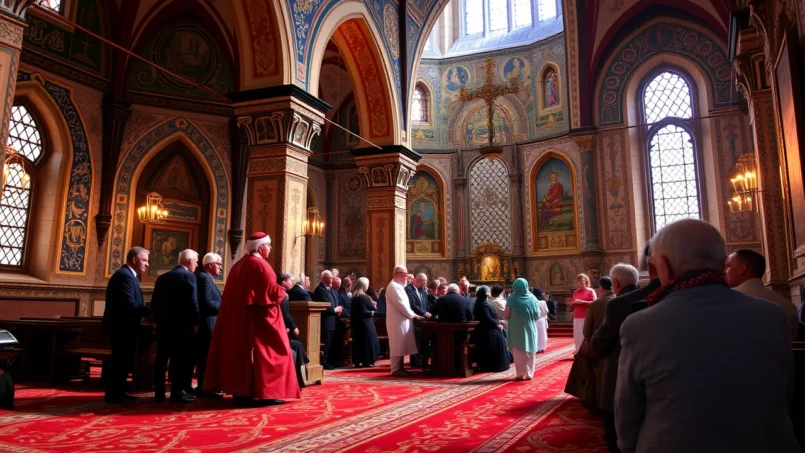
For an expatriate, attending an Orthodox liturgy, for example at the Cathedral of the Nativity of Christ in Riga, is a striking experience. It is characterized by domed architecture, gilded interiors, and an iconostasis. The service is punctuated by a cappella chanting in Church Slavonic or Russian, and the faithful often remain standing throughout its duration.
Etiquette is more codified than in Lutheran or Catholic churches. Some basic rules, useful even if they come from more general guidelines applicable in many Orthodox parishes:
Dress modestly and soberly: avoid shorts, short skirts, bare shoulders, and tight clothing. Men should wear long pants and a proper shirt; women a skirt or dress at knee length or longer, with shoulders covered. In some parishes, a headscarf for women is encouraged. Behavior: enter silently, phone off, do not take photos without permission (often prohibited during services), and avoid talking during the liturgy. Stand as much as possible, as pews are often reserved for the elderly. Movements: do not walk during key moments (Gospel reading, Great Entrance, consecration); if you arrive late, wait at the back. Gestures: you may respectfully venerate icons (kiss, sign of the cross) and light candles, no obligation. Avoid lipstick to avoid damaging icons.
Eucharistic communion is strictly reserved for baptized Orthodox Christians in good standing with their Church, after preparation (fasting, confession). Non-Orthodox are welcome at services but do not approach the chalice; however, they can often receive a piece of blessed bread at the end.
Old Believers, Baptists, Adventists, Other Minorities
Besides these major groups, Latvia has a mosaic of smaller communities: Orthodox Old Believers, Baptists, Pentecostals, Adventists, Methodists, Jehovah’s Witnesses, Buddhists, Hindus (Hare Krishna), Mormons, etc. In total, over a thousand congregations are officially registered.
For an evangelical Protestant expatriate, there are also international churches or those oriented towards foreigners, especially in Riga. Some offer services in English, youth groups, and activities for expatriate families.
Judaism and Islam: Small but Visible Communities
The Latvian Jewish community is numerically small (around 4,000 people, sometimes more depending on estimates), but historically very significant, especially in Riga. The only active synagogue in the capital, Peitav Shul, survived the Holocaust and today serves as a religious and memorial center. Sites related to Holocaust memory (Riga Ghetto, destroyed synagogues, massacre sites) hold commemorations annually.
Islam is even more minority, with about a thousand Muslims. There is no monumental mosque; religious life is organized around small communities and Islamic cultural centers, notably in Riga and Ventspils. Authorities monitor these circles for security reasons, but no climate of systematic repression is reported.
The Pagan Revival: Dievturība and Baltic Heritage
A very singular trait of Latvia is the visibility of an avowed neo-pagan movement, Dievturība, which claims continuity with the pre-Christian Baltic religion. Even if the official number of members remains small (a few hundred registered, a few thousand sympathizers according to some studies), its symbolic impact is significant.
Dievturība draws on the dainas (traditional songs), legends, and rites linked to the cycles of nature. Its name comes from Dievs (God) and turēt (to keep): literally, “those who keep God.” The movement’s theology is rather monistic: the different deities (Saule, Mēness, Perkons, Laima, Māra…) are seen as manifestations of a single divine principle.
Since the fall of the USSR, the Dievturība movement has revived its activity in Latvia. It has built sanctuaries like the one in Lokstene and obtained the status of a traditional religion, which notably allows it to officiate marriages with legal recognition from the state.
In everyday life, this pagan heritage manifests itself mainly through solstice festivals (Jāņi in summer, Ziemassvētki in winter), practices like flower crowns, bonfires, songs about the sun and fertility, or a very strong connection to certain natural sites (hills, forests, springs, sacred stones).
For an expatriate, taking part in a Jāņi celebration in a village, even entirely organized by families claiming to be “non-religious,” in practice means experiencing a Christianized pagan rite.
Places of Worship Not to Miss and What They Reveal
Latvia has over a thousand churches and a multitude of natural sites considered sacred. Some of these buildings alone summarize the major layers of the country’s religious history.
Riga: A Showcase of the Three Major Christianities
In the capital, a few buildings allow you to grasp the religious diversity at a glance.
– Riga Cathedral (Dome Cathedral): the largest and oldest medieval church in the country, founded in 1211. Now Lutheran, it blends Romanesque, Gothic, and Baroque styles. It houses a monumental 19th-century organ, famous throughout Europe. Attending a concert or service here touches the heart of local Lutheran tradition.
– St. Peter’s Church: another major Lutheran church, with a high tower offering panoramic views of the city. The rooster atop its spire is a symbol of Riga, recalling both spiritual vigilance and Hanseatic tradition.
– Orthodox Cathedral of the Nativity of Christ: the largest Orthodox church in the Baltic states, built in the 19th century in Neo-Byzantine style. Turned into a planetarium during the Soviet era, it has since been restored for worship. Its gilded interior and icons allow one to discover Orthodox spirituality in all its solemnity.
– Catholic churches (St. James’s, Our Lady of Sorrows, St. Mary Magdalene…): they testify to the Catholic presence in urban areas and the continuity with Latgale.
Peitav Shul synagogue, located in the old town, is the only synagogue in Latvia to have survived Nazi destruction. Discreet from the outside, it symbolizes the depth and resilience of Jewish history in the country.
– St. Saviour’s Anglican Church: the only Anglican church in the country, now part of the Diocese in Europe of the Church of England. It offers services in English and is explicitly inclusive, welcoming a very diverse audience (tourists, students, expats, LGBTQ+ individuals, seekers, etc.).
For an expatriate, Riga is thus the ideal place to explore different religious traditions without leaving the city: Catholic mass, Lutheran liturgy, Orthodox services, Anglican or international evangelical services.
Latgale: Aglona Basilica, Old Believer Village, and Sacred Hills
In Latgale, several religious sites concentrate the country’s Catholic and Orthodox memory:
– Aglona Basilica: a grand Baroque Marian sanctuary, major pilgrimage site on August 15. An icon of the Virgin is particularly venerated. Visits are possible outside the large crowds, but the pilgrimage period offers a unique immersion in popular Latvian Catholicism.
<!– wp:group {"className":"custom-block-example background-example","layout":{"type":"constrained"}}The Old Believer ethnographic village of Slutiški, with its wooden houses and small church, illustrates a traditional way of life based on a very conservative Orthodox religiosity. This community arose from a break with the official Russian Church in the 17th century.
– Daugavpils – Church Hill: on a single hill, places of worship from four different denominations stand side by side, symbolizing the region’s religious diversity.
The region is also rich in wooden churches (sometimes built without nails), small chapels, and wayside crosses, showing the interweaving of Catholic rites and ancient nature cults.
Other Regions: Lutheran, Catholic, and Orthodox Churches in Mirror
In other regions (Kurzeme, Vidzeme, Zemgale), each major town or large village has its main church, often Lutheran, and sometimes a Catholic or Orthodox church:
– Liepāja – Holy Trinity Cathedral: a Baroque Lutheran church with a richly decorated rococo interior, a symbol of urban Lutheranism in Kurzeme.
– Jelgava – Holy Trinity Church: one of the first masonry Lutheran churches in Europe, an emblematic building of the transition from Catholicism to the Reformation.
– Karosta (Liepāja) – St. Nicholas Naval Cathedral: an imposing Orthodox church with golden domes, a former place of worship for the Imperial Russian Navy.
For an expatriate interested in heritage, the church routes (wooden Lutheran churches, Baroque Catholic cathedrals, Orthodox sanctuaries) offer a very concrete way to understand the country’s religious geography.
Calendar, Festivals, and Public Holidays: What This Changes for Daily Life
Many local religious practices are perceived through the calendar of public holidays and traditional festivals. For an expatriate, this has practical consequences (offices closed, disrupted transport, etc.) but also cultural ones: certain periods are ideal for discovering the spiritual and folkloric dimension of the country.
Christmas (Ziemassvētki): Between Winter Solstice and Nativity
Christmas is a major public holiday, with three days off (December 24, 25, and 26). The word Ziemassvētki literally means “winter festival,” a sign that the seasonal dimension precedes the Christian connotation in the popular imagination.
Traditions blend midnight mass, decorated tree, hearty meals (sausages, gray peas with bacon, sauerkraut, roast pork, carp…), and practices inherited from paganism: a log dragged to ward off misfortune, dishes left on the table for ancestors, straw decorations (puzurs) to capture bad energies. Many families say they are “not very religious” but absolutely maintain these rites, experienced as a link to ancestors and nature.
For a Christian expatriate, attending a Christmas service (Lutheran, Catholic, or Orthodox, keeping in mind sometimes different calendars) is an opportunity to discover how the celebration of the Nativity has been superimposed on ancient solstice festivals, enriching the cultural and spiritual experience.
Easter (Lieldienas): Eggs, Swings, and Resurrection
Easter is also a major event, with a long weekend extended by two public holidays (Easter Sunday and Monday). Again, popular traditions combine Christian symbolism of the resurrection with rites of renewal: decorating eggs with natural dyes, egg rolling and “fighting” contests, high swings to “help the sun,” rituals to chase away birds and diseases.
Easter foods (special cheeses, sweet breads, ritual omelet) reinforce the dimension of transition into the beautiful season.
Jāņi (Midsummer): The Most Identity-Defining Celebration
If you had to remember just one festival to understand Latvians’ relationship with nature and spirituality, it would be Jāņi, the summer solstice celebration. Two days are public holidays (Jāņi Eve and Jāņi Day), and most inhabitants leave the cities for the countryside.
The night is devoted to bonfires, traditional songs (dainas), flower and oak leaf crowns, craft beer, and a specific cheese (Jāņu siers). People stay awake until sunrise, in an atmosphere that is both festive and quasi-ritual, far from ecclesiastical frameworks. For many Latvians, this night embodies national identity more strongly than any Mass or political ceremony.
Latvian St. John’s tradition
For an expatriate, being invited to celebrate Jāņi with a Latvian family is probably the strongest possible immersion into the non-institutional “spiritual” dimension of the country.
Jewish Commemorations and the Holocaust
Commemorations of the Shoah hold a specific place in the country’s moral calendar. Each year, events are organized for International Holocaust Remembrance Day and for the Latvian Genocide Remembrance Day. Visits to the Riga Ghetto Museum, ceremonies at massacre sites like Rumbula, readings of names: these moments are not festivals, but important civil-religious rituals, where the small Jewish community and the Latvian state come together.
How to Behave in Places of Worship: Practical Advice for Expats
Beyond the specifics of each tradition, certain general rules of conduct in Latvian places of worship are worth recalling. They largely draw from Orthodox customs, which are stricter, but apply with common sense to all denominations.
Dress Code and Attitude
Overall, Latvian places of worship—especially Orthodox and Catholic—expect proper attire, even for a simple visitor. Without going overboard:
– Avoid clothing that is too short, too low-cut, or beach-style.
– Choose sober colors and clean clothes.
– In some churches, a cloth or scarf is offered to visitors to cover shoulders or head.
Attitude should remain calm and respectful: phone on silent, conversations kept to a minimum, no food or drink inside (except for specific rituals).
Participation in Rites
If you attend a service you are not familiar with, adopt a posture of respectful observer:
– Stand when others stand, sit when everyone sits (in churches with pews).
– Don’t feel obliged to recite prayers or sing if you don’t know them, or to perform gestures you don’t understand. It is acceptable to remain silent.
– Do not participate in sacraments (especially Eucharistic communion) if they are theologically reserved for members of that denomination. This is particularly the case for Catholics and Orthodox.
In Orthodox churches, lighting a candle or venerating an icon are possible but never obligatory gestures. If you are unsure about proper conduct, it is recommended to simply observe the faithful.
Photography
Rules vary widely, but in the majority of cases:
– Photography is tolerated, even encouraged, in buildings outside of services, especially for historical monuments (Riga Cathedral, St. Peter’s…).
– During celebrations, especially in Orthodox churches, it is often forbidden to photograph, especially with flash.
– Always ask a staff member or check at the entrance before taking out your camera or phone.
Addressing Religious Leaders
Catholic priests, Orthodox priests, and most Lutheran pastors are addressed as “Father” or the equivalent in Latvian (“Tēvs”) or English, depending on the language used. In English-speaking communities, the approach is often more informal. If you wish to ask questions, prefer after the service or a time of explicit availability.
Finding a Community as an Expatriate
For foreigners wishing to practice their religion in Latvia, especially in Riga, several options exist, particularly for English speakers.
International Churches and Anglican Chaplaincy
In Riga, for example:
– St. Saviour’s Anglican Church: the only Anglican congregation in the country, linked to the Diocese in Europe of the Church of England. Services are mainly in English and follow a classic Anglican liturgy. The parish is explicitly inclusive and international, welcoming people from all backgrounds, including seekers and those from other traditions.
– International Church in Riga: a community presenting itself as “international and Christ-centered,” offering an informal atmosphere, coffee and snacks, supervised activities for children. Worship is in English and gathers members from many countries.
Some Lutheran parishes offer services in English. For example, St. John’s Church in Riga holds a Sunday service in English following a traditional Lutheran liturgy.
To locate these communities, church websites, social media, or expat Facebook groups are good starting points.
Mosques, Synagogues, Other Places
For Muslims, there is no official large mosque, but there are Islamic cultural centers, notably in Riga, with public contact information. For practicing Jews, the Peitav Shul synagogue and the Jewish Community Council in Riga are the main points of contact.
Finally, for adherents of Eastern traditions (Buddhism, Hinduism, etc.), a few small centers exist, mostly in the capital, but they remain relatively low-profile. Local research or word-of-mouth through expatriate communities is often necessary.
Religious Education and Schools: What Expat Parents Should Know
The Latvian school system provides courses in religion and ethics for younger students, overseen by the state.
In primary school (grades 1 to 3), specific religion classes are organized if at least 10 parents request it for a traditional denomination; otherwise, the child follows general ethics courses. From the middle cycle onwards, religious content is integrated into ethics or social studies courses, with a cultural rather than indoctrinating approach. All programs are validated by an Educational Content Center that ensures respect for freedom of conscience.
Latvia is progressively reforming its curriculum towards a competency-based approach, where tolerance, solidarity, and “religious literacy” (understanding of religious facts) are treated transversally.
For expat parents, it is therefore possible that their children may be exposed to content on Christianity, Judaism, Islam, or local pagan traditions, but normally in a descriptive perspective. If confessional courses are offered, families generally have the option to choose an ethical alternative.
Religion, Identity, and Integration: What This Changes for an Expatriate
In a country where only a minority regularly attends services, but where religious symbols structure national memory, religion often functions as a cultural marker more than a dogmatic commitment.
Religion as an Identity Resource
The major churches—Lutheran, Catholic, Orthodox—played decisive roles at key moments in recent history: maintaining language and culture under occupation, quietly supporting dissent, mobilizing peacefully during the “Singing Revolution” for independence. Even today, they are associated in collective memory with the defense of the nation against external oppression.
Latvia’s pagan traditions, such as the celebration of Jāņi (summer solstice festival), participation in a song and dance festival, or visiting a sacred natural site (a hill, forest, or spring), illustrate how ancestral symbolism provides the material for major festivals, artistic expressions, and a deep connection to nature.
For the Expatriate: An Opportunity for Social Connection
For a foreigner, integrating into Latvia rarely passes through the religious sphere alone, but faith communities can offer a valuable social network: practical help, friendships, mutual assistance. International studies show that expats who join a religious or spiritual community feel less lonely and adapt more quickly.
In Latvia, this can work on three levels:
– Local communities (Lutheran, Catholic, Orthodox parishes): linguistic and cultural immersion, discovery of local traditions.
– International churches (Anglican, evangelical): support in English, expat network, children’s activities.
– Cultural or neo-pagan circles: participation in solstice celebrations, dainas singing workshops, trips to sacred natural sites.
The important thing, to avoid giving offense, is to approach these circles with genuine curiosity, without judgment, keeping in mind that certain historical wounds (Soviet occupation, the issue of Russian-speaking minorities, Holocaust memory) make the religious question sensitive.
In Conclusion: A Diffuse Spirituality, More Than an Omnipresent Dogma
Latvia is neither a theocracy nor a spiritual desert. It is a country where a majority identifies as Christian, but only a minority attends church weekly; a country where grand Lutheran, Catholic, or Orthodox cathedrals stand alongside wayside crosses and venerated oaks; a country where Christmas and Jāņi are experienced as much as festivals of light and nature as strictly religious events.
To understand Latvia, you must avoid clichés. The country is neither a secularized Europe without religion, nor a traditionally pious nation. The experience consists of gradually discovering how Latvians articulate their personal faith, a pagan heritage, a national identity, and the demands of modernity.
Knowing how to behave with respect in an Orthodox church, understanding what the influx to Aglona in August means, recognizing the symbolic weight of Jāņi or the Holocaust commemorations, identifying spaces where expats can pray in English: these are concrete benchmarks that will ease your settlement in Latvia and, above all, enrich your perspective on this country with a discreet but deeply rooted spirituality.
Disclaimer: The information provided on this website is for informational purposes only and does not constitute financial, legal, or professional advice. We encourage you to consult qualified experts before making any investment, real estate, or expatriation decisions. Although we strive to maintain up-to-date and accurate information, we do not guarantee the completeness, accuracy, or timeliness of the proposed content. As investment and expatriation involve risks, we disclaim any liability for potential losses or damages arising from the use of this site. Your use of this site confirms your acceptance of these terms and your understanding of the associated risks.

Cyril Jarnias is an independent expert in international wealth management with over 20 years of experience. As an expatriate himself, he is dedicated to helping individuals and business leaders build, protect, and pass on their wealth with complete peace of mind.
On his website, cyriljarnias.com, he shares his expertise on international real estate, offshore company formation, and expatriation.
Thanks to his expertise, he offers sound advice to optimize his clients' wealth management. Cyril Jarnias is also recognized for his appearances in many prestigious media outlets such as BFM Business, les Français de l’étranger, Le Figaro, Les Echos, and Mieux vivre votre argent, where he shares his knowledge and know-how in wealth management.





