
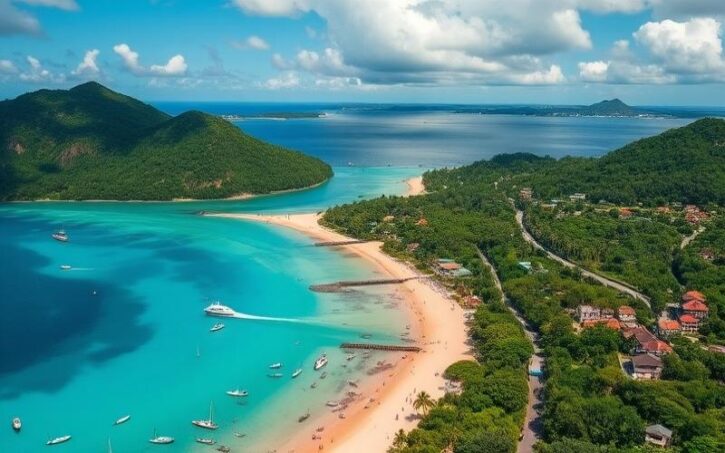
 Published on and written by Cyril Jarnias
Located in the Caribbean, the Dominican Republic is a country whose captivating history is marked by a rich tapestry of cultures and events that have shaped its modern identity.
From the arrival of Christopher Columbus in 1492, this paradise island became a crucial crossroads for European exploration and colonization, with Santo Domingo claiming the title of the first European city established in the New World.
From the colonial era to the dictatorships of the 20th century, not to mention the key role of independence movements, Dominican history is a vibrant testament to resilience and transformation.
As readers go through this article, they will discover how African, European, and Indigenous influences have coexisted and converged, giving rise to a rich cultural heritage and a nation proud of its roots.
The Origins: From the Island of Hispaniola to Today
The discovery of the island of Hispaniola by Christopher Columbus in 1492 marks the beginning of a new era for the region. After landing in the Bahamas, Columbus reached the island now called Hispaniola (shared between Haiti and the Dominican Republic) in December 1492. He founded the first European settlement, La Navidad, leaving a few men behind before returning to Europe.
List of major milestones from the initial period:
- Arrival of Christopher Columbus at Hispaniola in December 1492
- Founding of the first European settlement: La Navidad
- Beginning of the Spanish colonial process
The coexistence between the European settlers and the indigenous Taíno populations quickly became conflictual. The Taíno lived according to a community-based organization and practiced diversified agriculture, but they soon suffered the destructive impact of colonization: unknown diseases brought by Europeans, forced exploitation (encomienda), violence, and rapid loss of ancestral lands. Within less than a century, their population was decimated.
Major consequences for the indigenous populations:
- Demographic collapse due to diseases and exploitation
- Deep social disorganization
- Gradual disappearance of indigenous cultures
Throughout the colonial period, the island of Hispaniola held major economic and strategic importance for European powers, primarily Spain, which established Santo Domingo as the first capital of the New World. The economy relied on sugar, tobacco, and later on forced African labor after the massive disappearance of the Taíno.
In the 17th century, France settled in the western part of the island, leading to a territorial division formalized by the Treaty of Ryswick (1697). This division gave rise to two distinct entities: French Saint-Domingue (future Haiti) in the west; Spanish Santo Domingo (future Dominican Republic) in the east.
Comparative table – European influence on Hispaniola
| Period | Dominant Power | Main Economic Activity | Social Consequences |
|---|---|---|---|
| 16th century | Spain | Sugar & mining | Decimation of the Taíno |
| 17th-18th centuries | France/Spain | Sugar plantation & slavery | Massive importation of Africans |
The 19th century was marked by a succession of struggles to achieve or preserve independence. After various foreign occupations—including the Haitian one—the Dominican Republic proclaimed its independence on February 27, 1844. This process was punctuated by battles against Haiti and then against Spanish or American attempts until lasting sovereignty was achieved in the 20th century.
Main events of the 19th century:
- Haitian occupation (1822–1844)
- Official proclamation of Dominican independence in 1844
- Resistance against foreign interventions
Historical influences persist strongly in contemporary Dominican culture, visible in:
- The Afro-European blend in music (merengue, bachata) and culinary traditions.
- The colonial architecture still present in Santo Domingo.
- Religious festivals mixing imported Catholicism with syncretic practices from Taíno or African heritage.
From this plural history emerges an identity marked by both its indigenous roots and its European and African colonial legacies.
Good to know:
Hispaniola was discovered by Christopher Columbus in 1492, marking the beginning of European colonization, with profound consequences for the Taíno. The influence of Spanish and French colonization persists today in Dominican culture and architecture.
From the Taíno to the Clash of Worlds
The Taíno were the main indigenous civilization of the Greater Antilles before the arrival of Europeans, occupying the island of Hispaniola (now shared between the Dominican Republic and Haiti), Puerto Rico, Jamaica, and eastern Cuba. Their society, of Arawak origin, had been established in the region for over a millennium and had developed complex social structures and a prosperous, peaceful culture.
| Domain | Characteristics before 1492 |
|---|---|
| Social Organization | Hierarchical society divided into cacicazgos (chiefdoms) led by a cacique (chief). Existence of dominant and laboring castes, with territorial organization into kingdoms (e.g., five kingdoms in Hispaniola: Higüey, Marién, Magua, Xaragua, Maguana). |
| Economy | Subsistence economy based on agriculture (cassava, corn, sweet potato), fishing, and hunting. Development of refined crafts (pottery, weaving, wood and stone carving). |
| Daily Life | Villages organized around large plazas and bohíos (circular houses made of wood and palm leaves). Practice of batey, a ball game with strong ritual and symbolic value. |
| Religion and Beliefs | Polytheism centered on major deities: Yukiyú (god of good) and Juracán (god of evil, associated with hurricanes). Rich cosmology, myth of the celestial struggle evoked in the ball game, shamanic rituals, and belief in the power of zemís (spirits or idols). |
The Taíno demonstrated a great capacity for adaptation to their island environment and a political organization partly inspired by Mayan societies, with strong community cohesion and respect for the natural order.
The arrival of Christopher Columbus in 1492 marked a decisive turning point for Taíno society, inaugurating the “clash of worlds.” Initial contacts were characterized by the peaceful welcome of the Taíno, fascinated by European objects, but the rapid settlement of the Spanish disrupted all balances.
Major Impacts of the European Conquest
- Demographic collapse: introduction of unknown diseases (smallpox, influenza, measles), to which the Taíno had no immunity, leading to massive mortality within a few decades.
- Conflicts and violence: Taíno resistance suppressed by brutal military campaigns, enslavement, executions of chiefs, destruction of traditional power structures.
- Economic transformation: establishment of the encomienda system, forced exploitation of the Taíno in gold mines and plantations, ruin of the subsistence economy.
- Cultural changes: imposition of Christianity, destruction of idols and sacred sites, accelerated loss of languages and traditional knowledge, upheaval of lifestyles and ritual practices.
These upheavals had profound consequences for the historical, cultural, and demographic evolution of the Dominican Republic:
- Near-total disappearance of the Taíno population in less than half a century.
- Creation of a Creole society through forced mixing between surviving Taíno, Spanish settlers, and deported Africans.
- Persistent Taíno legacy in toponymy, food (cassava, corn), certain craft traditions, and popular beliefs, despite the marginalization of their memory in official history.
The transition from the Taíno to the clash of worlds thus symbolizes the first stage of European colonization, foundational to the social, cultural, and ethnic dynamics that would durably mark the Dominican Republic.
Good to know:
The Taíno lived in hierarchical societies with an economic system based on agriculture and fishing; Columbus’s arrival led to the spread of devastating diseases and conflicts that profoundly disrupted their social and cultural structures.
The Colonial Legacy: Conquests and Transformations
The historical context of colonial conquests in the Caribbean is part of the European dynamic of seeking new trade routes, wealth, and territorial expansion. The Spanish, motivated by the desire to access natural resources, gold, and political power, began a series of expeditions as early as 1492 that marked the start of the colonization of the New World.
Main Events of the Conquest of Hispaniola:
- Arrival of Christopher Columbus in 1492 on the island he named Hispaniola.
- Founding of the first permanent European settlement in Santo Domingo by Bartolomé Colón in 1498.
- Rapid establishment of Spanish institutions (first cathedral, hospital, customs house, and university on the continent).
- Urban construction according to a grid plan that became a model for the American colonies.
Notable Historical Figures:
- Christopher Columbus: official discoverer of the island; his expedition marked the beginning of Spanish colonialism in the Americas.
- Bartolomé Colón: younger brother of the navigator; effective founder of Santo Domingo and colonial administrator who oversaw the establishment of the first official buildings.
Economic, Political, and Cultural Transformations Induced by Spanish Colonization:
- Lasting introduction of the Spanish language, now official in the Dominican Republic.
- Massive spread of Christianity with rapid construction of churches and founding of the first American ecclesiastical institutions.
- Early establishment of the economic system based on agricultural plantations (notably sugar cane) relying on forced indigenous then African labor.
| Transformation | Detail |
|---|---|
| Language | Spanish introduced as the dominant language |
| Religion | Christianity imposed via clergy and religious buildings |
| Urban Planning | Cities built according to a grid pattern, a model for the entire continent |
| Economy | Agricultural plantations/transatlantic trade |
Impacts on Indigenous Populations & Encomienda:
Sharp demographic decline due to imported diseases, armed violence, and systematic exploitation.
Establishment of the encomienda system, granting lands and indigenous labor to settlers under the pretext of evangelization: total or partial loss of Taíno social structures.
Long-Term Consequences – Architectural Legacy & Current Cultural Influences:
The colonial city of Santo Domingo preserves over 300 major historical sites including:
- Alcázar de Colón
- Fortaleza Ozama
- Catedral Santa María la Menor
These buildings still bear witness today to the Hispanic architectural influence, visible both in urban organization and in certain contemporary social customs. The cultural influence is also manifested in:
- Traditional religious festivals
- Mixed gastronomy
- Local linguistic forms
Modern Dominican society remains deeply imbued with this colonial heritage, both in terms of identity and patrimony.
Good to know:
Spanish colonization introduced the encomienda system, enslaving the indigenous Taíno, and durably marked the Dominican Republic through colonial architecture and the spread of Christianity, visible today in Ciudad Colonial in Santo Domingo.
From Regained Freedom to the Modern Republic
The struggle for the independence of the Dominican Republic began with a series of uprisings against colonial domination, first Spanish then Haitian. Juan Pablo Duarte, an emblematic figure, founded in 1838 the secret society La Trinitaria, with members like Francisco del Rosario Sánchez and Ramón Matías Mella, to organize resistance and prepare for independence.
Main Founding Events:
- 1821: Proclamation of independence from Spain, quickly followed by the Haitian occupation led by Jean-Pierre Boyer.
- 1838: Creation of La Trinitaria, the driving force of the independence struggle.
- February 27, 1844: Official proclamation of Dominican independence. Duarte, Sánchez, and Mella were the main leaders of the movement.
- November 6, 1844: Adoption of the first constitution, marking the birth of a state with executive, legislative, and judicial powers.
Major Obstacles to Sovereignty:
Haitian occupation (1822-1844): While it ended slavery in the eastern part of the island, it imposed unpopular reforms and strengthened the Dominican national sentiment.
Foreign interventions: After independence, the young Republic had to face multiple Haitian reconquest attempts and pressures from other powers (Spain, United States).
Dictatorships and instability: Pedro Santana, the first president, imposed an authoritarian regime and even temporarily re-annexed the country to Spain (1861-1865), provoking the War of Restoration. The following decades were marked by coups d’état, military regimes, and, in the 20th century, the dictatorship of Rafael Trujillo (1930-1961).
Impact of These Obstacles:
- Hindrances to democracy and political stability.
- Institutional fragility and dependence on foreign powers.
- Repression and persecution of opponents, notably members of La Trinitaria.
Transition to Democracy and Modernization:
- 1961: Assassination of Trujillo, opening towards a democratic transition.
- 1963: Brief presidency of Juan Bosch, marked by a progressive constitutional reform (social rights, limitation of military powers), but quickly overthrown.
- 1965: Civil war, US intervention, then gradual return to constitutional order.
- Since the 1970s: Political alternation, development of democratic institutions, economic reforms (liberalization, opening to tourism), and modernization of the state.
Role of Social Movements and Political Parties:
- Major parties: Dominican Liberation Party (PLD), Dominican Revolutionary Party (PRD), Social Christian Reformist Party (PRSC).
- Social movements: Mobilizations for social justice, transparency, education reform, and the fight against corruption.
- Constitutional reforms: Multiple revisions to strengthen civil rights, separation of powers, and the rule of law.
Examples of Modernization:
| Reform | Year | Main Impact |
|---|---|---|
| Abolition of slavery | 1822 | End of servitude, advent of new rights |
| First constitution | 1844 | Birth of the rule of law |
| Constitutional reform | 1963 | Extension of social and civil rights |
| Economic reforms | 1990-2020 | Growth of tourism, financial modernization |
Contemporary Challenges and Future Prospects:
- Fight against corruption and impunity.
- Strengthening the rule of law and judicial independence.
- Persistent social inequalities and educational challenges.
- Management of Haitian migration and border tensions.
- Sustainable development in the face of climate and economic challenges.
>> The consolidation of Dominican democracy depends on the ability to deepen institutional reforms, promote social justice, and guarantee citizen participation in a context of globalization and new regional challenges.
Disclaimer: The information provided on this website is for informational purposes only and does not constitute financial, legal, or professional advice. We encourage you to consult qualified experts before making any investment, real estate, or expatriation decisions. Although we strive to maintain up-to-date and accurate information, we do not guarantee the completeness, accuracy, or timeliness of the proposed content. As investment and expatriation involve risks, we disclaim any liability for potential losses or damages arising from the use of this site. Your use of this site confirms your acceptance of these terms and your understanding of the associated risks.

Cyril Jarnias is an independent expert in international wealth management with over 20 years of experience. As an expatriate himself, he is dedicated to helping individuals and business leaders build, protect, and pass on their wealth with complete peace of mind.
On his website, cyriljarnias.com, he shares his expertise on international real estate, offshore company formation, and expatriation.
Thanks to his expertise, he offers sound advice to optimize his clients' wealth management. Cyril Jarnias is also recognized for his appearances in many prestigious media outlets such as BFM Business, les Français de l’étranger, Le Figaro, Les Echos, and Mieux vivre votre argent, where he shares his knowledge and know-how in wealth management.





