
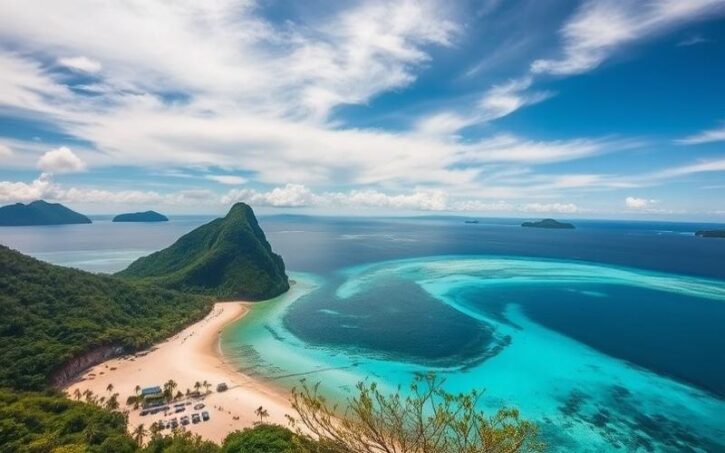
 Published on and written by Cyril Jarnias
The Philippines, an island nation of exceptional cultural richness, stands out for its complex history, interwoven with narratives of conquest, struggles for independence, and unwavering resilience. Emerging from the ancestral traditions of its indigenous peoples, this country is shaped by the successive influences of Spanish and American colonization, which have left an indelible legacy on its language, religion, and institutions.
A crossroads of cultural and commercial exchange in Southeast Asia, the Philippines has, over the centuries, managed to preserve its unique identity, oscillating between modernity and age-old traditions. Exploring the history of this archipelago means discovering how stories of resistance and rebirth have forged a dynamic nation, at the forefront of social and cultural transformations in the region.
The Origins of the Philippines: A Fascinating History
The early human migrations to the Philippine archipelago were profoundly influenced by the region’s unique geography. The insular location and proximity to the major landmasses of Southeast Asia facilitated the passage of human groups during periods when sea levels were lower, easing movement between islands and continents.
Key Geographical Aspects Influencing Migrations
- An archipelago composed of over 7,000 islands, creating an environment conducive to gradual human settlement.
- Presence of narrow sea passages allowing navigation even with rudimentary technology.
- Climatic changes (glaciations) that altered sea levels and temporarily exposed or connected certain landmasses.
| Geographical Factor | Influence on Migrations |
|---|---|
| High number of islands | Multiplication of access points |
| Ocean currents | Natural orientation of settlement |
| Resource-rich areas | Long-term population fixation |
Major Theories on the Arrival of the Austronesians
“Out of Taiwan” Model: The dominant theory posits that Austronesians departed from Taiwan around 4,000 years ago, first reaching the northern part of the country (Batanes, Luzon) before spreading to the rest of the archipelago. Their rapid expansion was made possible by their advancements in navigation and shipbuilding.
Alternative Models (“Out of Sundaland”): Propose a migration from Sundaland (a now-submerged continental shelf), driven by rising sea levels at the end of the last ice age. These models suggest greater diversity in migratory trajectories.
Influence of Geology and Climate on Island Civilizations
Intense volcanic activity, forming varied terrain favorable for agriculture but also a frequent source of natural disasters.
Tropical climates alternating between dry and wet seasons, forcing human societies to adapt agriculturally (flooded rice cultivation, root crops).
Early Settlements and Emerging Cultural Diversity
Very ancient presence of “Negrito” populations, arriving over 30,000 years ago, testifying to an initial Paleolithic migration wave from mainland Asia.
Subsequently: Massive arrival and subsequent cultural predominance of Austronesians, bringing Neolithic agriculture (rice cultivation), characteristic red pottery, and advanced navigation techniques.
Key Inherited Cultural Contributions
- Exceptional maritime mastery
- Remarkable linguistic diversity (>170 languages)
- Rich oral traditions passed down to the present day
Essential Archaeological Remains
| Type of Remains | Examples | Importance |
|---|---|---|
| Lithic tools | Polished axes | Daily life |
| Red pottery | Neolithic sites | Austronesian diffusion |
| Collective burials | Funerary caves | Ancient rites |
The Foundational Impact of These Origins
The foundational impact of these origins is found in the current ethnic mosaic, resilience in the face of natural challenges, the constant valorization of oral traditions, and the symbolic importance given to ancestors. Living traditions—such as those observable during ritual festivals or in certain decorative arts—as well as major archaeological discoveries, still allow us to deepen our understanding of this plural genesis that profoundly shapes modern Filipino identity.
Good to Know:
The early human migrations to the Philippines were influenced by geographical proximity to Southeast Asia, facilitating the arrival of the Austronesians, whose linguistic and cultural heritage is still evident today. The diversity of climates and the rich geology of the archipelago supported varied island civilizations, whose ancestral traditions and archaeological remains play a crucial role in understanding the country’s modern identity.
From Colonization to Independence: A Turbulent Journey
The arrival of Ferdinand Magellan in 1521 marks the beginning of European contact with the Philippines. Magellan, commissioned by Spain, set foot on the island of Cebu and named the archipelago “Islas de San Lazaro.” He established diplomatic relations with some local chiefs and initiated the first conversions to Catholicism. However, resistance was not absent: during the Battle of Mactan in April 1521, Lapu-Lapu, a local chieftain, inflicted a defeat on the Spanish and killed Magellan.
Over the following decades, other Spanish expeditions failed to establish a lasting foothold until the arrival of Miguel López de Legazpi in 1565. He founded the first permanent settlement in Cebu and gradually conquered Manila (1571), laying the foundations for a centralized colonial administration that would last for over three centuries.
Main Colonial Structures Established:
- Encomienda system (land distribution and indigenous exploitation)
- Massive implantation of Catholicism
- Centralized administration around the Governor-General
- Economic control via the Manila-Acapulco Galleon Trade
Major Impacts on Philippine Society:
- Widespread diffusion of Christianity (largest Catholic nation in Asia today)
- Introduction of Spanish administrative institutions
- Emergence of a hispanized local elite (principalia)
- Partial linguistic transformation; massive adoption of Spanish lexical borrowings
Local Revolts Against Spanish Rule:
Numerous insurrections marked the colonial period:
- Dagohoy Revolt (1744–1829)
- Peasant revolt led by Diego Silang (1762–1763)
The major turning point came with the Philippine Revolution sparked in 1896 by the Katipunan.
Key Figures:
| Name | Key Role |
|---|---|
| José Rizal | Reformist intellectual; his writings inspired the nationalist movement |
| Andrés Bonifacio | Founder of the Katipunan; armed revolutionary leader |
The revolution, however, led to a new foreign domination after the Spanish-American War.
Transition to American Rule:
After their victory over Spain in 1898 during the Spanish-American War, the United States took possession of the Philippines.
Changes Under American Administration:
- Introduction of an Anglo-Saxon public education system
- Partial administrative modernization
- Limited development of urban economic infrastructure
However, this period was marked by intense armed resistance—the Philippine-American War—followed by direct colonial control until the gradual granting of legislative autonomy in the 1930s.
During World War II, Japan brutally occupied the archipelago between 1942 and 1945. This occupation caused massive destruction and considerable human losses before the Allies regained control.
The process towards official independence, completed on July 4, 1946, took place in a difficult context:
- Major post-war reconstruction
- Economic dependence on the United States
- Persistent social tensions stemming from inherited inequalities
The official birth of the Republic of the Philippines sparked democratic hopes but faced these major structural challenges: building a coherent national identity after nearly four centuries under foreign influence; establishing political stability; reducing social inequalities.
Summary List – Key Historical Milestones:
- 1521: Arrival of Magellan / Victorious battle for Lapu-Lapu
- 1565–1571: Effective colonization / Permanent Spanish settlement
- 16th–19th centuries: Multiple indigenous revolts / Growing influence of Catholicism
- 1896–1898: Philippine Revolution driven notably by Rizal & Bonifacio
- 1898–1946: American then Japanese domination during WWII
The complex historical path leading to independence durably shapes cultural identity and political aspirations in the Philippines.
Good to Know:
The Spanish conquest in the 16th century transformed the Philippines into a colony with Spanish administrative structures, leading to a series of revolts, including the 1896 Revolution inspired by figures like José Rizal. After the American interlude and the Japanese occupation, the independence achieved in 1946 symbolized both a national renewal and challenges to overcome for the young republic.
The Name of the Philippines: From Indigenous Archipelago to Modern Nation
Historical and Cultural Origins of the Name “Philippines”
The early populations of the archipelago were Malayo-Polynesian groups with their own languages and names for the islands, without a unified name for the entire territory. Each island or region bore a distinct indigenous name (e.g., Luzon, Visayas, Mindanao), reflecting the linguistic and cultural diversity of the archipelago.
The arrival of the Spanish marked a major turning point in the naming of the archipelago. In 1542, Spanish explorer Ruy López de Villalobos named the archipelago “Islas Filipinas” in honor of the Spanish crown prince, Philip II, who would become King of Spain in 1556. This choice symbolized the Spanish crown’s claim over the new lands and the integration of the archipelago into the Spanish colonial empire. This name gradually extended to all the islands, replacing local denominations and asserting colonial authority.
| Period | Main Appellation | Origin / Meaning |
| Pre-colonial era | Indigenous names (Luzon, etc.) | Linked to local language and culture |
| 1542 (Villalobos) | Islas Filipinas | In honor of Philip II of Spain |
| Spanish colonization | Islas Filipinas | Official name under the Spanish empire |
| American period | Philippines | Anglicization of the Spanish name |
| Independence | Republic of the Philippines | Official adoption of the name |
The Role of Philip II of Spain
Philip II, King of Spain from 1556 to 1598, embodied Spanish imperial power at its zenith. His name given to the archipelago by Villalobos manifested Spain’s will to impose its authority and administrative system on distant and culturally varied territories.
Evolution and Official Adoption
The name “Philippines” (or “Filipinas” in Spanish) gradually became established from the 16th century onwards, becoming the symbol of a new collective identity, shaped by colonization, Christianity, and cultural mestizaje. The Anglicization of the name became widespread during the American occupation (1898-1946), before “Republic of the Philippines” was officially adopted upon independence in 1946.
Transformation of a Diverse Archipelago into a Unified Nation
The transition from a mosaic of independent islands to a unified nation under a common name reflects the construction of a national identity. This process was accompanied by resistance, struggles for independence, and a desire to federate the diverse cultures, languages, and religions of the archipelago under a shared banner.
Attempts to Change the Name Since Independence
Several debates have taken place to rename the country after independence, in order to break away from the colonial past. Among the proposed names is “Maharlika,” a term evoking pre-colonial nobility and indigenous identity. However, no initiative for change has succeeded to date.
Contemporary Significance
The name “Philippines” today embodies the synthesis of a complex heritage: indigenous, Spanish, American, and Asian influences. It recalls both the diversity of its origins and the journey towards a modern, unified nation, while retaining the memory of foreign domination and the will to forge its own identity.
The name “Philippines” thus symbolizes the meeting of multiple worlds, the memory of a colonial past, and the contemporary quest for national unity and cultural recognition.
Good to Know:
The name of the Philippines originates from King Philip II of Spain, the nation having been so named by the Spanish during colonization in the 16th century; since independence, although discussions about a name change have occurred, the country has maintained this designation, which symbolizes its transition from diverse indigenous archipelagos to a unified modern entity.
Disclaimer: The information provided on this website is for informational purposes only and does not constitute financial, legal, or professional advice. We encourage you to consult qualified experts before making any investment, real estate, or expatriation decisions. Although we strive to maintain up-to-date and accurate information, we do not guarantee the completeness, accuracy, or timeliness of the proposed content. As investment and expatriation involve risks, we disclaim any liability for potential losses or damages arising from the use of this site. Your use of this site confirms your acceptance of these terms and your understanding of the associated risks.

Cyril Jarnias is an independent expert in international wealth management with over 20 years of experience. As an expatriate himself, he is dedicated to helping individuals and business leaders build, protect, and pass on their wealth with complete peace of mind.
On his website, cyriljarnias.com, he shares his expertise on international real estate, offshore company formation, and expatriation.
Thanks to his expertise, he offers sound advice to optimize his clients' wealth management. Cyril Jarnias is also recognized for his appearances in many prestigious media outlets such as BFM Business, les Français de l’étranger, Le Figaro, Les Echos, and Mieux vivre votre argent, where he shares his knowledge and know-how in wealth management.





