
 Published on and written by Cyril Jarnias
Settling in Wallis and Futuna means entering a society where religion is not confined to Sunday morning but structures time, space, and social relations in daily life. For an expatriate, understanding this centrality of the religious sphere – and learning to navigate it tactfully – is one of the keys to successful integration, both at work and in the village.
In Wallis and Futuna, almost the entire population is Catholic. Polynesian identity and Catholic faith are seen as complementary. Social life, major holidays, weddings, family reconciliations, and important political decisions revolve primarily around the church, the customary chiefdom, and collective ceremonies.
This guide offers a deep dive into this singular universe, with a very practical goal: to enable an expatriate to know how to behave in churches, during religious holidays, at katoaga, and more broadly in everyday life, without making a faux pas.
An archipelago where Catholicism is everywhere… but never alone
Wallis and Futuna is a small French territory in the Pacific, composed of two island groups separated by about 260 km: the Wallis Islands (Uvea) on one side, and the islands of Futuna and Alofi on the other. Approximately 11,000 people live there, overwhelmingly of Polynesian culture, distributed across three customary kingdoms: Uvea (on Wallis), Sigave, and Alo (on Futuna and Alofi).
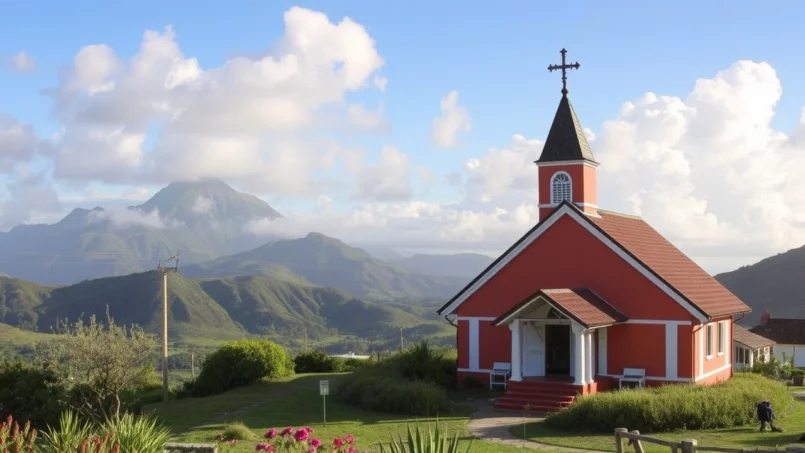
Within this small island setting, the presence of the Catholic Church is massive. The territory forms a diocese in its own right, with a bishop, a cathedral in Mata Utu, a basilica dedicated to Saint Peter Chanel in Futuna, and churches or chapels in almost every village. There are approximately 26 religious monuments on Wallis and 22 on Futuna.
The Catholicism of the Marquesas Islands is not a simple import. It results from a process of exchange, initiated by the arrival of the Marist missionaries in 1837, between the Christian faith and pre-existing Polynesian beliefs. This hybridization produces a religion structured by the authority of Rome, but continually influenced by local custom and a worldview inherited from ancient Polynesian religious systems.
From Polynesian Religion to Local Catholicism
Before the arrival of French missionaries, the inhabitants practiced a polytheistic religion of Polynesian inspiration: worship of multiple gods, importance of ancestors, the notion of mana (sacred power), and rules of tapu (taboo) regulating behavior, social relations, and access to certain sacred places or objects.
When the Marists landed in the late 1830s – Pierre Chanel on Futuna, Pierre Bataillon on Wallis – they proposed a highly organized Roman Christianity. But to be accepted, this Catholicism had to compromise with existing structures. It didn’t simply replace the old system; it reorganized it: customary rulers kept a central role, collective rituals remained, some symbols changed meaning without disappearing.
The canonization of Pierre Chanel, martyred on Futuna in 1841 and declared a saint in 1954, consecrates this unique history: one of the territory’s main saints is both a figure of the universal Church and a key landmark in Futunian local memory.
A Religion at the Heart of Political Power and Law
Another unique feature: religion is not limited to the private sphere. The 1961 statute, which transformed the former protectorate into a French collectivity, formally recognizes the role of religion in the territory. The customary kings of the three kingdoms are officially recognized by the State; they sit on the Territorial Council alongside the Republic’s representative and play a leading role in customary justice, especially for civil and land disputes.
For decades, the State entrusted primary education to the bishopric: schools were funded by the Republic but managed by the diocese, with catechism integrated into the curriculum. The French law of 1905 on the separation of Church and State did not apply there in the same way as in mainland France.
For an expatriate, this means the usual boundaries between “State” and “Church”, or between “religious” and “cultural”, do not function here as they do in mainland France or many Western countries. Understanding religious practices is in part about understanding how the society itself functions.
Attending Church: Codes, Attitudes, and Expectations
In a territory that is almost entirely Catholic, attending Sunday mass, participating in a patron saint’s feast, or entering a village church is a matter of both spirituality and social life. An expatriate will almost always be welcome, but some implicit rules are important to know.
The Importance of Modest Dress
The basic rule, widely shared in the Catholic world, is modesty. It takes on particular significance here because society is both very devout and conservative on the matter of clothing.
In churches and Greek villages, covering clothing is expected for both men and women: shoulders and knees should be covered. Avoid tank tops, low-cut tops, miniskirts, short shorts, and overly tight clothing. Transparent fabrics, sportswear, or beachwear (swimsuits, light pareos, flip-flops) are inappropriate in a religious context.
Conversely, a simple, clean, and neat outfit is more than enough: for women, a dress or skirt at least knee-length, a top with sleeves, possibly a scarf for more coverage; for men, light trousers or a lava-lava (traditional wraparound skirt) with a collared shirt. Many parishioners wear what could be called their “Sunday best,” more formal than their everyday clothes.
The table below summarizes the main trends, without claiming to cover all possible situations.
| Religious Situation | Recommended Attire for Women | Recommended Attire for Men |
|---|---|---|
| Ordinary Sunday Mass | Dress/skirt to the knee or longer, covered shoulders, modest sandals | Trousers or lava-lava, collared shirt, closed-toe shoes or sandals |
| Patron Saint Feast, Major Ceremony | Long dress or traditional skirt, discreet accessories | Formal shirt (often white), lava-lava or trousers, sometimes a jacket |
| Church Visit Outside of Service | Simple outfit covering shoulders and knees, sandals | Simple outfit covering shoulders and knees, sandals |
For children, the logic remains the same: comfortable but modest clothing, clean, covering shoulders and knees. Overly sporty or sloppy outfits are frowned upon on holidays.
Gestures, Postures, and Behavior During Mass
Masses in Wallis and Futuna generally follow the Roman rite, with the same main stages as elsewhere: Liturgy of the Word, Eucharistic Liturgy, Communion, final blessing. But they are often longer, more sung, and very marked by the local language (Wallisian or Futunian) and Polynesian codes.
Before entering the church, the faithful typically make the sign of the cross with holy water. Then, they briefly genuflect before the tabernacle, a gesture of respect for the Eucharist. This genuflection is done specifically on the right knee, a classic devotional practice in Catholicism.
During mass, one alternates between standing (prayers, Gospel), sitting (readings, homily), and kneeling (consecration, according to local customs). A newcomer is not expected to know everything by heart: it’s enough to follow the faithful, imitating their gestures without ostentation.
The implicit rule can be summed up in three words: silence, respect, attentiveness. The nave is not a place for informal conversations. One arrives before the celebration begins, turns off their phone, avoids moving around the church during the liturgy unless absolutely necessary. Applause is not part of standard practice during mass, except for explicit instruction from the celebrant for a particular occasion.
Who Can Receive Communion, and How?
At communion time, practicing Catholic faithful commune by receiving the host, sometimes also the consecrated wine according to local arrangements. The general rules of the Church apply: being baptized, having made one’s first communion, being in a spiritually appropriate state, and respecting a fast of about one hour before mass (excluding water and medicine).
For a non-Catholic expatriate or a non-practicing Catholic, there is no obligation to receive communion. It is possible to remain seated in a respectful attitude. In some parishes, one may approach with crossed arms to receive a blessing instead of the host, but it is recommended to first observe local customs or ask the priest for advice.
After communion, silence and concentration are paramount. It is an important moment of recollection for the faithful; leaving the church right after receiving the host, as one might rush out of a meeting, is considered disrespectful.
A Life Rhythmed by Religious Holidays and Katoaga
One cannot understand local religiosity without looking at the calendar of holidays. The year in Wallis and Futuna is punctuated by major Catholic holidays common to the whole world (Christmas, Easter, Ascension, All Saints’ Day, etc.), but also by celebrations specific to the territory, such as the feast of Saint Peter Chanel or Territory Day, both intimately linked to religious and customary memory.
Major Catholic Dates in the Archipelago
The classic religious public holidays – Christmas, Easter, Ascension, Pentecost, Assumption, All Saints’ Day – are widely celebrated. Masses on these days are heavily attended, often followed by community meals or small village parties.
Alongside this universal calendar, certain days take on particular significance:
On April 28th, the feast of Saint Peter Chanel, martyr and patron saint of Futuna, is celebrated with masses, processions, dances, and the veneration of relics at the Basilica in Poï. The feast of Saint Joseph, patron saint of families and workers, gives rise to lively celebrations with prayers, dances, and community meals, notably in the parish of Mala’efo’ou on Wallis.
An expatriate wishing to integrate will gain much by following this calendar, if only to understand why, on a given day, all activity seems suspended in favor of mass, and why professional obligations often adapt to major holidays.
Katoaga: When Custom Meets Religion
Around these holidays, one institution dominates social life: the katoaga. This is a major customary ceremony that accompanies a religious event (patron saint’s feast, commemoration of a saint, jubilee) as well as a family event (wedding, funeral) or a political one (Territory Day, French National Day).
The heart of the katoaga is the offering of food and goods, following a logic of gift and counter-gift. Pigs hold a central place: raised with care, they are presented whole, cooked in the traditional umu oven or arranged in a spectacular fashion. Around these offerings are organized speeches, dances, songs, and distribution to the different actors: the king, chiefdoms, the Church, families, guests.
For an expatriate, attending a katoaga is an unforgettable experience, but one that requires knowing a few codes:
– The customary rank of individuals determines where they sit, the order for speeches, and the share of offerings they receive.
– Gestures addressed to the king, chiefs, or representatives of the Church follow precise protocols, often related to how to greet, stand, or present gifts.
– Traditional dances, like the soamako (competitive dance), the kailao (war dance), or the eke (created in Futuna in memory of Pierre Chanel), are not mere entertainment: they carry stories, tributes, sometimes messages addressed to the royalty or the Church.
The best attitude for a newcomer is to let oneself be guided by hosts, to observe, to ask questions outside of solemn moments, and to accept that part of the deep meaning of these rituals may be elusive at first.
The following table contrasts the religious and customary dimensions of a typical katoaga.
| Religious Dimension | Customary Dimension |
|---|---|
| Opening Mass (often outdoors) | Presentation of pigs and agricultural products |
| Blessing of offerings and people | Allocation of gifts according to rank and alliances |
| Prayers for the community and territory | Dances, songs, and codified speeches |
| Processions with statues or relics | Kava ceremony and interventions by chiefs |
Visiting Places of Worship: More Than Heritage, Living Spaces
For an expatriate, discovering Wallis and Futuna often involves visiting numerous religious buildings, which are simultaneously places of faith, architectural landmarks, and pieces of collective memory.
Mata Utu Cathedral: Symbol of a Dual Power
At the heart of the capital Mata Utu stands the Cathedral of Our Lady of the Assumption, built from hand-carved bluish volcanic stone. Two massive towers frame a blue Maltese cross, a motif also found on the territory’s flag. It overlooks the lagoon and, together with the neighboring palace of the King of Uvea and the customary square, forms a revealing triptych: Church, royalty, and public space literally coexist here.
The cathedral is also a burial place for customary sovereigns: several Lavelua (Kings of Uvea) and queens are buried there, as are some bishops. Entering it is therefore not just visiting a listed monument; it’s entering a space where dynastic continuities, missionary history, and collective memory are intertwined.
The rules of conduct are similar to those of a parish church, but with increased vigilance as the cathedral is the bishop’s seat and an important symbol. Avoid visits during services, speak quietly, and do not photograph praying faithful without their permission.
Chapels, Basilicas, and Pilgrimage Sites
The archipelago boasts a constellation of holy sites, each with its own history and function in local devotion. Futuna, for example, is home to the Basilica of Saint Peter Chanel in Poï, where major celebrations take place every year on April 28th. Relics of the saint are displayed there, and pilgrims sometimes come from far away, including other regions of the Pacific.
Other chapels, like that of Saint Peter Chanel on Mount Mauga or the Loka grotto dedicated to the Virgin, host annual pilgrimages. These journeys on foot or by vehicle, followed by processions, prayers, and sometimes katoaga, fit into a logic where walking, effort, and nature become supports for spiritual quest.
On Wallis, village churches like Saint-Joseph in Mala’efo’ou, or those in Vaitupu, Hihifo, and Lausikula, illustrate the evolution of the missionary presence. They materialize the transition from the first prayer huts to stone buildings, retain traces of Marist colonial architecture, and bear witness to necessary restorations after cyclones. The old seminary, where the first indigenous priests were trained, is a key element of this history.
Sacred Sites, Polynesian Custom, and Visitor Attitude
Even though the dominant religion is Catholic, the Polynesian idea of “tapu“ places, where there is a particular presence of ancestors or the sacred, continues to permeate practices. An old family cemetery, a site of ancient Tongan fortifications, a stone linked to a mythical narrative can be felt as powerful spaces, to be approached with respect.
Concretely, certain rules inspired by the broader Polynesian world can guide an expatriate:
– Do not climb on walls, platforms, or altars, especially when they are clearly ancient places of worship or burial.
– Stay on marked paths, avoid moving stones or taking “as souvenirs” pebbles, shells, or fragments of construction.
– When possible, ask permission from a resident or customary authority before entering land that is clearly not public.
– Maintain a discreet posture: few words, no shouting, no loud music.
Again, the idea is not to “play the ethnologist,” but simply to remember that these places, even without explanatory signs, are often loaded with meaning for local populations.
Religion, Language, and Education: A Single Fabric
In Wallis and Futuna, religion is also a matter of language. Liturgy, catechism, hymns, and sermons are largely in Wallisian or Futunian, two Polynesian languages that over 90% of adults can read and write. French is present, particularly in state institutions, but remains a minority language in family life.
For an expatriate, this has several consequences:
Attending mass often involves hearing mostly Wallisian or Futunian, although the liturgy remains familiar. To understand sermons and announcements, it is necessary to master the local language or have the main points translated. Children, meanwhile, follow catechism in primary school within programs adapted from the French system, familiarizing them very early with this dual educational and religious dimension.
Things are evolving – the recent transfer of primary education management from the Church to the state vice-rectorate is a sign – but the continuity remains strong: a school often remains, in practice, “the brother’s school” or “the sister’s school,” so much have nuns and priests shaped local history.
Religion, Marriage, and Family Life: A Partially Invisible Framework for Expatriates
In daily life, the religious dimension also manifests in areas that may seem, to an expatriate, primarily “private”: marriage, management of the extended family, distribution of tasks and property.
Marriage, for example, is almost always thought of as both a customary and religious event. A civil ceremony at the town hall makes little sense if it is not followed by a nuptial mass and a katoaga. The role of parents, of “papa” and “mama” (respected elders), is major; their blessings, sometimes staged in a family liturgy, signify social recognition of the union.
For an expatriate involved in a local wedding – as a guest, colleague, neighbor – attention to codes is crucial:
At a katoaga, attire should be particularly well-groomed, often even more so than for an ordinary mass. Gifts offered can take the form of consumer goods or contribution to the purchase of traditional items like pigs, fabrics, or mats, which will circulate during the ceremony. It is essential to respect the long series of speeches, songs, and dances, which constitute a complex symbolic exchange and not mere entertainment. For this, remain seated, be attentive, and avoid frequently getting up.
Even outside of major occasions, family morals remain strongly imbued with Catholicism: importance of marital bonds, valorization of large families, central place of grandparents, taboos on certain behaviors deemed contrary to Christian values. An expatriate may not share these norms but will benefit from not challenging them head-on in public.
Work, Governance, Belief: A Three-Headed System
Another crucial point for anyone working with local institutions: Wallis and Futuna operate on a delicate balance between three poles of authority – the French administration, the customary chiefdom, and the Catholic mission.
For an infrastructure project, public policy, sporting or cultural event, having the agreement of the state representative or the territorial council is not enough. Often, the approval of the kings is also needed, and more informally, the goodwill of the Church. Development operations that ignore this institutional triangle, or treat the religious dimension as mere folklore, risk encountering blockages or lasting distrust.
Concretely, this means that:
– When an inauguration takes place, a mass or at minimum a blessing is often organized.
– The king, the bishop (or his representative), and the senior administrator regularly sit side by side at public ceremonies.
– A project affecting land, villages, or natural resources will benefit from including, from the outset in its consultation meetings, customary authorities and, when relevant, the parishes.
For an expatriate assigned to development, cooperation, teaching, or health work, learning these relational codes is at least as important as mastering French administrative procedures.
Practical Advice for Expatriates: Building Ties Without Denying Oneself
One can live in Wallis and Futuna without being a believer, without going to mass every week, or participating in all the holidays. But one cannot live comfortably by ignoring or scorning the religious dimension of society.
A few guidelines can help find a personal balance:
To integrate harmoniously into Wallis and Futuna, it is important to respect local practices. This includes being willing to attend important masses (during major holidays, professional or family events) while adopting a respectful posture without simulating gestures of belief. Learn a few words of Wallisian or Futunian, like greetings and thanks, often used after church. Inquire about the calendar of major holidays from colleagues or neighbors to avoid scheduling important meetings on a sacred day. Finally, wear modest attire when passing through villages, as attire deemed normal on a tourist beach elsewhere may be considered inappropriate, especially away from swimming areas.
Finally, it’s useful to remember that attitude often counts more than exhaustive knowledge of the rules: a person perceived as respectful, curious without being intrusive, willing to apologize if they make a blunder, will generally be very well received, even if they do not share the local religion.
Conclusion: A Faith Lived Collectively
What may strike an expatriate discovering Wallis and Futuna the most is perhaps the deeply collective dimension of religion. Sunday mass, katoaga, pilgrimages, major holidays: everything is experienced in groups, in the extended family, in the village. One comes to pray, certainly, but also to affirm solidarities, renew alliances, settle conflicts, and transmit a common heritage.
In this context, it’s not just about protocol in churches. It’s a key to understanding a society where faith, custom, and politics are tightly interwoven. For an expatriate, knowing how to decode and respectfully navigate these codes with tact fosters trust, improves professional effectiveness, and greatly enriches the human experience.
Disclaimer: The information provided on this website is for informational purposes only and does not constitute financial, legal, or professional advice. We encourage you to consult qualified experts before making any investment, real estate, or expatriation decisions. Although we strive to maintain up-to-date and accurate information, we do not guarantee the completeness, accuracy, or timeliness of the proposed content. As investment and expatriation involve risks, we disclaim any liability for potential losses or damages arising from the use of this site. Your use of this site confirms your acceptance of these terms and your understanding of the associated risks.

Cyril Jarnias is an independent expert in international wealth management with over 20 years of experience. As an expatriate himself, he is dedicated to helping individuals and business leaders build, protect, and pass on their wealth with complete peace of mind.
On his website, cyriljarnias.com, he shares his expertise on international real estate, offshore company formation, and expatriation.
Thanks to his expertise, he offers sound advice to optimize his clients' wealth management. Cyril Jarnias is also recognized for his appearances in many prestigious media outlets such as BFM Business, les Français de l’étranger, Le Figaro, Les Echos, and Mieux vivre votre argent, where he shares his knowledge and know-how in wealth management.





