
 Published on and written by Cyril Jarnias
Moving to Wallis and Futuna, whether for a temporary assignment, a professional project, or a more radical life change, is nothing like settling in a major metropolitan city. The territory is tiny, isolated in the middle of the Pacific, structured by custom and strong family ties. All of this is immediately felt in the housing market: limited supply, a lot of word-of-mouth, very particular land rules, and rents that often surprise newcomers.
This guide provides a realistic overview of the market, including prices, key contacts, and pitfalls to avoid when looking for housing. It presents the destination in a balanced way, without exaggeration or pessimism.
Understanding the playing field: a tiny territory, limited supply
Wallis and Futuna is a French overseas collectivity located between Fiji and Samoa. Three main volcanic islands (Wallis / Uvea, Futuna, and Alofi) and about twenty islets share just over 120 km² of land, for approximately 11,000 inhabitants. Most of the population lives on Wallis, around the capital Mata’Utu.
The housing market is directly shaped by the customary organization of the three kingdoms (Uvea, Sigave, Alo), which manage the land, and by the geographical isolation worsened by a demographic decline due to young people leaving.
On one hand, a majority of residents own their homes on customary family land. On the other, the rental stock is limited and highly segmented: mainly single-family homes intended for expatriates on assignment (civil servants, contractors, some private sector employees) and some more modest accommodations rented at lower rates, but rarely visible online.
The consequence is simple: finding housing is not done with a few clicks on a national real estate portal, but by building local connections, contacting the right people, and accepting that the search may take time.
Customary property: why buying is (almost) a mission impossible
Before talking about rent, one must understand a crucial point: in Wallis and Futuna, land is almost entirely governed by custom. There is no land registry in the metropolitan sense of the term; most land is inalienable and managed by families, villages, and chiefdoms.
The texts governing the territory’s status guarantee this particular system: land is practically never sold, especially to non-natives. Reform projects exist to better formalize customary law and possibly create modern tools (land register, adapted property rights), but the spirit remains the same: land belongs primarily to lineages and communities.
For an expatriate, the consequences are very clear: it is essential to fully understand and anticipate the legal, tax, and social implications of your status in the host country to avoid administrative or financial difficulties.
– purchasing land or a house is legally complex, extremely rare, and generally not recommended,
– the rare offers for sale must be examined with extreme caution to avoid scams or customary conflicts,
– the normal path for housing is renting, not buying.
The territory has had to invent specific solutions to finance the construction of local houses (guarantee funds, financing structures without traditional mortgages), proof that even for residents, the customary land system makes access to home loans very complicated.
In practice, for a newcomer external to the customary fabric, the real estate market is therefore almost entirely limited to renting.
The rental market: small, expensive, very dependent on expatriates
The total housing stock is small, but the proportion of rental properties is even smaller: over 87% of homes are owner-occupied, and less than 10% are truly part of the rental market. In this small segment, you mainly find properties rented to expatriates, often civil servants posted for a few years.
Available figures also show that new construction was once dynamic, before slowing down with the cessation of certain financing schemes. A good portion of this construction fueled homeownership, not rentals.
Each year, several dozen teachers and administrative staff from the National Education system generate a continuous flow of requests for furnished rentals.
At the same time, emigration to New Caledonia, mainland France, or other territories has left empty houses, which mechanically increases the potential stock. But these homes belong to families, often scattered, and are not systematically put up for rent or are rented informally through the network.
This organization, very far from a “classic” market regulated by agencies and public listings, explains why many newcomers feel they are “searching in the dark” if they limit themselves to the internet.
What types of housing are actually available?
Forget the image of apartment buildings and large rental complexes. In Wallis and Futuna, the norm is the single-family house, more or less recent, more or less equipped, sometimes complemented by a traditional fale.
In the most recent statistics, over 80% of houses are of modern type (cinder block walls, metal roof, tiled concrete floor), and the share of traditional dwellings has declined sharply. The vast majority of homes are connected to electricity, and over four out of five households have running water.
In practice, a newcomer is likely to be offered:
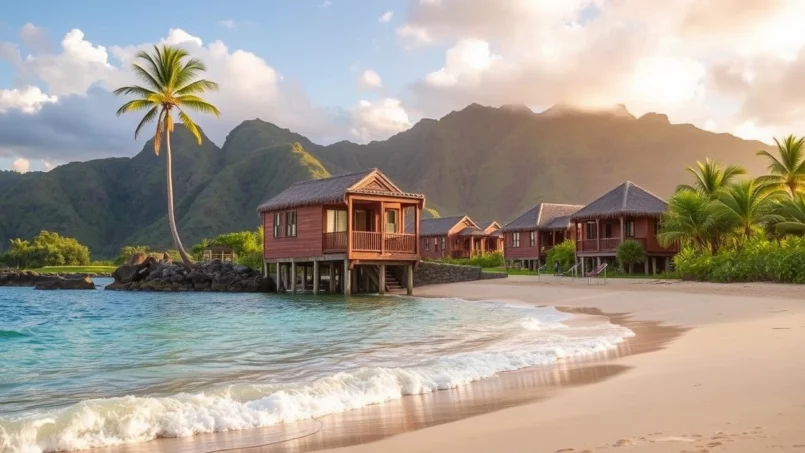
Accommodation options with locals in Wallis and Futuna come in several forms: a furnished, independent single-family house, often on enclosed land and sometimes with a lagoon view; a simpler house, sometimes without air conditioning, but with the essentials (kitchen, bathroom, basic bedrooms); a studio or small apartment in a family home; or, more rarely, a bungalow or small lodging within a hotel or guesthouse compound.
Housing specifically designed for short stays (modern studios by the water, bungalows in guesthouses) often serve as a temporary solution upon arrival, before finding a monthly rental.
On Futuna, the supply is even more limited: two small hotels, one guesthouse, and a few rooms with locals form the bulk of the accommodation capacity. For a long stay on Futuna, it is almost essential to prepare the ground well before departure and obtain a local referral.
How much does housing cost in Wallis and Futuna?
Available data paints a mixed picture of rents. On one hand, there are examples of modest budgets (35,000 to 60,000 XPF per month) for simple housing, sometimes shared or far from key areas. On the other, overall estimates align rents comparable to those of major mainland French cities for properties located in the center or very well-equipped.
Order of magnitude of monthly rents
Here is a reference table based on aggregated data available for the territory:
| Type of housing | Location | Average Monthly Rent (XPF) | Range (XPF) |
|---|---|---|---|
| 1 bedroom (T1/T2) | Center (Mata’Utu, etc.) | 210,000 | 130,000 – 350,000 |
| 1 bedroom (T1/T2) | Outskirts / villages | 154,000 | 110,000 – 350,000 |
| 3 bedrooms (T3/T4) | Center | 420,000 | 250,000 – 750,000 |
| 3 bedrooms (T3/T4) | Outskirts / villages | 302,500 | 160,000 – 500,000 |
At the same time, other sources mention much more moderate rents for family homes with three bedrooms, around 80,000 to 120,000 XPF per month (approximately €670 to €1,000). One average estimate even mentions about €800 per month for a furnished three-bedroom house.
These disparities should be understood as reflecting a very heterogeneous market.
Market Analysis
– some housing intended for expatriates, well-located and very well-equipped, rent at very high prices,
– others, simpler, rented within relationships of trust or via customary channels, remain at much lower levels.
The “high-end” rents are more visible in overall estimates or on certain international platforms, while more affordable offers circulate mainly through the local network.
Purchase: a theoretical indicator more than a real option
Purely as an indication, price per square meter estimates exist, but they do not reflect a classic market since land sales are heavily regulated by custom.
| Area | Average Price per m² (XPF) |
|---|---|
| Center (Mata’Utu, etc.) | 42,992 |
| Outside center | 26,048 |
For an expatriate, these figures are of little practical use: purchasing remains exceptional, and most often reserved for people long-established in the customary fabric or returning to the territory.
Cost of living: calibrating your housing budget in an expensive environment
Housing cannot be considered in isolation from the rest of the cost of living, which is significantly higher than in mainland France. Food, imported goods, and services weigh heavily on the budget, especially for a family.
For a family of four, a realistic monthly budget estimate looks something like this:
| Expense Category | Average Monthly Amount (XPF) | Comment |
|---|---|---|
| Food | ~140,000 | Nearly half of the total budget |
| Rent for a 3-bedroom house | ~100,000 | Can be much higher depending on the property |
| Electricity + water | ~15,000 | High variability with heavy air conditioning use |
| Internet + phone | ~7,500 | High-speed access via submarine cable |
| Fuel and transport | ~25,000 | A car is almost indispensable |
| Leisure and miscellaneous | ~20,000 | Activities, small outings, unforeseen expenses |
| Total estimated | ~307,500 | Approximately €2,575 |
Adding to this that most consumer goods are imported, it’s easy to see why a rent representing “only” one-third of the budget can quickly become unsustainable if you’re aiming for a very high-end property.
For residents, medical care and medication are completely free. Furthermore, tuition fees are covered by the system up through the baccalauréat (high school diploma).
Where and how to look for housing?
In such an unstructured market, your search strategy matters enormously. Waiting to see “on the spot” without preparation is risky, especially if you arrive with children or during the high administrative season (start of the school year, mass renewal of positions).
Rely on word-of-mouth and expatriate networks
The main search channel remains the local network. Property owners wishing to rent often do so by:
– going through family or professional connections,
– responding to the needs of institutions (Vice-Rectorate, government offices),
– relaying information within circles of existing expatriates.
Community platforms like Expat.com play a bridging role. You can find sections like “Real Estate in Wallis and Futuna” where some post listings or requests. It’s also where newcomers like Victor – a future resident looking for housing near Lavegahau for a year, with a budget of 35,000 to 60,000 XPF – try their luck.
Forums, discussion groups, and networks of former or current expatriates are valuable resources to facilitate your move and housing search.
Exchange with expatriate communities to get practical advice and feedback on living abroad.
Benefit from contacts and recommendations from teachers, healthcare workers, or civil servants who have completed their contracts abroad.
Get contact information for reliable landlords, often shared by recommendation within these networks.
Get advance notice of properties becoming available at the end of expatriation contracts.
Use the few professional channels: agencies and local sites
The territory now has a real estate agency, WALLIS et FUTUNA IMMO, a subsidiary of the REVA IMMO group (present in the Pacific for 25 years). Based in Mata’Utu and led by an experienced professional, the agency offers rental management, long-term and seasonal rentals.
Its role is twofold:
– help expatriates and people on assignment find suitable housing,
– assist owners who wish to make the most of their properties.
Even though the market remains small, this type of intermediary provides a structured channel, with formalized contracts and a clearly identified point of contact in case of problems. Some listings also appear on local sites like loina.wf, which sometimes lists houses for rent or sale.
It’s crucial to know that not all rental offers are published online. A large portion of the rental stock is exchanged by word-of-mouth, trust, and local networks.
Consider temporary accommodations for arrival
When arriving without a signed lease, small tourist structures can serve as a stepping stone. On Wallis, for example, you can find:
– hotels and inns (TANOA Inn, Fiafia hotels, Lomipeau, Moana Hou, Ulukula, Oceania guesthouse),
– rooms with locals (Masisi Liufau family in Afala, bed and breakfasts),
– modern studios on the beachfront (like the studio near Kulu’ui beach).
These accommodations are designed for short stays, but many newcomers spend a few weeks or months there while waiting to find a more suitable monthly rental. The nightly cost is obviously higher than a monthly rent, but this flexibility allows you to visit properties, meet owners, and better target the neighborhood.
On Futuna, with only two hotels, one guesthouse, and a few accommodations with locals, it is even more important to book in advance and negotiate the possibility of an intermediate stay while you find a house.
Neighborhoods, location, and mobility: choices constrained by the need for a car
The complete absence of public transport and a structured taxi service changes the game compared to a typical move. On both Wallis and Futuna, having a vehicle (car or at minimum a scooter) is almost indispensable to get to work, do shopping, or take children to school.
This constraint strongly influences the criteria for choosing the location of your housing:
Living in Mata’Utu or nearby allows you to be close to essential services (administration, bank, Fenuarama shopping center, schools, hospital). Living in a more remote village offers a quieter and often more friendly setting but involves longer daily commutes dependent on a well-maintained car.
The main roads on Wallis are in fairly good condition, but many sites and neighborhoods are still accessed via dirt tracks or paths. On Futuna, the road network is more basic, and some areas become difficult to access in bad weather.
In practice, many civil servants favor intermediate areas: close enough to Mata’Utu for daily errands, but in villages where community life is rich and noise is lower.
Formalizing the rental: contract, security deposit, and inventory
Even though custom strongly permeates local life, renting a property remains governed by French law, supplemented by specific rules for overseas territories. It is strongly advised to always sign a written lease, even when the relationship with the owner seems “friendly” or “based on trust.”
A rental contract should specify in particular: the identity of the parties (tenant and landlord), a description of the rented property, the rent amount, the duration of the lease, and the payment terms.
– the identity of the owner and the tenant,
– a description of the property (surface area, rooms, amenities),
– the rent amount, any additional charges, payment terms,
– the lease duration and renewal conditions,
– the amount of the security deposit,
– the rules for maintenance and repairs.
An entry inventory, conducted jointly and signed by both parties, is just as essential. It will detail the condition of the property and its fixtures room by room to avoid disputes upon departure. In the case of a furnished rental, a precise inventory of furniture and appliances is indispensable.
In the absence of written documents, the rental relies solely on the good faith of the parties, which may work until the first serious disagreement. It is therefore better to formalize everything from the start, for example by using a contract template or seeking advice from a local agency.
Security deposit and rent
In practice, most landlords request a deposit equivalent to one month’s rent. Some may require more, especially for high-end or very well-located properties. It’s important to clarify:
– the conditions for its return (timeframe after keys are handed back, possible reasons for deductions),
– responsibility for repairs (what constitutes normal wear and tear vs. damages).
Even if local practice may be more flexible, the general framework of French rental law remains the reference.
Avoiding unpleasant surprises: scams, property quality, climate
The idyllic setting of the lagoon and the relative scarcity of public information about the market can open the door to certain abuses or disappointments. A few key reflexes are essential to limit risks.
Be vigilant about listings that seem too good to be true
The customary land system and the lack of a land registry make classic property verification almost impossible. For a purchase, this is a major risk for litigation, which is why authorities urge extreme caution. For rentals, the danger is lesser, but there are still cases of:
– properties listed online by people who are not truly the owners,
– “virtual” leases where the contact disappears after a deposit is wired.
To avoid this, it’s better to:
To secure your housing search, prioritize contacts obtained through official institutions (employer, Vice-Rectorate, Prefecture, CCIMA) or trusted residents. Be systematically wary of requests for full payment before viewing the property. When possible, go through a reputable real estate agency. Finally, always verify that the person signing the lease is locally recognized as having the legal authority over the property.
Anticipate climate constraints when choosing housing
The climate is tropical, hot, and humid year-round, with a rainy season and cyclone risks from November to April. This means certain criteria carry more weight than in mainland France:
– the quality of the roof and openings (waterproofing, sturdiness),
– the presence or absence of air conditioning (and the impact on the electricity bill),
– natural ventilation (orientation, cross-ventilation),
– the condition of electrical and plumbing installations (sensitive to humidity).
A house without air conditioning can be livable if it’s well-ventilated and located in an area exposed to trade winds. However, since heat tolerance is individual, it’s advisable to visit the property at different times of day to assess the real thermal comfort.
Assess the real quality, not just the size
Over 90% of houses are permanent structures, with tiled floors and cinder block walls. But the quality of construction can vary considerably: finishes, waterproofing, condition of windows/doors, kitchen equipment level, sound insulation.
A large tiled living room with a lagoon view says nothing about the quality of the electrical wiring, the water pressure, or the roof’s strength in a cyclone. During visits, therefore, look beyond aesthetics and ask very concrete questions:
– year of construction and last significant renovation work,
– type of water heater, condition of plumbing,
– history of leaks or weather damage,
– type of connection (municipal water or tank, sanitation).
Integrating into the neighborhood: custom as the cornerstone
Finding a place to live isn’t just about signing a lease; it’s entering a very dense social fabric, where everyone knows each other. Neighborhood and village life plays a central role, and respecting customary practices often determines the quality of cohabitation.
A few principles guide daily life:
For a harmonious stay, it is recommended to: ask for permission before crossing private property or accessing certain customary beaches; adopt respectful attire in villages and places of worship; participate in major collective events (feasts, ceremonies, katoaga) when invited; and avoid making too much noise, especially in the evening and on Sundays.
In this context, a good landlord isn’t just someone who maintains their property well, but also someone who will introduce you to the neighborhood, explain the local codes, and facilitate your first steps in the community. This is particularly valuable for families arriving with children and settling in a village where ties are very strong.
Moving and settling in: what to bring, what to leave?
Finally, finding housing means thinking about what you’ll put in it. The territory is served by a freight ship approximately every three weeks, and by Aircalin for air traffic. Bringing personal belongings by sea container requires time, organization, and a non-negligible budget.
Certain personal effects and household goods may be imported duty- and tax-free for a primary residence transfer, under conditions (previous possession and use). Vehicles are excluded from this exemption and remain heavily taxed.
In this context, many expatriates opt for a mixed strategy:
– send by sea a reasonable volume of durable personal effects (essential furniture, cherished appliances, recreational equipment),
– complete locally with furniture bought new or second-hand,
– transport by air only the essentials for the first weeks (clothes, documents, professional equipment, a few comfort items).
Before deciding, it is useful to know the equipment level of the targeted housing: some are fully furnished and ready to live in, others barely equipped with a basic kitchen. Here again, clarifying in writing exactly what the rental includes avoids many misunderstandings.
In summary: an atypical market that requires advance preparation
Looking for housing in Wallis and Futuna is not impossible, but it isn’t managed like a simple search on a classic real estate portal. The market is tiny, highly dependent on expatriates, and framed by a customary law that makes property ownership virtually inaccessible to newcomers.
The key lies in anticipation and networks:
For a successful move abroad, it is recommended to: make contact very early with your future employer, administrative services, or the chamber of commerce (CCIMA) to obtain housing lists and landlord contacts; mobilize communities of current or former expatriates to benefit from their feedback and recommendations; accept a temporary solution (hotel, guesthouse, studio) for the first few weeks, while you identify a monthly or yearly rental; formalize every rental with a written contract, an inventory, and a detailed condition report to secure the rental relationship; and calibrate your budget considering a generally high cost of living and the quasi-essential need for a car.
In return for these constraints, the territory offers an exceptional environment: pristine lagoons, mild climate year-round, intense community life, virtually non-existent crime, very high-speed internet since the Tui Samoa cable. For those who accept adapting to its own rules – land-related, social, and practical – finding a roof in Wallis and Futuna becomes the first step of a life experience difficult to compare to anywhere else.
Disclaimer: The information provided on this website is for informational purposes only and does not constitute financial, legal, or professional advice. We encourage you to consult qualified experts before making any investment, real estate, or expatriation decisions. Although we strive to maintain up-to-date and accurate information, we do not guarantee the completeness, accuracy, or timeliness of the proposed content. As investment and expatriation involve risks, we disclaim any liability for potential losses or damages arising from the use of this site. Your use of this site confirms your acceptance of these terms and your understanding of the associated risks.

Cyril Jarnias is an independent expert in international wealth management with over 20 years of experience. As an expatriate himself, he is dedicated to helping individuals and business leaders build, protect, and pass on their wealth with complete peace of mind.
On his website, cyriljarnias.com, he shares his expertise on international real estate, offshore company formation, and expatriation.
Thanks to his expertise, he offers sound advice to optimize his clients' wealth management. Cyril Jarnias is also recognized for his appearances in many prestigious media outlets such as BFM Business, les Français de l’étranger, Le Figaro, Les Echos, and Mieux vivre votre argent, where he shares his knowledge and know-how in wealth management.





