
 Published on and written by Cyril Jarnias
Moving to Wallis and Futuna means both entering the French Republic and landing on a Polynesian archipelago thousands of kilometers from Europe. It’s a tiny territory lost in the middle of the Pacific, still largely untouched by mass tourism, where custom governs daily life and you’re quickly on a first-name basis with the entire community. For an expatriate, the experience can be exceptional… provided you know the lay of the land before packing your bags.
Good to know:
This guide covers the essential aspects for an expatriation project to this isolated archipelago: the administrative framework, cost of living, housing, healthcare, schooling, work, social life, and the specific logistical constraints of this territory.
Understanding the territory: a little French Polynesia
Wallis and Futuna is a French overseas collectivity located in Polynesia, between Fiji and Samoa. The territory consists of three main volcanic islands – Wallis (Uvea), Futuna, and Alofi – along with about twenty small islets. Wallis and the Futuna-Hoorn islands are separated by about 260 km of ocean, which is felt in daily life: it’s not a compact archipelago, but two distinct island groups.
Note:
Mata Utu (or Mata’Utu), located on the island of Wallis, is the capital of the territory. It concentrates the majority of administrative services, the main port, the Fenuarama shopping center, the main hospital, and the territory’s only international airport, Hihifo.
The population is around 11,000 inhabitants, with a clear majority on Wallis (about 72.5%) and the rest on Futuna. Ethnically, the territory is very homogeneous: the society is predominantly Polynesian, deeply Catholic, and structured around three customary kingdoms (Uvea, Sigave, and Alo). French is the official language, but Wallisian and Futunian are mostly spoken in homes.
The general atmosphere is that of a huge village: a close-knit community where everyone quickly knows everyone. For an expatriate, this means both potentially rapid integration… and the obligation to accept a certain degree of transparency about your daily life.
Climate, environment, and pace of life
The climate is typically tropical rainforest type: hot, humid, and wet all year round. The average temperature is around 26–27 °C (79–81 °F). Lows rarely drop below 24 °C (75 °F), and the sea remains warm permanently.
There are two main seasons:
– from November to April, a hot and very rainy season, which also corresponds to the cyclone season in the Pacific;
– from May to October, a “cooler” and somewhat drier period, marked by southeast trade winds, generally considered the most pleasant.
Tip:
Annual rainfall is very high, between 2,500 and 3,000 mm, with rain at least 260 days a year. The average relative humidity is around 80%. It is therefore advisable to really appreciate tropical rain and lush vegetation, and to plan for a well-ventilated home for greater comfort.
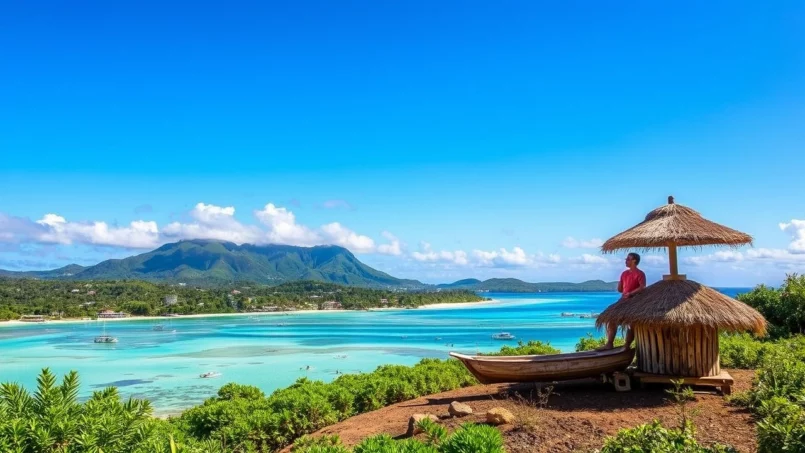
Despite this sometimes intense weather, the natural setting is one of the territory’s great assets: dazzling lagoons, small deserted motu (islets), crater lakes like the famous Lalolalo on Uvea, Futuna’s volcanic landscape, the almost uninhabited islet of Alofi. In return, the archipelago is vulnerable to climate change: coastal erosion, rising sea levels, more frequent cyclones. For an expatriate, this requires a real awareness of risk (cyclones, floods) and often appropriate insurance.
Example:
In some Pacific islands, as described in the content, daily life is peaceful and community-oriented. Residents spend a lot of time outdoors, gathering for nautical activities, customary feasts, mass, or rugby and volleyball matches. Crime is almost non-existent. Although there are no movie theaters or theaters, social and cultural life is rich, driven by numerous associations, sports clubs, and events organized by local and expatriate communities.
Entering and residing in the territory: visas, residence permits, formalities
For a French citizen or other European Union citizen, access to Wallis and Futuna is extremely simple: entry rules are the same as for France, as the archipelago is fully part of the Republic. EU nationals can enter with their national identity card alone (passport recommended for international stopovers) and reside, work, or start a business without any special visa procedure.
Good to know:
For third-country nationals, the French visa applicable to Wallis and Futuna is not a Schengen visa by default. It must bear an explicit mention of validity for the overseas territories and does not automatically allow entry to mainland France or the Schengen area.
Notable types include:
– the short-stay visa (maximum 90 days) for tourism, short professional assignments, family visits;
– the long-stay visa (more than 90 days) for settling, working, studying, or joining family;
– residence permits such as the temporary residence card (renewable for one year) and the resident card (valid for ten years), which allow work without restriction.
6
Minimum validity period, in months, of a multiple-entry Schengen visa issued by France to be able to enter Wallis and Futuna.
In all cases, the passport must be valid for at least six months after the intended departure date, with enough blank pages for entry and exit stamps. For an expatriation project, it’s crucial to anticipate processing times: for long-stay visas, allow between 10 and 30 days for processing depending on nationality and application location.
For foreigners already settled in the territory, it’s recommended to carry your residence document or, failing that, proof of application submission to the administration. These documents may be checked upon entry and exit.
Getting there and getting around: distance, the name of the game
Access to Wallis and Futuna must be earned. There is only one commercial airline connecting the archipelago to the rest of the world: Aircalin, the airline from New Caledonia. International flights arrive at Hihifo (Wallis) from Nouméa, sometimes via Nadi (Fiji). From mainland France, expect about 30 hours of travel, with at least one stopover in Asia or another hub, then a Nouméa-Wallis leg (about three hours of flight). A round-trip Paris-Wallis ticket generally costs around €2,500 in economy class.
Inter-island flights Wallis-Futuna
Essential information for air travel between Wallis and Futuna, operated by Aircalin.
Flight characteristics
Flight of about 50 minutes operated by small aircraft (Twin Otter type). Two daily frequencies, six days a week, with extra flights during peak periods.
Booking and fares
Online booking is not always possible. It is advised to go through local agencies (e.g., Wallis Voyages, SB Travel). High fare: about 400 USD for a round trip.
Availability
The number of seats is limited due to aircraft size. Early booking is highly recommended.
On site, the complete lack of public transport or taxis surprises many newcomers. There are no buses or organized taxi network; to get around, a car or scooter is essential. You can rent a vehicle by the day (around 8,000 XPF, or about 70 USD), or buy a car locally, making do with a limited inventory and high prices due to import costs.
Good to know:
There is no regular passenger sea service to or from Wallis and Futuna. Freight is handled by cargo ships about every three weeks. Access for pleasure craft is very restricted, especially during the Covid crisis, except in cases of distress.
For an expatriate, this logistical isolation means several things: rare and costly travel, difficulty with emergency evacuation, dependence on maritime supplies for food, fuel, equipment. Parameters to consider before signing a contract or renting accommodation.
Housing: finding a roof in a tiny market
The housing supply is limited and very different from what you might know in mainland France or in major Pacific cities. You’ll mostly find small single-family homes, often simple, sometimes without air conditioning, and a few hotel structures or guesthouses run by families.
Good to know:
On Wallis, several types of accommodation are available: hotels and pensions (Auberge TANOA, Gîte Océania, hotels Fiafia, Lomipeau, Moana Hou, Ulukula), rooms with locals (e.g., Masisi Liufau family), and modern studios near beaches (e.g., Kulu’ui). On Futuna, the offer is more limited, with two hotels, a guesthouse, and a few rentals with locals.
For a long-term stay, it’s common to rent a house or apartment through word of mouth, local classifieds, or platforms like Expat.com, where there is a “Real estate in Wallis and Futuna” section. Budgets vary greatly, but a concrete example mentions an expatriate looking for housing in Lavegahau with a budget of 35,000 to 60,000 XPF per month, which remains in the low range of the market.
Broader data on rents, however, shows a high price level when it comes to truly “standard” apartments:
| Type of accommodation | Location | Average monthly rent (XPF) | Observed range (XPF) |
|---|---|---|---|
| 1 bedroom | Downtown / “City” center | 210,000 | 130,000 – 350,000 |
| 1 bedroom | Outskirts / outside center | 154,000 | 110,000 – 350,000 |
| 3 bedrooms | Downtown / “City” center | 420,000 | 250,000 – 750,000 |
| 3 bedrooms | Outskirts / outside center | 302,500 | 160,000 – 500,000 |
These amounts reflect a niche market, where modern or well-located supply (by the lagoon, near Mata’Utu) comes at a premium. For purchase, the average price per square meter is estimated at around 42,992 XPF downtown and 26,048 XPF outside, but land is often managed by custom more than by a traditional land registry. For an expatriate, real estate acquisition is therefore legally complex and rarely the first option; renting is overwhelmingly preferred.
38
This is the average price in dollars for renting a modern studio on Uvea for one night.
Cost of living: a paradise… that’s expensive
The territory’s small size, isolation, and heavy reliance on imports significantly drive up the cost of daily life. Available comparisons show an overall cost (rent included) barely higher than in mainland France, but day-to-day consumption is clearly more expensive once rent is excluded:
– total cost of living (with rent): about +0.3% compared to France;
– cost of living excluding rent: about +19.8% compared to France.
Estimates in dollars
They give an idea of the monthly budget needed for costly imports like food, electronics, and home equipment.
| Profile | “Tight” monthly budget (USD) | Average budget (USD) | “Comfortable” level (USD) |
|---|---|---|---|
| Single – with rent | 1,335 | 2,615 | 4,695 |
| Single – excluding rent | 835 | 1,765 | 3,395 |
| Couple – with rent | 1,924 | 3,792 | 6,852 |
| Couple – excluding rent | 1,424 | 2,942 | 5,552 |
| Family (2 adults, 2 children) – with rent | 2,740 | 5,369 | 9,648 |
| Family – excluding rent | 2,090 | 4,264 | 7,958 |
The average net monthly salary is said to be around 3,800 USD, which in principle remains above the average cost of living for a single person, but below that of a household with children if aiming for a high comfort level.
In practice, the main monthly expenses can be summarized as follows (in USD):
| Expense item | Indicative monthly range |
|---|---|
| Rent for primary residence | 500 – 1,300 |
| Electricity | 40 – 220 |
| Water | 25 – 70 |
| High-speed internet + TV | 80 – 135 |
| Mobile phone with data | 60 – 160 |
| Food / groceries | 350 – 980 |
| Household / hygiene products | 45 – 105 |
| Transport (fuel, vehicle, etc.) | 30 – 320 |
| Leisure, outings | 60 – 560 |
| Healthcare (insurance + supplements) | 55 – 180 (excluding evacuations) |
| Maintenance, cleaning, laundry | 90 – 350 |
To gauge the cost of certain everyday consumer goods, look at some prices noted in XPF (or USD):
Cost of living in New Caledonia
Overview of average prices for common products and services to assess the necessary budget.
Basic foodstuffs
Baguette: ~300 XPF • Milk (1L): ~313 XPF • Eggs (dozen): ~637 XPF
Drinks
Local beer (bottle): 350 to 500 XPF
Transport
Gasoline (1 liter): about 225 XPF
Dining out
Simple meal at a restaurant: ~1,500 XPF
Services
High-speed internet subscription: ~27,800 XPF/month
Imported international brand products (clothing, electronics, perfume, toiletries) are particularly expensive. Estimates mention 150 USD for brand-name jeans, 280 USD for branded sneakers, over 1,000 USD for a smartphone, and up to 3,000 USD for a high-end laptop.
The archipelago is therefore not a financial “bargain”. On the other hand, some advantages compensate: free schooling up to the baccalaureate, free healthcare and medication on site, and extremely advantageous tax rules for companies whose income comes from abroad (see below).
Banking, currency, and financial system
The official currency is the CFP franc (XPF), shared with New Caledonia and French Polynesia. It is pegged to the euro at a fixed rate of approximately 119.33 XPF to 1 €, eliminating any exchange rate risk for a European.
Banknotes come in denominations of 500, 1,000, 5,000, and 10,000 XPF, with coins from 1 to 100 XPF. Euros or dollars are rarely accepted in shops, and there are no currency exchange offices at the local airports. It’s therefore advised to arrive with XPF withdrawn or exchanged in Nouméa or Nadi, or to rely on ATMs upon arrival.
The banking landscape consists of a single institution: the Bank of Wallis and Futuna (BWF), a subsidiary of BNP Paribas New Caledonia. It has:
– a main branch in Mata’Utu, in the Fenuarama shopping center;
– two ATMs on Wallis (at the branch and the post office in Mata’Utu);
– one ATM on Futuna, near the post office in Leava.
Tip:
It is possible to open a bank account in French Polynesia, even as a foreigner. Thanks to the fixed parity between the euro and the CFP franc (XPF), cash withdrawals are free when using a bank card issued by a French bank. However, many small businesses do not accept card payments due to a lack of terminals. It is therefore prudent to always have some cash on hand.
The regulatory framework is that of the French system: Banque de France, European prudential rules, consumer law monitored by the Autorité des marchés financiers (AMF). For investors, some activities (discretionary management, proactive advice) remain in a regulatory gray area, and a very cautious approach is recommended, especially as authorities are strict on practices like “reverse solicitation.”
Specialized firms, in fact, offer support for opening professional bank accounts, creating holding companies, or setting up investment structures, in compliance with French and international anti-money laundering standards.
Taxation and business creation: a very attractive regime
Wallis and Futuna generally applies French tax law, but with very distinct features for companies whose activity is oriented externally. For this type of structure, the territory offers an almost tax-exempt regime:
– 0% corporate tax on profits;
– 0% VAT;
– 0% tax on distributed dividends.
Note:
Saint-Barthélemy offers an interesting tax environment for companies with international activities but remains fully subject to French and European law, with strict application of transparency and anti-money laundering rules.
To create a business, the procedure follows French company law. Registration is done notably with the Registre national des entreprises (RCS). On site, accounting firms can handle the creation and domiciliation, with prices starting from 1,250 € for incorporation, sometimes also providing assistance with residence permits or naturalization in case of significant investment.
Good to know:
The Chamber of Commerce, Industry, Trades, and Agriculture (CCIMA) is a key contact to guide procedures, identify promising sectors, and understand constraints (customs, imports, standards). The territory encourages the digital economy and remote work, with an incubator equipped with connected offices planned to welcome digital nomads and online entrepreneurs.
For goods intended for professional activity, however, you must account for non-negligible import costs: an entry tax (around 20% of the value), customs duties (about 10%), and proportional fees (2%). Phytosanitary rules are strict to protect a fragile island biodiversity.
Healthcare: free care, medical isolation
The healthcare system in Wallis and Futuna is very particular: care and medication are free for residents, funded directly by the state via the Agence de santé (ADS), under the joint authority of the French ministries for Overseas Territories, Health, and Finance. There is no local social security fund: expenses are covered by the national budget, notably under the 1972 finance law.
The archipelago has two hospitals:
– the Sia hospital, on Wallis, the most important, located near the main road in Mata’Utu, with about 49 beds (surgery, medicine, obstetrics-gynecology, intensive care), an operating room, imaging (X-ray, CT scan, mammography), dental consultations, and a pharmacy;
– the Kaleveleve hospital, on Futuna, in Taoa, with about fifteen beds for general medicine, some spaces for obstetrics-gynecology, and a more modest technical setup.
Good to know:
Three clinics are spread across Wallis (one per district) and one on Futuna. The limited staff includes general practitioners, hospital doctors, a radiologist, dentists, a pharmacist, and a biologist. This system handles routine care, simple deliveries, and basic surgery. However, for serious conditions, the lack of specialists quickly leads to medical evacuations to New Caledonia, Australia, or mainland France.
These evacuations are frequent and very costly; they represent a large part of the health budget. They are organized by the ADS, which has agreements with the Caisse nationale d’assurance‑maladie (CNAM) and the Assistance publique – Hôpitaux de Paris (AP‑HP) to improve patient care in Paris. Discussions are also underway with structures in New Caledonia to optimize these pathways.
Good to know:
Since the arrival of fiber optics, telemedicine has developed, notably allowing teleconsultations with specialists in France since 2018. This helps reduce the need for some transfers.
For an expatriate, two essential points:
– within the territory, care and medication are free;
– as soon as you leave Wallis and Futuna, this free coverage no longer applies.
It is therefore highly recommended to take out an international health insurance or supplementary coverage for hospitalizations and evacuations abroad. British authorities, for example, advise their nationals to inquire about their long-term coverage rights via the DWP, proof that the issue is far from trivial.
In terms of public health, no specific vaccination is required for a standard stay, except yellow fever for travelers coming from a risk area. On the other hand, dengue fever circulates sporadically: protection against mosquitoes is essential. Tap water is drinkable on Wallis; on Futuna, it is considered safe in some areas, but caution is advised after heavy rain (bottled water recommended).
Education and family life
For those moving with children, Wallis and Futuna offers a framework that is surprisingly favorable in terms of schooling: education is free up to the baccalaureate, and the system follows the French curriculum, with a strong connection to the French National Education network.
You will find:
– on Wallis: 9 to 12 primary schools depending on counts, four middle schools (one with a vocational section), two high schools (a general and technological state high school with boarding, and an agricultural high school);
– on Futuna: 5 to 6 primary schools, two middle schools.
Good to know:
Historically, primary education was managed by the Catholic education authority under state delegation. Since 2025, management has been handled by the vice-rectorate and primary school teachers are civil servants. At the secondary level, teaching is mostly provided by teachers from mainland France, on two-year contracts, ensuring a level in line with national standards.
The local languages (Wallisian, Futunian) are integrated: the vast majority of inhabitants speak, read, and write them, and these languages can be chosen as options for national exams (Brevet, Baccalauréat). For a child from mainland France, it’s an opportunity to open up to unique bilingualism while following a “classic” French curriculum.
Good to know:
There is no physical university in Wallis and Futuna. Young people generally continue their studies remotely or by moving to New Caledonia, French Polynesia, or mainland France. However, the “Campus connecté” (Digital University of Wallis and Futuna) allows students to follow university courses online with local support. This solution also interests adult expatriates wishing to train.
For families, beyond school, the territory has real advantages: almost no insecurity, spectacular natural environment, dynamic community life, sunny climate. On the other hand, structured cultural leisure offerings (museums, shows, cinema) are very limited; you must enjoy the simple life, barbecues on the motu, rugby matches, and village feasts more than multiplexes and shopping malls.
Work, employment, and remote work
The local economic fabric is modest: about 80% of the active population lives on subsistence farming, fishing, and livestock (pigs), with other jobs spread across administration, healthcare, education, commerce, construction, and some services. GDP is around 212 million dollars, with a tourism sector estimated to represent only about 2% of the economy. A significant portion of the territory’s income comes from subsidies from the French state, fishing licenses (agreements with Japan, South Korea), import taxes, and remittances from expatriates settled in New Caledonia or mainland France.
For an expatriate wishing to find a salaried position on site, be realistic: the market is narrow. The profiles sought mainly concern:
Example:
In an overseas collectivity like Mayotte, job opportunities are mainly concentrated in the public sector (teachers, contract workers, healthcare personnel, technicians) and medico-social establishments (the French Red Cross, for example, deploys various activities there). You can also find some positions in management, accounting, or supervisory roles within local companies or administrations, as well as rare technical positions in sectors like telecoms, energy, or infrastructure.
Portals like Jobijoba, international job platforms, or tools like WeXpats Job sometimes list offers, but in very small numbers and often aimed at high-level French-speaking profiles. Generally, public sector positions are recruited through the usual channels of the French state and major NGOs.
On the other hand, Wallis and Futuna is beginning to position itself as a haven for remote workers and digital entrepreneurs. Several factors contribute to this:
Good to know:
Samoa benefits from a connection to a submarine cable (Tui Samoa) since 2018, bringing fiber optics, and a 4G mobile network (Manuia), complemented by the increasing use of solutions like Starlink. The country offers a calm, safe environment conducive to concentration, as well as an ultra-attractive tax regime for internationally-oriented companies.
Local authorities, in fact, express their desire to “bet on online tools” to boost the economy. An incubator for mobile workers is in the works, with equipped offices and lagoon views. For a freelancer, consultant, developer, or small SaaS business owner, the archipelago can thus become an ideal base, provided you accept the distance, cost of living, and limited international flights.
Moving, freight, and customs: shipping your life to the ends of the earth
Organizing a move to Wallis and Futuna is nothing like a simple Paris-Lyon trip. Almost all bulky goods arrive by ship, on cargo vessels that serve the territory about every three weeks. Several major international transport groups (via platforms like NEX, Europacco, Happy‑Post, Parcel2Go, Stackry, etc.) offer sea or air freight solutions, in less than container load (LCL) or full container load (FCL), for personal effects, professional equipment, or commercial goods.
From a regulatory standpoint, the following rules apply:
Note:
During a transfer of primary residence to Wallis and Futuna, personal effects and furniture can be exempt from duties and taxes, provided you can prove prior ownership and use before departure. Motorized vehicles are excluded from this exemption and remain subject to customs duties and taxes. For goods for professional use, an entry tax (about 20%), customs duties (about 10%), and proportional fees (2%) apply.
Everything entering the territory must be declared to customs. Phytosanitary regulations are strict: the Inspection vétérinaire, alimentaire et phytosanitaire (BIVAP) defines the import conditions for plants, seeds, animals, foodstuffs, to protect an ecosystem already weakened by deforestation and erosion. Some products (weapons, hazardous materials, perishable goods, etc.) are subject to additional restrictions.
Good to know:
For small parcels, each carrier has its own weight limits (e.g., max. 20 kg) and dimensions (e.g., max. 100 cm length). Documents are generally exempt from customs clearance, while commercial goods and gifts exceeding a certain value are subject to inspection and taxation according to local regulations.
In practice, many expatriates adopt a mixed approach: a suitcase and a few air shipments for essentials, a larger sea shipment if the stay is long-term, and purchasing non-essential bulky items locally.
Communications, mail, and internet
Postal and telecom services are managed by the Service des postes et télécommunications (SPT). It is this service that distributes mail to post office boxes (there is no home delivery), sells stamps, markets SIM cards and top-ups, and provides fixed internet access.
Good to know:
To receive mail, you must rent a post office box, available only at the post office in Mata’Utu (Wallis) or Leava (Futuna). Sending letters or parcels is also done at the counter of these offices, as there are no street mailboxes. Opening hours are generally early: Monday to Thursday from 7:30 AM to 2:30 PM, and Friday from 7:30 AM to 1:30 PM.
Regarding telephony, the Manuia mobile network offers decent 4G coverage, although it can be uneven depending on the area. SIM cards are sold only at SPT agencies; top-ups can then be purchased in many small shops. International roaming exists for a few foreign operators but remains expensive; it’s better to buy a local SIM upon arrival.
Example:
To call Wallis and Futuna from abroad, dial 00, then the country code 681, followed by the local number. To call from Wallis and Futuna to abroad, dial 00, followed by the country code (e.g., 33 for France, 81 for Japan, 61 for Australia, 64 for New Zealand, 689 for French Polynesia, 687 for New Caledonia), then the local number.
The internet infrastructure combines:
– fixed ADSL/fiber access provided by SPT (with relatively expensive high-speed subscriptions);
– a 4G mobile data network;
– and, increasingly, Starlink satellite dishes installed by individuals.
For a remote worker, connection quality will depend on the technology chosen, but overall, the territory is no longer the “dead zone” it was until the mid-2010s.
Daily life, custom, and integration
Living in Wallis and Futuna isn’t just about managing your budget and administrative procedures. It’s above all learning to navigate a society where custom (AGA’IFENUA) deeply structures social relations.
The customary kings, village chiefs, and family elders play a key role in conflict resolution, event organization, land management. Major feasts – katoaga – revolve around mass, kava ceremonies, speeches, gift exchanges (mats, tapa, pigs, yams), dances, and songs. Participation in these events is an important marker of integration.
Good to know:
In Polynesia, details of dress have social meaning: a tiare flower worn on the right or left ear indicates marital status, flower necklaces (kakala) are a sign of welcome and those made of shells a symbol of farewell. Expatriates are often invited to traditional meals cooked in an umu (underground oven), featuring pork, taro, breadfruit, and coconut milk.
A few basic rules greatly facilitate integration:
– ask for permission before crossing private property or accessing a “private” beach;
– adopt respectful attire in villages and, especially, in churches (remove headwear inside);
– remain seated and discreet during kava ceremonies, where any untimely gesture can be interpreted as disrespect;
– listen to the advice of locals and cultural leaders, especially regarding feast days or sacred sites.
Wallisians and Futunians are known to be particularly welcoming, especially towards those who show curiosity and respect for their culture. Exchanges with expatriates are numerous, mixed couples are frequent and generally well-integrated, provided they gain the families’ approval.
Wallisian and Futunian culture
Daily life sees shops open very early (often from 6 AM) and close midday, reopening in the late afternoon until around 7 PM. The only shopping center, Fenuarama, houses a supermarket, the bank, the Aircalin agency, a small museum, a hair salon, and other shops.
For leisure, you must love the sea: swimming, snorkeling, diving, kayaking, fishing, sailing are on the agenda. Canoe trips, ultralight flights, and motu visits are possible. Culturally, local television and radio (Wallis‑et‑Futuna La Première) broadcast in French and local languages; print media is mainly represented by Les Nouvelles calédoniennes.
An expatriation project to weigh carefully
Moving to Wallis and Futuna is neither completely fleeing France nor joining an “independent state”: it’s living in a tiny corner of the French Republic, with the same legal foundation, the same currency, some of the same administrations… but in a Polynesian setting and a separate customary world.
For an expatriate, the main advantages are clear:
Advantages of living and working on the island
Discover the main assets of this territory, combining security, quality of life, and economic opportunities.
Safety and living environment
Very high security with almost no crime. Peaceful quality of life within a close-knit community, in an exceptional natural environment ideal for families and sea lovers.
Health and education
Free care and medication on site. Free schooling up to the baccalaureate, following French National Education programs.
Economic opportunities
Very attractive corporate taxation for internationally-oriented activities, offering a favorable environment for business development.
Culture and environment
Unique cultural experiences in a preserved natural setting, enriching residents’ daily lives.
The constraints are equally clear:
– extreme isolation, long, infrequent, and costly travel;
– high cost of living, especially for food and equipment;
– very limited local job market;
– almost non-existent “urban” leisure offerings (no cinema, few shows);
– need to accommodate custom, traditional authorities, and a very community-oriented life;
– specialized healthcare and serious emergencies dependent on evacuations abroad.
Such a project cannot be improvised. Before taking the plunge, it’s wise to:
Tip:
For a successful move to Wallis and Futuna, it is crucial to: verify your residence status precisely (visa, residence permit if applicable); secure sufficient income (public contract, remote work, structured business); inquire with the prefecture, CCIMA, the Health Agency, and the Wallis and Futuna offices in Nouméa, Papeete, or Paris; arrange international health insurance for travel outside the territory; anticipate your move and customs constraints; and, if possible, make an exploratory visit during the “cool” season to test life on site.
For those who accept these constraints, the archipelago offers in return something few places can still provide: the feeling of living in a small, protected society, in daily contact with a living Polynesian culture, in a natural setting that remains – for now – largely untouched by crowds.

Cyril Jarnias is an independent expert in international wealth management with over 20 years of experience. As an expatriate himself, he is dedicated to helping individuals and business leaders build, protect, and pass on their wealth with complete peace of mind.
On his website, cyriljarnias.com, he shares his expertise on international real estate, offshore company formation, and expatriation.
Thanks to his expertise, he offers sound advice to optimize his clients' wealth management. Cyril Jarnias is also recognized for his appearances in many prestigious media outlets such as BFM Business, les Français de l’étranger, Le Figaro, Les Echos, and Mieux vivre votre argent, where he shares his knowledge and know-how in wealth management.





