
 Published on and written by Cyril Jarnias
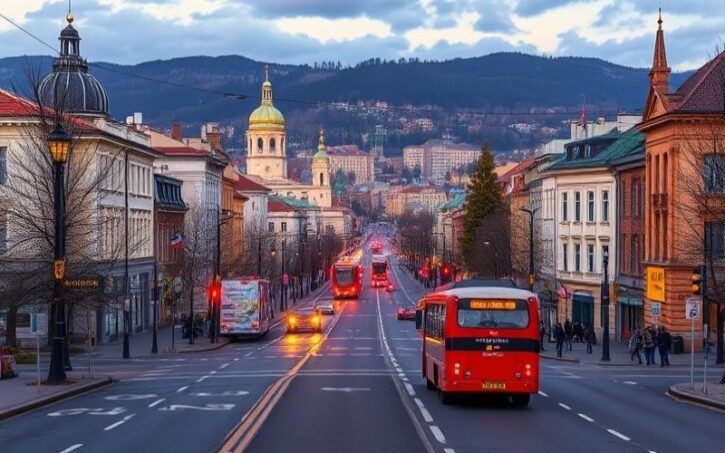
Traveling in Belarus without a car is not only possible, but often the simplest and most economical solution. Inheriting a long Soviet tradition of network planning, the country has maintained a dense, affordable, and overall reliable public transportation system, particularly in the capital, Minsk. This practical guide gathers the essential information to understand how public transport works, how to buy tickets, read schedules, and get around independently, whether staying in Minsk or crossing the country.
Understanding the Transport Network Architecture
Belarus has a full range of collective transport modes: metro (only in Minsk), urban and intercity buses, trolleybuses, trams, regional and interregional trains, private minibuses (marshrutkas), and, to a lesser extent, river boats. Together they form a highly structured network, although access remains unequal between large cities and rural areas.
The system has been much less privatized than in other post-Soviet countries. The state, via the Ministry of Transport and Communications, sets the general framework, while local executive committees (regions, cities) manage the details of the service. In Minsk, for example, the municipal company Minsktrans operates almost the entire urban network (metro, bus, trolleybus, tram, city trains).
The regulatory framework includes “state social standards,” which are minimum thresholds. They define, for example, the number of vehicles required to serve a population or the maximum distance to travel to reach a stop. These standards apply to all transport organizations and have a direct impact on public budgets.
City / Countryside Disparities
While the focus is often on Minsk and large cities like Brest, Grodno, Gomel, Vitebsk, or Mogilev, the picture is more contrasted in small localities. In villages, the national standard sets the maximum walking distance to a stop at 3 km, but without clearly stating how this distance should be measured. Hamlets with fewer than 20 inhabitants are not guaranteed any service. In some districts, like Pastavy (Vitebsk region), buses only run on demand, after intervention by local officials.
For intercity connections, the standard can be limited to one daily round trip between two cities in the same region. This legal minimum has favored the emergence of informal private carriers, who fill the gaps left by the regular service, but without offering the same level of control or information for the traveler.
The table below summarizes some significant standards and realities.
| System Element | Official Standard / Practice | Consequence for the User |
|---|---|---|
| Maximum walking distance in rural areas | 3 km to the public bus stop | Some residents walk a long time before finding a bus |
| Localities < 20 inhabitants | No service obligation | Hitchhiking, private car, or private minibuses essential |
| Intra-regional intercity | 1 daily round trip required | Inflexible schedules, limited choice of departures |
| Minsk – vehicles per inhabitant | 1 vehicle / 1,500 inhabitants (threshold) | The actual fleet exceeds 2.2 times this standard |
| Distance between urban stops | 350–600 m (bus, tram, trolley) / 800–1,200 m (rapid lines) | Comfortable stop density in the city |
These rules provide a skeleton for the system, but say little or nothing about aspects fundamental to the user: frequency, start and end of service times, vehicle comfort, accessibility. Increasingly, voices are calling for these standards to be revised to include, for example, maximum wait times or requirements for low-floor vehicles.
Minsk: A Dense, Modern, and Very Affordable Urban Network
As the capital of nearly two million inhabitants, Minsk concentrates most of the modernization effort. The city has a very comprehensive multimodal network: metro, bus, trolleybus, tram, electric buses, city train, and private minibuses. Most lines operate from about 5:30 AM to midnight, with the metro running until 12:40 AM – 1:00 AM depending on the day. Punctuality and regularity are major strengths of the system.
The Minsk Metro: Backbone of Travel
The Minsk Metro is the country’s only underground network. Entirely underground, it has three lines: Maskoŭskaja, Aŭtazavodskaja, and Zelenaluzhskaja, covering about 46 km and 36 stations. The three lines intersect at Ploščaĺ Niezaležnasci (Independence Square), facilitating transfers.
The network’s on-time rate, making it particularly reliable for daily commutes.
Beyond practicality, the metro is almost an underground museum: many stations feature mosaics, marbles, and Soviet symbols. Some are thematic—revolution, sports, industry—others play on particular lighting atmospheres (starry sky, winter sunset, bright August morning). Commercial advertising is absent from the platforms, reinforcing the impression of monumental public space typical of the post-war USSR.
Regarding information, signage and audio announcements are mainly in Belarusian (or Belarusian/Russian), with English transcriptions in several central stations. Line maps are displayed in the trains and on platforms. A free Wi‑Fi network covers all stations (SSID “MinskMetro_Free”).
Buses, Trolleybuses, Trams: Tight Surface Network
Above ground, Minsktrans operates more than 200 bus lines, 65 trolleybus lines, and 8 tram lines. Buses, often yellow, are the most widespread surface mode. Trolleybuses, powered by overhead lines, form the world’s largest trolleybus network, with dozens of lines and over 490 km of overhead lines. Trams, less extensive but strategic, serve some key routes.
On major routes, frequency is high, often with a bus every 5 minutes during peak hours (slightly more spaced out in the evening or on weekends). Many stops are equipped with electronic displays showing real-time waiting times, thanks to GPS tracking of vehicles.
In practice, you usually board through the front door if you need to buy a ticket from the driver, then head to the validators to stamp your ticket. Drivers don’t always give change: it’s better to have small bills in Belarusian rubles.
Minsk’s tram network, although smaller than in many European cities with about a dozen lines and approximately 120 km of track, is being modernized. The city recently introduced new locally produced models, equipped with low floors, air conditioning, USB ports, and a battery feature allowing them to operate without overhead wires on some sections.
Marshrutkas: Fast but More Expensive Private Minibuses
Marshrutkas, these minibuses with fixed routes but private operation, complement the municipal offer. In Minsk, their numbers are often related to those of regular lines (e.g., 1053 for an extension of line 53), but they are distinguished by a significantly higher fare—typically between 2.5 and 3 BYN for an urban trip—and sometimes more flexible frequency.
You hail them at an official stop with a hand signal. You pay the driver directly in cash when boarding. For a hurried visitor or to reach a somewhat outlying area, these vehicles can be practical. However, accessibility is poor (high steps, no ramp) and information in English is almost non-existent.
Typical Schedules in Minsk
From one mode to another, service hours are relatively homogeneous, concentrated between early morning and midnight. The following table gives a synthetic overview.
| Mode in Minsk | Approximate Start of Service | Approximate End of Service | Frequency during Peak Hours |
|---|---|---|---|
| Metro | 05:30 AM | 12:40 AM–1:00 AM | 2–3 min |
| Urban buses | 05:30–05:45 AM | 12:30–12:55 AM | ~5 min on major routes |
| Trolleybus | 05:00 AM | 12:00 AM | 5–10 min depending on the line |
| Tram | 05:30 AM | 12:30 AM | 7–10 min |
| Urban marshrutkas | 08:00 AM | 10:00 PM (variable) | Very variable, depending on operator |
For night trips after service ends, taxi or ride-hailing apps like Yandex.Go become the main options.
Transport Tickets: Paper Tickets, Tokens, Cards, and Apps
The ticketing system is based on three main pillars: single paper tickets, metro tokens, and especially rechargeable contactless cards, which quickly become the most practical option once you start making multiple trips.
Basic Fares and Ticket Purchase
In Minsk, the principle is simple: one trip = one flat fare, regardless of the distance traveled on the same vehicle. Transfers from bus to trolleybus or from tram to metro are not included: each boarding requires a new ticket.
Recent approximate fares for Minsk are as follows:
| Type of Ticket in Minsk | Approximate Price (BYN) | Main Notes |
|---|---|---|
| Paper ticket bus/trolley/tram | 0.85 BYN | Purchase at kiosks (“Tabak,” “Sayuzdruk”…) |
| Paper ticket from driver | ~1.00 BYN | Slightly more expensive, change given sporadically |
| Metro token | 0.90–1.00 BYN | Purchase at metro ticket office or vending machines |
| Urban marshrutka | 2.5–3 BYN | Paid in cash to the driver |
| Fine for fare evasion (without valid ticket) | 18.5–37 BYN | Payment possible via ERIP system or at a bank |
Outside Minsk, fares are generally lower, while still following the per-ride pricing model.
Any paper ticket must be validated immediately after boarding using the validator on board. Inspectors conduct random checks, and an unpunched ticket, even in your possession, is considered fare evasion.
Contactless Cards and Passes
For frequent transport users, the contactless card (proezdnoy or “Karta Minsk”) is essential. It is a rechargeable card, subject to a refundable deposit (1 to 3 BYN depending on the source), which allows loading a certain number of trips or an unlimited period.
There are two main categories:
– Prepaid trip cards: you credit, for example, 10, 20, 30, 40, 60, or 100 journeys, valid for a given period (60 to 80 days). Each validation deducts one trip. The unit cost is then slightly lower than a paper ticket.
– Time-based passes: 1, 3, 10, 15, 30, or 31 days, sometimes with mixed formulas including several modes (bus, trolley, tram, metro, even city train and express bus). A 30-day all-mode pass in Minsk is around 51 BYN.
Tourist passes for 2 or 3 days are available for visitors. They generally offer unlimited access to the entire urban transport network, including the metro, for the chosen duration.
Recharging is done mainly at metro stations, at ticket offices, and sometimes at dedicated terminals. You then simply hold the card near the validator (on the bus or at the metro turnstile) until a beep sounds or a green light comes on.
Digital and Bank Payments
The capital introduced a more advanced contactless payment system for surface transport in 2014. In practice, several options coexist:
– payment by contactless bank card or smartphone at the metro turnstile,
– dedicated mobile payment app (“Oplati” notably), which allows purchasing and activating digital tickets via Visa, MasterCard, or BELKART,
– integrated ticketing in the “Karta Minsk”.
The rest of the country is not always as digitized, especially in small bus stations or on rural lines. Regularly having small bills in rubles remains a prudent reflex.
Traveling by Train: The Backbone of National Travel
Beyond urban networks, Belarus has a dense railway network, operated by the public company Belarusian Railway (Belaruskaya Chyhunka). With nearly 5,500 km of track (over 1,200 km electrified) and more than 2,100 destinations served, the train is one of the most comfortable and reliable ways to cross the country.
Types of Lines and Onboard Comfort
Services are classified into several categories:
– urban/suburban lines (городские линии): commuter rail type, around large cities,
– regional lines (региональные линии),
– interregional lines (межрегиональные линии): for connections between large cities,
– international lines.
Interregional trains often offer two classes:
– business (1st class): more spacious seats, power outlets, individual reading lights, blinds, sometimes Wi‑Fi,
– economy (2nd class): upholstered seats, power outlets.
The classic overnight cars of the post-Soviet space still exist on international routes (compartments with 2, 4 berths, open sleeping cars). However, there are currently no longer any purely domestic overnight trains.
Maximum commercial speed reached on certain sections of the domestic railway network.
Prices, Booking, Discounts
Rail fares, by European comparison, are very low. A typical example: a Minsk–Brest ticket can be as low as around €6.15; a Brest–Vitebsk trip is in the range of USD 7–10 depending on the class and type of train.
The pricing policy remains fairly simple:
– no complex discount card networks nor Interrail/Eurail,
– no sophisticated “flexible” tickets: the journey is tied to a specific train,
– no savings from buying a round trip versus two one-way tickets,
– few “promo” offers, but some targeted discounts (e.g., 50% for retirees on some regional trains in summer, children’s fares up to age 10, free without a seat for children under 5).
Tickets can be purchased:
Travelers have several options for booking and paying for train tickets in Belarus, from physical ticket offices to digital solutions.
Available in the 20 largest stations in the country, which have complete infrastructure for purchase and pickup.
Allows reservation with later ticket pickup directly at the station.
On the official website pass.rw.by or via authorized intermediaries like Busbud or INFOBUS.
As e-tickets, payable by bank card or via systems like EasyPay and WebMoney.
For e‑tickets, once digital registration is complete, your passport is sufficient to board, without a printed ticket. International trains sometimes still require a paper ticket.
The following table summarizes some useful benchmarks for the train.
| Aspect | Practical Data |
|---|---|
| Network length | ~5,480–5,512 km (of which ~1,228 km electrified) |
| Number of destinations served | > 2,100 |
| Approximate price Minsk–Brest | From ~€6.15 in 2nd class |
| Purchase method | Ticket offices, phone, online (paper or electronic ticket) |
| Typical discounts | Children 5–10 years old, retirees during certain periods, groups |
| Included luggage | Up to 36 kg free (total dimensions ≤ 200 cm) |
Onboard Services and Accessibility
Belarusian Railway offers a range of onboard services: dining (restaurant car or at-seat service, sometimes a snack included in “prestige” class), air conditioning, power outlets, sometimes Wi‑Fi. On some international routes, a meal “ration” is included in the ticket price.
People with reduced mobility can request, at least five days before departure, the provision of an adapted car with ramps and multifunctional space. Station and onboard staff can assist with boarding, transfers, and access to restrooms, but personal care (daily assistance) remains the responsibility of the companion or the traveler themselves.
Intercity Buses and Marshrutkas: Complementing Rail
Buses play a central role in connecting cities not served by train or offering more direct connections. All cities and most towns have a bus station, even if it’s just a simple building with a few ticket windows. In Minsk, the main hubs are the central Tsentralny bus station, as well as the Yugo‑Zapadnaya and Avtozavodskaya stations.
Bus Organization and Ticket Purchase
For long-distance and international buses, several channels are available to the traveler:
– bus station ticket offices,
– aggregator websites like INFOBUS, ticketbus.by, tickets.by, busfor.by,
– websites of major companies (Ecolines, for example, on EU–Belarus routes),
– sometimes reservation by phone or SMS (for some small companies).
Online sales open 15 days before departure and close about 4 hours before. For purchase, prepare the following information: origin, destination, date, identity, and any discount entitlements (student, pensioner). The e-ticket can be presented on a smartphone, but some drivers prefer a printed version; it is therefore prudent to have a paper copy.
Within the country, buses offer an attractive quality/price ratio, especially for distances of 150–200 km. A Gomel–Brest trip, for example, takes about 6 hours by bus, compared to 8–9 hours by train, for a comparable or slightly lower fare.
Marshrutkas (regional minibuses) follow a fixed route. Reservation can be made by phone and payment is made directly to the driver. The level of comfort (air conditioning, power outlets, Wi‑Fi) varies by operator and is not guaranteed.
Travel Experience: Between Comfort and Variables
Feedback highlights several constants:
– buses often clean, generally punctual, drivers perceived as courteous,
– but uneven equipment: Wi‑Fi sometimes limited abroad, power outlets absent, air conditioning unreliable,
– announcements mainly in Russian, making understanding stops more difficult for a non-Russian-speaking visitor,
– frequent uncertainties at borders on international lines (particularly on the European Union side), with waits that can reach several hours.
For strictly domestic Belarusian lines, these problems are rarer; the main delay factors remain weather and traffic.
Accessibility and Travelers with Specific Needs
Since ratifying the Convention on the Rights of Persons with Disabilities, Belarus has undertaken a gradual adaptation of its public spaces and transport system. Minsk has invested in many low-floor buses, trolleybuses, and trams, with deployable ramps, dedicated wheelchair space, call buttons, and automatic audio announcements. Most recent vehicles also have clear pictograms for priority seats, sometimes with tactile or braille markings.
In detail:
On recent vehicles, the height difference between the platform and the floor is generally less than 16 cm. A button with the wheelchair pictogram at the middle doors allows you to request assistance from the driver or deployment of a ramp. Audio announcements are broadcast onboard, often in Belarusian (and sometimes in English in the metro and on certain lines). Finally, on some lines, schedules specify departures operated by low-floor vehicles, using a wheelchair symbol or a dedicated color.
In practice, there is still a significant gap between large cities and the rest of the country. A significant portion of wheelchair users rarely leave their homes, notably due to ramps that are too steep, undersized elevators, or inaccessible building entrances. For a traveler with a disability, it is highly advisable to:
For a trip in a wheelchair, plan ahead by preparing a list of hotels with adapted rooms, as the offer is limited. Also identify museums and public buildings that are truly accessible, as many historical buildings or cafes are not. Finally, plan to combine, if necessary, accessible public transport with a taxi to handle the last meters of the journey.
Specific resources exist, notably via the Belarusian Association of Disabled Persons, which lists accessible transport and attractions.
For a traveler who cannot read Cyrillic, mobile apps quickly become indispensable. Several local or international solutions cover Minsk and a good part of the country:
Recommended mobile apps for navigation, public transport, and taxis in the Belarusian capital.
Unofficial but very comprehensive apps (Android/iOS). They sometimes use real-time data from minsktrans.by to check schedules, routes, nearby stops, and plan a trip with transfers.
Popular app allowing you to save favorites, with map display of lines and GPS location.
Useful for locating stops, stations, and hotels. Yandex.Maps is often more up-to-date than Google Maps regarding transport information.
App dedicated to the underground network, with an interactive metro map and sometimes accessibility features.
The main app for ordering a ride-hail or taxi in Minsk, essential for occasional trips.
Many of these tools have interfaces in Russian or Belarusian, but some offer an English translation and transliteration of stop names, which simplifies the task. Before departure, it is wise to download maps for offline use, as international mobile data is not always available or cheap.
Practical Tips for Using Transport in Belarus
A few good habits allow you to fully benefit from the Belarusian network, while avoiding the most frequent pitfalls for a visitor.
On the practical side:
To travel smoothly on public transport in Belarus, it is recommended to avoid rush hours (7-9 AM and 5-7 PM) if you dislike crowds, as metro trains and buses are often very full. Always keep small bills in BYN, essential for buying tickets directly from the driver or at small bus stations. Once on board, always validate your ticket immediately upon boarding, as random checks are frequent, even without a visible inspector. Finally, for major connections, plan your route in advance: although reading Cyrillic is useful, a printed map in the Latin alphabet or a screenshot of your trip on an app can help if your phone battery is low.
Regarding behavior, local etiquette on transport is simple but quite strict:
– give priority to the elderly, pregnant women, people with children, or people with disabilities for seating,
– speak at a moderate volume, avoid playing music on speakerphone,
– line up to board without pushing, as much as possible,
– don’t be put off by the sometimes closed-off demeanor of passengers: it’s mostly a way of coping with the world and proximity.
For late trips, especially to outlying neighborhoods, it is prudent to check the last departures via an app or the Minsktrans website. After midnight, a taxi or Yandex.Go often becomes the safest and simplest choice.
Beyond Minsk: Trains, Buses, and Boats to Explore the Country
Once familiar with urban transport, it is quite simple to extend your range to all of Belarus. The train remains the preferred option for major routes (Minsk–Brest, Minsk–Grodno, Minsk–Vitebsk, Minsk–Gomel), while buses take over to reach secondary towns or more isolated sites.
Direct connections still exist with some neighboring countries, but the international offer has shrunk since the war in Ukraine and sanctions. Several services to Poland, Lithuania, Latvia, and Germany are suspended, while trains to Russia remain numerous. Strictly domestic travel is little impacted by these geopolitical turbulences.
River transport plays a role mainly for tourism. Cruises and boat trips are offered on the Dnieper, Berezina, Pripyat, or the Augustów Canal (with a small 12-passenger boat-bus), as well as on the rivers crossing Minsk, Brest, Gomel, or Pinsk. Ships like the floating hotel “Polesie” on the Pripyat even allow for multi-day stays on the water.
Key Takeaways for Planning Your Stay
One of Belarus’s great advantages for the independent traveler is the combination of a dense public transport network and low fares. As long as you are in or between major cities, it is entirely possible to rely exclusively on public transport, without a rental car.
The key points to keep in mind are as follows:
In Minsk, the transport network is modern (metro, tram, electric buses) with contactless tickets, but each boarding requires separate validation, as tickets are not integrated between modes. In the regions, major connections rely on the train, supplemented by buses and marshrutkas. Mastering Cyrillic and a few basic phrases in Russian or Belarusian is very useful. Accessibility, although progressing in Minsk, remains uneven; prior research is advised for people with reduced mobility.
By adopting these habits, you can discover Belarus at the pace of its metros, trolleybuses, and trains, observing along the way the daily life of a country where collective transport remains at the heart of territorial organization.
Disclaimer: The information provided on this website is for informational purposes only and does not constitute financial, legal, or professional advice. We encourage you to consult qualified experts before making any investment, real estate, or expatriation decisions. Although we strive to maintain up-to-date and accurate information, we do not guarantee the completeness, accuracy, or timeliness of the proposed content. As investment and expatriation involve risks, we disclaim any liability for potential losses or damages arising from the use of this site. Your use of this site confirms your acceptance of these terms and your understanding of the associated risks.

Cyril Jarnias is an independent expert in international wealth management with over 20 years of experience. As an expatriate himself, he is dedicated to helping individuals and business leaders build, protect, and pass on their wealth with complete peace of mind.
On his website, cyriljarnias.com, he shares his expertise on international real estate, offshore company formation, and expatriation.
Thanks to his expertise, he offers sound advice to optimize his clients' wealth management. Cyril Jarnias is also recognized for his appearances in many prestigious media outlets such as BFM Business, les Français de l’étranger, Le Figaro, Les Echos, and Mieux vivre votre argent, where he shares his knowledge and know-how in wealth management.





